You want to keep running when your knees, shins, or a nagging injury say otherwise, and the Zero Runner promises exactly that: the motion of running with none of the pounding.
The question is whether a machine can replace the real thing, or whether you give up too much when your feet never touch the ground.
Here is what the machine does, what the research on zero-impact training shows, and who gets the most out of it.
You’ll learn:
- What the Zero Runner is and how it differs from an elliptical
- Whether it trains your heart and lungs like real running
- Which muscles it works and which ones it lets off easy
- Who should own one, and whether it justifies the price
What Is the Zero Runner?
The Zero Runner is a cardio machine built by Octane Fitness that copies the up-and-down motion of your legs when you run.
Each leg moves on its own hinge at the hip and the knee, so your stride is not locked to a fixed oval the way it is on an elliptical.
Your feet rest in cradles that never strike the ground, which is where the name comes from: zero ground impact on every step.
The Zero Runner mimics your running gait in the air, so your hips and knees drive through a running-style range of motion without any impact force.
That design sits between an elliptical and a treadmill.
An elliptical keeps both feet on gliding pedals through a set path, and a treadmill gives you running with full ground impact.
The Zero Runner drops the pedals and the fixed path, letting each leg swing closer to how it moves during an actual run.
Is the Zero Runner the Same as Running?
The Zero Runner reproduces the shape of your running stride, but it removes two things that define running outdoors.
The first is ground impact, the force that travels up your leg each time your foot strikes the ground.
The second is the braking and push-off your foot and calf perform against the ground, which the cradles take over for you.
No study has tested the Octane Zero Runner directly, so the honest answer draws on research into the closest comparison we have: zero-impact machines that copy running motion.
That research is encouraging on the part that matters most for fitness, which is the demand on your heart and lungs.
It falls short of running on the calf and foot loading, and on the ground impact that keeps your bones and connective tissue adapted to the road.
Think of the Zero Runner as running for your engine and a partial substitute for your suspension.
RunnersConnect Bonus
Had to take some time off recently with an injury? Download our one-of-a-kind Performance Decline Calculator to find out what your estimated performance decline would be for any race distance.
Does the Zero Runner Give You the Same Cardio Workout?
For your aerobic system, a zero-impact machine that copies running motion comes remarkably close to the real thing.
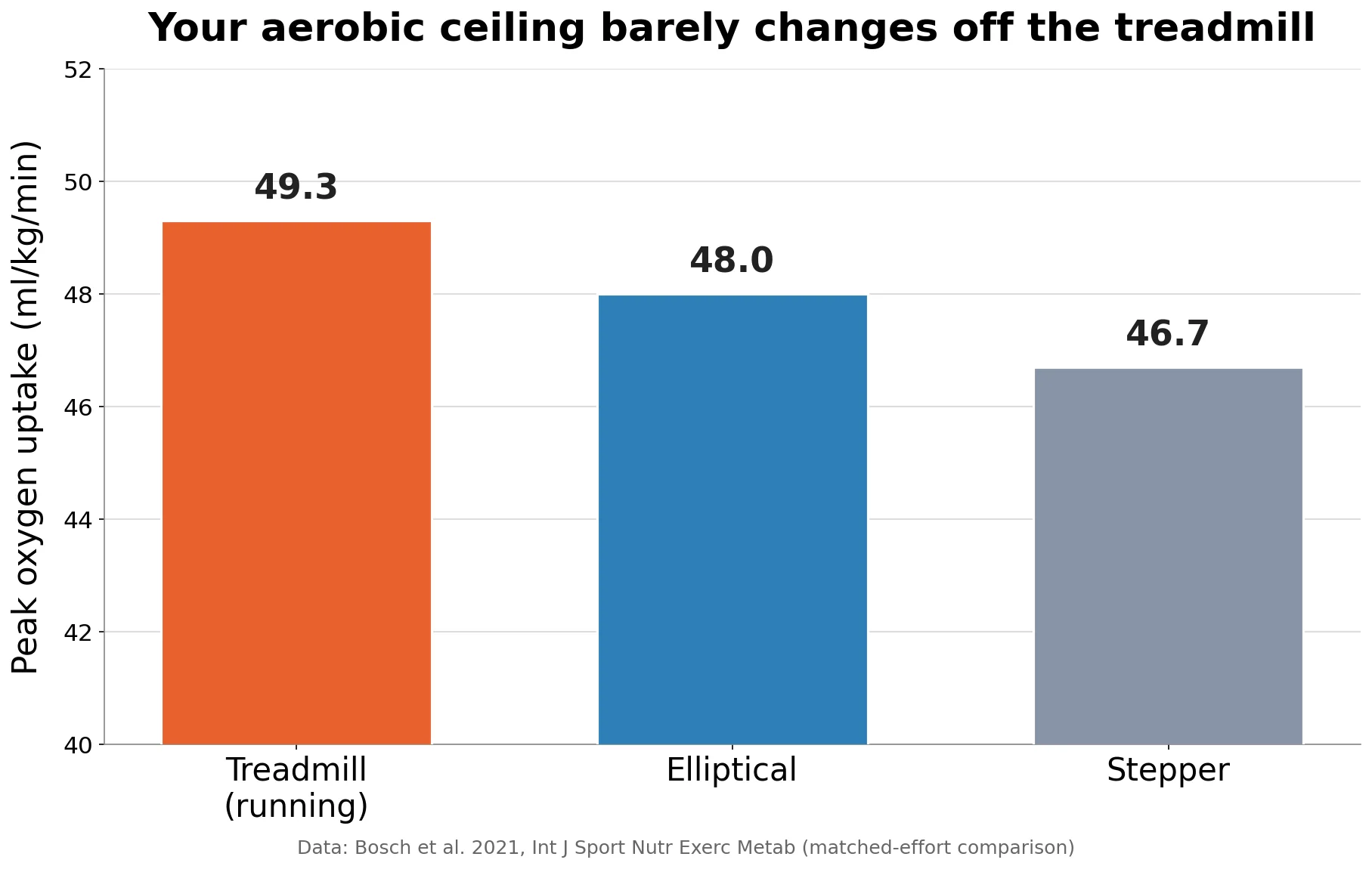
One controlled comparison found peak oxygen uptake was nearly the same on a treadmill, an elliptical, and a stepper, at 49.3, 48.0, and 46.7 ml/kg/min.

That means the ceiling on your cardiovascular effort barely moves when you switch from running to a zero-impact machine.
Your heart rate is the one reading that shifts.
Researchers comparing treadmill and elliptical work found heart rate ran 15 to 20 beats per minute above the treadmill at a matched perceived exertion.
So if you train by heart rate, that same effort will read 15 to 20 beats above your running number, and you should pace by feel instead.
The calorie burn holds up too.
A study of self-selected intensity found energy expenditure was the same on a treadmill and an elliptical, even though the machine again elevated heart rate.
For aerobic fitness, a hard 40 minutes on a zero-impact machine buys you close to what a 40-minute run would.
What Muscles Does the Zero Runner Work?
The Zero Runner drives the big movers of your running stride: your quads and glutes fire to lift each leg, and your hip flexors swing the knee through.
Your hamstrings work through the pull-back phase, much as they do when you run.
The gap is in your calves and feet.
Because your foot never pushes off the ground, your calves and Achilles skip the eccentric loading that running demands on every stride.
Your foot and ankle stabilizers also work less, since there is no uneven ground or impact to control.
That is a benefit when you are protecting an Achilles or a stress-reactive shin, and a gap when you are trying to keep those tissues race-ready.
Who Should Use a Zero Runner?
The Zero Runner earns its place fastest for runners who need to train through impact-related problems.
If you are managing a stress reaction, plantar fasciitis, shin splints, or arthritic knees, it lets you hold running-shaped fitness while the impact tissue heals.
The research on non-impact training backs this up as a fitness-holding strategy.
Trained runners who replaced running with water running for 6 weeks kept their VO2max, showing that non-impact work can defend hard-won aerobic fitness.
High-mileage and masters runners are the second group who benefit.
Swapping one or two easy runs a week for the Zero Runner trims your weekly impact load while keeping your aerobic volume intact.
If you want to compare it against the other machines and methods runners lean on, our guide to cross-training options for injured runners lays out the trade-offs.
Is the Zero Runner Worth the Money?
The Zero Runner is a premium purchase, and the value depends on how much impact-free running you need.
If you are chronically injured, race often, or run high mileage, a machine that keeps you fit without pounding your joints can pay for itself against months of lost training.
If you run healthy and only cross-train occasionally, cheaper tools cover most of the same ground.
Aqua jogging costs a pool pass and keeps your hip flexors and glutes engaged, and a standard elliptical delivers nearly the same cardiovascular stimulus for a fraction of the price.
An outdoor low-impact option like the ElliptiGO gives you fresh air and terrain that no indoor machine can.
Buy the Zero Runner for its convenience and its close-to-running feel, not because it does something cheaper cross-training cannot.
The Zero Runner is an Octane Fitness machine that copies your running gait with zero ground impact, using independent hip and knee hinges instead of an elliptical’s fixed path.
For cardio, a zero-impact running machine comes close to running: peak oxygen uptake is nearly the same as a treadmill, and calorie burn matches at equal effort.
Your heart rate reads about 15 to 20 beats higher on the machine at the same perceived effort, so pace by feel rather than by heart rate.
The Zero Runner works your quads, glutes, hip flexors, and hamstrings, but lets your calves, Achilles, and foot stabilizers off easy because there is no push-off or landing.
It suits injured runners protecting impact tissue and high-mileage or masters runners cutting their weekly pounding.
The Zero Runner is worth the money for convenience and a close-to-running feel, but aqua jogging and a standard elliptical cover most of the same fitness for far less.
Frequently Asked Questions
What is a zero runner machine?
A zero runner is a cardio machine made by Octane Fitness that reproduces the up-and-down motion of running with no ground impact. Each leg moves on its own hinge at the hip and knee, so your stride is not locked to a fixed oval the way it is on an elliptical. Your feet sit in cradles that never strike a surface, which removes the landing force that travels up your leg on every running step while keeping a running-shaped range of motion.
Is the Zero Runner the same as running?
The Zero Runner copies the shape of your running stride, but it is not identical to running. It removes ground impact and the push-off your foot and calf perform against the ground. For your heart and lungs it comes close to running, since oxygen uptake and calorie burn match a treadmill at equal effort. Where it differs is the lower-leg loading and impact that keep your feet, calves, and bones adapted to the road.
Does the Zero Runner give you the same cardio workout as running?
Close to it. Research on zero-impact machines that copy running motion found peak oxygen uptake almost identical to a treadmill, and energy expenditure the same at a matched effort. The main difference is heart rate, which reads about 15 to 20 beats per minute higher on the machine for the same perceived effort. If you train by heart rate, pace your Zero Runner sessions by feel instead so you do not overcook the workout.
What muscles does the Zero Runner work?
The Zero Runner drives the big movers of your running stride: your quads, glutes, and hip flexors lift and swing each leg, and your hamstrings work through the pull-back phase. Because your foot never pushes off the ground, your calves and Achilles skip the eccentric loading that running demands. Your foot and ankle stabilizers also do less, since there is no landing or uneven surface to control. That is a benefit when protecting an Achilles or shin, and a gap when keeping those tissues race-ready.
Can the Zero Runner keep you fit while injured?
Yes, for impact-related injuries it is a strong option. If you are managing a stress reaction, plantar fasciitis, shin splints, or arthritic knees, the Zero Runner lets you hold running-shaped fitness while the impact tissue heals. Research on non-impact training supports this: trained runners who replaced running with water running for six weeks kept their VO2max. The machine works the same way, defending your aerobic fitness without loading the injured tissue.
Is the Zero Runner worth the money?
It depends on how much impact-free running you need. If you are chronically injured, race often, or run high mileage, a machine that keeps you fit without pounding your joints can pay for itself against months of lost training. If you run healthy and only cross-train occasionally, cheaper tools cover most of the same ground. Aqua jogging costs a pool pass, and a standard elliptical delivers nearly the same cardiovascular stimulus for a fraction of the price.
Zero Runner vs elliptical: what is the difference?
An elliptical keeps both feet on gliding pedals that follow a fixed oval path. The Zero Runner drops the pedals and the fixed path, letting each leg swing on independent hip and knee hinges that move closer to a real running stride. Both remove ground impact and produce similar cardiovascular demand. The Zero Runner feels more like running and can better maintain your running-specific coordination, while an elliptical costs much less.
References
Bosch, Andrew N., et al. “Physiological and Metabolic Responses to Exercise on Treadmill, Elliptical Trainer, and Stepper: Practical Implications for Training.” International Journal of Sport Nutrition and Exercise Metabolism, vol. 31, no. 2, 2021, pp. 135-142.
Brown, Gregory A., et al. “Comparison of Energy Expenditure on a Treadmill vs. an Elliptical Device at a Self-Selected Exercise Intensity.” Journal of Strength and Conditioning Research, vol. 24, no. 6, 2010, pp. 1643-1649.
Green, James M., et al. “Heart Rate and Ratings of Perceived Exertion During Treadmill and Elliptical Exercise Training.” Perceptual and Motor Skills, vol. 98, no. 1, 2004, pp. 340-348.
Wilber, Randall L., et al. “Influence of Water Run Training on the Maintenance of Aerobic Performance.” Medicine and Science in Sports and Exercise, vol. 28, no. 8, 1996, pp. 1056-1062.