
You have less than 24 hours until your marathon, your training is done, and you’re wondering whether a run today will help you or leave you tired tomorrow.
Some training plans include a run the day before the race and others schedule complete rest, so it’s easy to end up unsure which one to follow.
I tell every runner I coach to run the day before a marathon or half marathon, as long as the run stays short and easy.
Here’s what you’ll learn about running the day before a race:
- Why a short run beats a full rest day before a marathon
- How the advice changes before a half marathon
- How far and how fast to go
- Whether a run cuts into your glycogen
- What else to get done the day before the race
Should You Run the Day Before a Marathon?
Run the day before a marathon. A short, easy run leaves you better prepared than a day on the couch, and I can’t think of a healthy runner who should skip it.
The only time I would skip it is if you’re nursing an injury and hoping it holds together for race day, because then every step you save matters more than anything a short run gives you.
No study has tested the day-before run on its own, but the taper research on how athletes should cut back before a big race points the same way.
A 2007 meta-analysis of 27 taper studies found the best race results came from cutting training volume by 41% to 60% over 2 weeks while keeping intensity and the number of runs per week the same.

That means you freshen up by cutting the length of each run, and you keep running on the days you normally would.
Skipping the day-before run cuts how often you run in the final days of the taper, even though a 20-minute jog adds almost nothing to your weekly volume.
I also like the day-before run for two practical reasons. The first is that you wake up on race morning with less stiffness after getting blood moving through your legs the day before.
The second is routine, because running is part of your daily life after months of training, and a normal run gives the day some structure and settles your nerves.
Should You Run the Day Before a Half Marathon?
You should run the day before a half marathon too, using the same short, easy run you would do before a marathon.
The run looks the same before both distances, including the optional strides covered in the next section.
The fear behind skipping the run is that it will make you tired, and your training already shows that fear is misplaced.
As an example, if you ran 4 or 5 days a week during your build, you ran 3 to 8 miles (5 to 13 km) the day before every hard workout and still hit your paces the next day.
A 20-minute jog is a fraction of the running you recovered from every week of your training block.
The same logic holds for shorter races, which is why you should also run the day before a 5K or 10K race.
How Far and How Fast Should You Run the Day Before a Race?
Aim for about 20 minutes of easy, conversational running the day before your race. Anything from 10 to 30 minutes works.
Keep the pace easy enough to talk in full sentences the whole way.
Skip marathon pace, tempo work and intervals the day before the race.
If you like how your legs feel after strides, finish with 4 relaxed strides of about 20 seconds each and walk or jog for a minute between them.
Run the day-before run in the morning or early afternoon so it doesn’t push back your dinner or your bedtime.
For the full breakdown of timing, strides and pace, read how to plan your shakeout run the day before a marathon.
Does Running the Day Before a Marathon Use Up Your Glycogen?
A short, easy run the day before a marathon uses only a small part of the carbohydrate stored in your muscles, and what you eat that day has plenty of time to top it off.
Researchers have measured how fast those stores fill when you eat enough carbohydrate.
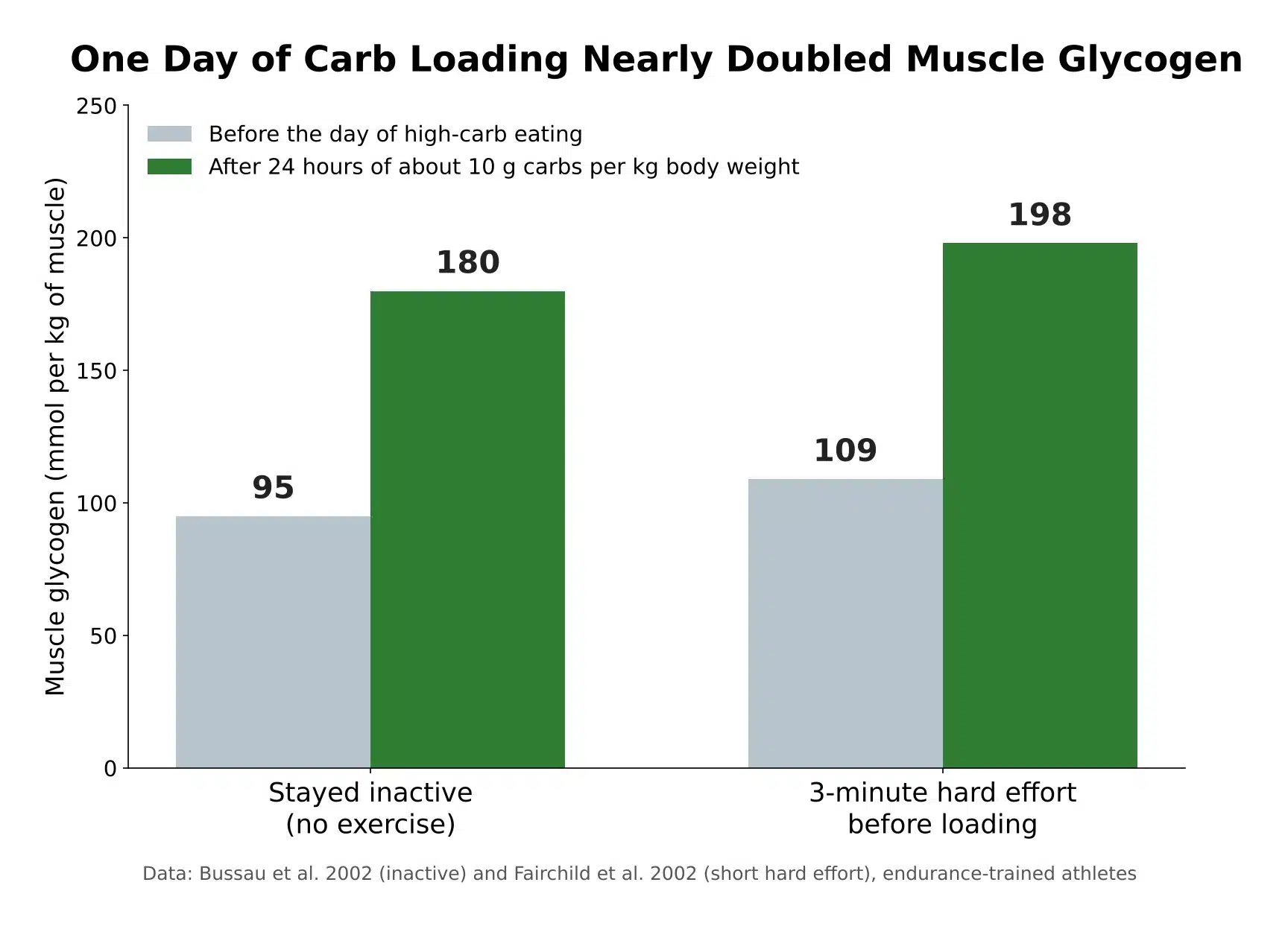
In a 2002 study, trained athletes ate 10 grams of carbohydrate per kilogram of body weight in one day and their muscle glycogen rose from 95 to 180 millimoles per kilogram of muscle.
That is close to double, and it happened within 24 hours, with no extra days of loading needed to reach the maximum.
A second 2002 study had athletes do a 3-minute bout of hard, faster-than-race-pace cycling before a similar day of eating, about 10 grams of carbohydrate per kilogram, and their muscle glycogen climbed from 109 to 198 millimoles per kilogram.
Neither study tested an easy jog, but together they suggest a short run the day before leaves plenty of room to load, as long as you eat the carbohydrate.
A study of 257 London Marathon runners found that those who ate more than 7 grams of carbohydrate per kilogram of body weight the day before ran faster overall and held their pace better late in the race than runners who ate less.
For a 70 kg (154 lb) runner, 7 grams per kilogram works out to 490 grams of carbohydrate, which is about what you would get from 10 plain bagels spread across the day.
The sports nutrition guidelines set the target higher, at 10 to 12 grams per kilogram of body weight each day for the 36 to 48 hours before a race lasting longer than 90 minutes.
That’s why you need to plan your carbohydrate for the day before the race as carefully as you plan your pace.
RunnersConnect Bonus
Download your FREE Marathon Nutrition During Your Taper Guide.
The guide contains a plan of exactly what you should be eating in the 5 days to 3 hours before your race. We give specific food recommendations to make sure you are ready on race day.
What Else Should You Do the Day Before a Marathon?
Once your short run is done, the rest of the day before a marathon goes to eating, getting organized and staying off your feet.
Use this list as your day-before routine:
- Eat carbohydrate at every meal and snack, starting at breakfast so you aren’t forcing a huge pasta dinner at 9 p.m.
- Pick lower-fiber foods like white rice, white bread, potatoes and juice, which are easier on your stomach than beans, bran and salads.
- Stick with foods you have eaten before long runs during training, even if the restaurant near your hotel has something new.
- Keep the expo short so you aren’t walking or standing for hours the day before the race.
- Lay out everything you’re wearing and carrying, including your bib, gels, shoes and watch, and plan how you’ll get to the start.
I want my runners organized early because the night before a race is when nerves make sleep hardest.
A survey of 283 elite athletes found that 64% had slept worse before an important competition, and 83.5% of them blamed thoughts about the competition.
That means anything you finish before evening is 1 less thing to think about once you’re in bed.
RunnersConnect Bonus
Download your FREE Race Day Checklist now.
Make sure that you don’t forget a single detail on race day!
If You Take a Rest Day During Race Week, When Should It Be?
If you want a day off during marathon week, take it 2 days before the race and run the day before.
That order gives you a full 24 hours of recovery and still lets you run the day before, so your legs and your routine feel normal heading into race morning.
For the rest of race week, I usually cut each run by about 40% to 50% of its normal length.
As an example, if your usual easy day during training was 8 miles (13 km), you would run 4 to 5 miles (6 to 8 km) instead.
During race week, shorten every run by about 40% to 50% and keep running on your usual days.
Early in race week I like one short session at goal pace, such as 2 to 3 miles (3 to 5 km) at marathon pace, then 3 to 5 minutes of easy running, then 4 x 1 minute at about half marathon pace.
The session isn’t hard enough to leave you tired, and it reminds your legs what marathon pace feels like before race day.
Adjust these numbers based on what has worked for you before, since you know your own body better than any plan does.
What Is the Best Plan for the Day Before a Marathon?
Here’s the full day-before plan in one place.
| Day-before task | What to do |
|---|---|
| Run | About 20 minutes easy, anywhere from 10 to 30 minutes |
| Pace | Conversational, with 4 optional 20-second strides |
| Timing | Morning or early afternoon |
| Carbohydrate | At least 7 grams per kilogram of body weight, spread across the day |
| Food choices | Lower fiber and familiar from training |
| Feet | Short expo visit, then rest |
| Gear | Bib, shoes, gels and watch laid out before dinner |
| Rest day | 2 days before the race, if you take one |
You should run the day before a marathon or half marathon, keeping it to about 20 minutes of easy, conversational running.
Taper research found the best race results came from cutting training volume 41% to 60% while keeping the number of runs per week the same, which supports keeping your day-before run.
A short run the day before does not stop you from carbohydrate loading, since one day of high-carbohydrate eating nearly doubled muscle glycogen in trained athletes.
London Marathon runners who ate more than 7 grams of carbohydrate per kilogram of body weight the day before ran faster and held their pace better.
The day before a marathon, eat familiar lower-fiber carbohydrate, keep the expo short and lay out your gear before dinner.
If you take a rest day during race week, take it 2 days before the race.
Frequently Asked Questions
Should I run the day before a half marathon?
Run about 20 minutes at an easy, conversational pace the day before a half marathon, the same as you would before a full marathon. A half marathon uses less of your stored carbohydrate, so you can add 4 relaxed strides of about 20 seconds at the end if your legs like them. Skip any tempo or interval work and do the run in the morning or early afternoon.
Should you run the day before a marathon or rest?
Do a short, easy run the day before a marathon, because it keeps your routine normal, reduces stiffness on race morning and settles your nerves. Taper research found the best results came from cutting volume while keeping the number of runs per week the same. The only reason to rest completely the day before is an injury you are trying to protect for race day.
How long should I run the day before a marathon?
Aim for about 20 minutes, and anywhere from 10 to 30 minutes works. The run should be easy enough to talk in full sentences the whole way. A run this short is a small fraction of the training you recovered from every week of your marathon build, so it will not leave you tired the next morning. Do it in the morning or early afternoon so it does not push back dinner or bedtime.
Will running the day before a race drain my glycogen?
A short, easy run uses only a small part of the carbohydrate stored in your muscles. In a 2002 study, trained athletes who ate 10 grams of carbohydrate per kilogram of body weight for one day nearly doubled their muscle glycogen within 24 hours. As long as you eat enough carbohydrate across the day, you have plenty of time to top off your stores before the race.
How many carbs should I eat the day before a marathon?
Aim for at least 7 grams of carbohydrate per kilogram of body weight. London Marathon runners who ate more than that the day before ran faster and held their pace better late in the race than runners who ate less. For a 70 kg (154 lb) runner, that is 490 grams. Sports nutrition guidelines suggest 10 to 12 grams per kilogram each day for the 36 to 48 hours before a marathon.
What should you not do the day before a marathon?
Avoid hard running, new foods, high-fiber meals and long hours on your feet at the race expo. Skip any workout at marathon pace or faster, since the training is already done. Finish packing and travel planning before evening, because thoughts about the competition were the main reason athletes in one survey slept poorly before important events, and a finished checklist leaves less to think about.
When should I take a rest day during marathon week?
If you want a rest day during race week, take it 2 days before the marathon and run the day before. That gives you 24 hours of full recovery while keeping a normal run right before the race. During the rest of the week, cut each run by about 40% to 50% and keep one short session at marathon pace early in the week.
References
Atkinson, Greg, et al. “Pre-Race Dietary Carbohydrate Intake Can Independently Influence Sub-Elite Marathon Running Performance.” International Journal of Sports Medicine, vol. 32, no. 8, 2011, pp. 611-617.
Bosquet, Laurent, et al. “Effects of Tapering on Performance: A Meta-Analysis.” Medicine and Science in Sports and Exercise, vol. 39, no. 8, 2007, pp. 1358-1365.
Bussau, Vanessa A., et al. “Carbohydrate Loading in Human Muscle: An Improved 1 Day Protocol.” European Journal of Applied Physiology, vol. 87, no. 3, 2002, pp. 290-295.
Fairchild, Timothy J., et al. “Rapid Carbohydrate Loading after a Short Bout of Near Maximal-Intensity Exercise.” Medicine and Science in Sports and Exercise, vol. 34, no. 6, 2002, pp. 980-986.
Juliff, Laura E., et al. “Understanding Sleep Disturbance in Athletes Prior to Important Competitions.” Journal of Science and Medicine in Sport, vol. 18, no. 1, 2015, pp. 13-18.
Thomas, D. Travis, et al. “American College of Sports Medicine Joint Position Statement. Nutrition and Athletic Performance.” Medicine and Science in Sports and Exercise, vol. 48, no. 3, 2016, pp. 543-568.