You finish 6 miles on the treadmill, look at the display, and wonder whether those miles count the same as 6 miles on the road.
The question shows up every winter, when the treadmill turns from a backup plan into your main way to train.
A treadmill mile and a road mile cost your body about the same effort once you make one small adjustment, though they are not identical in every way that shapes your training.
Here is what you’ll learn about treadmill running versus road running:
- Whether a treadmill mile equals a mile outside
- Why the 1% incline trick works and when it matters
- How accurate treadmill distances are
- How to make your indoor miles transfer to race day
Is a Mile on the Treadmill the Same as a Mile Outside?
A mile on the treadmill covers the same distance as a mile outside, and at most training paces it costs your body close to the same energy.
The main difference is air resistance. Outdoors you push through still air for the whole mile, and that adds a few percent to the energy you burn.
On a treadmill the belt moves underneath you in a room with no headwind, so that small cost disappears at flat settings.
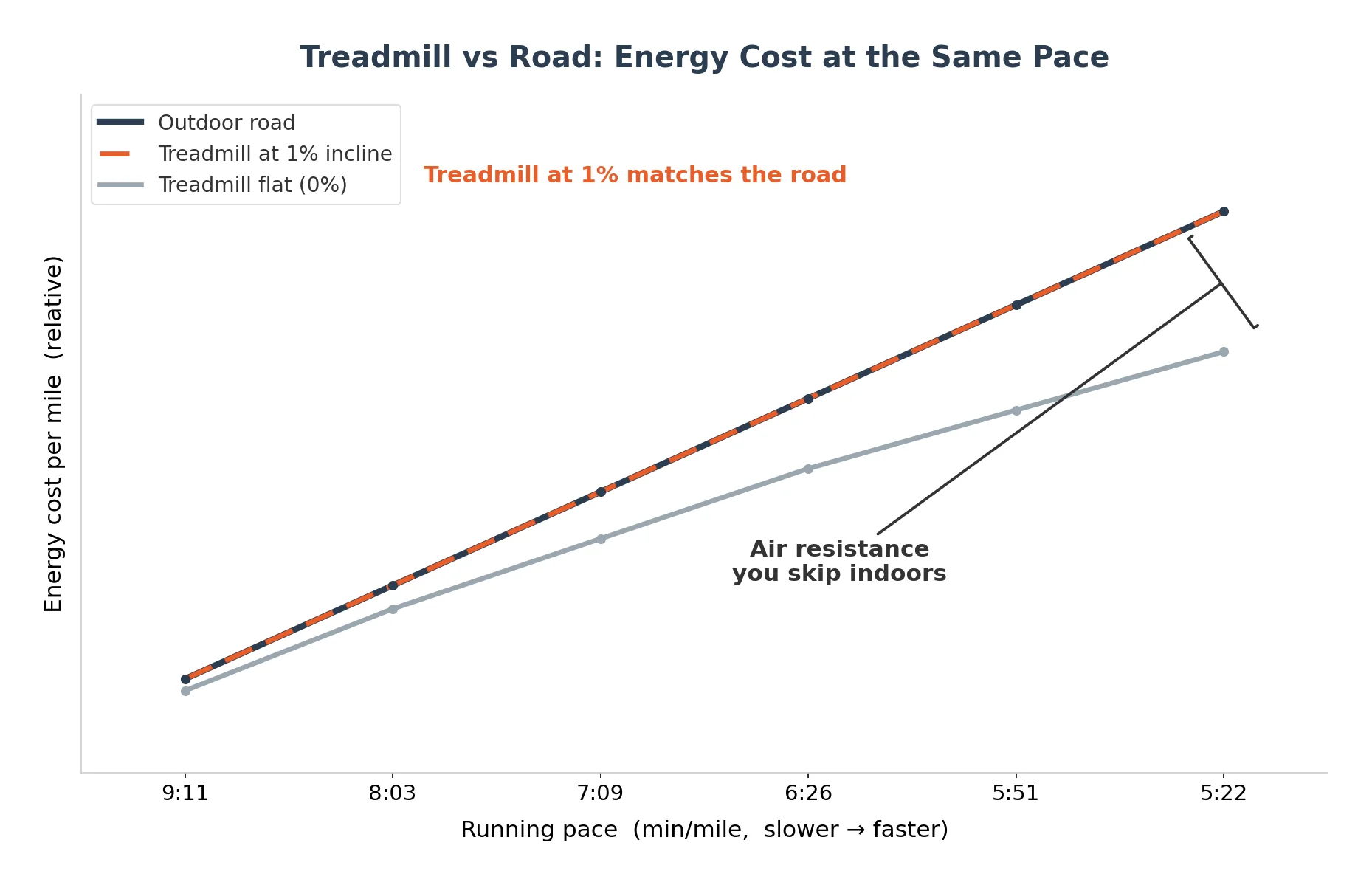
A study of trained runners found that a flat treadmill matched the oxygen cost of road running at easy speeds, while faster speeds needed a 1% incline to stay equal.

At slow paces the air you displace is minor, so a flat belt already matches the road.
As you speed up, air resistance grows, and a slight incline covers the gap.
Why Should You Set the Treadmill to a 1% Incline?
Setting the treadmill to a 1% incline replaces the air resistance you would meet outdoors, which keeps your indoor effort honest at faster paces.
The study that established this tested runners at 6 speeds, from 2.92 to 5.0 meters per second, roughly 9:11 down to 5:22 per mile (5:42 to 3:20 per km).
At the two slowest speeds, a flat belt matched the road. Once the pace picked up, only the 1% grade held the energy cost equal.
One percent is all it takes.
For most everyday runs, 1% works as a safe default that lines your treadmill pace up with outdoor effort.
Set the treadmill to 1% once you run faster than about 8:00 per mile (4:58 per km), where air resistance starts to matter.
If your run stays slower than 9:00 per mile (5:35 per km), a flat belt is close enough and the incline barely changes the effort.
RunnersConnect Bonus
Download your FREE Treadmill Guide for Runners.
The guide contains 4 treadmill specific workouts guaranteed to keep you sane and fit! You’ll learn about the In-N-Out workout, how to “run like an Egyptian” and get my favorite “green eggs and ham” workout.
Are Treadmill Distances Accurate?
Treadmill distance comes from belt speed multiplied by time, so it stays accurate as long as the machine is calibrated, because the belt travels a fixed length with each rotation and the console counts those rotations to build the distance you see.
Older or heavily used treadmills can drift out of calibration, which pushes the displayed distance long or short.
Your GPS watch often disagrees with the treadmill because it has no satellite signal to track distance indoors and falls back on arm swing.
A calibrated foot pod or your watch’s indoor mode gives a more reliable treadmill distance than raw GPS.
To check a machine, run a known distance on a track at a fixed speed, then repeat it on the treadmill at the same speed and compare the time.
Is Treadmill Pace the Same as Road Pace?
Treadmill pace and road pace produce a similar heart rate and oxygen cost. The same pace can still feel different, for reasons that have nothing to do with distance.
A 2020 review of crossover studies concluded that treadmill running stays largely comparable to overground running, with only small biomechanical differences.
The moving belt helps carry your leg through the back of each stride, so the belt can let you hold a quicker pace indoors for the same effort.
Still air and a warm room raise your core temperature faster, which can make a set pace feel harder after 15 to 20 minutes.
A fixed view and the hum of the motor also change how hard a run feels, even when your body works at the same rate.
Those perception gaps explain why treadmill running can feel easier or harder than the road on any given day.
The physiology underneath stays close, though, since a separate review of crossover studies reported comparable heart rate and oxygen use between treadmill and overground running at matched speeds.
How Do You Make Treadmill Training Transfer to the Road?
Treadmill training carries over to race day when you match outdoor effort and give up the small assists the machine hands you.
These 4 habits keep your indoor miles race-ready:
- Run at 1% incline for any pace faster than 8:00 per mile (4:58 per km) so the effort matches the road.
- Go by effort, not just the number on the display, since heat and belt assist can shift how a pace feels.
- Cool the room with a fan aimed at your body to replace the wind chill you lose indoors.
- Get outside when you safely can so your legs keep practicing push-off and pace judgment on real ground.
Outdoor running also trains you to hold a pace without the belt setting it for you, which is the skill you need on race day.
For the full comparison, here is what the latest science says about treadmills versus outdoor running.
| Factor | Treadmill | Outdoor road |
|---|---|---|
| Air resistance | None at flat setting | Present the whole run |
| Energy cost at easy pace | Matches the road | Baseline |
| Energy cost at fast pace | Matches at 1% incline | Baseline |
| Distance measurement | Belt speed and time | GPS or measured course |
| How the pace feels | Belt assist, more heat | Wind, varied footing |
A treadmill mile covers the same distance as a road mile, and at easy paces it costs your body nearly the same energy.
The one gap is air resistance, which you lose indoors and replace by setting the treadmill to a 1% incline.
Research on trained runners found a flat belt matched road running at slow speeds, while faster speeds needed that 1% grade to stay equal.
Treadmill distance is accurate when the machine is calibrated, and a foot pod reads more reliably than GPS indoors.
Treadmill pace and road pace produce a similar heart rate and oxygen cost, though belt assist and a warm room can change how the pace feels.
To make indoor miles transfer to race day, run at 1% incline, go by effort, cool the room with a fan, and get outside when you can.
Frequently Asked Questions
Is a mile on the treadmill really a mile?
Yes. A treadmill measures distance from belt speed and time, so a mile on a calibrated machine covers the same ground as a mile outside. The effort is close too, since at easy paces a flat treadmill matches the oxygen cost of road running. The main difference is air resistance, which you lose indoors and can replace with a small incline. For most training runs, your treadmill miles count the same as road miles.
Why do you set a treadmill to 1% incline?
A 1% incline replaces the air resistance you would push through outdoors. On a flat belt in still air, running costs slightly less energy than the same pace on the road, and the gap grows as you speed up. Research found that a 1% grade kept the energy cost of treadmill running equal to outdoor running at faster paces. At easy paces slower than about 9:00 per mile (5:35 per km), a flat belt is close enough that the incline barely matters.
Are treadmill distances accurate?
Treadmill distance is accurate when the machine is calibrated, because the console counts belt rotations of a known length. Older or heavily used treadmills can drift, which makes the reading run slightly long or short. Your GPS watch often disagrees indoors because it has no satellite signal and falls back on arm swing. A calibrated foot pod or your watch’s indoor mode gives a more reliable number than raw GPS on a treadmill.
Is treadmill pace the same as road pace?
Treadmill pace and road pace produce a similar heart rate and oxygen cost at matched speeds, so the physical work is close. The same pace can still feel different, because the moving belt helps carry your leg through each stride and a warm, still room raises your core temperature faster. Boredom and a fixed view also change how hard a run feels. Setting a 1% incline and running by effort keeps your treadmill pace honest against the road.
Does running on a treadmill build the same fitness as running outside?
Yes, a treadmill builds the same aerobic fitness as outdoor running when the effort matches. A review of crossover studies found treadmill and overground running are largely comparable in both biomechanics and physiology. The gaps are practical rather than physiological: you lose wind resistance, varied footing, and the skill of holding a pace yourself. Adding a fan, a 1% incline, and occasional outdoor runs closes most of that gap.
Why does treadmill running feel harder for some runners?
Treadmill running can feel harder because the room has no airflow to carry away heat, so your core temperature climbs faster and a set pace feels tougher after 15 to 20 minutes. A fixed view and the motor noise also make time drag, which raises perceived effort even when your heart rate is the same. Other runners feel the opposite, since the belt assists leg turnover. Aiming a fan at your body and running by effort rather than the display evens things out.
References
Jones, Andrew M., and Jonathan H. Doust. “A 1% Treadmill Grade Most Accurately Reflects the Energetic Cost of Outdoor Running.” Journal of Sports Sciences, vol. 14, no. 4, 1996, pp. 321-327.
Van Hooren, Bas, et al. “Is Motorized Treadmill Running Biomechanically Comparable to Overground Running? A Systematic Review and Meta-Analysis of Cross-Over Studies.” Sports Medicine, vol. 50, no. 4, 2020, pp. 785-813.
Miller, Jonathan R., et al. “A Systematic Review and Meta-Analysis of Crossover Studies Comparing Physiological, Perceptual and Performance Measures Between Treadmill and Overground Running.” Sports Medicine, vol. 49, no. 5, 2019, pp. 763-782.