
Runner’s Knee: How Long It Lasts and How to Treat It

Jeff Gaudette, MS   |

Runner’s knee, or patellofemoral pain, is an ache around or behind the kneecap that flares on downhills, stairs, squats and long runs.

Runner’s knee was the most common injury in an analysis of 2,002 running injuries.

In runners who followed an 8-week rehab program, 78% improved enough to count as a clinical success 3 months after it ended.

Runners who only changed their training improved as much as runners who also added exercises or gait retraining.

Combined hip and quadriceps exercises reduced knee pain and made daily activities easier, and the 2018 expert consensus recommends them.

Raising your cadence by 5% to 10% reduced the energy your knee absorbs with each step.

Knee pain that lasted more than 12 months before treatment predicted worse pain 5 to 8 years later, so treat runner’s knee early.

Runner’s knee is the ache around or behind your kneecap that shows up on downhills, on stairs and in the back half of long runs.

An analysis of 2,002 running injuries seen at a sports medicine clinic found it was the most common injury of all, ahead of IT band syndrome and plantar fasciitis.

The mistake many runners make is resting until the ache settles, then going straight back to the training that caused it.

The research from the last decade points to a different plan: keep running at a load your knee tolerates and add hip and quadriceps strength work.

So, in this article you’re going to learn the research-backed practical advice on:

  • How to tell runner’s knee apart from a meniscus tear when your knee locks or buckles
  • Why people who had knee pain for more than a year before treatment tended to still hurt 5 to 8 years later
  • The 8-week trial where training changes alone helped runners as much as adding exercises or gait retraining
  • Which hip and knee exercises reduce pain, and how a 5% to 10% cadence change lowers the load on your knee

What Is Runner’s Knee?

Runner’s knee is the common name for patellofemoral pain, which is pain where your kneecap glides over the groove at the end of your thigh bone.

Experts at a 2016 international research retreat agreed on one core symptom: pain around or behind the kneecap that hurts during at least one activity that loads a bent knee, such as squatting, running, stairs or jumping.

A 2018 review found that about 1 in 5 people (22.7%) deal with kneecap pain in any given year, rising to 28.9% in teenagers.

That means a sore kneecap is the first thing to consider when the front of your knee starts hurting on your runs.

What Does Runner’s Knee Feel Like?

Runner’s knee usually feels like a dull ache spread around the front of the kneecap, so you can’t point to the pain with one fingertip.

The ache flares when you:

  • Run downhill or reach the back half of a long run
  • Walk down stairs
  • Squat or kneel
  • Stand up after sitting for a long time with your knees bent

That same 2016 consensus statement lists a grinding feeling under the kneecap and mild swelling as extra signs, though you don’t need either one for the diagnosis.

A slow squat is the most useful single test, because in clinical exams about 80% of people whose squat brought on pain at the front of the knee had runner’s knee.

Runner’s knee can make the knee briefly give way on stairs or downhills, but giving way that repeats or follows a twist needs a physical therapist’s check.

Is It Runner’s Knee or a Meniscus Tear?

A meniscus tear is the more likely cause when your knee locks, meaning it gets stuck and won’t fully straighten until you wiggle it free.

Meniscus tears usually start with a twisting moment, and they cause pain along the joint line on the inside or outside of the knee instead of around the kneecap.

If your knee locks and won’t straighten, or swells quickly after a twist, see a physical therapist or sports doctor before you run on it again.

Is It Runner’s Knee or IT Band Syndrome?

IT band syndrome hurts on the outside of the knee, at the bony bump on the side of the joint, while runner’s knee hurts around the kneecap itself.

IT band pain often starts at the same point in each run and keeps building until you stop.
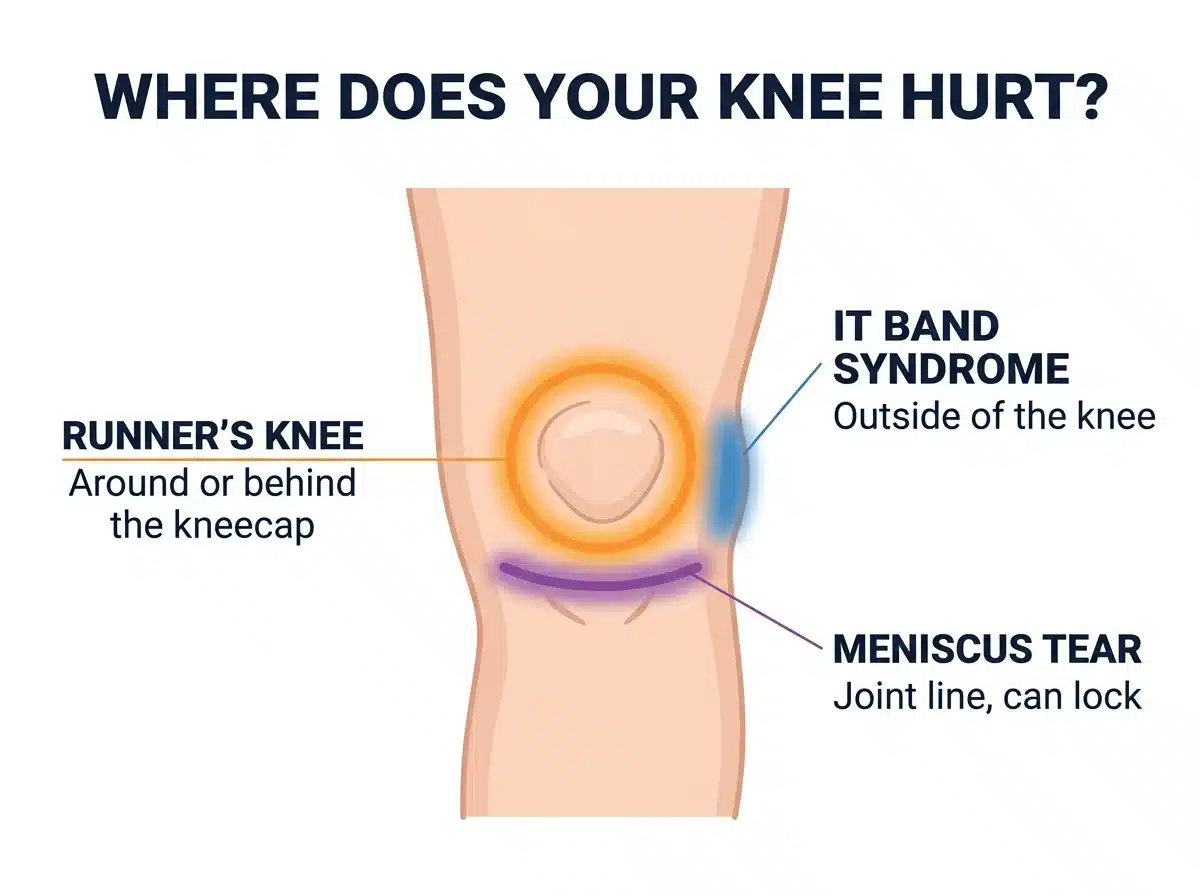
Front view of a knee showing where each injury hurts: runner's knee around or behind the kneecap, IT band syndrome on the outside of the knee, and a meniscus tear along the joint line, where it can cause locking

What Causes Runner’s Knee?

Runner’s knee usually shows up after you load the joint behind your kneecap faster than it can adapt, often after a jump in mileage, hills or speed work.

Most runners were taught that weak hips are the root cause.

A 2014 review found moderate to strong evidence that hip strength did not predict who went on to develop runner’s knee, even though people who already had it showed weaker hips than pain-free people.

That means weak hips may be a result of knee pain more than the cause of it.

research
Research has shown that weak quadriceps predicted who later developed kneecap pain in military recruits, while weak hips did not predict it in any group studied.

That 2019 review included 18 studies and 4,818 people.

Your hips still belong in your rehab, because people who already had runner’s knee showed weaker hips in that 2014 review, and strengthening them reduces pain, as the exercise section below shows.

How Long Does Runner’s Knee Last?

Runner’s knee usually improves within a few months once you change your training, though a case that has dragged on for a year or more can take much more time.

In a 2018 analysis of 58 runners who followed an 8-week rehab program, 78% improved their daily-function scores enough to count as a clinical success 3 months after the program ended.

The runners least likely to reach that mark started with more pain in daily life and quadriceps strength below 70% of their body weight.

That means it’s worth testing your quadriceps strength early, since runners below 70% of their body weight were less likely to reach that clinical success mark.

research
Research has shown that 57% of people with runner’s knee still reported an unfavorable recovery 5 to 8 years after their diagnosis.

In that long-term follow-up, having knee pain for more than 12 months before treatment was one of the 2 factors that predicted a poor outcome.

That means waiting a year or more for runner’s knee to go away on its own is a poor plan.

The same follow-up found that 48 of the 50 people who had knee X-rays showed no signs of knee arthritis.

Can You Keep Running With Runner’s Knee?

You can usually keep running with runner’s knee if you cut the runs that flare it and keep the pain mild.

research
Research has shown that runners who only learned how to manage their pain and training load improved as much over 8 weeks as runners who also did strength exercises or gait retraining.

That 2018 trial split 69 runners into 3 groups: one that got education on symptoms and training changes, another that added an exercise program, and a third that added gait retraining.

All 3 groups had less pain and better function at 4, 8 and 20 weeks, and the extra exercises or gait changes added nothing further to those pain scores.

That means adjusting your training belongs at the center of your plan, with exercises and form work added to it.

Adjust your running in these 4 ways while your knee settles:

  • Keep pain at 3 out of 10 or lower. This is a common coaching rule: mild pain during a run is fine if it settles by the next morning and doesn’t build from week to week.
  • Cut downhills and stairs first. Running downhill bends your knee more under load, so flat routes or a treadmill at a 0% to 1% incline are easier on the kneecap.
  • Shorten your long run before you drop days. Pain usually builds late in a run, so stop at the point where it starts or split the run into 2 shorter runs.
  • Replace lost miles with cross-training. Pool running and cycling with the seat set high keep your fitness up while the knee calms down.

Cross Training While Injured and During Recovery

Cross training is recommended while you’re injured and as you slowly return to running.

The best form of cross training for this injury is Aqua Jogging. Studies have shown that aqua jogging can enable a well-trained runner to maintain running fitness for up to 4-6 weeks.

Aqua jogging is a form of deep water running that closely mimics the actual running movement.  Your feet don’t actually touch the bottom of the pool, so it is zero impact and safe for almost any type of injury. In my experience, the only time to avoid aqua jogging is when you have a hip flexor injury, which can be aggravated by the increased resistance of the water as you bring your leg up.

Because aqua jogging closely mimics natural running form, it provides a neuromuscular workout that, in addition to aerobic benefits, helps keep the running specific muscles active. The same can’t be said for biking and swimming.

The only downside to aqua jogging is that you need a pool that is deep enough to run in without touching the bottom. If you’re lucky enough to have access to a pool of this size, aqua jogging should be your first cross training choice.

In one study, a group of ten runners trained exclusively with deep water running for four weeks and compared 5km race times pre deep water running and post deep water running.

The researchers found no statistical difference in 5k time or other markers for performance, such as submaximal oxygen consumption or lactate threshold.

In a second study, researchers measured the effects of aqua jogging over a six week period.

This time, 16 runners were separated into two groups – one who did aqua jogging workouts and the other who did over land running.

Using the same training intensities and durations, the researchers found no difference between the groups in maximal blood glucose, blood lactate, and body composition.

It get’s better:

Research has also demonstrated that aqua jogging can be used as a recovery tool to facilitate the repair of damaged muscles after hard workouts.

These findings make aqua jogging an important recovery tool in addition to being the best cross training method for injuries.

Need one more reason?

The calories burned aqua jogging are even higher than running on land, so if you want to avoid weight gain while you take time off from running, this is definitely the exercise for you!

Aqua Jogging Workouts For Runners

If you’re interested in aqua jogging to rehab your injury, then the absolute best way is to use one of my favorite programs, Fluid Running.

First, it comes with an aqua jogging belt and waterpoof bluetooth headphones so you have everything you need to aqua jog effectively.

Second, they have an app that pairs with the headphones so you can get workouts, guided instructions on how to aqua jog properly, and motivation while you’re actually pool running.

This has been an absolute game changer for me when I am injured.

I used to dread aqua jogging workouts because they were so boring and it took all my mental energy to stay consistent.

But, with workouts directly in my ear, it’s changed the whole experience and I actually look forward to the workouts. So much so that I now use aqua jogging as a cross training activity in the summer, even when I am not injured.

Fluid running is an awesome deal when you consider it comes with the belt (highly recommended for better form), the waterproof headphones (game changer for making pool workouts fun), a tether (to add variety to the workouts you can do) and the guided workout app (to make your cross training structure and a whole lot more interesting).

That’s why we’ve partnered with them to give you 2 additional running-specific workouts you can load into the app when you use the code RTTT .

Check out the product here and then on the checkout page, add the code RTTT in the coupon field and the workouts will be added to your order for free.

If you’d rather do the aqua jogging workouts on your own, here are some great ideas to get you started!

Medium Effort Workouts

The Pyramid

10 minutes easy warm up – 1:00 hard, 30 seconds easy – 1:30 hard, 30 seconds easy – 2:00 hard, 30 seconds easy – 2:30 hard, 30 seconds easy, go to 5:00 in 30 second intervals and then come back down the pyramid (4:30 hard, 30 easy, 4:00 hard, 30 easy etc). Finish with 10 minutes easy cool down.

Wave your hands in the air like you just don’t care

10 minutes easy warm up, 1 minute medium (87-92% of maximum heart rate or what feels like tempo effort), 1 minute sprint (95-100% of maximum heart rate or all out sprint), 30 seconds hands in air (keep moving your legs in the running motion, but put your hand above your head), 1 minute rest, Repeat 10-15 times. 10 minutes easy cool down.

Hard Workouts

One of the difficulties of cross training is replicating those truly lung-busting, difficult workouts.

So, if you’re going to be pool running quite a bit due to injury or limited training volume, invest in a bungee cord designed for sprinters.

Tie one end of the resistance band to a sturdy object (pole, lifeguard stand, pool ladder) and bring the other into the water with you.

Put the strap around your waist and begin aqua jog away from your starting point.

You’ll begin to notice the bungee tighten and resist against you (depending on the length of your pool, you may need to wrap the bungee around the supporting object or tie it in knots to make it shorter to feel resistance).

Spend a few moments testing yourself to see how far you can pull the bungee.

This is a great challenge and a fun way to compete with yourself during an otherwise boring cross training activity.

Now for the hard part:

Pick a point on the pool wall or side of the pool that you feel stretches the bungee to a very hard sprint that you could maintain for 60-90 seconds.

This will be your “sprint” marker that you’ll use on sprint intervals (95-100% of maximum heart rate or all out sprint).

Now:

Find a point that feels like the end of a hard tempo run.

Mark this spot as your “medium” interval distance.

When you complete the hard workouts, you can use these reference points to ensure that you maintain a very hard effort.

The springboard

10 minutes easy warm up, 90 seconds easy (slowly moving out and stretching the bungee), 2 minute medium, 1 minute sprint, 1 min rest (let the bungee pull you back – this is kind of fun). Repeat 10 times. 10 minutes easy cool down.

The race simulation

10 minutes easy warm up, 90 seconds easy (slowly moving out and stretching the bungee), 5 minutes medium (focus and concentrate, just like during the hard part of a race), 30 seconds sprint, 2 minutes rest. Repeat 4 times. 10 minutes easy col down

The lactic acid

10 minutes easy warm up, 90 seconds easy (slowly moving out and stretching the bungee), 2 minutes sprint, 90 seconds rest. Repeat 12 times, 10 minutes easy cool down.

I guarantee that with the bungee, you’ll get your heart rate through the roof.

You can challenge yourself and make aqua jogging more fun by seeing how long you can stay at your maximum stretched distance or seeing how far you can push it.

Likewise, if you have a friend who is injured (or someone willing to be a good sport) you can try pulling each other across the pool for some competitive fun.

Cross training can be tough, especially when you’re injured or want to be increasing your volume faster.

However, I hope that providing a variety of workouts, either through the Fluid Running app (which also makes it easier to keep track of the workout while in the water) or on your own can add a fun challenge in the pool and you can emerge from your injury with minimal fitness loss.

Which Exercises Help Runner’s Knee Heal?

Adding hip exercises to your quadriceps work gives you the best-supported exercise plan for runner’s knee.

A 2015 review of 14 studies found strong evidence that hip exercises combined with quadriceps exercises reduced pain and made daily activities easier in the short term.

That review also found limited evidence that the combination still reduced pain more than quadriceps work alone at 1 year.

The 2018 international consensus statement recommended exercise therapy for runner’s knee and singled out combined hip and knee exercises.

Give your hip and knee exercises at least 8 weeks before you judge whether they work.

Start with these 5 exercises, doing 3 sets of 10 to 15 reps 3 days a week and keeping knee pain at 3 out of 10 or lower.

Wall squat: slide down a wall until your knees bend to about 45 degrees and hold for 30 seconds, staying shallow enough that the pain stays mild.

Straight leg raise: lie on your back with one knee bent, tighten the thigh of your straight leg, then lift it to the height of the bent knee and lower it over 3 seconds.

Side-lying hip abduction: lie on your side with your bottom knee bent and lift your top leg up and a few inches back, keeping your toes pointed forward.

Monster walk: place a resistance band around your legs just above the knees, sink into a quarter squat and take slow steps to the side without letting your knees cave in.

Single leg squat: once wall squats are pain-free, squat on one leg to a shallow depth while keeping your knee in line with your second toe.

For the full program with progressions, use this runner’s knee exercise routine.

RunnersConnect Bonus

Download our Top 5 Runner’s Knee Prevention Exercises for Free.

It’s a PDF with the 5 best exercises to help you prevent runner’s knee.

GET MY GUIDE

Does a Knee Brace Help Runner’s Knee?

A knee brace or tape can reduce pain while you run, so it works best as support while your hip and quadriceps strength builds.

The 2018 consensus statement rated patellar taping and bracing as uncertain.

What Did the NuNee Research Find?

In a 2022 study from the Nazareth College School of Physical Therapy, 89% of people with pain at the front of the knee reported less pain as soon as they put on NuNee during the activity that hurt them most.

NuNee is a strap designed to reduce the pressure on your kneecap with each stride.

In that study, average pain during the activity fell from 3.4 to 1.6 on a 0-to-10 scale with the brace on.

After 6 weeks of wearing it, every participant reported 0 out of 10 pain while using the brace during testing.

That study was small, so treat a brace as short-term support while the strength work does its job.

We partner with NuNee, and it comes with a 100% money-back guarantee if it doesn’t reduce your pain.

Should You Change Your Running Form for Runner’s Knee?

A 5% quicker cadence is the simplest form change to try, because quicker steps reduce the energy your knee absorbs each time your foot hits the ground.

research
Research has shown that raising your step rate by 5% to 10% reduced the energy your knee absorbs with every step.

For a runner at 160 steps per minute, a 5% increase means 168 steps per minute, which you can practice with a metronome app for a few minutes of each easy run.

The 2018 consensus statement rated gait retraining as uncertain for runner’s knee, so treat cadence work as an extra.

If you’ve never tracked it, start with this guide to running cadence and injury risk.

In the 2018 trial of 69 runners, the gait retraining group raised their cadence by 7%, though their pain improved no more than the education-only group’s pain.

That means cadence work is an add-on to your training changes.

Watching your knees as you run helps too.

In a 2012 study, 10 female runners with runner’s knee practiced running in front of a mirror for 8 sessions, keeping their hips level and knees pointing forward.

They reported less pain and better function, and both improvements lasted for 3 months after the sessions ended.

Without a mirror, put a short strip of athletic tape on the front of each knee and keep the tape facing forward each time your foot hits the ground.

If the tape turns inward as your foot hits the ground, your knee is likely caving in and putting extra stress on the kneecap.

How Do You Stop Runner’s Knee From Coming Back?

Keep your strength work going after the pain is gone, since weak quadriceps predicted future runner’s knee in military recruits in that 2019 review.

Keep 1 to 2 short hip and quadriceps sessions a week after your knee pain is gone.

When you build your mileage back, add hills and speed work one at a time instead of adding both in the same week.

If the ache returns, drop back to the last weekly mileage that felt fine and hold it for a week before you build again.

What Works Best for Runner’s Knee?

Here’s a quick summary of each treatment, what the research found and how to use it.

Treatment What the research found How to use it
Training changes and education Runners improved as much over 8 weeks as runners who added exercises or gait retraining Keep pain at 3 out of 10 or lower, cut downhills and shorten long runs
Hip and quadriceps exercises Reduced pain and improved function, with limited evidence of more pain relief than quadriceps work alone at 1 year 3 days a week for at least 8 weeks
Quicker cadence A 5% to 10% higher step rate reduced the energy absorbed at the knee Practice a 5% increase on easy runs
Knee brace or tape Rated uncertain by experts, with early brace data showing less pain Use it to keep running comfortably while strength builds
Early treatment Pain lasting more than 12 months predicted a poor outcome 5 to 8 years later Start rehab well before pain reaches the 12-month mark
How long does runner’s knee last?

Runner’s knee usually improves within a few months once you change your training and start hip and quadriceps exercises.

In a 2018 analysis of 58 runners who followed an 8-week rehab program, 78% improved their daily-function scores enough to count as a clinical success 3 months after the program ended.

Cases that have lasted more than a year take longer, because pain lasting more than 12 months before treatment predicted worse pain 5 to 8 years later.

Can I keep running with runner’s knee?

You can usually keep running with runner’s knee, and a common coaching rule is to keep pain at 3 out of 10 or lower and make sure it settles by the next morning.

In a 2018 trial of 69 runners, the group that only learned to manage pain and training load improved as much over 8 weeks as the groups that added exercises or gait retraining.

Cut downhills and stairs first, shorten your long run and replace lost miles with pool running or cycling.

Why does my knee lock up or buckle when I run?

Runner’s knee can make the knee briefly give way on stairs or downhills, but giving way that repeats or follows a twist needs a physical therapist’s check.

A knee that locks, meaning it gets stuck and won’t fully straighten until you wiggle it free, points more toward a meniscus tear.

If your knee locks or swells quickly after a twist, see a physical therapist or sports doctor before you run on it again.

What is the difference between runner’s knee and a meniscus tear?

Runner’s knee causes a dull ache around or behind the kneecap that flares with squats, stairs, downhills and long runs.

A meniscus tear usually starts with a twisting moment, hurts along the joint line on the inside or outside of the knee and can cause the knee to lock.

In clinical exams reported by a 2016 expert consensus statement, about 80% of people whose slow squat brought on pain at the front of the knee had runner’s knee.

Does runner’s knee go away on its own?

Runner’s knee often lingers when you wait it out without changing anything.

In a long-term follow-up, 57% of people with runner’s knee still reported an unfavorable recovery 5 to 8 years after their diagnosis.

Having pain for more than 12 months before treatment was one of the 2 factors that predicted a poor outcome, so start adjusting your training and doing hip and quadriceps exercises well before you reach that point.

What exercises help runner’s knee?

Doing hip and quadriceps exercises together reduced runner’s knee pain in a 2015 review of 14 studies, with limited evidence that the combination beat quadriceps work alone at 1 year.

A good starting set is the wall squat, straight leg raise, side-lying hip abduction, monster walk and a shallow single leg squat once wall squats are pain-free.

Do 3 sets of 10 to 15 reps 3 days a week and give the program at least 8 weeks before you judge it.

Does a knee brace help runner’s knee?

A knee brace or tape can reduce pain while you run, though a 2018 expert consensus statement rated bracing and taping as uncertain.

In a small 2022 knee-strap study, 89% of people with pain at the front of the knee reported less pain as soon as they put it on.

Use a brace to keep running comfortably during the 8 or more weeks your hip and quadriceps exercises need.

Jeff Gaudette, M.S. Johns Hopkins University

Jeff is the co-founder of RunnersConnect and a former Olympic Trials qualifier.

He began coaching in 2005 and has had success at all levels of coaching; high school, college, local elite, and everyday runners.

Under his tutelage, hundreds of runners have finished their first marathon and he’s helped countless runners qualify for Boston.

He's spent the last 15 years breaking down complicated training concepts into actionable advice for everyday runners. His writings and research can be found in journals, magazines and across the web.

Collins, N. J., et al. “2018 Consensus Statement on Exercise Therapy and Physical Interventions (Orthoses, Taping and Manual Therapy) to Treat Patellofemoral Pain: Recommendations from the 5th International Patellofemoral Pain Research Retreat, Gold Coast, Australia, 2017.” British Journal of Sports Medicine, vol. 52, no. 18, 2018, pp. 1170-1178.

Crossley, K. M., et al. “2016 Patellofemoral Pain Consensus Statement from the 4th International Patellofemoral Pain Research Retreat, Manchester. Part 1: Terminology, Definitions, Clinical Examination, Natural History, Patellofemoral Osteoarthritis and Patient-Reported Outcome Measures.” British Journal of Sports Medicine, vol. 50, no. 14, 2016, pp. 839-843.

Esculier, J. F., et al. “Is Combining Gait Retraining or an Exercise Programme with Education Better than Education Alone in Treating Runners with Patellofemoral Pain? A Randomised Clinical Trial.” British Journal of Sports Medicine, vol. 52, no. 10, 2018, pp. 659-666.

Esculier, J. F., et al. “Predictors of Clinical Success in Runners with Patellofemoral Pain: Secondary Analyses of a Randomized Clinical Trial.” Journal of Science and Medicine in Sport, vol. 21, no. 8, 2018, pp. 777-782.

Heiderscheit, B. C., et al. “Effects of Step Rate Manipulation on Joint Mechanics during Running.” Medicine and Science in Sports and Exercise, vol. 43, no. 2, 2011, pp. 296-302.

Lack, S., et al. “Proximal Muscle Rehabilitation Is Effective for Patellofemoral Pain: A Systematic Review with Meta-Analysis.” British Journal of Sports Medicine, vol. 49, no. 21, 2015, pp. 1365-1376.

Lankhorst, N. E., et al. “Factors that Predict a Poor Outcome 5-8 Years after the Diagnosis of Patellofemoral Pain: A Multicentre Observational Analysis.” British Journal of Sports Medicine, vol. 50, no. 14, 2016, pp. 881-886.

Neal, B. S., et al. “Risk Factors for Patellofemoral Pain: A Systematic Review and Meta-Analysis.” British Journal of Sports Medicine, vol. 53, no. 5, 2019, pp. 270-281.

Rathleff, M. S., et al. “Is Hip Strength a Risk Factor for Patellofemoral Pain? A Systematic Review and Meta-Analysis.” British Journal of Sports Medicine, vol. 48, no. 14, 2014, p. 1088.

Smith, B. E., et al. “Incidence and Prevalence of Patellofemoral Pain: A Systematic Review and Meta-Analysis.” PLoS One, vol. 13, no. 1, 2018, e0190892.

Taunton, J. E., et al. “A Retrospective Case-Control Analysis of 2002 Running Injuries.” British Journal of Sports Medicine, vol. 36, no. 2, 2002, pp. 95-101.

Willy, R. W., et al. “Mirror Gait Retraining for the Treatment of Patellofemoral Pain in Female Runners.” Clinical Biomechanics, vol. 27, no. 10, 2012, pp. 1045-1051.

Picture of Who We Are

Who We Are

Your team of expert coaches and fellow runners dedicated to helping you train smarter, stay healthy and run faster.

We love running and want to spread our expertise and passion to inspire, motivate, and help you achieve your running goals.

One Response

  1. Good article, John. Well thought out. I like the wobble board suggestion. I am a Janda board guy myself, but there’s little difference there. Keep up the research and the writing. Runner’s Knee is a pain for all of us and for women even more so. When you have time, take a look at some of the work that Geno Auriemma’s training team at UConn has done for his b-ball players in reducing ACL injuries big time.
    Bill Boland

Leave a Reply

Your email address will not be published. Required fields are marked *