Key Takeaways
How you should feel after a run depends on the run.
After an easy run you should feel refreshed within a few hours and ready to go the next morning.
After a hard workout or long run, expect soreness and heavy legs to peak 24 to 72 hours later, then fade.
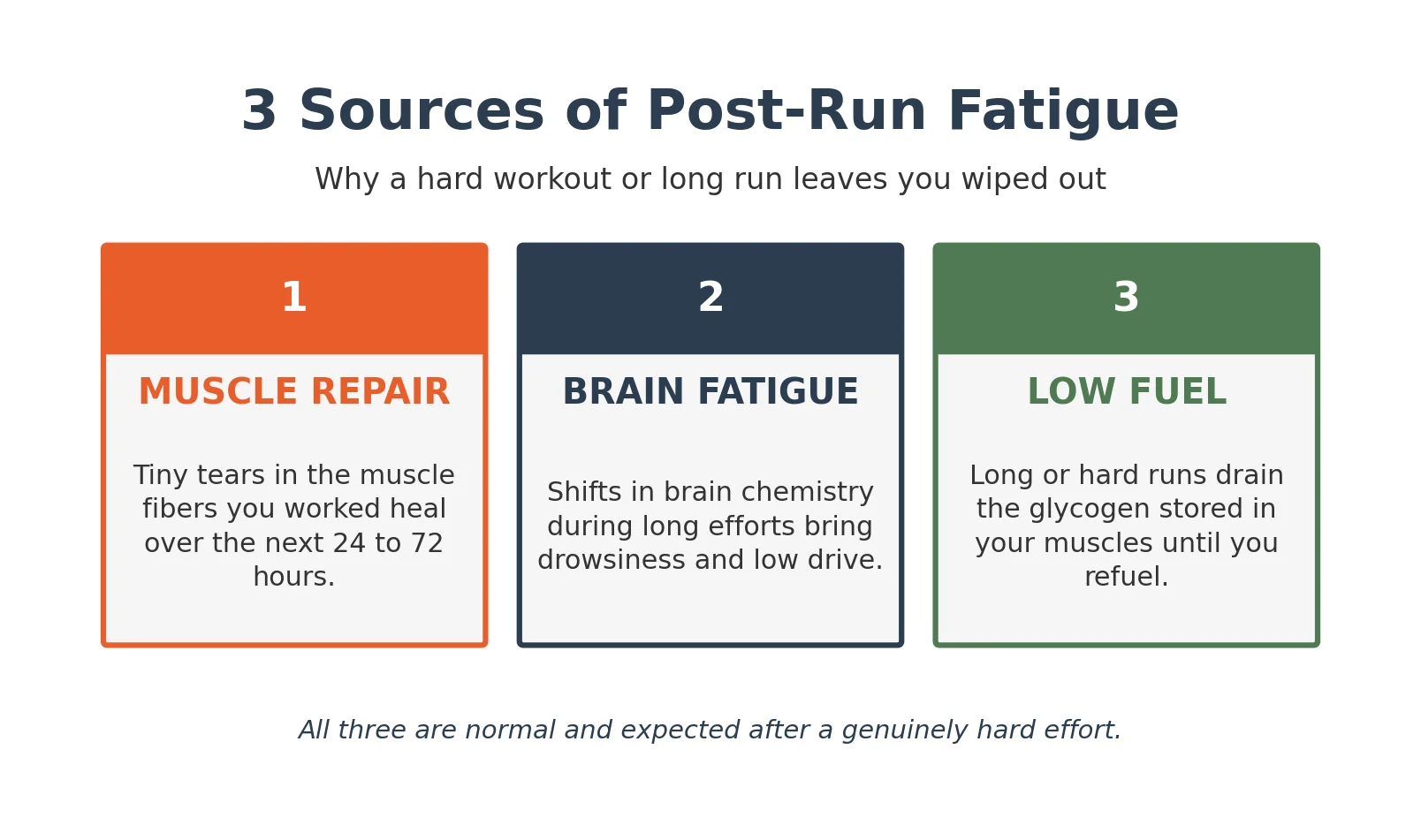
That post-run fatigue comes from muscle repair, a brain-driven drop in drive, and drained fuel stores.
Needing a nap after a long run is normal and helps you recover.
Warning signs of overdoing it are all-day exhaustion, poor sleep, low mood, and paces that keep sliding backward.
When fatigue lingers, keep your easy runs easy, take a rest day, and build in a down week.
You finish a hard interval session feeling strong, and by mid-afternoon you’re flat on the couch and fighting the urge to nap.
That afternoon crash raises a fair question: did you overdo it, or is this what recovery feels like?
The honest answer depends on which sensations show up, how strong they are, and how long they stick around.
Here’s what you’ll learn about reading your body after a run:
- What a normal easy run should feel like afterward
- Why hard workouts and long runs leave you wiped out and foggy
- How long post-run fatigue should last for each type of run
- The warning signs that separate healthy fatigue from overtraining
- What to do when the tiredness won’t lift
How should you feel after an easy run?
An easy run should leave you feeling refreshed and loose, ready to run again the next day.
Your breathing stays conversational the whole way, and you finish with the sense that you could have kept going.
A little leg tiredness in the hour afterward is normal.
Feeling wiped out for the rest of the day after an easy run usually means the pace crept too fast.
If your easy runs regularly leave you drained for hours, the pace is the first thing to check.
Hard workouts and long runs are a different story, and the fatigue they produce has real physiology behind it.
RunnersConnect Bonus
Download your FREE Long Run and Aerobic Pacing Calculator now.
Need help converting your race times to your optimal easy and long run pace? Download our FREE calculator and we’ll do the math for you.
Why do you feel wiped out or foggy after a hard workout or long run?
The heavy, drained feeling after a hard session comes from several systems recovering at the same time.
The soreness starts in your muscles, where a hard effort causes tiny tears that your body repairs over the following day or two.
Research on delayed onset muscle soreness shows the tenderness peaks between 24 and 72 hours after a hard session, then fades as the muscle fibers repair.

The fog and low motivation come from somewhere else: your brain.
Researchers studying central fatigue have linked prolonged exercise to rising brain serotonin activity, which is tied to drowsiness and loss of motivation, so you can feel mentally flat even when your legs are fine.
A long run past about 90 minutes also draws your muscle glycogen stores down toward empty, and running low on that fuel adds to the hollow, heavy-legged feeling until you restock over the following day.
Time on your feet matters as much as pace.
3 hours of easy running still leaves you tired, because you have spent that whole time upright and moving.
That repair, over the hours and days after the session, is where your fitness gain comes from.
Your muscles adapt during the days after a hard session, which is the whole reason you trained hard in the first place.
Is it normal to need a nap after a long run?
Needing a nap after a long run is normal, and taking that nap is a smart move for your recovery.
Weekend long runs often start early and cover 90 minutes to 3 hours, which leaves a real dip in energy by midday.
A nap gives your body uninterrupted time to repair, and the research on sleep and athletes shows how much that rest matters.
A Stanford study on sleep extension found that basketball players who slept at least 10 hours a night ran faster sprints and lifted their shooting accuracy by about 9%.
That pull toward the couch after a long run is a green light.
Needing a nap every single day, when that is not usual for you, points the other way and suggests you are carrying more fatigue than you’re clearing.
How long should post-run fatigue last?
The answer depends far more on the type of run than on your fitness.
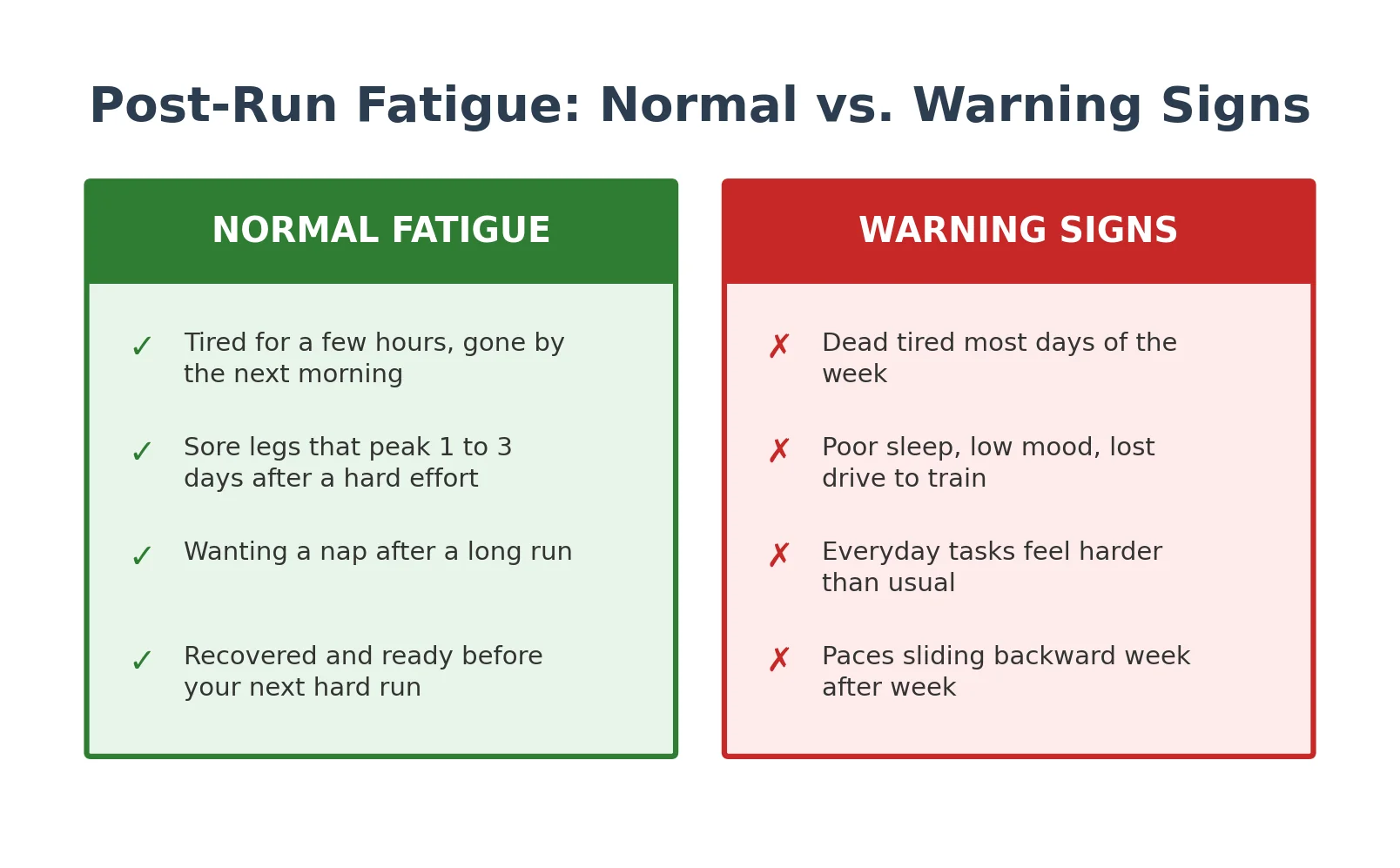
Easy runs clear the fastest, and any tiredness should lift within a few hours so you wake up ready to go.
After a hard workout or long run, soreness and heavy legs usually peak a day or two later before they fade.
A marathon sits at the far end, where the muscle damage from 26.2 miles keeps your legs compromised for the better part of a week.
A study of 64 marathon finishers found that muscle damage markers stayed elevated for up to 8 days after the race.
Use one practical marker: if you feel recovered and ready by the time your next hard session comes around, the fatigue was doing its job.
| Type of run | How long the fatigue should last |
|---|---|
| Easy run | A few hours, and fully recovered by the next morning |
| Hard workout or long run | Soreness peaks 24 to 72 hours, then fades |
| Marathon | Legs compromised for most of a week |
What are the warning signs you’re overdoing it?
The line between healthy fatigue and a problem shows up in how long the tiredness lasts and whether it spreads into the rest of your life.
Short-term tiredness after hard training that lifts with a few easy days is normal, and coaches call it functional overreaching.
A joint consensus statement from sports science and sports medicine bodies describes functional overreaching as a short-term dip in performance that turns into a fitness gain once you recover.
The trouble starts when the fatigue stops clearing.
Watch for these red flags that you have pushed past healthy fatigue:
- Constant exhaustion. You feel dead tired most days, and getting through your run is all you can manage.
- Fatigue that hits your daily life. Work and everyday chores feel harder than they should.
- Sleep and mood changes. You sleep poorly, feel irritable or low, and lose your usual drive to train.
- Performance sliding backward. Paces that used to feel steady now feel hard, week after week.
These are the same patterns behind the symptoms of overtraining, and catching them early keeps a few tired days from turning into a few lost weeks.
What should you do when post-run fatigue lingers?
When tiredness hangs on longer than it should, a few adjustments usually turn it around before it becomes a real setback.
Keep your easy runs slow and easy. This is the fix that helps most, and the mistake runners make most often.
Your easy pace should feel like a slow jog where you can hold a full conversation, slow enough that you finish without any real fatigue.
Analyses of elite endurance training show that roughly 80% of sessions are run at low intensity, which protects recovery for the hard days that move your fitness.
The full case for keeping your easy runs easy is worth reading if your recovery days have gotten too fast.
Take a rest or cross-training day. If you’re tired for a couple of days rather than weeks, a full day off or an easy swim or bike ride can restart your recovery.
Build in a down week. Every third week or so, cut your volume and drop a workout so your body can absorb the training you’ve already done.
Account for life stress. Work deadlines and short nights add to your fatigue, so ease off your running when life gets heavy.
Backing off for a few days when fatigue lingers keeps a tired stretch from turning into forced time off.
A short, deliberate step back protects the training you’ve already banked and gets you back to feeling normal within a few days.
Frequently Asked Questions
Is it normal to feel exhausted after a run?
Feeling tired after a hard workout or long run is normal and expected, because your muscles are repairing and your fuel stores are low. That kind of fatigue should ease over the next day or two. What is not normal is feeling exhausted all day after an easy run, or staying wiped out for days at a time, which usually means the effort was too hard or you need more recovery.
How long should you feel tired after a long run?
After a long run, expect heavy legs and some soreness that peak between 24 and 72 hours later, then fade. You may also want a nap the same afternoon, which is normal. If you still feel drained several days later, or the tiredness carries into your work and sleep, that points to too much training rather than ordinary recovery.
Why do I feel flat or foggy for hours after a hard workout?
The mental fog after a hard session comes largely from your brain, not your legs. During prolonged exercise your brain chemistry shifts in ways that trigger drowsiness and a drop in motivation, so you can feel dull even when your muscles are fine. Burning through your carbohydrate stores adds to it. Both usually clear once you eat, hydrate, and rest.
Is it bad to need a nap after running?
A nap after a long run is one of the best recovery tools you have, and it gives your body uninterrupted time to repair. Research on sleep and athletes links more sleep to faster recovery and better performance. The only caution is needing a nap every single day when that is not normal for you, which can signal you are carrying too much fatigue.
How do I know if I’m overtraining or just tired?
Ordinary tiredness lifts after a few easy days, and coaches call that functional overreaching. Overtraining looks different: all-day exhaustion, poor sleep, low mood, and paces that keep sliding backward week after week. If a rest day or a few easy days fix it, you were just tired. If the fatigue hangs on for a week or more and spreads into daily life, treat it as a warning sign.
Should you run every day if you feel tired?
You can run most days as long as your easy runs are truly easy and the tiredness clears between hard sessions. When fatigue lingers, taking a full rest day or an easy cross-training day often speeds recovery more than grinding out another run. Building a down week into your schedule every third week also helps your body absorb the training you have already done.
How should you feel after an easy run?
After an easy run you should feel refreshed and loose rather than drained. Your breathing should stay conversational the whole way, and you should finish feeling like you could keep going. A little leg tiredness in the hour afterward is fine, but if easy runs regularly leave you exhausted for the rest of the day, your easy pace is probably too fast.
References
Cheung, Karoline, Patria Hume, and Linda Maxwell. “Delayed Onset Muscle Soreness: Treatment Strategies and Performance Factors.” Sports Medicine, vol. 33, no. 2, 2003, pp. 145-164.
Martinez-Navarro, Ignacio, et al. “The Week After Running a Marathon: Effects of Running vs Elliptical Training vs Resting on Neuromuscular Performance and Muscle Damage Recovery.” European Journal of Sport Science, vol. 21, no. 12, 2021, pp. 1668-1674.
Mah, Cheri D., et al. “The Effects of Sleep Extension on the Athletic Performance of Collegiate Basketball Players.” Sleep, vol. 34, no. 7, 2011, pp. 943-950.
Meeusen, Romain, et al. “Central Fatigue: The Serotonin Hypothesis and Beyond.” Sports Medicine, vol. 36, no. 10, 2006, pp. 881-909.
Meeusen, Romain, et al. “Prevention, Diagnosis, and Treatment of the Overtraining Syndrome: Joint Consensus Statement of the European College of Sport Science and the American College of Sports Medicine.” Medicine and Science in Sports and Exercise, vol. 45, no. 1, 2013, pp. 186-205.
Seiler, Stephen. “What Is Best Practice for Training Intensity and Duration Distribution in Endurance Athletes?” International Journal of Sports Physiology and Performance, vol. 5, no. 3, 2010, pp. 276-291.