
When runners worry about their stride, they almost always mean its length: overstriding, heel striking, or a step rate that’s too slow.
The side-to-side spacing of your feet gets far less attention, even though a narrow stride width has been linked in the lab to higher strain on your IT band and higher stress on your shin bone.
If your feet cross the midline of your body on every step, you usually can’t feel it happening, so the only way to know is to check.
In this article, you’ll learn:
- What stride width is and how wide a normal step is when you walk and when you run
- How a narrow stride changes the strain on your IT band
- Why a crossover gait raises stress on your shin bone
- What step width does to your knee and hip
- Whether running with your feet wide apart makes you burn more energy
- A 2-minute footprint test to check your own stride width, and how to widen it
What Is Stride Width, and How Wide Is a Normal Step?
Stride width, which researchers call step width, is the side-to-side distance between your left and right feet at the moment each one lands.
Picture your footprints in wet sand. Step length is the distance from one print to the next in the direction you’re traveling, and step width is the gap between the line of left prints and the line of right prints.
When you walk, your feet land well apart. A 2001 study of walking found adults preferred a step width of 13% of their leg length, the same width that cost them the least energy.
For an adult with a 90 cm (35 in) leg, that works out to roughly 12 cm (4.6 in) between the feet.
Running pulls your feet much closer to the midline of your body.
Research has shown that running with your feet on a single line raised energy cost 3%, and a step width of 15% of leg length raised it 9%.

The runners in that study ran at 8:56/mi (5:33/km) and chose a width between those 2 extremes, and their chosen width was the cheapest of all the widths tested.
That means a narrow step is the normal way to run, and a narrow stride only becomes a problem when your feet land on or across the midline.
Your natural step width also shrinks as you speed up. A review of gait data from 166 college athletes found that the distance between each foot and the body’s center line got smaller at faster speeds, and at those faster speeds the men ran narrower than the women.
In the same athletes, the movements most tied to a narrow base were how far the thigh angled in toward the midline and how the foot was angled at landing, and both are potentially changeable with training.
Does a Narrow Stride Width Raise Your Risk of IT Band Syndrome?
Running with your feet closer to the midline stretches your IT band further than a normal-width step, and faster than a wide step, and that faster stretch is what showed up in runners who later developed IT band pain.
A 2012 step-width study had 15 healthy runners run at their normal step width, then narrower and wider by at least 5% of leg length. For a 90 cm (35 in) leg, that’s a change of about 4.5 cm (1.8 in).
IT band strain and the speed of that strain both rose in a straight line as the runners’ steps got narrower, and both were highest in the narrow condition.
That means a change in foot placement of just a few centimeters is enough to measurably raise the strain on your IT band.
The speed of that strain matters most. A prospective study of female runners compared the women who went on to develop IT band syndrome with runners who stayed healthy.
The injured group’s IT bands were strained faster during each step, and the injured leg was strained faster than the other leg.
A narrow stride stretches your IT band faster than a wide one, and a faster stretch was the measure that set apart runners who went on to develop IT band syndrome.
The same research group also followed a group of healthy female runners for 2 years. The 18 women who developed IT band syndrome had shown more hip adduction, the thigh angling in toward the midline, and more inward rotation at the knee before they got hurt.
A crossover stride produces that same inward thigh angle, which is why widening a narrow step is one of the few form changes aimed straight at IT band pain.
RunnersConnect Insider Bonus
Download our free Top 5 IT Band Prevention Exercises guide.
It’s a PDF with the 5 best exercises to help you prevent IT band syndrome.
Does a Crossover Stride Put More Stress on Your Shin Bone?
Landing with your feet on or across the midline bends your shin bone more on every step, and that bending load is linked to tibial stress injuries, including stress fractures.
A 2014 study had 15 runners run at their 5K pace at their normal step width, then 5% of leg length narrower and wider, and modeled the forces inside the lower third of the tibia.
As step width increased, compression on the back and inside surfaces of the shin bone decreased, tension on the front surface decreased, and shear stress fell at all 4 sites measured.
If you’ve had a tibial stress injury and your feet cross the midline, widening your step is a direct way to lower the bending load on the bone.
The narrow runs in that study were only 5% of leg length narrower than normal, and the stress on the shin bone rose steadily as the runners’ steps narrowed.
How Does Step Width Change Your Knees and Hips?
Step width changes the angles at your hip and knee as well, so a narrow stride loads more than your IT band and shin.
A study of 30 runners, half of them men, found that switching from a narrow to a wide step reduced how far the thigh angled inward and how far the heel rolled inward.
The wider steps also lowered the peak force pushing the knee inward and the total amount of that force over each step.
A 2024 review of 23 studies and 399 people concluded that a wider step may help people rehabilitating from kneecap pain, IT band syndrome, or a shin bone stress injury.
A narrow stride often starts at the hip. When the hip muscles on your standing leg can’t hold your pelvis level, the opposite side drops, and our guide to hip drop and running injuries explains how to test and strengthen it.
Is a Wider Stride Always Better for Runners?
A wider stride lowers the load on your IT band and shin, but running with your feet far apart burns more energy, so the goal is to land your feet just either side of the midline.
Once you move past your natural width, you burn extra energy quickly. In the running study from the first section, a step width of 20% of leg length raised the energy cost of running 12%, and 25% raised it 15%.
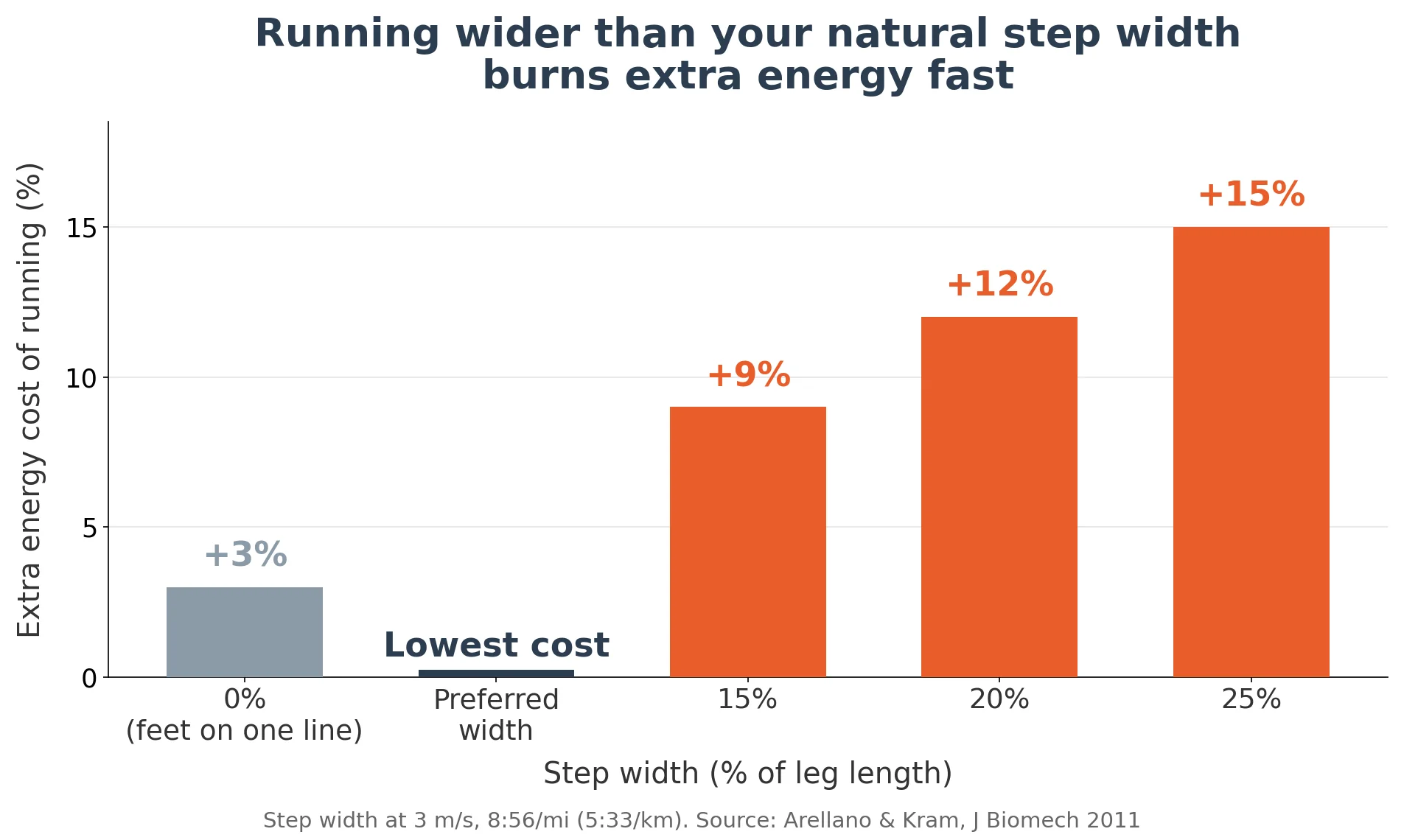
That means moving from a crossover stride back to a normal width takes little extra energy, while going well past your natural width takes a lot.
Widen your stride only enough to stop your feet crossing the midline, because steps of 15% to 25% of leg length raised the energy cost of running 9% to 15%.
Steps far wider than normal also make it harder to stay balanced. The same study found step-to-step variation in width rose 33% at 15% of leg length and 69% at 25%, a sign the runners were working harder to control their side-to-side balance.
How Can You Check Your Stride Width at Home?
You can check your own stride width in about 2 minutes with a flat stretch of pavement, a bucket of water, and a phone.
- Wet the ground. Splash water across a dry, flat section of pavement or run through a shallow puddle. Fresh snow or damp sand also works.
- Run through it at your easy pace. Keep going for 10 to 15 steps past the wet patch so you leave a clean trail of prints.
- Look at the line of prints. Draw an imaginary center line down the middle of the trail.
- Film yourself from behind. On a treadmill or a quiet road, have someone record you from directly behind for 20 seconds at your normal pace, and play it back in slow motion.
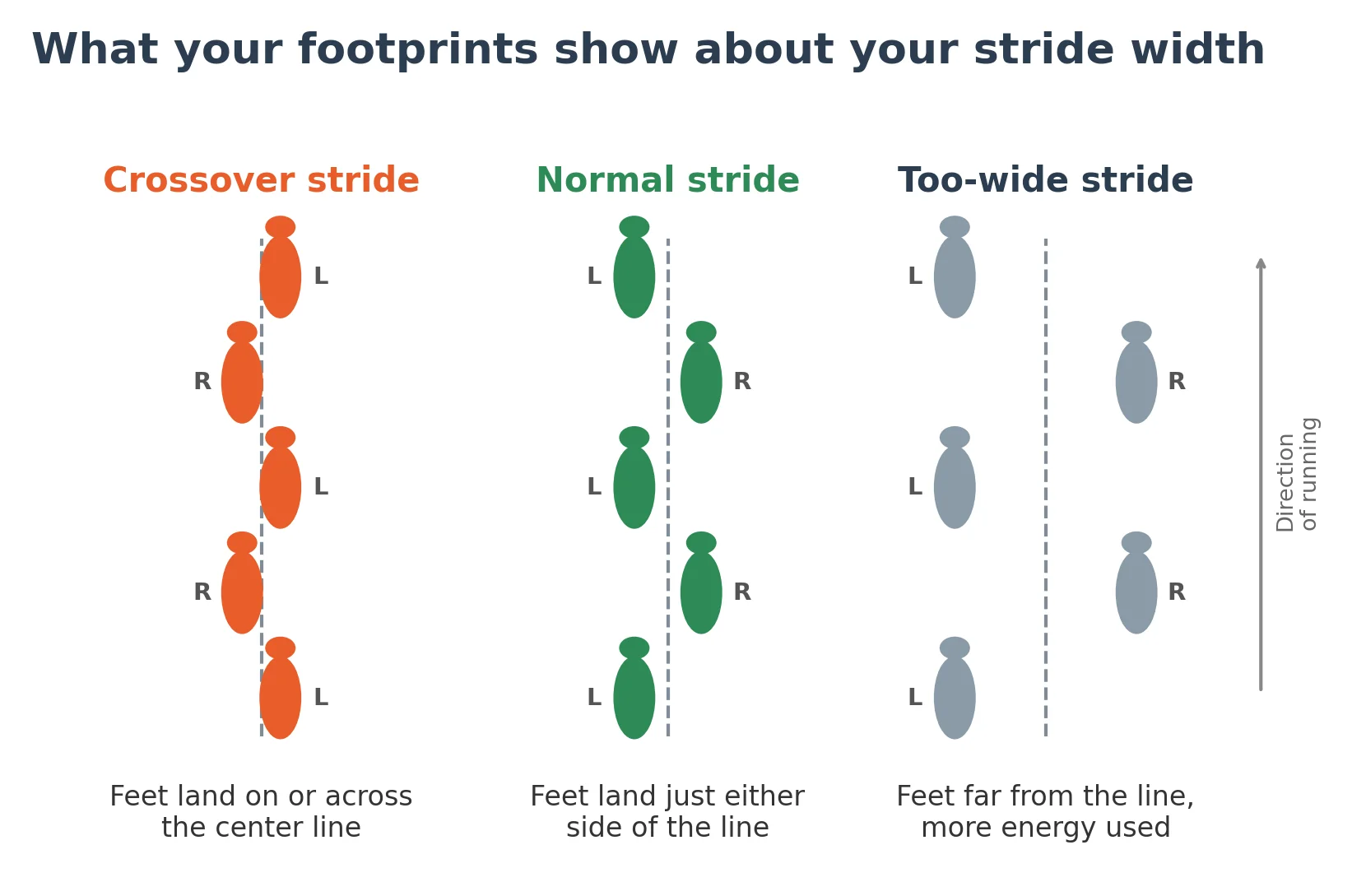
If your left and right prints land just either side of the imaginary center line from step 3, your stride width is normal for running.
If your prints sit on the line or cross over it, so that your left foot lands to the right of your right footprints, you have a crossover stride.
In the video, the same pattern shows up as each foot landing under or past the opposite hip, with the knees brushing close together as the legs swing past each other.
Repeat the test near the end of a long run as well as at the start, so you see your stride width when your legs are tired.
How Do You Widen a Narrow Stride Safely?
You can widen a crossover stride with a simple visual cue and a short block of practice on your easy runs.
The closest evidence for retraining foot placement comes from a mirror study that targeted thigh alignment in runners with kneecap pain. A 2012 mirror retraining study had 10 female runners watch themselves in a full-length mirror on a treadmill and correct their hip and knee alignment over 8 sessions in 2 weeks.
The runners cut how far their thigh angled inward by an average of 5.9 degrees and kept most of that reduction, and their pain and function scores improved and held 3 months later.
Most of the changes stayed in place without any further feedback, and 6 of the 10 runners were running more at the 3-month check because their knee pain had eased.
Short blocks of treadmill running with mirror feedback changed the runners’ hip mechanics and eased their knee pain through a 3-month follow-up.
Here’s how to apply the same approach to your stride width:
- Pick a line and run either side of it. On a track, a road marking, or a treadmill with a strip of tape down the middle, aim to land your left foot left of the line and your right foot right of it.
- Aim for a small change. The lab studies changed step width by at least 5% of leg length, roughly 4 to 5 cm (1.5 to 2 in). Your feet should still land close to the line.
- Build the time gradually. Start with 5 minutes inside an easy run and add time each session, since the mirror study built treadmill time from 15 to 30 minutes over 8 sessions in 2 weeks.
- Use a mirror or video. Watch your feet and knees in real time on a treadmill so you can see where each foot lands.
- Remove the cue. Once the new width feels automatic, run without the line and recheck your footprints every few weeks.
If your crossover comes with IT band pain on the outside of your knee, our guide to correcting a crossover gait for IT band syndrome walks through the drills and strength work that go with it.
Here’s a summary of what the research shows about stride width:
| Question | What the research shows | What to do |
|---|---|---|
| How wide is a normal step? | Walking: about 13% of leg length. Running: much narrower, close to the midline | Expect your running footprints to land just either side of a center line |
| Does a narrow stride strain the IT band? | IT band strain and strain speed rose steadily as step width narrowed | Widen a crossover stride if you’ve had IT band pain |
| Does a narrow stride load the shin? | Compression, tension, and shear stress on the tibia all fell as step width increased | Widen your step after a tibial stress injury |
| What happens at the knee and hip? | Wider steps reduced inward thigh angle, heel roll, and the force pushing the knee inward | Strengthen your hips if your pelvis drops on each step |
| Is wider always better? | 15% to 25% of leg length raised energy cost 9% to 15% | Stop crossing the midline, and stop there |
| Can you change it? | 8 mirror sessions over 2 weeks cut inward thigh angle 5.9 degrees, with less pain at 3 months | Practice with a line or mirror in short blocks |