

The taper is only the last 3 weeks of a typical 18-week marathon training plan.
Yet mistakes during these final 3 weeks can undo months of consistent training.
A 2021 analysis of 158,000+ recreational marathoners found that a properly executed 3-week taper improved finish times by an average of 5 minutes and 32 seconds.
Most runners leave that time on the table because they get the taper wrong in predictable ways.
The 3 mistakes below aren’t the obvious ones you’ve already read about, and they’re responsible for more blown races than most runners realize.
So, in this article you’re going to learn the research-backed practical advice on…
- Whether a 2-week or 3-week taper works better, and the mid-taper mileage bump that costs most runners time
- Why cutting too much volume too fast leaves you flat on race day, and how much to actually reduce each week
- Which workouts to run in the final 2 weeks and which ones sabotage your taper
- How to fuel properly without obsessing over the scale, including the specific carb-loading protocol that maximizes glycogen stores
- Why phantom pains and taper anxiety happen to almost every marathoner, and what to do about them
Is a 2-Week or 3-Week Taper Better for a Marathon?
A 3-week taper gives you the biggest race-day benefit, as long as your mileage comes down in every one of those 3 weeks.
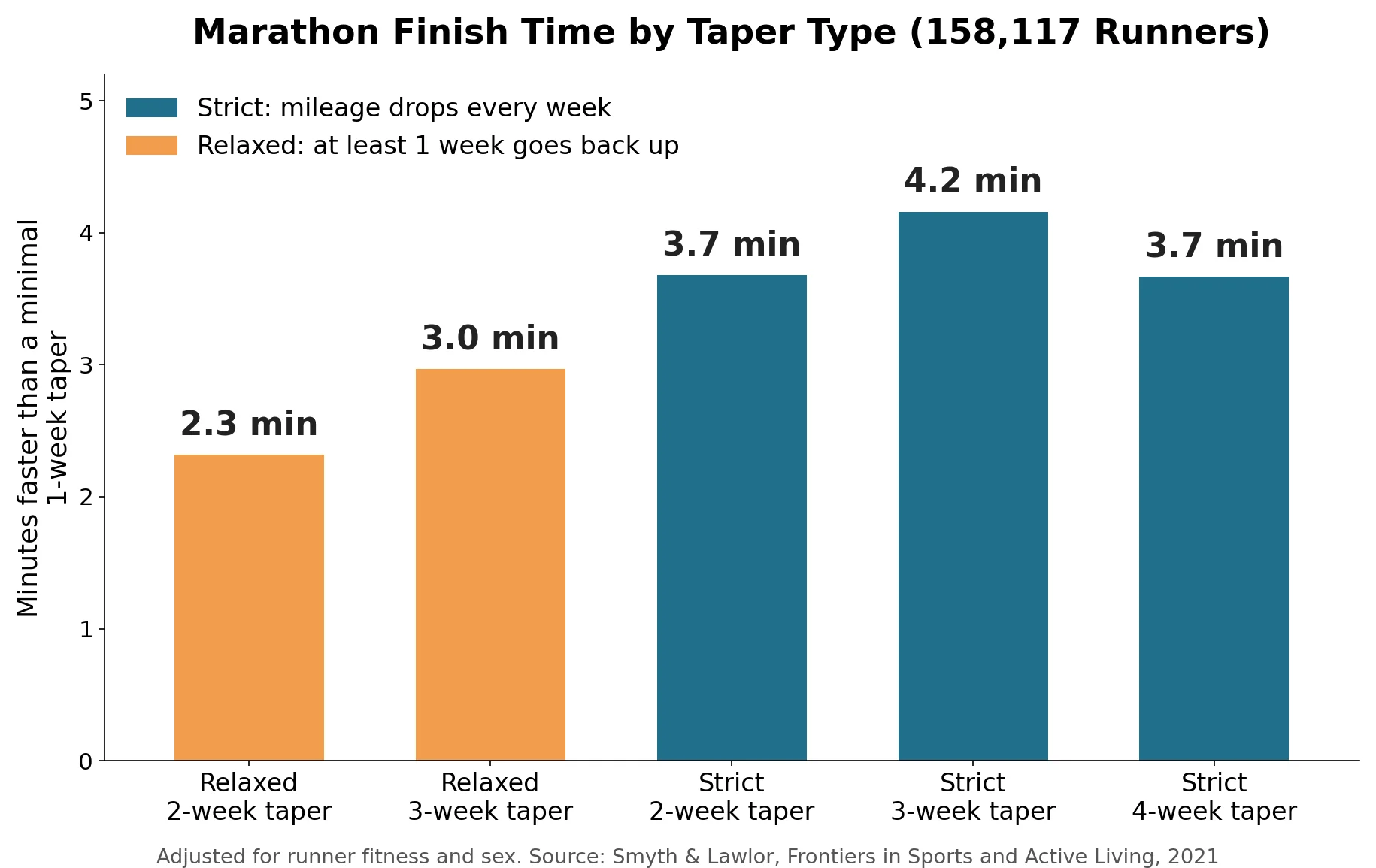
The 158,000-runner analysis in the intro sorted every taper by how long it lasted and by how steadily the mileage came down.
In a strict taper, your weekly mileage drops every week until race day and never goes back up.
A relaxed taper has at least one week where the mileage goes back up before it drops again.
Once the researchers accounted for each runner’s fitness and sex, a strict 3-week taper was linked to finishing 4.2 minutes faster than a minimal 1-week taper.
A strict 2-week taper was linked to finishing 3.7 minutes faster.
That means a 2-week taper still gets you most of the benefit, so a plan with only 2 weeks of taper still sets you up well.
A strict 2-week taper beat a relaxed 3-week taper by about 40 seconds, so cutting your mileage steadily matters more than starting your taper early.
The relaxed tapers finished well behind, at 3.0 minutes faster for a relaxed 3-week taper and 2.3 minutes faster for a relaxed 2-week taper.
And 64% of the runners in the analysis used one of those relaxed 2-week or 3-week tapers.
That means most of these runners lost time to a single up week, such as a late 20-mile (32 km) long run that pushes week 2 of the taper above week 1.
Can You Taper Too Much for a Marathon?
You can taper for too long.
A strict 4-week taper was linked to finishing 3.7 minutes faster, the same as a strict 2-week taper and about 30 seconds slower than a strict 3-week taper.
The researchers’ explanation is that a taper has to be long enough to clear the fatigue from your peak weeks, but a taper longer than 3 weeks starts to lose some of the fitness you built.
You can also taper too deep, and that’s the first of the 3 mistakes below.
Mistake 1: Cutting Mileage Too Aggressively
The single most common marathon taper mistake is reducing training volume too aggressively in the first week.
Runners assume more rest equals more freshness, so they slash mileage by 40-50% right away, skip workouts, and essentially stop training.
The result is showing up on race day feeling flat, sluggish, and heavy.
A 2023 systematic review found that the optimal total volume reduction during a taper is 41-60% across the entire taper period, applied progressively rather than all at once.

That means week 1 should only be a 10-15% reduction, not a 40% nosedive.
If your peak mileage was 60 miles (97 km) per week, your first taper week should land around 48-54 miles (77-87 km).
That’s still a real training week, and your body will notice the reduced load without crashing.
An abrupt drop in training also affects your immune system.
Research on elite cyclists found that a 3-week taper significantly reduced pro-inflammatory markers like IL-6 and TNF-α.
A 1-week taper didn’t produce the same drop.
Why don’t you feel better right away?
One reason runners over-taper is that they expect to feel amazing after a couple of easy days.
When the legs still feel heavy on day 3 of the taper, they panic and cut even more.
The fatigue from your peak weeks clears gradually across the whole taper, which is why the longer strict tapers above were linked to faster finishes than the 1-week tapers.
So if your last hard long run was last weekend, heavy legs this week are expected.
Heavy legs in the first week of your taper are normal, because the fatigue from your peak weeks takes the full taper to clear.
What’s the right workout 3 weeks out?
Your hardest sessions are behind you, but stepping off the gas completely this early is a mistake.
Schedule 1 quality workout this week, especially if the last hard long run fell the previous weekend and recovery is the priority.
8-mile (13 km) tempo: first 4 miles at marathon pace, final 4 miles at half marathon effort.
Marathon pace should feel comfortable at this point in your fitness.
The faster finish gives you a chance to run with some pop and walk away from the session feeling confident.
Mistake 2: Running the Wrong Workouts
With 2 weeks to go, runners get antsy and throw in short, speed-oriented workouts to feel sharp: 400m repeats, mile intervals at 5k pace, Yasso 800s as a “race predictor.”
These sessions feel productive, but they’re working against you.
The same 2023 review found that the tapers that improved performance kept training intensity and frequency the same while the volume came down.
For a marathoner, keeping the intensity means running marathon pace through half marathon pace, the efforts this training block was built on.
Your VO2max intervals and speed sessions were back in the earlier phases of training, 4-6 weeks ago.
Jumping back to that stimulus now is like doing a set of heavy squats when you haven’t touched the weight room in over a month.
Your muscles aren’t conditioned to that type of work anymore, so you’ll create more soreness and micro-damage instead of sharpness.
The second problem is pacing.
One of the most critical factors in marathon success is executing your race plan, especially in the first 10k when adrenaline is screaming at you to go faster.
Every marathon-pace rep you run in these final weeks builds the muscle memory and confidence you need to hold back early and finish strong.
Speed work at 5k pace does nothing for that skill.
What are the best taper workouts 2 weeks out?
Keep your workouts marathon-specific with 2 quality sessions this week.
Workout 1 (about 10 days out): 6-8 mile (10-13 km) straight tempo at marathon pace.
The length depends on your normal weekly training volume.
Placing this 10 days from race day gives you full recovery time, and marathon pace should feel moderate at this stage of your fitness.
Workout 2 (about 7 days out): 2 x 3 miles (5 km) at marathon pace with 3-minute rest.
The rest interval keeps the effort easy while still locking in goal pace.
You walk away having run 6 miles at race pace without accumulating real fatigue.
Both sessions accomplish 2 things: they keep the right energy systems engaged, and they give you precise pacing feedback you’ll rely on during the race.
For a deeper look at how to structure your taper correctly, the full guide covers the week-by-week breakdown.
Mistake 3: Fear of Weight Gain Limits Glycogen Stores
The taper mistake that costs runners the most time on race day is under-fueling because of the fear of gaining weight.
Research on marathon nutrition recommends 10-12 g of carbohydrate per kg of body weight (4.5-5.5 g per lb) per day for the 36-48 hours before the race, which lets you hold your goal pace for longer before you fatigue.
For a 70 kg (154 lb) runner, that’s 700-840 g of carbs per day during those final 2 days.
Most runners don’t come close because they’re watching the scale.
When more food goes in and less training burns it off, the scale goes up, so most runners hold back on carbs and start the race with less glycogen than the 36-48 hour protocol would give them.
How much weight gain is normal during the taper?
Research on glycogen storage has established that each gram of glycogen binds to 3-4 grams of water.
Fully loaded muscles and liver in a 70 kg (154 lb) runner hold roughly 500 g of glycogen plus 1.5-2 kg (3-4 lbs) of water.
The 3-4 lbs (1.5-2 kg) you gain during race week is water bound to glycogen, not body fat, and it drops off within hours of finishing the marathon.
Full glycogen stores matter far more than feeling light on race morning.
What’s the best way to carb load without feeling stuffed?
Change how you eat rather than how much.
Instead of packing 3 massive meals, graze throughout the day on quality carb sources: oatmeal, sweet potatoes, rice, whole grain bread, bananas.
Keep individual meals under 600-700 calories, especially in the final 2 days before the race.
Eating smaller amounts more often makes 700-840 g of carbohydrate easier to get down, and you won’t feel bloated heading into race morning.
RunnersConnect Bonus
Download your FREE Marathon Nutrition During Your Taper Guide.
The guide contains a plan of exactly what you should be eating in the 5 days to 3 hours before your race. We give specific food recommendations to make sure you are ready on race day.
Bonus: How Do You Handle Taper Anxiety and Phantom Pains?
Almost every marathon runner experiences a strange phenomenon during the taper: aches and pains that appear out of nowhere.
A knee that never bothered you during 50-mile weeks suddenly twinges on a 4-mile easy run.
Your shin feels tight. Your hip flexor catches.
They’re a stress response, not an injury signal.
During heavy training, your body suppresses minor discomfort because it has bigger demands to manage.
When training volume drops, your nervous system recalibrates and suddenly notices sensations it was filtering out.
The same recalibration affects mood: irritability, restlessness, and trouble sleeping are common enough that runners call it “taper madness.”
The danger is overreacting by adding extra runs, skipping workouts over a phantom pain, or changing your gait to compensate for an ache that isn’t really there.
The plan you built over 15-18 weeks of training is what gets you to the start line ready.
For more detail on why this happens and how to manage it, the full guide on taper anxiety and phantom pains covers the psychological side in depth.
| Taper Week | Volume Reduction | Key Workout | Common Mistake |
|---|---|---|---|
| 3 weeks out | 10-15% of peak | 8-mile tempo (4 MP + 4 HMP) | Cutting volume 40-50% too early |
| 2 weeks out | 25-35% of peak | 6-8 mi MP tempo + 2×3 mi MP | Switching to speed work (Yasso 800s, 5k pace) |
| Race week | 50-60% of peak | Short shakeout runs + strides | Under-fueling to avoid weight gain |




11 Responses
Very timely post, I’m in week two of my taper, 10 days out from my marathon, and had 3X1600 on my schedule. I tweaked my Achilles a few days ago and while it seems fine, I didn’t want to push things, and having done this workout a year ago, I knew I’d find myself comparing times. So I switched to 8 miles at MP, ended up being one of the best taper runs I’ve ever done, even did the last 4 at HMP (accidentally – was running by feel) and felt like I had a ton left in the tank. Great confidence booster, now I feel like I can really ease up the rest of the taper and keep things mostly easy with some strides.
That darn achilles is a bugger 🙂 Glad you had a great workout though, that 8 mile tempo has always been a big confidence booster and glad it worked for you unintentionally.
Currently doing half marys, “A” race is 11/10. Maybe it’s because I’m a “Masters” age-grouper, but I have found I need a little longer than a week to taper, closer to 10 days, for my legs/energy to feel “refreshed”. (I start taper Th, race not next Sat but one following).
Any tips or suggestions on adapting the above to my situation? Thanks!
Love the newsletter and website – so useful.
Thanks for the compliments, MJ! One thing is that this is a marathon taper schedule, so the HM will look a little different. I’ve also found the same with Masters runners I coach – the taper needs to start a bit earlier. Usually, it’s not the mileage that needs to come down (another 3 tapering mistakes article here, just not marathon specific ) it’s the intensity. Here’s what a non marathon taper typically looks like for a pretty experienced Masters runner (meaning, you don’t have to copy the exact workouts, but helps give you an idea):
Monday Easy miles
Tuesday 2 mile w/u, 5 x 1.5 miles at HM pace w/2min “jog” (30 seconds slower than MP) rest, 2 mile c/d – last hard effort, HM specific
Wednesday Off – rest day
Thursday Easy miles
Friday 3 mile w/u, 4 miles at 10 faster than MP, 2 mile c/d – pretty moderate effort, really not hard. Typical workouts in 6-8 mile range
Saturday 12 mile long run – all easy pace – normal long run 16-18
Sunday Easy miles
Total
Monday Easy miles
Tuesday 3 mile w/u, 2 x 1 mile @ 3k-5k pace pace w/4min rest, 2 x 400 at mile pace w/3min rest, 2 mile c/d – my favorite pre race workout for anything other than marathon
Wednesday Off – rest day
Thursday 8 miles easy – no strides
Friday 6 miles easy w/4 x 20 sec strides + core
Saturday 3 miles easy w/4 x 20 sec strides
Sunday Half Marathon
Hope that helps
This is REALLY helpful, thank you so much!! I will adjust for the race being on Saturday (and dial it back just a bit ) I think I will do better having an actual PLAN for the taper, with rationale behind it. Tapering makes me twitchy enough, and the sort of random ad hoc approach i’ve used in the past probably doesn’t serve me well.
I have been using the HM plan you pointed me to (on active.com) for the last 2 weeks. I am adapting a bit it since it’s a 6 week straight through plan, and I do 2wks on/1wk cutback cycles which work better for me than straight through or the regular 3on/1off cycles in most plans – in the same way as 10 day taper works better for me than 7. I think I started with some of the wk 2/3 workouts in the beginner plan. Last wk was tough, this wk was tough but I felt better, esp after long run yday.
You are just awesome to be so helpful, I really appreciate it!! I have to tell you I’m checking the site every day now to see what’s new, and think the work you all are doing is consistently high quality – useful, straight shooting, no fluff – which isn’t easy to maintain. Your responsiveness to comments, tweets and questions is impressive. Great job!
Thanks for the high praise, MJ! I am glad the sample schedule helped. You’re right, the taper is hard enough without being unsure of what you’re doing. Keep me updated on how the race goes for you!
I made a terrible tapering mistake earlier this year. I followed a generic training plan for 16 weeks – my first – getting up to 60 miles per week. When the taper began I felt like I was slacking. The plan was calling for “wimpy” runs. Two weeks out I decided to run the short 4 mile run at a pace faster than any of my previous runs. The final week had a 4×400 scheduled for Monday but without telling me the pace. I decided to go max effort. I was quite pleased with my pace but the next day I had to bale on a 2 mile easy run. The fast pace had seriously inflamed my bursa sac (i.e., Hip bursitis) five days before the marathon – stupid, stupid, stupid!
Hi Coach Jeff,
Enjoyed your article…
Question: Your sub-3:30 program on the Runkeeper app has a 2×2.5mi run two weeks before the race (i’m doing Chicago). However, in your article above you talk about a 2×3 workout and a straight 6-8mp run. I’m not seeing the latter in your Runkeeper program.
Should I just stick to what’s in the Runkeeper program for this week’s midweek runs (7mi+, 6mi, 2×2.5)? Or should I substitute the 6-8 mile run for one of these runs and increase the 2×2.5 to 2×3?
Thanks
Mike
Hello Coach Jeff. I’m freaking out here. I’m running the full rock and roll marathon in 11 days from today. I got very sick with a chest pain and bronchitis about 8 weeks ago. I did have to complete stop my training for almost 5 weeks. Now I’m back but, I had train only to mile 15 until today. I was thinking to do my last long run of at least 20 miles on Saturday before the marathon. That’s only exactly one week before the marathon. Do you think I should do that? Or I should stay with the 15 miles that I just did today? Going to the full marathon with only 15 miles my longer run, it scare me to death. I don’t know what to do. I need your help please. Thanks
Hi Trisha, if your body required that much time off, I would not recommend running the 20 miler the week before the race. We actually think a lot of people place too much emphasis on that 20 miler, and this may help you feel better https://runnersconnect.net/coach-corner/are-you-putting-too-much-emphasis-on-the-long-run-as-part-of-your-marathon-training/ I would recommend a 16-18 mile run, but make sure to keep it easy as you do not want to run your race that day. The biggest thing now is that you need to adjust your expectations, as your body was in such a bad state (and well done for listening and resting), you are going to have to start conservative, or you might not make it to the finish. Best of luck, listen to your body, and just focus on enjoying the race.
Hi coach Jeff…i am a masters runner attempting my first full in aboutv18 days from now…i found this post very helpful but am unsure as to whether it is applicable to masters runners..i hv been struggling with multiple lower leg issues esp at the lag end of training…i ran my longest run a few days ago and wd really appreciate any inputs regarding runs 2 weeks out from race day..also what kind of workouts do you recommend on non run days…shd strength training be continued….thanks