
It was my first conference championship in cross country, arguably the most important team event in college running, and I was a nervous wreck.
The night before the race I tossed and turned in my bed, fretting about my fitness, and hoping that I had a good day ahead of me.
All told, I got maybe an hour of sleep that night.
On the morning shakeout run, I sheepishly told my coach, and he responded: “Don’t worry about bad sleep the night before a race. What matters is your sleep two nights before the race.”
Then he told me how he qualified for the Olympics as a college junior, running a personal best in both the preliminary and final round of the steeplechase, all without sleeping a wink the night before.
That convinced me, and I ran great that day.
The research since then partly backs his advice, because extra sleep across the nights before a race helped endurance, while a full night with no sleep at all slowed endurance performance by up to 10% in lab trials.
So, in this article you’re going to learn the research-backed practical advice on:
- Why a night of 3 hours’ sleep slowed runners’ 10K times by 5%, and how caffeine erased the loss
- The sleepless riders who guessed they’d cover a full kilometer less than they rode
- How 3 nights of extra sleep left endurance athletes almost 2 minutes faster in an hour-long time trial
- What to do when you’re still awake at midnight before the race
Will a Bad Night’s Sleep Before a Race Hurt Your Performance?
A restless night before a morning race slows you down far less than it feels like it will.
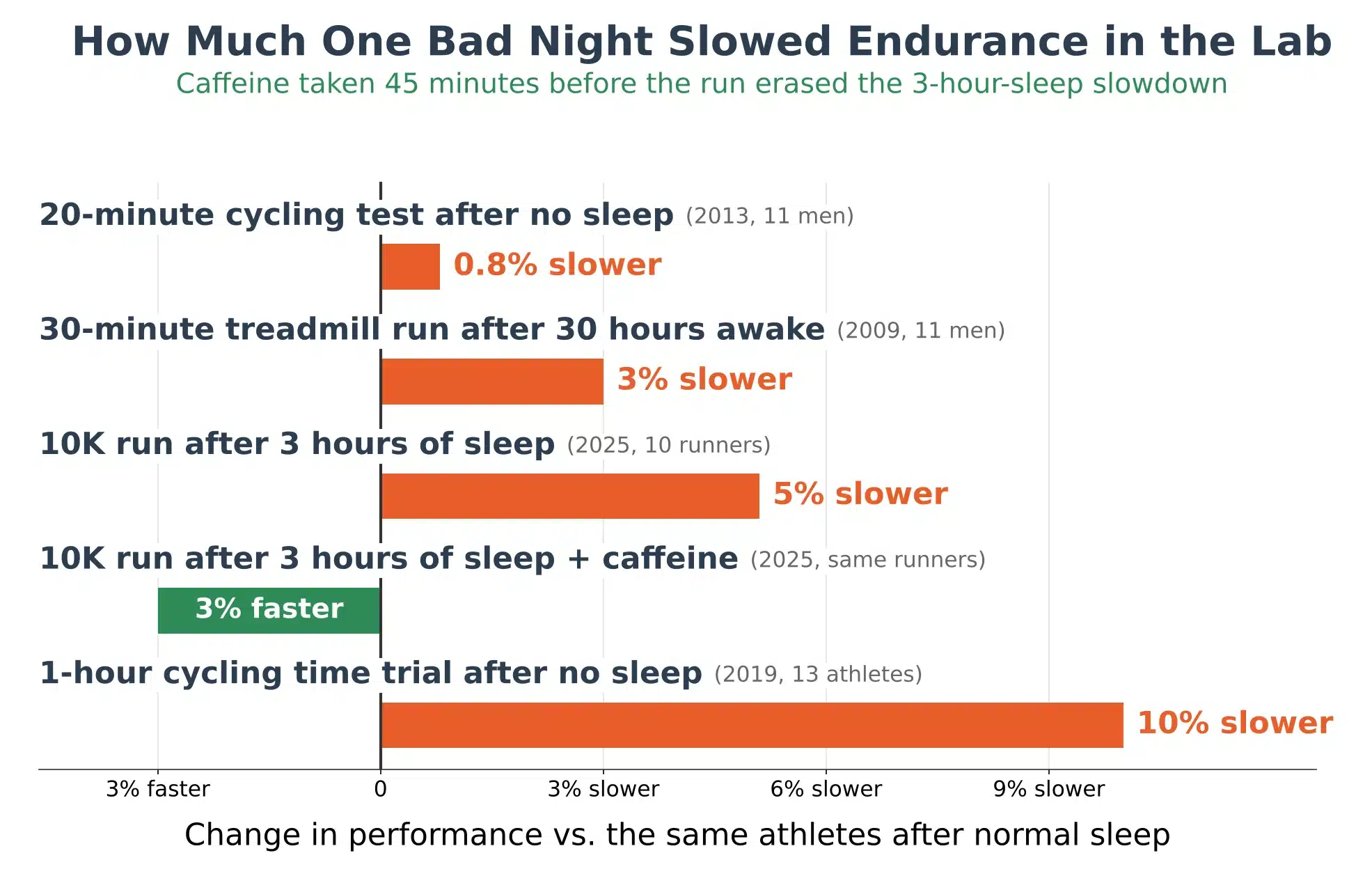
A 2013 study had 11 fit men ride an all-out 20-minute cycling test after a normal night and again after a night with no sleep at all.
After normal sleep, they rode 7.68 kilometers. The same men covered 7.62 kilometers after no sleep.
That means a full night without sleep changed their distance by less than 1%.
Other trials found a drop of 3% or more. In a 2009 trial, 11 men stayed awake for 30 hours and then ran a 30-minute easy pre-load followed by a 30-minute self-paced treadmill test.
They covered 6,037 meters, compared with 6,224 meters after a normal night’s sleep, which is about 3% less distance.
Research has shown that sleep loss cut exercise performance by an average of 7.6%, but efforts done in the morning were largely unaffected.
That 2022 review pooled 69 studies and found that after a sleepless night or an early wake-up, performance dropped about 0.4% for every extra hour you had been awake before the effort.
That means a race that starts a few hours after you wake up falls in the window where, on average across the review, a short night did less damage.
Can You Run on 2, 3 or 4 Hours of Sleep?
You can run on about 3 hours of sleep, the amount tested in runners, and expect a slowdown of about 5% over 10K.
A 2025 trial gave 10 recreational male runners either a 3-hour or an 8-hour sleep window, then had them run a 10K treadmill time trial the next morning.
After 8 hours of sleep, they ran the 10K in 49.4 minutes. With only 3 hours of sleep, their time rose to 51.9 minutes, about 5% slower.
A night with no sleep at all hurt more. Researchers who tested 13 endurance athletes found their time trial took 64 minutes after a sleepless night, compared with 59 minutes after normal sleep, on the day after an earlier time trial.
That 10% slowdown came from a night with zero sleep, the most extreme version of a bad night before a race.
Why Does Running Feel So Much Harder on No Sleep?
In these trials, sleep loss changed how far athletes expected to go and how hard a pace felt, while heart rate and breathing barely moved.
In that 2013 cycling study, the riders guessed how far they would ride before each test.
After a normal night, they guessed 7.26 kilometers. Following the sleepless night, their guess fell to 6.51 kilometers, and then they rode 7.62 kilometers.
That means the sleepless riders underestimated their own distance by more than a full kilometer in a 20-minute effort.
In the 2009 treadmill trial, the sleep-deprived runners rated their effort the same as after normal sleep, 14.9 versus 14.8, while covering less ground.
Heart rate, breathing and core temperature barely changed, so the researchers said an altered sense of effort may explain the 3% shorter distance.
After a sleepless night, riders in one study expected to cover over a kilometer less than they did, so start at the pace you trained for and check your splits.
Why Can’t You Sleep the Night Before a Race?
Poor sleep before a big race is common, even among elite athletes.
That survey of 283 Australian athletes found 82% of the poor sleepers struggled to fall asleep, and 84% blamed thoughts about the competition.
The same survey found the poor sleep was tied to competitions rather than a sign of an everyday sleep problem.
That means a sleepless night before your race is a normal reaction to nerves about the result.
Does Sleep 2 Nights Before a Race Matter More?
No study has compared sleep 2 nights out with sleep on the final night, but 3 to 6 nights of extra sleep improved a cycling time trial and a leg-extension endurance test in 2 trials.
In a 2019 trial, 9 cyclists and triathletes spent 30% more time in bed than usual for 3 nights, which gave them about 1.5 hours of extra sleep a night.
On the 4th straight day of time trials, they finished in 56.8 minutes, compared with 58.7 minutes with their normal sleep.
That means banking sleep for 3 nights left them almost 2 minutes faster over an hour of hard effort.
Banked sleep still helped after a night with no sleep. Another trial had 12 men spend 9.8 hours in bed for 6 nights, compared with their usual 8.2 hours, before a full night with no sleep.
After the sleepless night, the men who had banked sleep held a leg-extension effort 8.1% longer than when they had slept their usual amount before the same sleepless night.
Go to bed about an hour earlier for the 3 to 6 nights before your race, so you still have more endurance after a bad final night than you would after your usual sleep.
How Can You Fall Asleep the Night Before a Race?
Most of what helps on race eve lowers the mental load at bedtime, since thoughts about the race were the top cause of poor pre-race sleep in that survey of elite athletes.
- Finish your race prep by early evening. Lay out your kit, pin your bib, pack your fuel and set your alarm before dinner, so nothing is left to remember once you’re in bed.
- Eat your pre-race dinner early. I tell my athletes to finish dinner early in the evening, because a full stomach at bedtime is one more thing keeping you awake.
- Keep your normal bedtime. In my experience, going to bed 2 hours early to get ahead on sleep turns into 2 more hours of lying awake, so go to bed when you feel tired.
- Control the room. Pack earplugs and an eye mask for a hotel, and bring your own pillow if it helps you settle.
- Get up if you can’t sleep. If you’ve been lying awake for a while, get out of bed and read somewhere dim until you feel sleepy, then go back to bed.
Leaving the bed when you can’t sleep is called stimulus control, and the American Academy of Sleep Medicine’s guideline suggests it as a treatment for adults with chronic insomnia.
RunnersConnect Bonus
Download our free Pre-Race Bedroom Air Quality Checklist — an 8-point checklist covering PM2.5, CO2, temperature, humidity, and combustion sources so you can optimize your sleep environment the night before your next race.
What Should You Do on Race Morning After a Bad Night?
Caffeine erased the loss from a short night in the one trial that tested it in runners.
In the 2025 10K trial, the runners who slept 3 hours and took caffeine 45 minutes before the run finished in 47.9 minutes.
That was as fast as their runs after a full night’s sleep, and 4 minutes faster than the same short night with a placebo.
The runners took 6 milligrams of caffeine per kilogram of body weight, about 420 milligrams for a 70-kilogram (154-pound) runner, which is a high dose, so start lower and test any race-day caffeine before running on a long run first.
The 2022 review also found that cutting sleep short by waking early hurt performance consistently, while falling asleep late did not.
A nervous night where you fall asleep at 1 a.m. is the pattern of sleep loss that hurt performance least, so set your alarm for the latest time that still gets you to the start calmly.
Start at your planned pace and judge the first miles by your splits.
If the bad night falls before a workout instead of a race, use these rules for adjusting your run after a bad night of sleep.
RunnersConnect Bonus
Download your FREE Race Day Checklist now.
Make sure that you don’t forget a single detail on race day!
How Much Does Each Type of Bad Night Slow You Down?
Here’s a quick summary of what the research found for each type of bad night and what to do about it.
| Your night before the race | What the research found | What to do |
|---|---|---|
| Restless night, fell asleep late | Falling asleep late caused no consistent drop, and morning efforts held up better than afternoon efforts | Race your normal plan |
| About 3 hours of sleep | 10K about 5% slower | Caffeine 45 minutes before the start, tested in training |
| No sleep at all | Less than 1% to 10% slower across trials | An even start and pacing by your splits |
| Extra sleep for 3 to 6 nights before | Time trial almost 2 minutes faster, and longer endurance even after a sleepless night | Go to bed an hour earlier during race week |