

 Finishing a race a few seconds faster usually comes down to the speed and efficiency you built in training, not a last-second lunge for the line.
Strides are one of the simplest ways to build that speed, and this guide covers how to run them after easy runs and why they make you faster. To add them to your warm-up instead, read how to warm-up.
What are Strides?
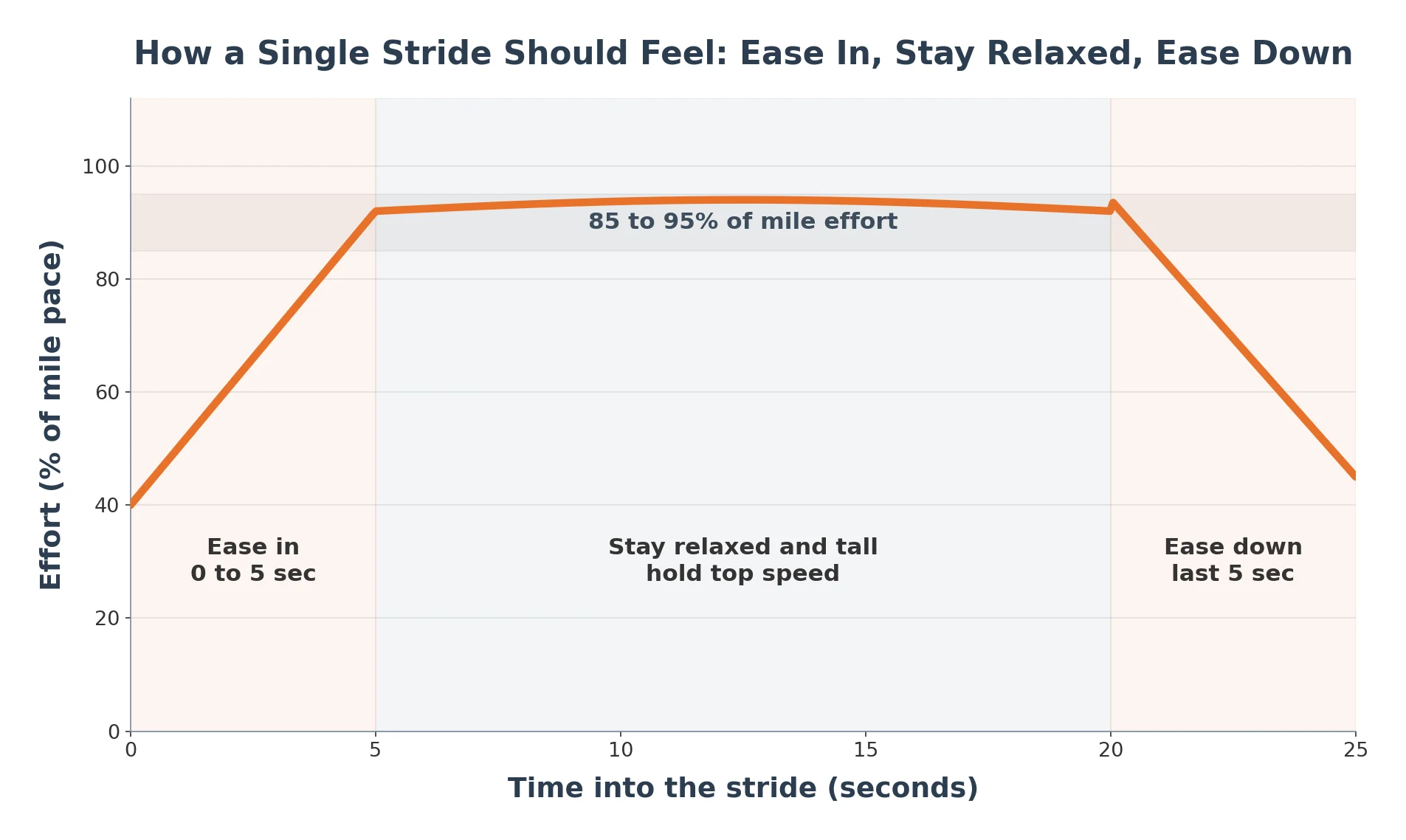
Strides are 20 to 35 second sprints at your mile race pace, or roughly 85 to 95% effort. Typically, they are assigned to a running schedule after an easy recovery run or before a big workout or race.
Strides are also used as part of the warm-up process to help get the blood flowing to your legs and your heart rate elevated.
RunnersConnect Bonus
Download your FREE Long Run and Aerobic Pacing Calculator now.
Need help converting your race times to your optimal easy and long run pace? Download our FREE calculator and we’ll do the math for you.
How to do Strides
Step 1: Complete your scheduled run on your schedule at an easy pace. Strides are completed after your run, not during.
Step 2: After your run, you should stretch lightly for 3-5 minutes. Focus on anything that was tight during your run, or that is a problem area for you.
Step 3: Begin your stride by easing into a fast pace over the first 5 seconds. It is important to ease into the pace, and not explode out of the gait to prevent injury.
Step 4: After 5 seconds, you should have reached full speed. Begin to focus on staying relaxed and letting your body do the work. Keep a relaxed face, make sure your arms aren’t flailing, and work on landing on your midfoot (closer to your toes), not your heel. Continue to stay relaxed at your top end speed and gradually, over the last 5 seconds slow yourself to a stop.
Step 5: Take a full recovery between each stride, which should be about 2 minutes. You can stop to catch your breath, walk, or slowly jog in place. The purpose of strides is not to get in a hard workout or to have you breathing hard. Strides are designed to work on speed and mechanics, so starting your next stride winded or before you are fully recovered is detrimental to the training adaptations.
How Many Strides Should You Do, and How Often?
Most runners get everything they need from 4 to 8 strides, done 2 to 3 times a week.
Start with 4 strides if you are new to fast running, then build toward 6 to 8 as they start to feel smooth and controlled.
Keep each stride to 20 to 30 seconds and run it at 85 to 95% of your mile effort, not an all-out sprint. The goal is fast and relaxed, so you can hold your form the whole way.
Take a full 2 minutes of easy walking or standing between each one. Cutting the recovery short turns a speed drill into a lung-buster and erases the point of the session.
| Runner | Strides per session | Sessions per week | Duration | Recovery |
|---|---|---|---|---|
| New to strides | 4 | 2 | 20 sec | 2 min |
| Building speed | 6 | 2 to 3 | 20 to 30 sec | 2 min |
| Experienced | 6 to 8 | 3 | 25 to 30 sec | 2 min |
Four to eight strides after two easy runs a week is enough to build speed without adding a hard workout to your schedule.
What are the benefits of strides?
Strides have many benefits and I use them in a multitude of fashions depending on what I am trying to accomplish with each runner.
- 1. Strides help you work on your mechanics in short increments. It’s easy to focus on form when you’re only running for 20 to 30 seconds and you’re not overly tired. Not only does it help you create mental cues to stay on your toes and feel relaxed, but it makes the process more natural for the body during the race.
- 2. As distance runners, we spend most of our time running at slower speeds to build our aerobic systems or work on our threshold. Strides offer you a great way to inject some speed work into your training plan without having to sacrifice a whole day of training. Just a few strides a couple of days a week will inject some “get down speed” into your legs.
- 3. Strides are a great pre-curser to faster, more rigorous training. For many of my beginner runners, before they start doing any workouts, I assign them strides. Because they may not be used to going fast or doing speed work, strides are a gentle introduction for the body and help you get used to the feeling of running faster.
- 4. Finally, strides can serve as a great way to stretch out the legs after an easy session. Often times, especially in marathon training, the legs can get stale with the mileage and tempo runs. Strides help break up the monotony and add a little spice to the training and your legs. A few stride sessions are usually enough to get your marathon weary legs feeling fresh again.
Do Strides Actually Make You Faster?
Strides make you faster by improving how efficiently you run, not by adding aerobic fitness.
Research has shown that runners who replaced part of their normal training with short bursts of fast, explosive running dropped their 5K time and became more economical, while their aerobic capacity stayed the same.

Running economy is the amount of oxygen you burn to hold a given pace. Reviews of the research show that economy predicts distance performance among runners who share a similar aerobic capacity.
Strides train your nervous system to recruit muscle fibers quickly and coordinate them, and that coordination is what lets you hold race pace with less wasted energy.
A handful of strides each week sharpens that running economy without the deep fatigue of a full speed workout.
Should You Run With Longer or Shorter Strides?
Reaching for a longer stride usually slows you down and raises your risk of injury.
One classic study found that runners burn the least oxygen at the stride length they naturally choose, and forcing a longer or shorter stride raises the energy cost of running.
When you consciously lengthen your stride, your foot lands farther in front of your body, which brakes your momentum and drives impact up the leg. That pattern, called overstriding, is one of the most common form faults in distance runners.
Real speed comes from pushing off the ground with more force and picking your feet up faster, which lengthens your stride on its own. Strides let you rehearse that quick, powerful turnover at speed without thinking about reaching.
Let your stride length take care of itself and put your attention on relaxed, quick, powerful steps.




3 Responses
Ha ha ha, I love the Once A Runner shout out — “get down speed”. I gotta git me soma that!!