
Watch a 2-year-old tear across a living room, then watch a 10-year-old sprint around a playground. The older child is far faster, yet the toddler’s little legs seem to move just as quickly.
That contrast is the whole story of how running speed develops. A child’s leg turnover is close to maxed out almost from the first steps, so nearly all the speed a kid gains through childhood comes from somewhere else.
Researchers have measured exactly how running mechanics change from age 2 to adulthood, and the findings answer the questions parents actually search for: how fast can a child run, when can a toddler truly run, and what a normal stride looks like at age 10.
Here’s what you’ll learn:
- Roughly how fast children can run at each age
- When a toddler stops walking fast and starts truly running
- Why little kids have such rapid leg turnover
- What actually limits a child’s top speed
How Fast Can Kids Run at Each Age?
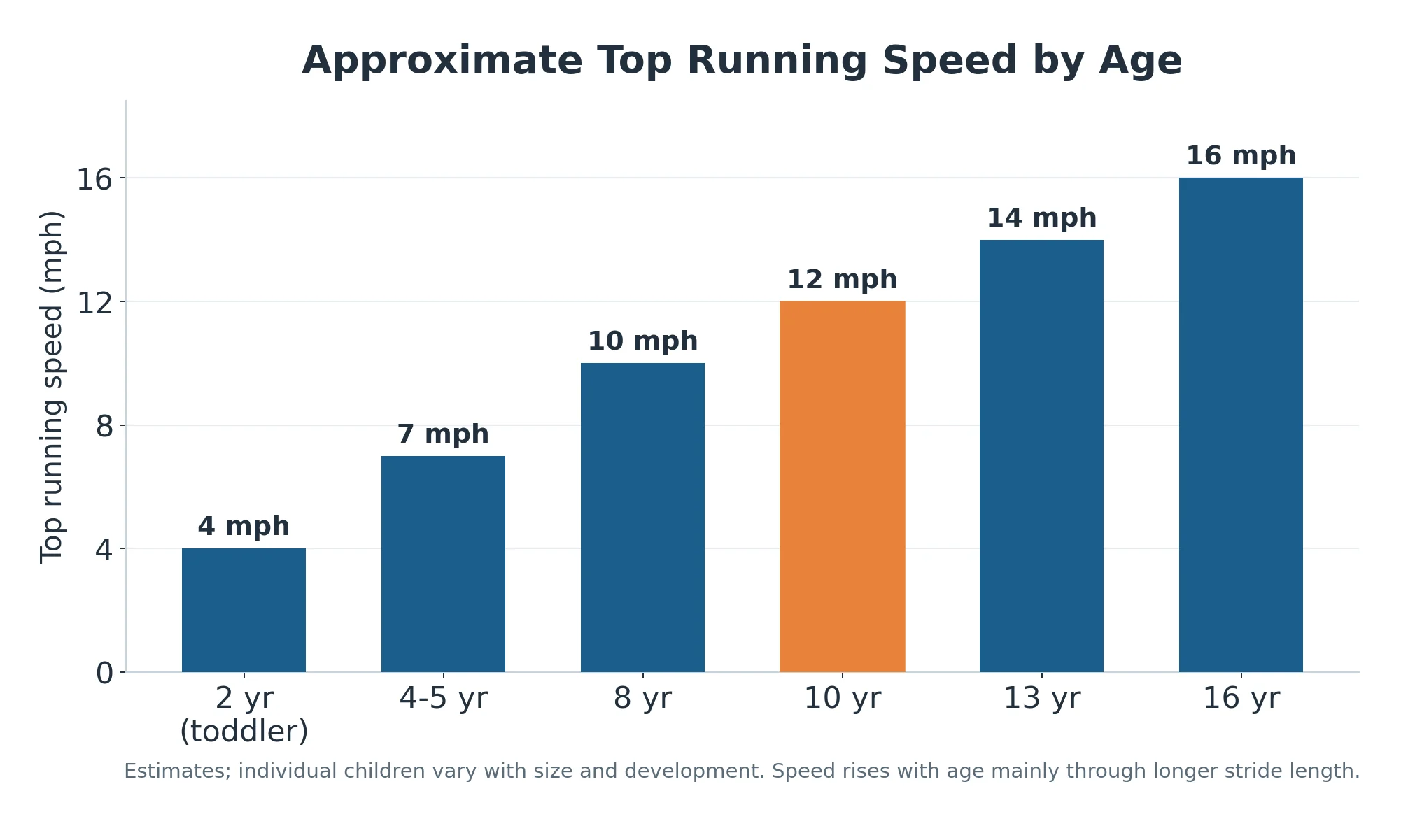
A child’s top running speed climbs steadily from the toddler years into the mid-teens, roughly quadrupling along the way.
The numbers below are approximate. Individual kids vary widely with size, coordination, and how much they run, so treat these as typical ranges rather than fixed benchmarks.
| Age | Approximate top running speed |
|---|---|
| 2 years (toddler) | 4 mph (6 km/h) |
| 4 to 5 years | 7 mph (11 km/h) |
| 8 years | 10 mph (16 km/h) |
| 10 years | 12 mph (19 km/h) |
| 13 years | 14 mph (23 km/h) |
| 16 years | 16 mph (26 km/h) |
The pattern matters more than any single figure. Speed rises with age in a smooth, predictable way, and it tracks growth far more closely than it tracks practice or coaching.
The reason comes down to two parts of running that develop on different clocks. Leg turnover, the one thing kids already do well, barely affects top speed, while stride length sets it and grows directly with the body.
A child’s fastest running gear is limited almost entirely by how long their legs are, not by how quickly they can move them.
Can a 2-Year-Old Actually Run?
A 2-year-old can run, but only in a rough, early version of the movement. True running requires a flight phase, the moment when both feet leave the ground at once, and that phase is barely present at age 2.
A 2021 analysis of children aged 2 to 9 found that the flight phase grows with age but never exceeds 20% of the running stride, and that young children lean on a walk-run strategy while they learn.

What looks like running in a toddler is often a fast walk with brief airborne moments spliced in. The child speeds up, catches a little air, then drops back into a walking pattern when balance runs out.
That same research found something useful for parents: how mature a child’s running looks does not line up neatly with their exact age. Two children born the same month can be at very different stages.
So a 2-year-old who seems to run everywhere and one who still mostly fast-walks are both developing normally. The airborne, adult-style stride fills in gradually over the next several years.
Why Do Little Kids Have Such Fast Leg Turnover?
Toddlers move their legs at a cadence that would exhaust an adult, and it comes down to physics rather than fitness. A running leg behaves like a spring, and a short, light spring bounces faster than a long, heavy one.
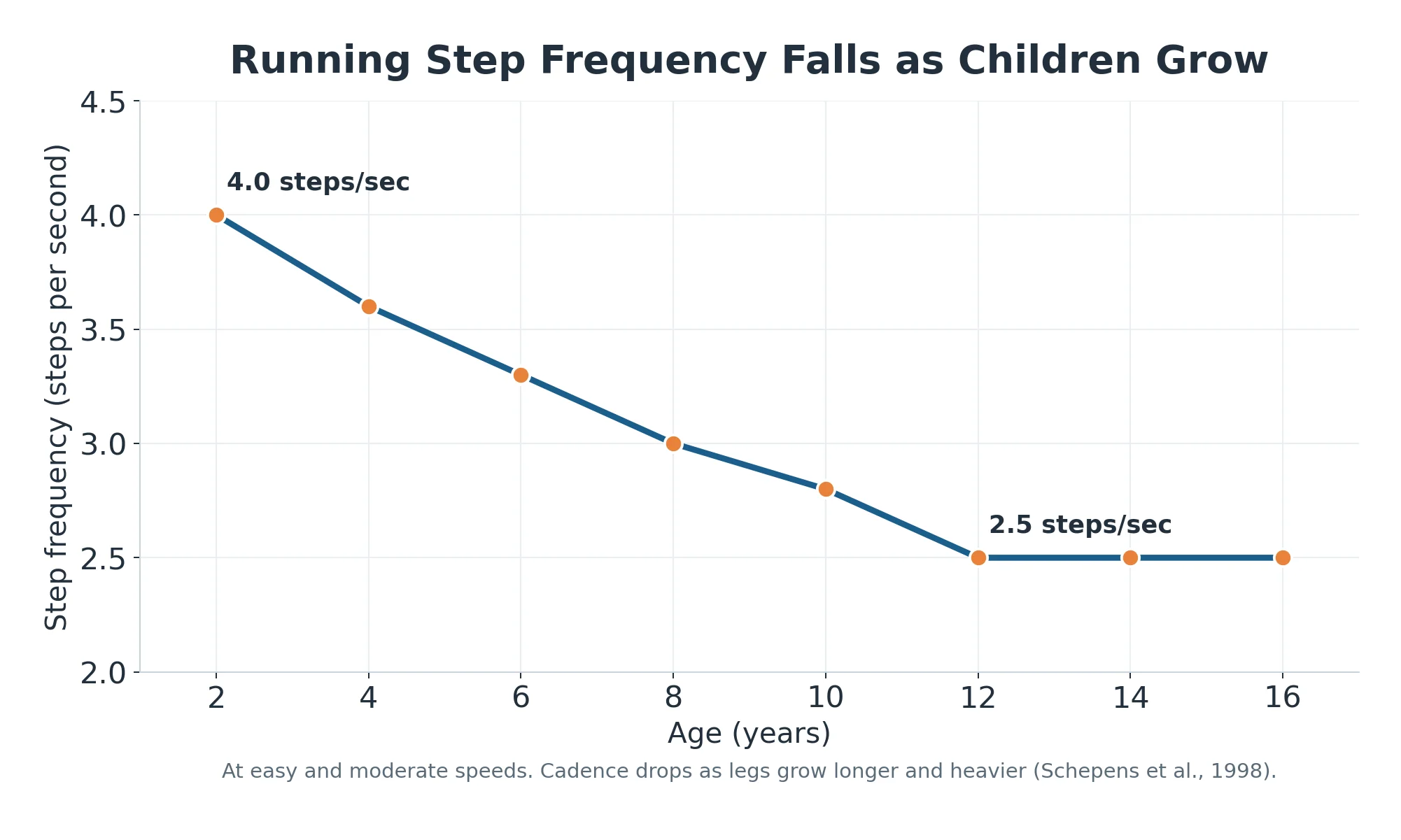
Classic research on running in children measured step frequency falling from about 4 steps per second at age 2 to roughly 2.5 steps per second after age 12.
As a child grows, the legs get longer and heavier, so the natural bounce of the running spring slows down. Step frequency drops with age even though the child is getting faster overall.
This spring-like bounce holds at easy and moderate speeds, up to about 8:45 per mile (5:27 per km). Below that pace, a runner of any age lands and pushes off in a smooth, symmetric rhythm set by the body’s natural frequency.
Above that speed the rhythm changes, and the runner has to push off the ground harder and spend more time floating. That threshold is set by gravity, which is why it holds at the same pace no matter the runner’s age or size.
That 4-steps-per-second cadence in a 2-year-old is about what an elite adult sprinter reaches at full speed. The toddler stays slow anyway, because each of those quick steps covers so little ground.
What Is a Normal Running Stride for a 10-Year-Old?
Stride length is what actually sets a growing runner’s speed, and at age 10 it sits roughly halfway between a toddler’s and an adult’s. A typical 10-year-old covers somewhere near 3 to 4 feet per running step at a hard effort, compared with 4 to 5 feet for a grown adult.
Those figures shift with the child’s height and leg length, so a tall 10-year-old will naturally out-stride a shorter classmate at the same turnover. Leg length is the strongest single predictor of how fast a child can sprint before puberty.
A 2026 study of young athletes found that before puberty, leg length drives maximum sprint speed by increasing step length, while after puberty muscle strength takes over.
Before a child hits their growth spurt, getting faster is mostly a matter of getting taller. Longer levers mean a longer stride at the same rapid turnover.
After the growth spurt, the driver changes. Strength and power become the main way a young runner adds speed, because turnover and leg length have largely settled.
How Do Runners Get Faster Once They Stop Growing?
For teens past their growth spurt and for every adult runner, speed no longer comes from a longer leg. It comes from generating more force into the ground to lengthen each stride.
Turnover hits a ceiling almost immediately. A grown runner cannot meaningfully out-cadence a 2-year-old, so moving your legs faster stops paying off within a few steps.
Your remaining speed lever is stride length, and that comes from stronger, more powerful muscles that drive you off the ground. The hip extensors do most of that work, especially the glutes and hamstrings that power hip drive.
Strength work like squats and lunges builds that force, and explosive drills like bounding, skipping, and short uphill sprints teach the muscles to apply it fast. This is the same lesson the research on children delivers: stride length, not turnover, decides your top speed.
You already turn your legs over about as fast as your body ever will, so every bit of new speed has to come from a longer, more powerful stride.
RunnersConnect Bonus
Download your FREE Hip Strengthening Exercises Guide.
Download a video version of the 5 most effective hip exercises for runners. You’ll get full descriptions on how to perform and a video to help guide you.
What Can Adult Runners Learn From How Kids Run?
The way children develop speed is a clean demonstration of what makes any runner fast. Watching turnover stay flat while stride length climbs strips the question down to its essentials.
If you have been trying to run quicker by raising your cadence, the child data explains why that plateaus. Cadence helps reduce impact, but it is close to fixed, so your added speed has to come from stride length instead.
Point your training at the muscles that extend your stride. Build hip and glute strength, add plyometrics, and run hills to convert that strength into ground force.
That is the surprising payoff of picking apart how a toddler runs. The same mechanics that cap a 2-year-old at a slow jog are the ones setting your own ceiling right now.