

As runners, we spend countless hours focused on the physiological aspects of training – VO2max, threshold, aerobic development, etc. And for good reason. There is no doubt that improving these biological systems will help you run faster.
However, when it comes to racing, are physiological limitations all that matter or is there a mental component involved as well? What role does the brain play in our attempt to race as fast as possible?
According to exercise scientist Dr. Tim Noakes and a growing number of colleagues, the brain may play a more important role in race potential than runners have typically considered. Noakes’s hypothesis suggests that the brain acts as a central governor when racing, limiting our ability to push beyond perceived fatigue to ensure self-preservation.
In this article, we’ll look at the central governor theory in more depth, explore why it matters to those racing for personal bests, and outline some specific strategies you can use to overcome your own central governor.
What is the central governor theory?
In short, the central governor theory is based around the premise that the brain will override your physical ability to run and “shut the body down” before you’re able to do serious or permanent damage to yourself.
Noakes believes that the point in the race when you think you’ve given everything you’ve got is actually a signal or response from the brain to slow down to preserve health, rather than a physiological reality. In actuality, Noakes believes you have more to give physically when this happens.
Runners experience this during almost every race they run. At mile 8 of a half marathon, goal race pace is extremely difficult and the thought of running faster, even for just a minute, seems impossible. Yet, when you get within 400 meters of the finish, you’re somehow able to summon a kick that finds you running minutes per mile faster than goal pace.
Once your brain realizes it won’t die if you pick up the pace (because the finish line is close) it opens the biological pathways to run faster.
The physiological demands of a race are still real.
The central governor theory simply adds that racing balances three things: your physical preparation and biological systems, your emotional state such as motivation and pain tolerance, and your brain’s drive for self-preservation.
The exact mix of those factors decides how hard you can push on race day.
Why does it matter? Does this mean you don’t have to train?
Perhaps the biggest misconception of the central governor theory is that if we could just teach ourselves to push harder or somehow turn off this central governor of the brain, that we could run faster. However, as mentioned above, racing is a combination of three important components: physical, emotional, and mental.
As an example, if you asked an Olympic-caliber runner to run a 7-minute mile, they would do so easily and be able to carry that pace on for 26 miles or more with little effort. Ask a four-hour marathoner to run a 7 minute mile and it will be an all-out effort they can only maintain for a mile. The physiological differences between these two runners means that even if the central governor was turned off, the four-hour marathoner couldn’t run with the Olympic-caliber runner. That’s pretty obvious.
However, if that same four-hour marathoner can learn to push the boundaries of their central governor, perhaps by adding motivation, like a Boston qualifier, or improving their mental fortitude, then they can tap into this extra performance reserve.
How does the central governor create the feeling of fatigue?
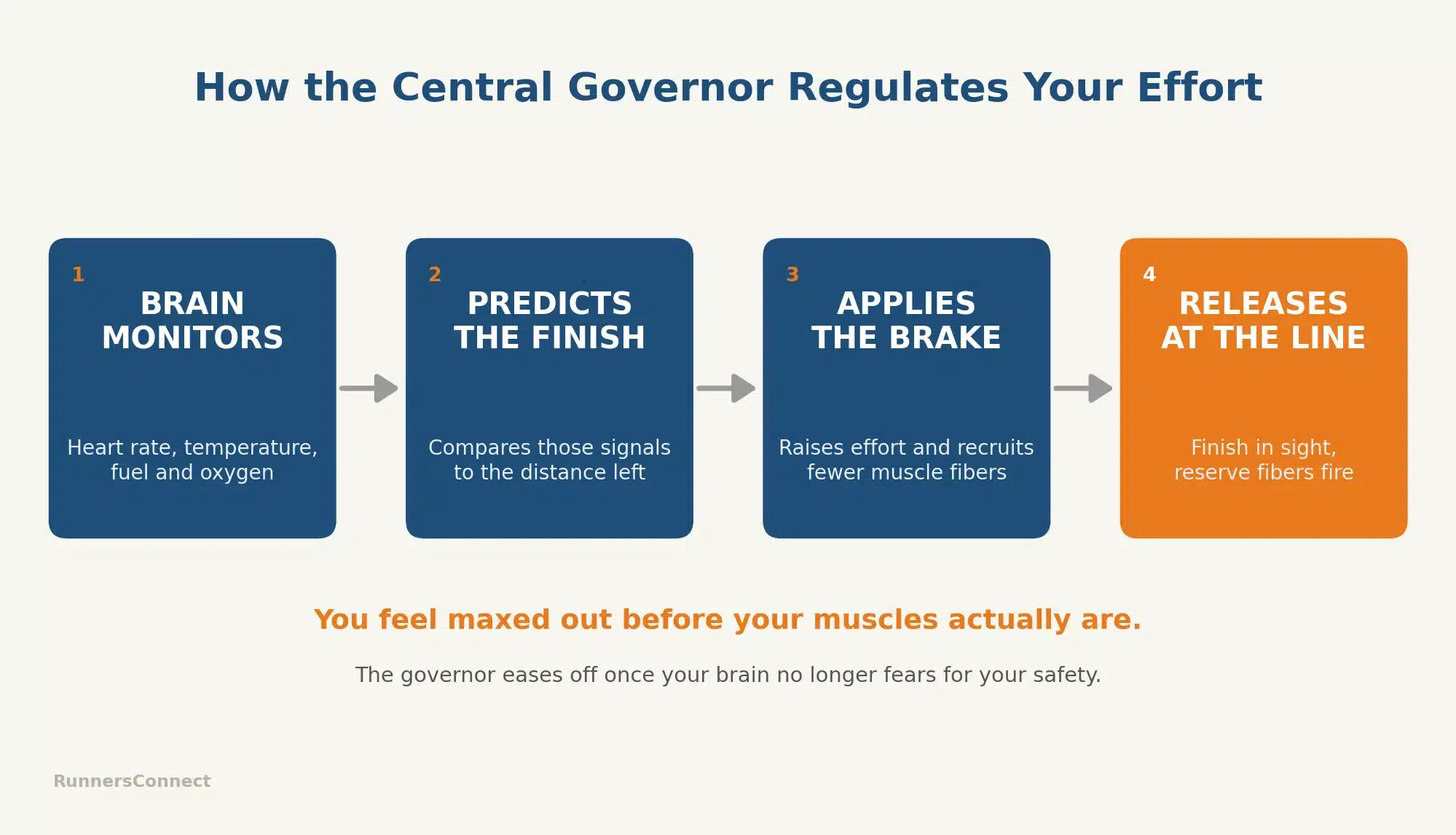
The central governor turns physical strain into a conscious feeling of effort long before your muscles actually run out of fuel.
Exercise scientist Tim Noakes describes fatigue as a brain-derived emotion the body creates to protect itself, not a failure of the muscles.

Your brain constantly reads signals from your heart rate, core temperature, fuel stores, and oxygen levels while you run.
It weighs those signals against the distance you still have to cover and how you expect to feel when you get there.
When the readings drift toward a level the brain treats as risky, it raises your sense of effort and quietly recruits fewer muscle fibers so you are forced to back off.
Research on pacing calls this anticipatory regulation, meaning your effort is set by the finish line the brain predicts rather than the damage you have already done.
This is why goal pace can feel impossible at mile 8 of a half marathon, yet you still find a sprint in the final 400 meters.
Once the finish is close enough that the brain no longer fears for your safety, it releases the brake and lets those held-back fibers fire.
Sharpening your sense of pace gives the governor better information, so it holds less in reserve through the middle miles.
Learning to relax at race pace lowers the effort signal the brain reads, which lets you hold the same speed with less perceived strain.
Ready For More?
Get Our FREE Race Day Strategy Calculator!
You’ll learn how to calculate your exact splits for the marathon in both KM and miles.
Is the central governor theory proven?
The central governor theory remains an open scientific debate, and not every physiologist agrees the brain limits performance the way Tim Noakes proposed.
A competing model from researcher Samuele Marcora argues that runners slow down when the effort simply feels too hard, not because a hidden governor shuts the muscles down.
Marcora calls this the psychobiological model, and it puts your conscious perception of effort at the center of every pacing decision.
His team found that draining mental tasks performed before exercise made athletes quit sooner, even though their muscles and hearts were no more tired than usual.
Other physiologists have questioned whether a single governor in the brain exists at all.
Earlier laboratory work reported that maximal oxygen uptake was not capped by any central nervous system governor, and a widely cited critical review openly asked whether fatigue is truly all in your head.
For most everyday runners, the practical answer sits between these camps.
Whether your limit is a protective governor or a ceiling on perceived effort, both models agree that your brain, not just your legs, decides how fast you finish.
That is why the mental and pacing work below improves race times regardless of which theory turns out to be correct.
How to overcome the central governor
So how do you do that? How do you push the boundaries of your central governor? While you can’t completely overcome the central governor, you can improve your ability to tolerate physical discomfort and prepare your mind for the physical demands you plan to place on it.
Workouts
The problem many runners face is that the experience of trying to push themselves beyond their comfort zone when their mind is telling them it can’t go faster only occurs on race day.
Typical interval workouts and tempo runs are performed at a consistent pace and the recovery between repeats allows you to recover to a state that is very unlike the corresponding point in a race. During workouts, you simply get to a certain fatigue level and then stop pushing.
This is great for building your physiological systems, but does nothing to teach you how to push the central governor and prove to your brain that you can in fact run faster, despite how bad you might feel.
One workout that trains this specific aspect of racing is called a hammer interval session. Succinctly, a hammer interval session is a traditional interval workout except that on the third or second to last interval, you break from your goal pace and simply focus on running that specific repeat as fast as you can – hammering it. An example hammer workout for a 5k runner might look like: 8 x 800 meters at 3k to 5K race pace w/2mins rest, hammer (run as fast as you can) interval numbers 4 and number 7. Maintain the 2-minute rest after each hammer and do your best to get back onto 5k pace after each hammer.
The specific pace of the hammer repeat isn’t the important part of this workout. Rather, it’s the ability to chip away at the mental constraints late in a workout or race that tell you that you can’t go any faster.
Mental training and visualization
Running a PR is tough! No matter how well rested or prepared the body is, racing hurts. If you toe the starting line thinking that somehow you’re going to feel good or that pushing during the last miles is going to be easy, then you’ve already set yourself up to let the brain override your physical abilities.
Prepare yourself mentally. Don’t head into a race telling yourself that somehow this race is going to be different. Be prepared for it to hurt, but remember that you’ve trained yourself to push through this exact situation. Visualize the race during your training runs or while meditating and picture yourself hitting that point in the race when your body starts to hurt. Recall those feelings from your last race or hard workout and then visualize yourself pushing through that moment. By preparing yourself mentally, you’ll be ready to face the realities of the race.
Pacing
Finally, work to improve your sense of pace. Pacing is one of the ways the brain self-regulates the central governor. The brain “anticipates” all the known variables of a race – distance, topography, temperature, etc. – and then calculates an optimal pace that will get you to the finish without dying.
When you deviate significantly from your optimal physiological pace, the brain reacts by reducing the level of muscle activation in order to force you to slow down. By going out too fast during a race, you kick in the central governor early and even elicit physiological changes by the brain designed to slow you down.
Armed with this new understanding of the central governor theory and how the brain impacts your ability to race, implement these three simple strategies into your training plan and start to push yourself harder than you think you can.



One Response
Very helpful article, thanks! Reminds me of the Radiolab episode from a few years back called ‘Limits.’ Talked about pushing ourselves beyond exhaustion, and filling our brains beyond capacity (sort of).