

About 20 minutes into a long run, something shifts.
The effort that felt grinding a few miles back gets easier, not because your legs recovered, but because your brain chemistry changed.
That shift is runner’s high, and while most runners have heard of it, fewer understand what’s actually happening in their body when it occurs, why it doesn’t happen every run, and what you can do to experience it more consistently.
In this article, you’ll learn:
- What runner’s high is and which brain compounds produce it
- Why the endorphin explanation is only half the story
- How long runner’s high typically lasts
- Why some runners never feel it and what that means
- The specific intensity and duration threshold that triggers it
- Whether running can become psychologically addictive
RunnersConnect Bonus
Download our Heart Rate Calculator to find out what your individual heart rate zones are.
What Is Runner’s High?
Runner’s high is a brief state of euphoria, reduced pain, and calm that some runners experience during or after sustained aerobic exercise.
It is not a dramatic sensation of invincibility.
For most runners, it feels more like a sudden lightness in the legs, a drop in perceived effort, and a quiet sense that everything is fine, even when the workout is objectively hard.
The state is real, measurable, and tied to specific neurochemical changes in the brain that exercise triggers above a certain intensity threshold.
Runner’s high is not caused by one chemical: it involves at least two separate brain compounds that work together and activate under different conditions.
Are Endorphins or Endocannabinoids Responsible for Runner’s High?
Endorphins are the first thing most people associate with runner’s high, but the science is more complicated.
Endorphins are opioid-like compounds the body produces during intense exercise.
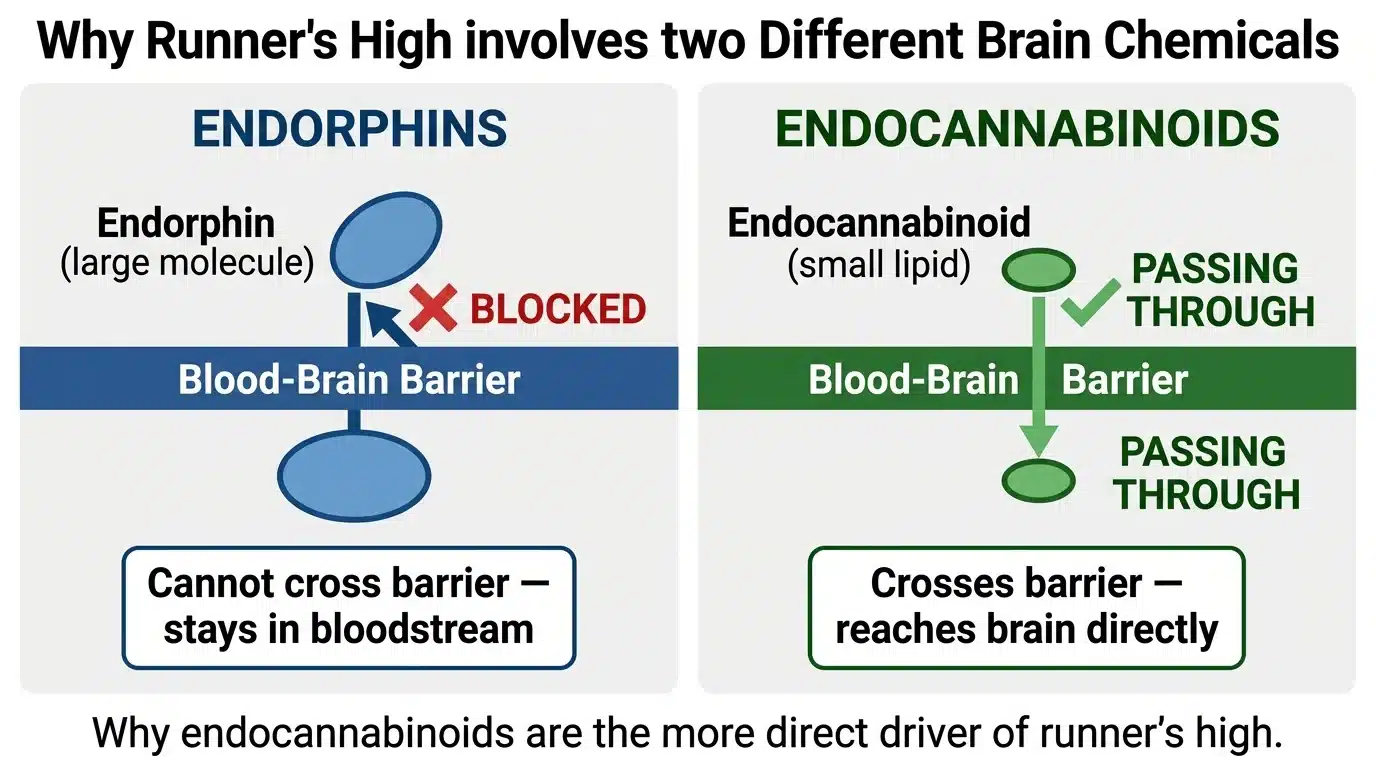
The problem with endorphins as the sole explanation is that they cannot cross the blood-brain barrier.
Because endorphins are large molecules, they stay in the bloodstream and never reach the brain directly, which makes them an incomplete explanation for a brain-level euphoric state.
A landmark PET scan study found that opioid receptor binding in the brain increased significantly after a two-hour run, and the increase correlated directly with runners’ subjective feelings of euphoria.

Boecker and colleagues injected ten runners with a radioactive tracer that binds to endorphin receptors in the brain, then scanned each runner before and after a two-hour run.
The tracer signal dropped post-run, meaning something was already occupying those receptors, and the more it dropped in areas like the prefrontal cortex and limbic system, the more euphoric the runners reported feeling.
This confirmed that endorphins do reach the brain through mechanisms that weren’t previously measurable, and that they do play a role in runner’s high.
But a second line of evidence points to endocannabinoids as an equally important, and possibly more reliable, mechanism.
Research comparing humans and other running mammals found that aerobic exercise significantly elevates circulating endocannabinoids, which cross the blood-brain barrier easily and produce anxiety reduction and pain relief.
Endocannabinoids are small lipid-based molecules the body synthesizes naturally.
Unlike endorphins, they cross the blood-brain barrier without difficulty, making them a more mechanistically plausible explanation for the mood and anxiety changes runners feel mid-run.
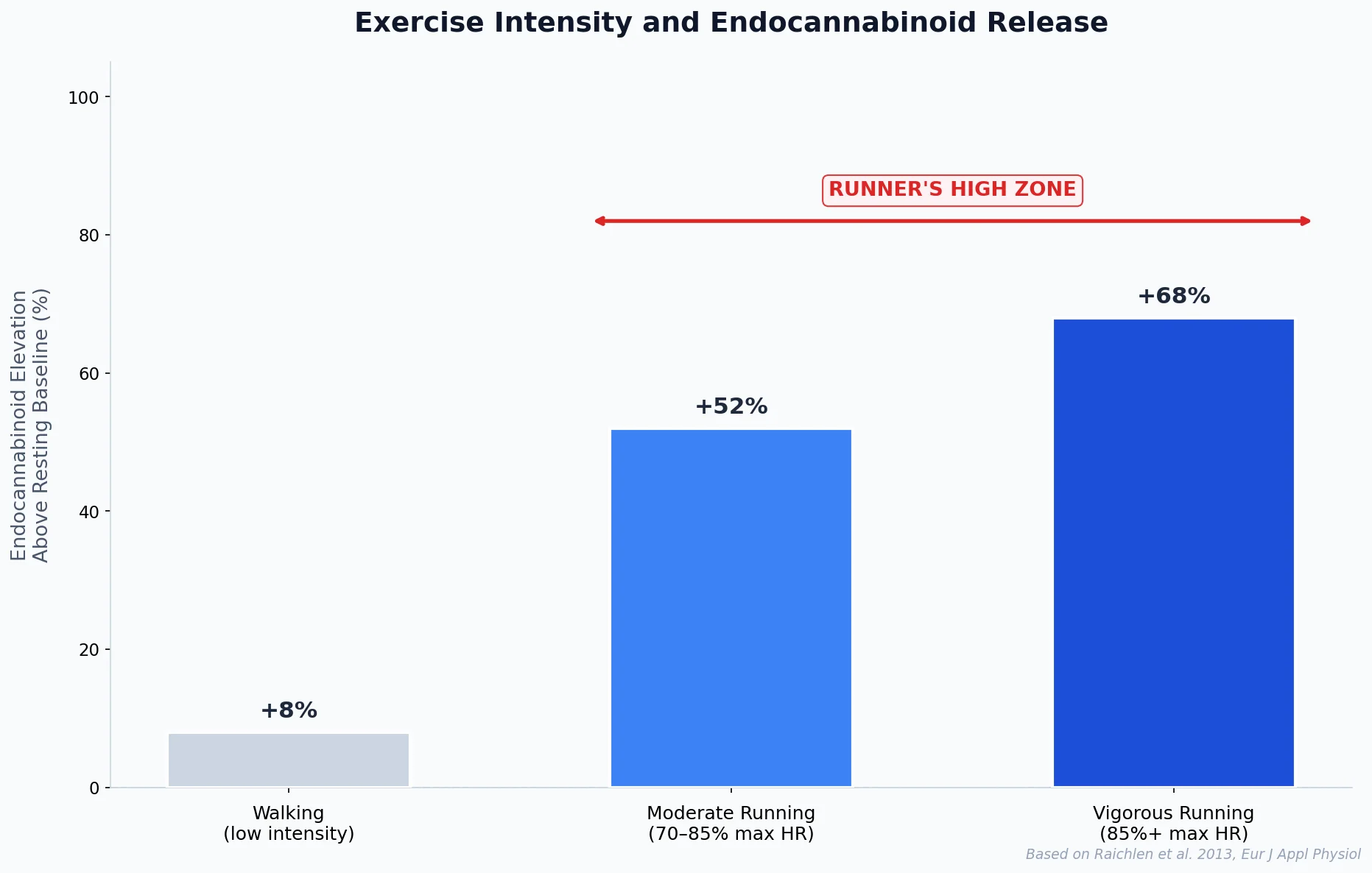
A follow-up study from the same research group found that endocannabinoid release is modulated by exercise intensity, with higher intensities producing greater increases in circulating levels.
A mouse study published in PNAS reinforced this picture: blocking cannabinoid receptors in mice eliminated the anxiolytic effects of running, while blocking opioid receptors did not, suggesting endocannabinoids drive the anxiety-relief component specifically.
The current understanding is that endorphins and endocannabinoids work together, with endocannabinoids likely responsible for the anxiety-relief and calm, and endorphins contributing to the euphoric and pain-dulling aspects.
Runner’s high is not a single chemical event: it is a combination of endorphin-driven euphoria and endocannabinoid-driven calm that together create the distinctive feeling most runners describe.
How Long Does Runner’s High Last?
The euphoric phase of runner’s high typically lasts 20 to 30 minutes after a run ends, though this varies by individual and run intensity.
The endocannabinoid elevation that drives the anxiety-relief component rises during moderate-to-vigorous exercise and begins returning to baseline within 30 to 60 minutes post-exercise.
What lingers longer is the post-run mood improvement, which can persist for two to four hours and is driven by a broader set of neurochemical changes beyond the acute high itself.
The depth and duration of the experience both increase with run duration and intensity, which is consistent with the intensity-dependent endocannabinoid release data from Raichlen and colleagues.
Does Everyone Experience Runner’s High?
No, and that is not a personal failing.
Several factors influence whether a given runner experiences runner’s high on a given day, and many of them are controllable.
The most common reasons runners don’t feel it include running below the intensity threshold that triggers endocannabinoid release, cutting runs short before the neurochemical shift has time to occur, and high baseline stress levels that blunt the contrast between pre- and post-run mood states.
Training experience also matters.
Novice runners who are still adapting to the physical demands of running often perceive exercise as high effort throughout, which crowds out the ability to notice the subtle mood shift when it arrives.
More experienced runners have a lower physiological cost per mile, which may lower the mental attention paid to discomfort and allow the brain to register the endocannabinoid-driven calm more clearly.
Individual variation in endocannabinoid sensitivity and baseline receptor density also plays a role, much the same way people respond differently to caffeine or alcohol at identical doses.
What Running Intensity Triggers Runner’s High?
The threshold appears to be moderate-to-vigorous continuous aerobic effort, roughly 70 to 85 percent of maximum heart rate, sustained for at least 30 minutes.
Raichlen’s 2013 research found that endocannabinoid signaling is modulated by intensity, with levels rising most significantly at moderate and vigorous intensities compared to low-intensity walking.
This means very easy recovery jogs and high-intensity track sessions shorter than 30 minutes are both unlikely to trigger the classic runner’s high feeling.
The sweet spot is the kind of run most coaches describe as “comfortably hard,” where you can still speak in short sentences but couldn’t hold a conversation effortlessly, sustained continuously for 30 minutes or more.
Studies on endocannabinoid signaling modulated by intensity show that walking does not produce meaningful endocannabinoid elevation, while moderate-to-vigorous running produces the significant increases associated with mood improvement.
If you want to experience runner’s high more consistently, running at the right aerobic intensity for your current fitness level is more important than pace.
A runner whose easy pace is 11-minute miles will find the 70 to 85 percent zone at a different absolute speed than someone running 8-minute miles, but the neurochemical trigger is the same.
The practical implication is that most of your long runs should be conducted at an effort where runner’s high is achievable, not so easy that you stay below the threshold and not so hard that you shift into anaerobic work that reduces run duration.
The intensity window that triggers runner’s high is moderate-to-vigorous continuous aerobic effort, roughly 70 to 85 percent of max heart rate, for at least 30 continuous minutes.
Can Runner’s High Lead to Exercise Dependency?
For most runners, the neurochemical reward of running is healthy and motivating.
The same mechanism that produces runner’s high, specifically the opioid-like effect of endorphins, also produces withdrawal-like symptoms when regular running stops suddenly.
Boecker and colleagues noted that the opiate-like effects of the runner’s high may explain not only the mood benefits of exercise but also the negative affect, irritability, and anxiety that some runners experience during forced rest periods.
This is not addiction in the clinical sense for most runners.
It is a physiological adjustment to losing a reliable source of neurochemical regulation, and it is both normal and temporary.
Where it becomes a concern is when runners continue training through injuries specifically to avoid the mood consequences of stopping, a pattern Boecker’s team called “excessive exercise.”
If you are injured and struggling with mood disruption, exercise motivation during difficult training periods is a real challenge, and the solution is substitution rather than abstinence.
Any sustained moderate-to-vigorous aerobic activity produces a similar neurochemical response.
Pool running, cycling, and elliptical work at equivalent intensities produce endocannabinoid elevation, which means the mood-regulating benefits of your training are available through cross-training even when running is off the table.
Research on exercise and major depression found that aerobic exercise three times per week was as effective as a daily antidepressant medication after 16 weeks, which underscores how meaningfully exercise regulates mood chemistry over time.
If injury forces you to stop running and your mood suffers, pool running or cycling at the same effort level will produce the same neurochemical response runner’s high requires.


9 Responses
Thanks for all the help. I’ve read your marathon training e- book cover to cover more than once during my marathon training. I will be running my first marathon ever for my 55 th birthday. My only other runs Wroe a 1/2 marathon Nov. 2012 and a 1/2 June 28/15. I’m hoping that I can finish strong. Thanks for the training plan, I followed it almost to the letter. I run the Victoria marathon Oct. 11/15. Wish me luck. Kathy P
Good luck Kathy. I’m doing the half in Victoria. It’s a nice course, pretty flat except for a few hills along the way. And there are 6 or 7 corners in the last kilometer!
The forecast is presently for rain, but I am sure that will change several times before race day.
Have a great run, it’s a good way to mark a milestone birthday.,
Hi Kathy, thanks for reaching out. Glad we have helped you out! That is very exciting about your first marathon, we do wish you lots of luck, and if we can help with anything else, please let us know. Just remember to have fun 🙂
I read the marathon training book and re-read some of the pages that were new concepts to me and followed them during my training. I was able to improve my personal record in a 10 K run from 1:01 to 55 mins in just a few months. I am a 57 year old person and will keep reading your wonderful articles. Thank you!
Thats awesome Marimena! Thanks so much for sharing with us, we are happy to help! Can we help you with anything else?
I used to feel the runner’s high 3 to 4 times a week while I.. believe it or not.. pushed carts at a grocery store!
Every single shift I’d speed walk and some times run while pushing hundreds of pounds of heavy steel on wheels (the carts) and every time at around 2 hours in, I’d get the high.
Every shift was 5 to 6 hours long and once the high would hit, I’d feel it until the end of the shift.
It’s honestly one of the best feelings ever. After 1 hour to 1 1/2 hour I’d start to feel tired and question if I’d last the rest of the shift and after around 2 hours in I’d get this giant euphoric feeling, I’d feel what ever stress I was feeling melt away, I’d think, see and smell more clearly, I’d start to feel more energetic and light as if I’m weightless and that I could keep going with ease.
Hi coach
I just started reading this today and finished this article im in high school and trying to lose weight and run faster and get alot of exersize any tips or hints i would love and any tips on what i should eat im 220 pound.
Hi
I just started reading this today and finished this article im in high school and trying to lose weight and run faster and get alot of exersize any tips or hints i would love and any tips on what i should eat im 220 pound
My grandfather at the age of 70 recently won a marathon. Pretty insane.