You finish a run expecting to feel energized, and an hour later you can barely keep your eyes open at your desk.
A run should leave you feeling more alert, so a crash afterward usually points to something in your sleep, your fueling or your training that needs a small fix.
Here’s what you’ll learn about feeling sleepy after running:
- The difference between normal post-run tiredness and sleepiness
- Why short nights and hard efforts leave you drowsy
- How eating and drinking before and after a run changes your energy
- When sleepiness after every run is a reason to get blood work
- Whether it’s OK to nap after running
Why Do You Feel Sleepy After Running?
Feeling sleepy after a run usually comes from one of 6 causes: short sleep, running too hard, running on an empty stomach, dehydration, running at the wrong time for your body clock, or low iron.
It helps to separate sleepy from tired first.
Tired legs and a heavy body after a long run or a hard workout are normal, and that feeling goes away with a meal and a good night of sleep.
Sleepy is different, because it means you’re fighting to stay awake, your focus drops and you want to lie down.
An easy run should leave you feeling the same or better than before you started, so sleepiness after easy runs is the signal worth investigating.
Work through the causes below in order, since the first few are the most common and the easiest to fix.
Could Short Sleep Be Why You’re Sleepy After Running?
The first thing to check is how much you sleep, because a run exposes a sleep debt you could ignore while sitting at a desk.
The American Academy of Sleep Medicine recommends that adults sleep 7 or more hours a night on a regular basis.
Researchers have measured what a night without sleep does to a run.
One study found that after a night without sleep, people ran 187 meters (204 yards) less in a 30-minute treadmill run, even though the run felt just as hard to them.

That means you can’t rely on how a run feels to tell you whether short sleep is holding you back.
If you’re regularly getting 6 hours or less, add 30 minutes to your night for 2 weeks before you change anything else about your training.
Are You Running Your Easy Runs Too Hard?
Running harder than your fitness can handle is the next most common reason a run leaves you drained instead of energized.
This happens most often to newer runners and to runners who only run once or twice a week, because every run turns into a test of how fast they can go.
A hard effort uses more of the carbohydrate stored in your muscles and causes more muscle damage, so you need more food and more rest afterward to feel normal again.
An easy run should be slow enough that you can speak in full sentences the whole way.
If you finish an easy run and need a nap, slow down by 30 to 60 seconds per mile (about 20 to 35 seconds per km) on your next one and see if the sleepiness goes away.
Running more often at an easy effort also helps, because your body gets better at handling a run you repeat 3 or 4 times a week than one you do every 10 days.
This guide shows you how to work out how fast your easy runs should be.
RunnersConnect Bonus
Download your FREE Long Run and Aerobic Pacing Calculator now.
Need help converting your race times to your optimal easy and long run pace? Download our FREE calculator and we’ll do the math for you.
Does Running on an Empty Stomach Make You Sleepy?
Running without eating can leave you sleepy afterward, most of all after long runs or when you skip food after the run as well.
During a run your muscles burn through the glucose in your blood and the glycogen stored in your muscles and liver.
If you start the run on an empty stomach, you have less of that fuel available, and you finish with your energy stores lower than they would be if you’d eaten.
A 2018 review of 46 studies found that eating beforehand helped people perform in long aerobic sessions, while it did not change results in brief ones.
That means a short, easy morning run is usually fine on an empty stomach, and long runs go better with a small snack first.
You don’t need a big breakfast, because a banana or a slice of toast 30 to 60 minutes before you run is enough.
What you eat afterward matters just as much.
A snack with carbohydrate and some protein within an hour of finishing, such as fruit with a handful of nuts or yogurt with granola, refills your energy stores and keeps you from crashing later in the day.
Keep that post-run meal moderate, because a large meal can make you drowsy on its own.
RunnersConnect Bonus
Download your FREE Guide where we share the Best Foods to Eat Before Running.
Can Dehydration Make You Tired After a Run?
Losing even a small amount of fluid through sweat can leave you feeling tired and foggy after you run.
Researchers have tested this by having people exercise until they lost a set amount of their body weight in fluid.
A 2012 study found that losing just 1.36% of body weight in fluid during exercise raised feelings of fatigue, lowered concentration and made tasks feel harder.
For a 150 lb (68 kg) runner, that is about 2 lb (0.9 kg) of sweat, which you can easily sweat out on a long run in warm weather.
Drink to thirst during long runs, and have a glass of water with your post-run snack.
If your urine is dark yellow a couple of hours after your run, you need to drink more during the rest of the day.
Does the Time of Day You Run Make You Sleepy?
Running at a time that fights your body clock can make the run feel harder and leave you sleepier afterward.
Your body clock sets the time of day you feel most alert, which is early morning for morning people and afternoon or evening for night owls.
In a 2014 study, cyclists who were natural morning people rated the same effort as harder at 6 pm and 10 pm than in the morning, even though their speed and power were the same.
That means the time you run changes how hard the run feels, even when the pace on your watch doesn’t change.
If you’re a night owl who forces yourself out the door at 5:30 am, try moving a few of your runs to lunchtime or the evening for 2 weeks.
If morning is the only time you can run, keep those runs easy and save harder sessions for the days you can run later.
Could Low Iron Be Why You’re Tired After Every Run?
If you sleep well, eat enough, keep your easy runs easy and still feel sleepy after most runs, low iron is the next thing to rule out.
Iron helps your blood carry oxygen to your muscles, so when your iron is low your muscles get less oxygen during a run and you finish feeling drained.
A review of 6 years of blood tests found that 56% of female and 31% of male elite runners had at least one episode of iron deficiency, even with doctors monitoring them.
Low iron can cause fatigue before it shows up as anemia on a standard blood test.
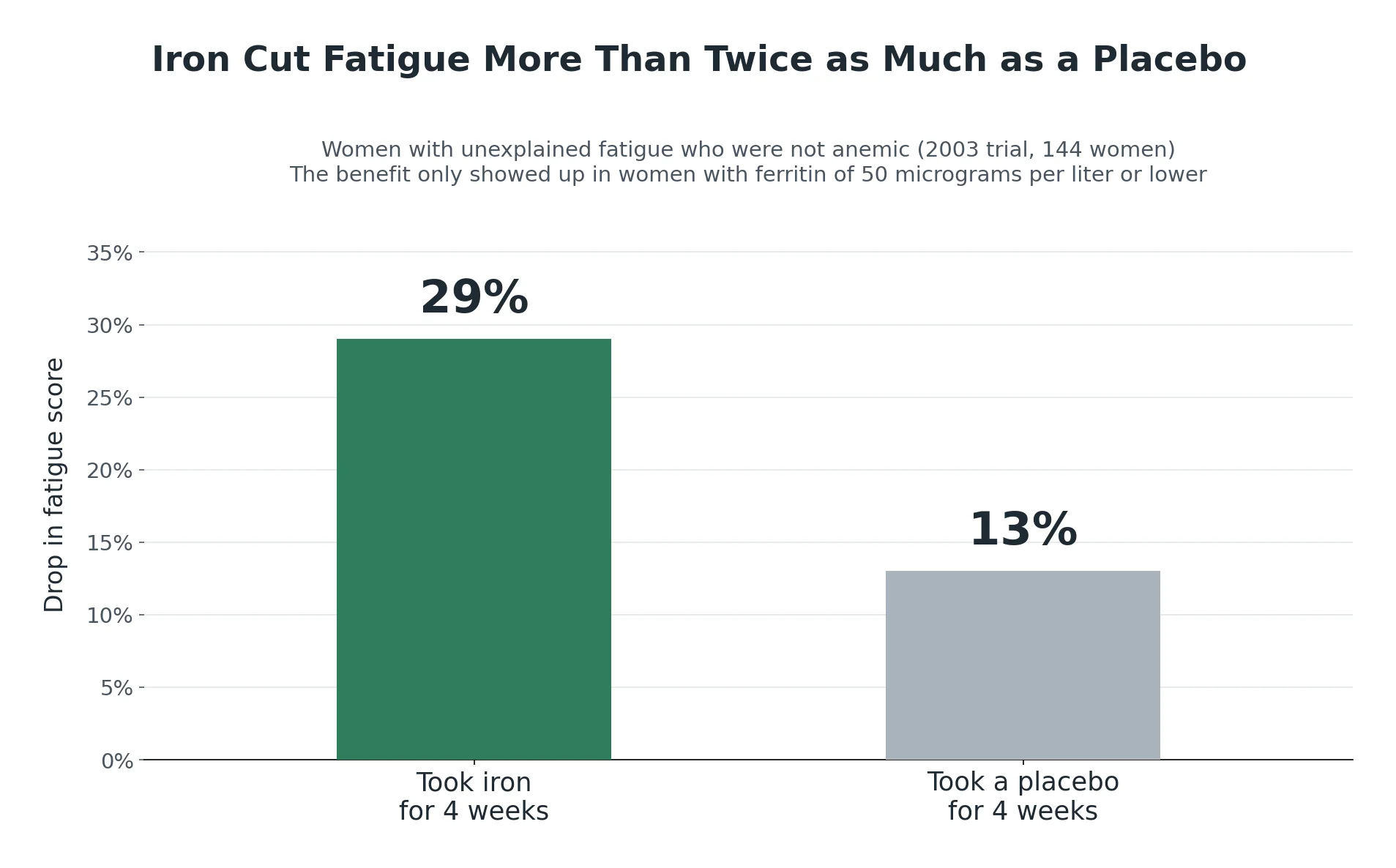
One trial found that in women with unexplained fatigue who were not anemic, 4 weeks of iron cut fatigue by 29%, compared with 13% for women taking a placebo.
That improvement only showed up in women whose ferritin, the measure of stored iron, was 50 micrograms per liter or lower.
That means you need a blood test that includes ferritin before you take iron, because extra iron does nothing for you if your stores are already full.
Ask your doctor to check vitamin D and vitamin B12 at the same appointment, since low levels of either can also leave you tired.
You can learn what your results mean in this guide to iron deficiency in runners.
Is It OK to Sleep or Nap After Running?
Taking a short nap after a run is fine, and it won’t undo the training you just did.
The risk is that a long nap late in the day can keep you awake at night, which leaves you short on sleep and sleepy after your next run.
Keep a post-run nap to about 20 to 30 minutes, and take it before mid-afternoon.
Running regularly should help your sleep at night.
A meta-analysis of 66 studies found that regular exercise improved sleep quality and helped people fall asleep faster.
That means that once you fix the cause of your post-run sleepiness, running should give you more energy during the day and better sleep at night.
How Do You Stop Feeling Sleepy After Running?
Here’s a quick way to match what you’re feeling to the most likely cause and fix.
| Likely cause | What you notice | What to do |
|---|---|---|
| Short sleep | Sleepy after most runs and during the day | Aim for 7+ hours a night |
| Running too hard | Can’t talk in full sentences on easy runs | Slow easy runs by 30 to 60 sec per mile (about 20 to 35 sec per km) |
| Empty stomach | Crash later in the day after morning runs | Small carb snack before longer runs, carbs and protein after |
| Dehydration | Headache, dark urine, foggy focus | Drink to thirst on longer runs and with your post-run snack |
| Wrong time of day | Runs feel harder at one time of day | Move some runs to the time you feel most alert |
| Low iron | Tired after every run despite good sleep and food | Ask your doctor for a blood test with ferritin |
Feeling sleepy after running usually comes from short sleep, running too hard, running on an empty stomach, dehydration, running at the wrong time of day or low iron.
Adults need 7 or more hours of sleep a night, and one night without sleep cut how far people ran in 30 minutes by 187 meters.
An easy run should leave you feeling the same or better than before you started, so if you need a nap after easy runs, slow them down until you can talk in full sentences.
Eating before long runs and having carbohydrate and protein afterward helps prevent a post-run energy crash.
Losing just 1.36% of body weight in sweat raised fatigue and lowered concentration.
If you’re tired after every run despite good sleep and food, ask your doctor for a blood test that includes ferritin.
Frequently Asked Questions
Why do I feel sleepy after running?
Sleepiness after running usually comes from not sleeping enough, running your easy runs too hard, running without eating, losing too much fluid in sweat, running at a time that fights your body clock, or low iron. Start with sleep and pace, since those are the most common causes and the easiest to fix. If you feel sleepy after every run even with good sleep and food, get a blood test that checks ferritin, vitamin D and vitamin B12.
Is it normal to feel sleepy after a run?
Feeling tired after a long run or a hard workout is normal, and it fades after a meal and a good night of sleep. Feeling like you need to lie down after an easy run is less normal. An easy run should leave you feeling the same or better than before you started, so regular sleepiness after easy runs is a sign to check your sleep, your fueling and how fast you run.
Why do I feel sleepy after running in the morning?
Morning sleepiness after a run often comes from short sleep, running on an empty stomach or running before your body is fully awake. In one study, morning people rated the same effort as harder in the evening than in the morning, so running against your body clock makes a run feel tougher. Try going to bed 30 minutes earlier, eating a banana or a slice of toast 30 to 60 minutes before longer runs, and keeping early runs easy. If you can, move a few runs to later in the day and compare.
Should I sleep or nap after running?
A short nap after a run is fine and won’t undo your training. Keep it to about 20 to 30 minutes and take it before mid-afternoon, because a long or late nap can make it harder to fall asleep at night. Running regularly should help your nighttime sleep, since a meta-analysis of 66 studies found regular exercise improved sleep quality and helped people fall asleep faster.
Does running make you tired or give you energy?
An easy run should give you more energy, while a long run or hard workout will leave your body tired for the rest of the day. If easy runs leave you drained, you’re likely running them too fast or starting them short on sleep, food or fluid. Slow your easy runs until you can talk in full sentences, and eat a snack with carbohydrate and protein within an hour of finishing.
What should I eat after a run so I don’t feel sleepy?
Eat a snack with carbohydrate and some protein within an hour of finishing your run, such as fruit with a handful of nuts or yogurt with granola. This refills the fuel your muscles used during the run and helps prevent an energy crash later in the day. Keep the meal moderate, because a large meal can make you drowsy on its own, and drink a glass of water with it.
Can low iron make you sleepy after running?
Low iron can leave you tired after every run, because iron helps your blood carry oxygen to your muscles. A review of blood tests found that 56% of female and 31% of male elite runners had at least one episode of iron deficiency. In one trial, iron cut fatigue by 29% in non-anemic women, but only in those with ferritin of 50 micrograms per liter or lower, so get tested before taking iron.
References
Aird, T. P., et al. “Effects of Fasted vs Fed-State Exercise on Performance and Post-Exercise Metabolism: A Systematic Review and Meta-Analysis.” Scandinavian Journal of Medicine and Science in Sports, vol. 28, no. 5, 2018, pp. 1476-1493.
Armstrong, Lawrence E., et al. “Mild Dehydration Affects Mood in Healthy Young Women.” The Journal of Nutrition, vol. 142, no. 2, 2012, pp. 382-388.
Coates, A., et al. “Incidence of Iron Deficiency and Iron Deficient Anemia in Elite Runners and Triathletes.” Clinical Journal of Sport Medicine, vol. 27, no. 5, 2017, pp. 493-498.
Kredlow, M. Alexandra, et al. “The Effects of Physical Activity on Sleep: A Meta-Analytic Review.” Journal of Behavioral Medicine, vol. 38, no. 3, 2015, pp. 427-449.
Kunorozva, Lovemore, et al. “Perception of Effort in Morning-Type Cyclists Is Lower When Exercising in the Morning.” Journal of Sports Sciences, vol. 32, no. 10, 2014, pp. 917-925.
Oliver, Samuel J., et al. “One Night of Sleep Deprivation Decreases Treadmill Endurance Performance.” European Journal of Applied Physiology, vol. 107, no. 2, 2009, pp. 155-161.
Verdon, François, et al. “Iron Supplementation for Unexplained Fatigue in Non-Anaemic Women: Double Blind Randomised Placebo Controlled Trial.” BMJ, vol. 326, no. 7399, 2003, p. 1124.
Watson, Nathaniel F., et al. “Recommended Amount of Sleep for a Healthy Adult: A Joint Consensus Statement of the American Academy of Sleep Medicine and Sleep Research Society.” Journal of Clinical Sleep Medicine, vol. 11, no. 6, 2015, pp. 591-592.