
Fueling for double workout days matters most because the short gap between sessions is your only chance to rebuild the glycogen your first run burned.
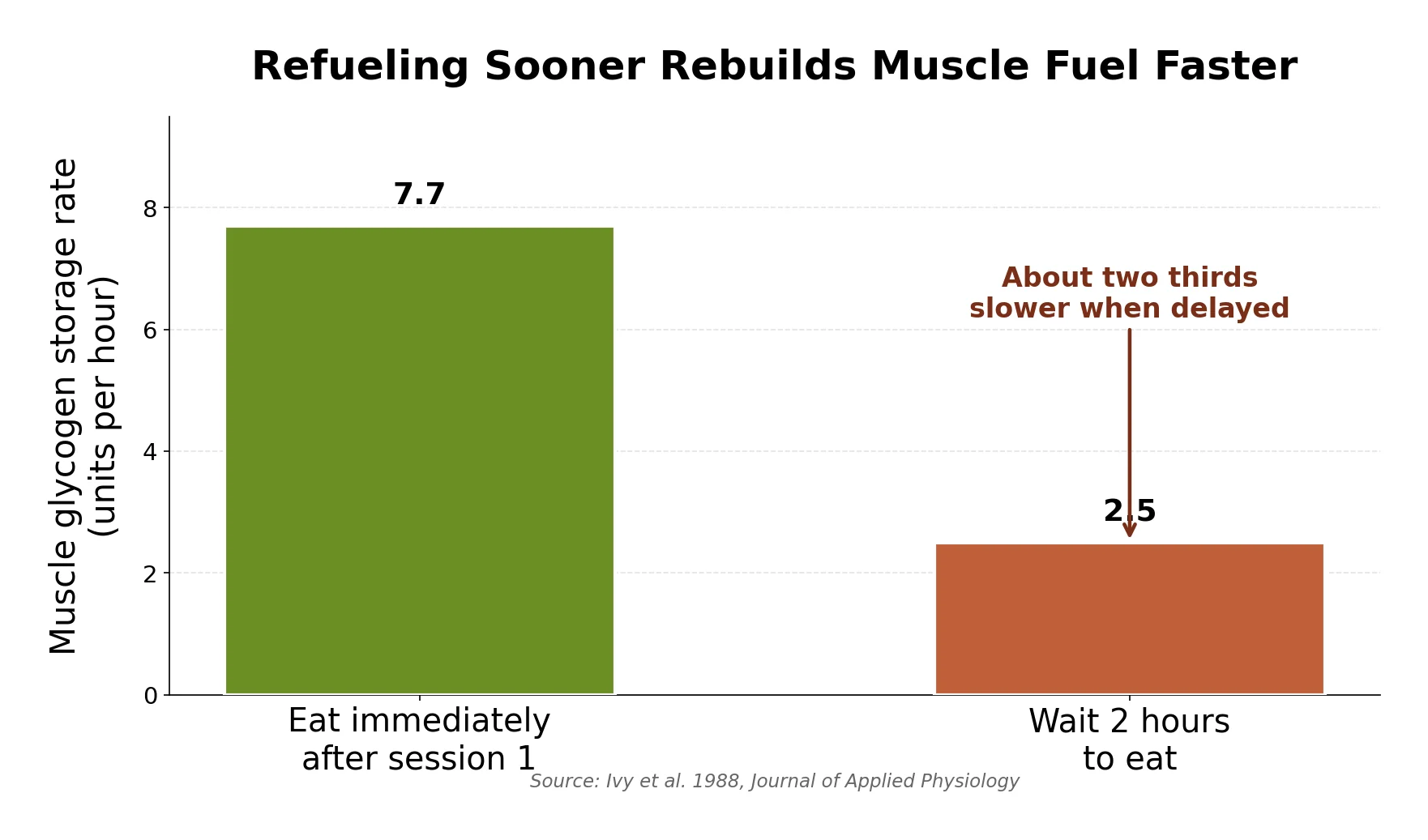
Start eating carbohydrate within 30 to 60 minutes of finishing session one, since delaying it by 2 hours cuts glycogen storage by roughly two thirds.
Aim for about 1 to 1.2 grams of carbohydrate per kilogram of body weight every hour, eaten as small frequent amounts rather than one large meal.
Add protein in a 3 or 4 to 1 carb-to-protein ratio to support muscle repair, especially if your second session is strength work.
Fueling between two-a-day sessions replaces energy you already used, so it supports training without causing weight gain, while under-fueling leaves you weak and shaky on the second run.
You finish a strong morning run, head out for your second session that afternoon, and 10 minutes in your legs feel heavy and your hands start to shake.
That weak, shaky feeling on the second session is almost always a fueling problem, not a fitness problem.
When you train twice in one day, the few hours between sessions are the only window your muscles have to rebuild the fuel they just burned.
Get that window right and the second session feels nearly as good as the first. Get it wrong and you spend the afternoon running on empty.
Here’s what you’ll learn about fueling for double workout days:
- Why the gap between two-a-day sessions changes how you need to eat
- How soon to eat after your first run
- How many carbs to aim for between sessions
- When protein actually helps your recovery fuel
- Whether fueling for double days makes you gain weight
Why Does Fueling Between Double Sessions Matter So Much?
Every hard run drains the carbohydrate your muscles store as glycogen, and that store is your primary fuel for the next session.
On a normal training day you have 24 hours to refill it, so timing barely matters.
On a double day you might have 6 hours or less, which turns refueling into the single factor that decides how your second session goes.
The shorter the gap between your two sessions, the more your between-session fueling determines your second performance.
This is exactly why running doubles feels manageable for some runners and brutal for others.
The runners who struggle are usually under-fueling the gap, not overtraining.
How Soon Should You Eat After Your First Run?
Start eating within 30 to 60 minutes of finishing your first session, while your muscles are primed to store carbohydrate fastest.
Waiting until your next regular meal wastes the most productive part of the recovery window.
Researchers have found that delaying carbohydrate by 2 hours after exercise cut the rate of muscle glycogen storage from 7.7 to 2.5 units per hour, a drop of roughly two thirds.

That gap matters most when your recovery time is short.
If your two sessions are 3 or 4 hours apart, a 2-hour delay in eating leaves you starting the second run half-refueled.
The practical rule is simple: eat something with carbohydrate as soon as you can stomach it after the first session.
How Many Carbs Do You Need Between Two-a-Day Sessions?
Aim for about 1 gram of carbohydrate per kilogram of body weight each hour during the recovery window.
Repeating that amount hourly matters more than eating one large meal.
Research on short-term recovery shows that eating around 1.2 grams of carbohydrate per kilogram per hour, at frequent intervals, maximizes how fast muscles rebuild glycogen.
For most runners that works out to a snack or small meal roughly every hour until the second session.
The table below shows how those targets translate into real amounts.
| Body weight | Carbs per hour | What that looks like |
|---|---|---|
| 55 kg (121 lb) | 60 to 65 g | 1 banana plus a bagel |
| 68 kg (150 lb) | 70 to 80 g | Rice bowl plus a piece of fruit |
| 82 kg (180 lb) | 90 to 100 g | Large sandwich plus a sports drink |
These are the same principles behind carbohydrate strategies before a marathon, compressed into a few hours.
RunnersConnect Bonus
Download our FREE recovery foods guide, with the top 10 foods for each of the essential recovery vitamins, minerals and macro nutrients. Plus a sample 1-day meal plan!
Should You Add Protein to Your Recovery Fuel?
Protein earns its place in your recovery fuel for two reasons on a double day.
It supports the muscle repair from your first session, and it helps rebuild glycogen when you cannot hit the full carbohydrate target.
A 2018 review concluded that carbohydrate is the main driver of glycogen recovery, and adding protein helps most when carbohydrate intake stays below about 0.8 grams per kilogram per hour.
The takeaway is to prioritize carbohydrate first and treat protein as the useful add-on.
A ratio of roughly 3 or 4 grams of carbohydrate to 1 gram of protein covers both jobs well.
If your afternoon session is strength work rather than a run, that protein becomes even more valuable for repair.
What Should You Eat Between a Morning Run and an Afternoon Session?
Reach for foods that are mostly carbohydrate, easy to digest, and simple to eat in small amounts across the gap.
Heavy, high-fat, or high-fiber meals sit in your gut and can leave you sluggish for the second session.
A practical between-session plan looks like this:
- Right after the first run: a smoothie with fruit, milk or yogurt, and a handful of oats
- 1 to 2 hours later: a normal meal built around rice, pasta, potatoes, or bread with a lean protein
- 60 to 90 minutes before session two: a small carbohydrate snack like a banana, toast with honey, or a sports drink
If you only remember one thing, keep eating small carbohydrate-rich amounts steadily rather than waiting for one big meal.
This steady approach is what keeps the shaky, weak feeling from showing up mid-session.
Will Fueling for Double Days Make You Gain Weight?
Fueling your sessions properly does not cause weight gain, because you are replacing energy your training just used.
The food you eat between two hard sessions is covering a real energy cost from the training you already did.
Under-fueling is the more common problem, and it quietly undermines both your training and your recovery.
One running study found that carbohydrate and protein taken during recovery improved performance in a later running session compared with under-fueling.
When you skip fuel to avoid weight gain, your second session suffers and your body adapts less to the training you worked to complete.
If body composition is your goal, adjust total daily calories across the whole day rather than starving the recovery window between sessions.
The Double-Day Fueling Protocol at a Glance
| Question | The answer for double days |
|---|---|
| When to start eating | Within 30 to 60 minutes of finishing session one |
| How much carbohydrate | About 1 to 1.2 g per kg body weight per hour |
| How often | Small amounts every hour until session two |