
Maybe you line up in the Clydesdale or Athena corral, or maybe you just carry more weight than the runners lining up around you.
A quiet voice tells you those extra pounds are grinding down your knees, shins, and feet with every stride.
That belief is everywhere in running, and it sounds mechanically obvious. More mass means more force, so more breakdown.
The research on body weight and running injury risk tells a more surprising story.
Here is what you will learn about how your weight actually affects your chance of getting hurt:
- Whether higher body weight raises your running injury risk
- Why new runners and experienced runners get different answers
- How being too light becomes its own injury problem
- What predicts running injuries better than the number on the scale
- How heavier runners can start and stay healthy
Does Higher Body Weight Increase Your Running Injury Risk?
The scale predicts running injuries far more weakly than almost every runner assumes.
When researchers pool the studies together, body weight keeps failing to stand out as a reliable cause of injury.
A 2024 umbrella review of thirteen systematic reviews concluded that the evidence is still too weak to confirm most individual factors, including body size, as clear causes of running injury.
An earlier review of long-distance runners reached a similar verdict, finding that weekly training distance and past injury drove risk while body mass did not show up as a consistent predictor.
Across the largest reviews, body weight on its own is not a dependable predictor of who gets injured.
Risk profiles also split by sex, which is one reason single-number rules of thumb break down so often.
A systematic review on sex differences found that the factors linked to injury in men were not the same ones linked to injury in women.
Does BMI Predict Injury for New Runners?
The answer changes the moment you look specifically at people who are new to running.
In beginners, a higher body mass index does begin to carry weight as a risk factor for men.
Research on novice runners found that each one-point rise in BMI raised injury risk by about 15% in men, while BMI did not predict injury in women.

That same study flagged a previous injury as a far bigger red flag, nearly tripling the odds of getting hurt again.
So the extra risk that comes with size is real for new runners, but it sits well behind training history.
The practical read is simple for anyone starting heavier. Your body will adapt, but the first weeks are when a higher BMI matters most.
Can Being Too Light Raise Your Injury Risk?
Carrying less weight brings an injury risk of its own that many runners overlook.
The clearest danger at low body mass is the bone stress injury, and it shows up most in women.
A study of over two thousand runners found that women with a BMI below 21 carried a markedly higher risk of tibial stress fractures than their heavier peers.
The likely reason is that low body mass often travels with lower bone density and disrupted menstrual cycles.
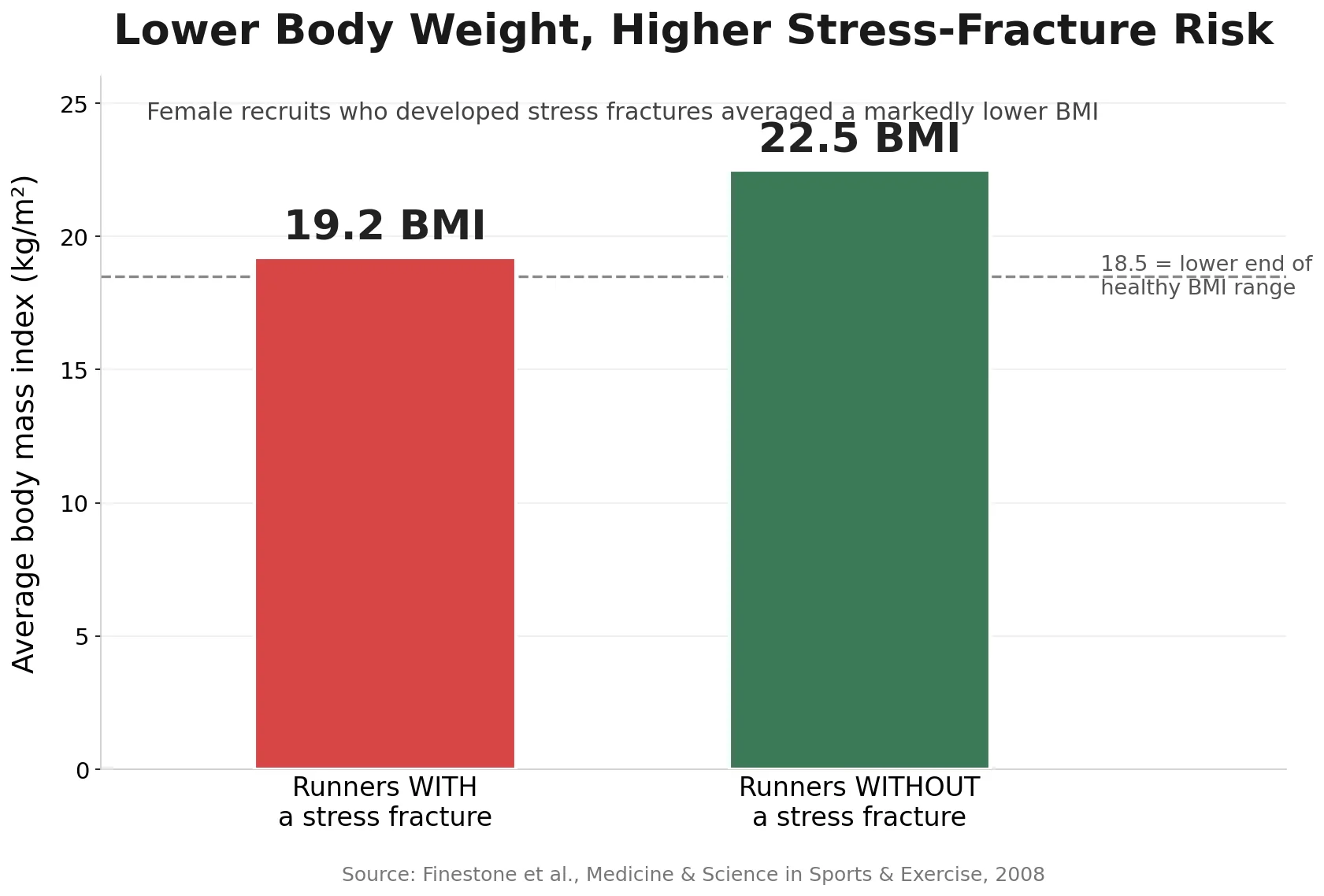
Research on female military recruits points the same direction, with stress-fracture cases averaging a lower BMI than those who stayed healthy.
Injury risk across the weight range looks less like a straight line and more like a U.
Very light runners face elevated bone-stress risk, the broad middle sits lowest, and higher loads climb again on the other side.
What Predicts Running Injuries the Most?
If the scale is a weak signal, the strong signals deserve your attention instead.
Two things dominate the research on running injuries: a recent injury and how fast you add mileage.
In recent tracking data, runners with a BMI above 30 who also had a running problem in the previous three months carried close to a 71% risk of a new injury, far above lighter runners with no recent problem.
A previous injury within the last few months tells you a tissue has not fully recovered.
That recent history is the signal that deserves your caution, well ahead of the number on the scale.
A sharp rise in weekly mileage is the other classic trigger, and a review of training errors ties sudden jumps in volume to running injuries.
When the load outruns your body’s ability to rebuild, the tissue you stressed fastest is the one that gives way.
This is why runners at the same weight can have completely different injury histories.
The one who ramped up slowly and stayed healthy last season is in a far better position than the one who did neither.
RunnersConnect Bonus
Download your FREE Injury Assessment and Prediction Video now.
A good injury prevention program starts with assessing where you’re weak and where you might be tight or inhibited. In the video I’ll demonstrate the six mobility tests you need to perform to assess what you need to begin working on.
How Can Heavier Runners Reduce Their Injury Risk?
The number on the scale is not the lever you should be pulling, so pull the ones that work.
The highest-risk runners in recent data had something in common beyond weight.
They carried a higher BMI and were already nursing a recent running problem when they pushed on.
That combination is the one to respect, and it points straight at how you manage your early weeks.
Start with less running than you think you need. Beginners with a higher body weight raised their injury risk when they ran more than about 2 miles, or 3 kilometers, in their first week.
Build volume slowly. Small, patient weekly increases give your tendons and bones time to catch up to your ambition.
Use walk breaks early. Alternating running and walking lowers the total pounding while you build durability.
Respect a niggle. If you are coming back from a recent injury, treat that history as your real risk factor and ease back in with a plan, which is exactly what our guide on returning to running after injury is built for.
None of this asks you to shrink first before you are allowed to run.
If weight loss is your goal, running can help you get there, and our guide on running and weight loss shows how to do it without wrecking your training.
Running safely comes down to managing your training load and protecting any recent injury, whatever the scale says.