

Ask a trainer for a core routine and you will probably get crunches, sit-ups, and a plank held until your abs shake.
For a runner, that advice targets the wrong muscles.
The core that keeps you injury-free and running tall is mostly hips, glutes, and deep trunk stabilizers, not the six-pack on the front of your stomach.
Research on injured runners keeps pointing to the same weak links, and none of them are your abs.
Here is what you’ll learn:
- Which muscles actually make up a runner’s core
- Whether sit-ups and crunches are worth your time
- How weak hips lead to common running injuries
- How core strength affects your pace and form
- The five core exercises that give runners the most return
What Actually Counts as Your Core When You Run?
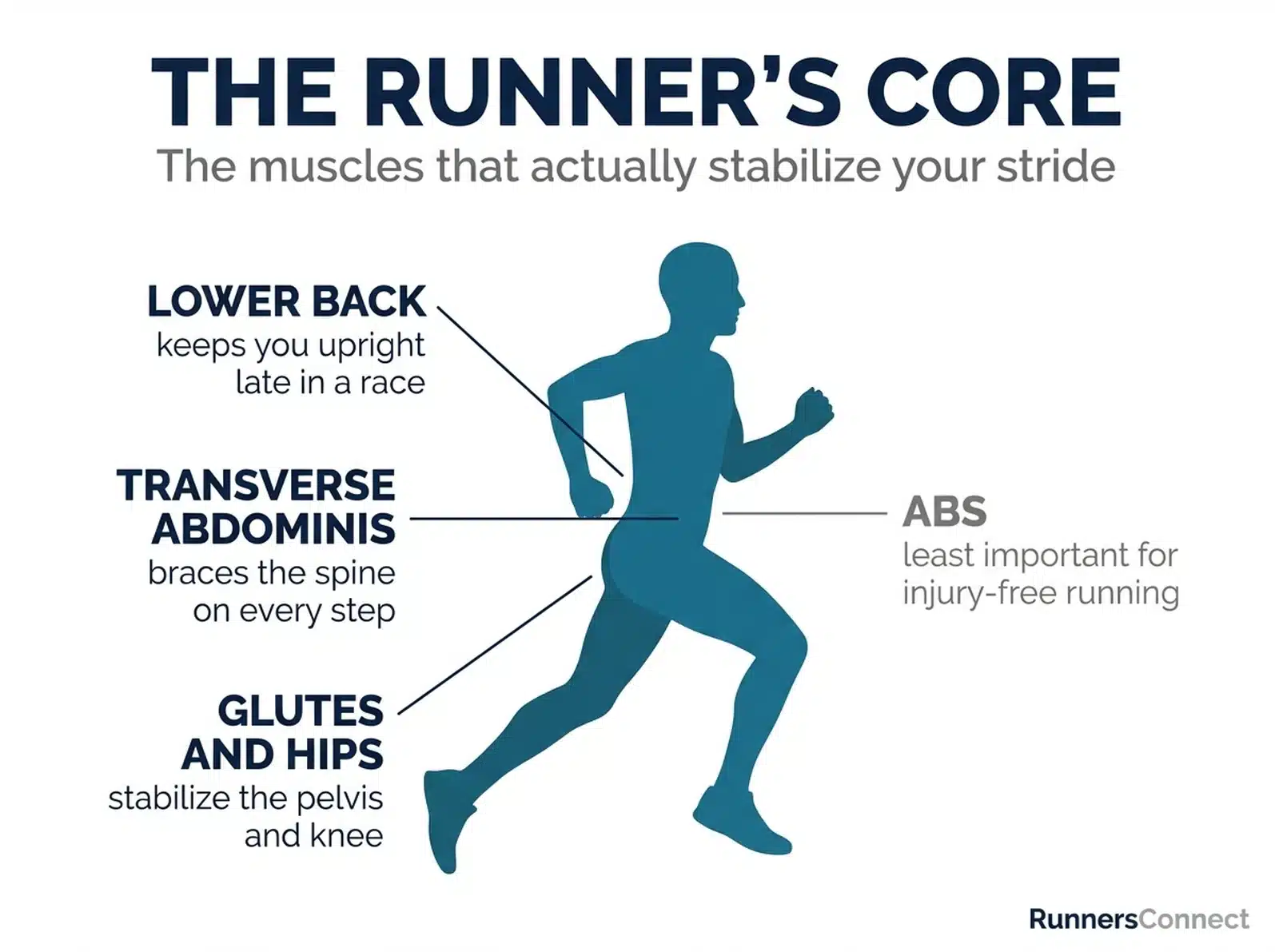
Your running core is every muscle that stabilizes your trunk and pelvis while your arms and legs move.
That means your hip flexors, abductors, and adductors, your glutes, your lower back, and the deep transverse abdominis, not just the abs you can see.
The transverse abdominis wraps around your midsection like a belt and braces your spine before each footstrike.
Your erector spinae runs up your lower back and keeps you from folding forward as a race wears on.
Your hips and glutes control side-to-side motion so your knees track straight instead of collapsing inward.
A runner’s core is a stability system for the pelvis, and the strongest muscles in it are the ones you cannot see in the mirror.
Are Sit-ups and Crunches Good for Runners?
Sit-ups and crunches build the rectus abdominis, the muscle least connected to staying injury-free.
Your abs look impressive at the beach, but they do little to control the pelvis while you run.
Crunches also flex your spine forward hundreds of times, which does nothing to train the bracing action running actually demands.
You do not need to avoid ab work, but building a routine around sit-ups spends your time on the wrong target.
The muscles worth training are the hips, glutes, and deep stabilizers that hold your form together late in a run.
Sit-ups are the least useful core exercise for a runner trying to prevent injuries.
Why Does Weak Core and Hip Strength Cause Running Injuries?
When your hips and pelvis cannot stay stable, the load shifts to tissues that were never meant to absorb it.
Researchers found that injured runners had measurably weaker hip abductors and hip flexors on their injured side compared with their healthy side.

That weakness lets the pelvis drop and the thigh rotate inward with every stride.
Over thousands of steps, that small collapse is what drives common running injuries like IT band pain, runner’s knee, and piriformis problems.
The pattern shows up in knee pain too, where women with patellofemoral pain tested weaker in hip abduction and external rotation than pain-free women, according to a study in the Journal of Orthopaedic and Sports Physical Therapy.
The knee often takes the blame, but the breakdown usually starts one joint higher.
RunnersConnect Bonus
Download your FREE Hip Strengthening Exercises Guide.
Download a video version of the 5 most effective hip exercises for runners. You’ll get full descriptions on how to perform and a video to help guide you.
Does a Strong Core Make You a Faster Runner?
A stable trunk keeps your energy moving forward instead of leaking into wasted motion.
In a randomized controlled trial, fatiguing the trunk and upper body worsened runners’ running economy, meaning they burned more oxygen at the same pace.
When your core tires, your posture sags and your stride loses the tension that returns energy to the ground.
A core that holds its position late in a race lets you keep good mechanics when tired runners around you are falling apart.
That is where core work pays off for performance, not in a flatter stomach but in a stride that stays efficient under fatigue.
What Are the Best Core Exercises for Runners?
The most effective routine trains the hips, glutes, and deep stabilizers instead of isolating the abs.
After a six-week glute-strengthening program, Stanford researchers reported that 22 of 24 runners with IT band syndrome returned to pain-free running.
Start with these five moves two or three times a week and build from there.
Bent-Knee Plank
This plank variation drives one knee toward your chest to engage the hip flexor in a running-specific position.
Hold the bent-knee position for up to 60 seconds while keeping your lower back flat.
Brace your deep core so your hips neither sag toward the floor nor pike up toward the ceiling.
Clamshells
Clamshells isolate the gluteus medius, the exact muscle Stanford found weak in runners with IT band pain.
Lie on your side with your knees bent and lift your top knee while keeping your feet together.
Keep your pelvis stacked and square rather than rolling backward, which is the easiest way to cheat the movement.
These are the same hip drop exercises that address the collapse behind so many overuse injuries.
Hip Thrusts
Hip thrusts load the glutes, hamstrings, and lower back as one connected posterior chain.
Drive your hips up until your body forms a straight line from knees to shoulders, then lower under control.
Perform 15 to 25 repetitions, and progress by resting one foot on a ball for a balance challenge.
Banded Balance Drill
This drill trains the hip abductors while sharpening the balance that keeps your footstrike stable.
Loop a band around one ankle and move that leg out to the side while balancing on the other foot.
Keep the working leg perpendicular to the ground rather than letting it tilt inward.
Side Plank
The side plank hits the obliques, adductors, and hip abductors that stop your trunk from twisting as you run.
Hold a straight line from head to feet for up to 60 seconds without letting your hips drift down.
Beginners can rest on a bent lower arm, while stronger runners can lift the top leg for more demand.
How Often Should Runners Train Their Core?
Two or three focused sessions a week is enough to build and keep the stability that protects your stride.
Each session only needs 10 to 15 minutes, which fits easily after an easy run when your form is already warm.
Consistency matters far more than volume, because stability is a skill your nervous system reinforces through repetition.
Add difficulty by holding positions longer or removing a point of balance, not by piling on hundreds of crunches.
Short, regular core sessions build more durable running strength than one long ab workout ever will.



One Response
This is such a great and helpful article! I have been looking for something just like this. Time to incorporate these exercises into my routine! Looking forward to more posts from you.
Kathryn
ChicksDigRunning.com