

A lot of readers have been asking for articles on biomechanics and running form, and as this is an area of intense interest for me, I’m eager to do more writing on that front. But, because even basic questions of the “what is good form?” sort straddle the boundaries between scientific knowns and unknowns, my articles will necessarily take less of a “hard science” tack. Now, we aren’t tossing everything out and starting anew, but working on this front is going to require a bit more predicting and inferring than we’ve had to do in the past. That being said, I’m eager to jump right in.
Forward and back versus side-to-side movements in runners
When most people picture a runner with “good form,” a very specific type of image usually springs to mind: a young, lean runner gracefully floating along. Our mind’s “camera” inevitably shows a lateral view, which highlights a very peculiar kind of bias in how we think about running form: that it is primarily related to motion in what biomechanics researchers call the “sagittal” plane (essentially, forwards and backwards).
But much of what’s being revealed in high-tech biomechanics laboratories around the world has less to do with forward-backward motions like body lean and leg extension and more to do with side-to-side motions, particularly in the hip and knee. That’s where we turn our attention today.
Importance of side-to-side stabilization for runners
As one of my articles several weeks ago pointed out, many runners who suffer injuries have weak hip stabilizing muscles.1 Among these muscles, the ones which are most often weakened in injured runners are the abductors and external rotators. Aptly, they abduct and externally rotate the hip.
Interestingly, and perhaps not surprisingly, research by Irene Davis at the University of Delaware has shown that one good predictor of future injuries in healthy runners is a mechanical evaluation of hip mechanics: runners who have excessive hip adduction (opposite of abduction) and internal rotation are at an increased risk of developing injuries in the knee and IT band.2
The logic is pretty simple, then: weak abductor and external rotator muscles cause excessive adduction and internal rotation during running, since the hip muscles aren’t strong enough to resist the forces from ground impact.
Relationship between muscle strength and muscle function
Unfortunately for us, however, the relationship between muscle strength and muscle function isn’t perfect. Other findings indicate that the link between muscle weaknesses causing injury is weaker than we’d expect, because another factor plays a role: neural function.3
Essentially, this is the way in which you “choose” to run. I put “choose” in quotation marks because it isn’t usually a conscious choice, but rather it’s a repetition of neural patterns that are strongly engrained in your brain. You don’t have to think “move left leg, move right leg” when you run; it just happens. Of course, if we could peer into the brain’s raw instructions, it’d be a bit more complicated than “left, right, left.” It’d be something more along the lines of “fire iliopsoas at 40% strength, fire rectus femoris & gluteus medius at 70% strength” and so on.
In other words, it may be possible that your muscles are strong enough but just aren’t firing in a way that would prevent excessive adduction and internal rotation.
Davis’ lab at U Delaware has a high-tech treadmill that allows runners to see their hip adduction in real-time so they can learn what it feels like to run with a “proper” stride (or at least one which should reduce the risk of knee injury).4 This technology is very new and very expensive, so it’s not something most runners will be able to use in the near future. And it’s very tough to evaluate hip adduction on your own. But nevertheless, in my own experience, I’ve found that it’s productive to look for one of the other consequences of improperly firing hip abductors: hip drop.
Hip drop and running injuries
What I’ve labeled “hip drop” is more properly called “Trendelenburg gait,” not exactly a quick phrase you could shout at a high-schooler with deteriorating form in a cross country race.
Remember, during the “stance” phase of the stride, the body is supported by only one leg. So, when your right leg is planted, it means your entire left side is “cantilevered” over your left hip. If the right hip muscles aren’t firing correctly (either because of weakness or just bad neural patterns), the pelvis and upper body will tilt downwards on the left side.
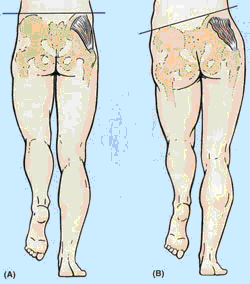
This is commonly demonstrated with illustrations (above), but is also fairly easily spotted in real runners too. The problem is usually exacerbated during races and long workouts, probably because your body as a whole is getting tired.
You don’t need a high-tech treadmill to spot hip drop. All you need is a friend you run with, or a treadmill plus a mirror or video camera. If you see excessive hip drop, see if you can consciously change it by focusing on “standing tall” and keeping your pelvis level. If you’re having trouble doing that, it probably means you’ve got weak hip abductors and external rotators. You can address that with some side leg lifts and “clamshell” exercises.
RunnersConnect Bonus
Download your FREE Hip Strengthening Exercises Guide.
Download a video version of the 5 most effective hip exercises for runners. You’ll get full descriptions on how to perform and a video to help guide you.
What Exercises Fix Hip Drop in Runners?
Five exercises target the hip abductors and external rotators with enough specificity to change how your pelvis behaves at mid-stance.
Research has shown that a targeted 6-week hip strengthening program reduced peak hip adduction during running, with improvements measurable on 3D motion analysis after just six weeks of consistent training.

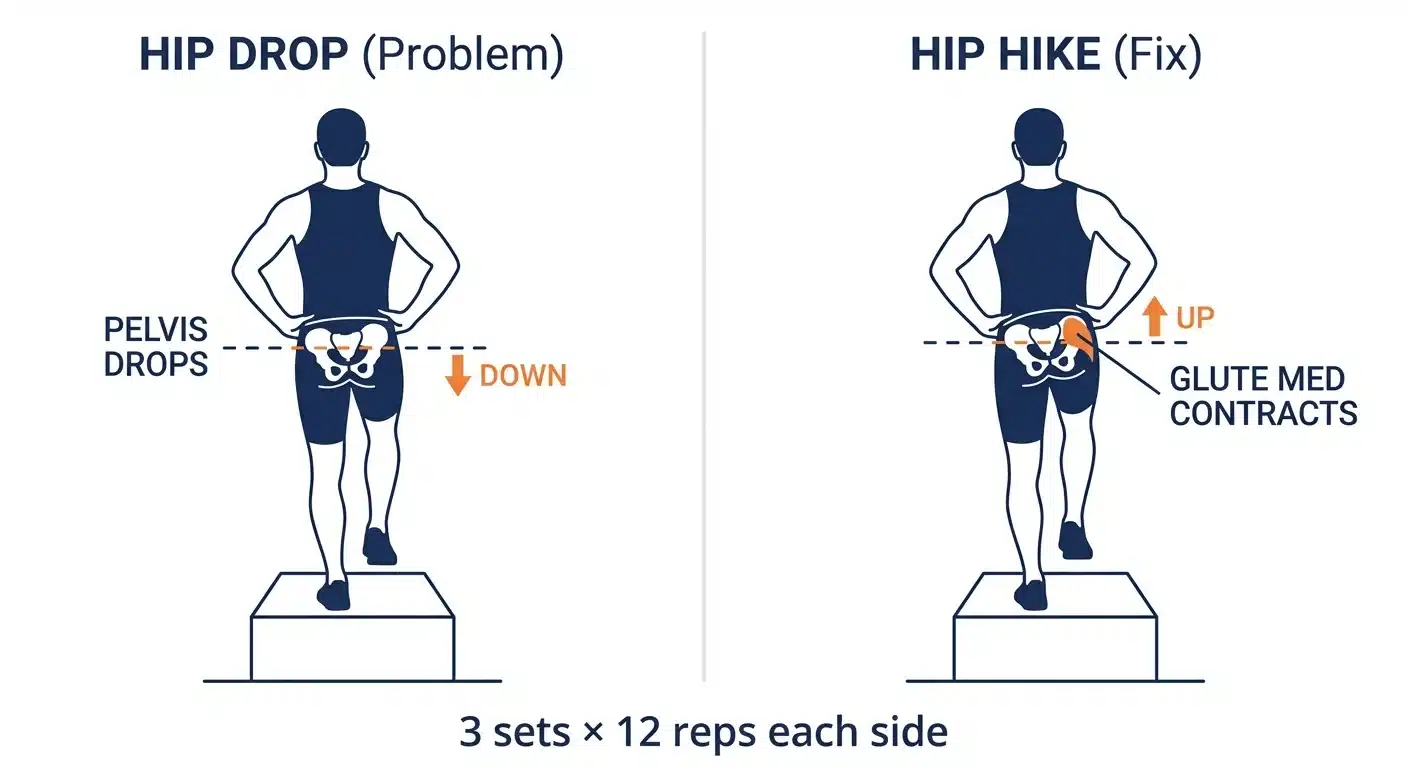
The key is choosing exercises that train the gluteus medius in the plane where it actually fails, not just in isolation on a table.
The single-leg hip hike is the most direct exercise for hip drop because it replicates the exact demand your hip struggles with at mid-stance.
1. Single-leg hip hike
Stand on a step or curb with one foot hanging off the edge.
Lower the hanging hip toward the ground by allowing the standing-side pelvis to drop, then drive it back up by contracting your standing-side glute.
Do 3 sets of 12 repetitions per side.
This is Trendelenburg gait in slow motion: you’re training the exact motion your hip fails to control during running.
2. Side-lying hip abduction
Lie on your side with your body in a straight line, bottom leg slightly bent for balance.
Lift the top leg to about 45 degrees, pause for two seconds at the top, then lower slowly.
Do 3 sets of 15 repetitions per side.
The two-second pause at top position recruits more of the posterior gluteus medius, the portion most commonly underactive in runners with hip drop.
3. Clamshells
Lie on your side with hips bent to 45 degrees and knees bent to 90 degrees, feet stacked.
Rotate the top knee open like a clamshell while keeping your feet together and pelvis still.
Do 3 sets of 20 repetitions per side.
To increase difficulty, add a resistance band just above the knees.
4. Lateral band walk
Place a resistance band just above both ankles and stand with feet shoulder-width apart, knees slightly bent.
Step sideways 15 steps in one direction, then 15 back without letting the band go slack between steps.
Do 3 sets in each direction.
This exercise trains the hip abductors under load while moving, which is closer to the dynamic demand of running than any static floor exercise.
5. Single-leg glute bridge
Lie on your back with both knees bent, feet flat.
Lift one foot off the floor, then press through the planted heel to raise your hips until your body forms a straight line from knee to shoulder.
Hold 2 seconds at the top, then lower.
Do 3 sets of 10 repetitions per side.
The single-leg version exposes any side-to-side strength imbalance and forces the standing-side hip to stabilize against rotational forces similar to those in running.
Perform this sequence 3 days per week on non-consecutive days.
Add strengthening your hip abductors as a sustained habit even after hip drop improves, since the weakness tends to return when the exercises stop.
How Long Does Hip Drop Take to Fix When Running?
The research points to about 6 weeks as the minimum before your hip mechanics change in a measurable way.
The reason it takes that long involves two separate processes happening at once.
The first is structural: your hip abductors and external rotators are physically getting stronger.
Muscle hypertrophy and strength adaptations require repeated loading over several weeks before force output improves enough to resist adduction forces during stance.
The second is neural: your brain’s movement patterns are being rewritten.
The article above explains that hip drop isn’t always a pure strength problem. The neural firing pattern matters too.
Changing an ingrained movement pattern requires weeks of repetition before the new pattern competes reliably with the old one during the fatigue and speed of actual running.
A useful way to track progress before 6 weeks is complete: run on a treadmill, record yourself from behind at 30-second intervals, and compare the footage to your baseline video.
Most runners see visible improvement in hip level by week 3 to 4, even though their running-speed mechanics won’t fully reflect it until week 6 or later.
Two factors slow progress significantly.
The first is skipping the single-leg hip hike. Runners who only do clamshells and band walks often stall because those exercises don’t replicate the single-leg stance demand closely enough.
The second is continuing high mileage while learning the new pattern, which means your old neural pathways keep getting reinforced hundreds of times per run.
If you are dealing with active knee or IT band pain, reduce mileage by 20–30% for the first 3 weeks while the strength and neural changes take hold.
Putting it all together
Hopefully this has been an informative, brief introduction to one aspect of “good running form” that’s fairly noncontroversial and easy to spot without high-tech equipment.
Hip drop is pretty common among runners (as is hip muscle weakness), so use a mirror, camera, or a friend to evaluate yourself to see if your hips tilt when you’re in the stance phase of your stride, particularly if you have had knee or IT band issues in the past.
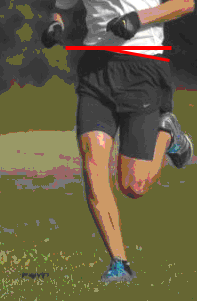
The runner pictured above, a teammate of mine in college, had IT band issues more than once during his college career, and fixed them only though rigorous strength work.
Now, we can’t yet say that the cause of his problems (or yours) was due to the abductors and external rotators, but a growing body of evidence and experience is pointing in that direction, and while hip drop may not be the best indicator of weak or dysfunctional abductors, it’s fairly accessible to all runners and eliminating it does not seem to have any real drawbacks either.
If you do find that your hips are dropping, you can fix it either by overriding your “natural” gait habits or by doing running-specific strength exercises to shore up your weaknesses. Fortunately, after practicing standing tall and keeping your pelvis level for a while, it will become automatic, overriding the old stride pattern in your brain.
Hopefully you’ve enjoyed this first foray into the sometimes-nebulous universe of what constitutes “good” running form, and I look forward to reading your comments and questions.




10 Responses
This is a great article. I have been working on changing my running form for a while now. By far the hardest part for me has been running with level hips. I have to consciously think about it. I am able to run longer distances each time before I get tired of it. I know that eventually it will become second nature. Thanks for the great article.
You’re welcome, Leon. I hope the exercises allow you to make the form changes long-term.
I have been in PT for weak hips for 6 months (!!) A mistake I made was when the PT first told me (months ago) that it was “weak muscles,” was continuing to run thinking to myself [wrongly], “I know how to ignore sore muscles…they’ll only get stronger.” I’ve ended up with stubborn tendinosis, specifically where the IT Band attaches to the Iliac Crest.
I took about a 30 day break whilst traveling – each time I tried to run while away, pain. I am now core strenghtening as well as trying (instinctively, w/o being told) to run with my hips square and pulled forward (not letting the lower back curve out) & it does help, but requires effort. Little did I know it was “hip drop” as you write about — that’s definitely what I have been doing & am grateful for this article.
Interestingly, I believe I had been spared this injury until now, despite being a 20-40 mile/week runner/marathoner for the past 25 years, because of an exercise that gets maligned by trainers & PTs — old-fashioned Army sit-ups, with the feet anchored/hands behind the head/ going all the way to the floor and all the way up. Doing hundreds of these sit-ups each week as part of my “job” (on active duty), plus push ups (which strengthen the core), I was more or less injury free. Now retired, I had slacked off, & the right hip started to “drop”, just like you describe.
I know serious athletes & PT schools poo-poo this old form of sit-ups, but I sure can feel it pulling & working the weaks spots (e.g., gluteus medius, hip flexor) when I do them, & it does help the abs. Perhaps another suffering (& aging!) runner reading this will want to try them. (along w/ push-ups/planks/clams/etc.) Sit-ups also can warn is where such hip-dropping is going to develop — my whole career, having to do 80 or so of these fast in 2 minutes, I always noticed that my butt would scoot over in one direction, to the side now injured w/ tendenosis. It’s odd how one side is weaker — the right, which I would have otherwise thought of as my dominate side.
Best wishes,
I have been asking so many people including doctors about my problem I am indebted to you guys, this was causing so much pain I was considering tapering off running a bit. I hope its okay that I repost this on my blog http://www.preliveson.com/ with proper credit to you all
Hi Samuel,
I am thrilled this post helped you so much. I really hope it kicks the nagging problem you’re having and allows you to continue running. There is nothing like being able to train pain-free and with peace of mind. Feel free to repost as long as you link back to use somewhere in the article. Good luck with your training!
Thank you for clearly explaining the hip drop issue and not only the permanent solution- strengthening exercises, but also the immediate fix of “walking tall”. Do you feel this is equally valid for not just runners, but also older folks who have ingrained postures. I have medial knee pain.
Thank you very much for this very informative article. It really helped a lot with my lower leg injuries. Now I can run with more confidence knowing that I won’t easily get injured when I run/jog if I continue to infuse hip exercises to my cross-training sessions and follow your tips religiously. 🙂
I think a friend of mine has the same problem.He has flat foot. Is there any solution? .
Helpful video. I am finding that flexing the foot to at least 45 degrees and pushing off while thinking about driving the knee straight ahead, standing tall, lifting my gaze to the middle distance, and aligning my posture and lean so that my entire body absorbs impact like a spring when my weight is on the ball of my foot, all of these things combine to take stress off the knees and calf. Currently I’m focused on walking 6.5 miles per day with good form, strengthening my lower back, calves, arches, and glutes, plus leg strength and flexibility training. I would be interested in hearing about differences between good walking form and good running form.