
Running in Wind: How Much It Slows You and How to Beat It

Jeff Gaudette, MS   |

Running in wind slows you down because the energy cost of air resistance rises with the square of the wind speed.

A substantial headwind costs roughly 12 seconds per mile, about 7 to 8 seconds per kilometer, while an equal tailwind gives back only about half of that.

That asymmetry is why an out-and-back route runs slower on a windy day even though you face the headwind for only half the distance.

Wind barely affects your run below about 9 mph, so a 6 mph breeze is not worth worrying about.

Run a strong headwind by effort rather than pace, shorten your stride, and save your hardest work for the tailwind leg.

Drafting a meter behind another runner removes up to 80% of wind resistance and is the most effective way to beat a headwind.

On a hot day a headwind can help more than it hurts by cooling your skin and holding your core temperature down.

You trained for months, the taper felt perfect, and then the forecast turns your race-morning excitement into dread.

A steady headwind is coming.

Wind is the one race-day variable you cannot control, and it does more to your finish time than most runners expect.

The good news is that the physics of running in wind are well understood, and a few smart adjustments win most of that lost time back.

Here’s what you’ll learn about running in windy conditions:

  • How much a headwind slows your pace
  • The rule of thumb for time lost per mile
  • When the wind is strong enough to move your run indoors
  • How to run into a headwind without wrecking your race
  • Why tucking behind another runner is worth the effort
  • When a stiff wind on a hot day works in your favor

Does Wind Slow You Down When You Run?

A headwind slows you down more than its speed suggests, because the energy cost of pushing through moving air climbs with the square of the wind speed.

Double the wind and you roughly quadruple the resistance you fight.

Researchers have now measured that penalty directly on treadmills fitted with horizontal pulling forces that mimic a headwind.

research
A 2022 study in the Journal of Applied Physiology found that every extra 1% of body weight in headwind-like drag raised the energy cost of running by about 6%.

You barely notice that penalty in a light breeze, but it grows large in a gale, which is why the same runner shrugs off a 5 mph wind yet struggles badly in a 20 mph one.

Wind also punishes your fast running more than your easy running.

At higher speeds you push more air out of the way every second, so a tempo run into a headwind feels far harder than an easy jog into the same breeze.

RunnersConnect Bonus

Download your FREE Temperature Calculator now.

It will help estimate how much your times will be impacted by hot weather. Find out exactly how much to adjust your summer workout and race paces.

GET MY CALCULATOR

How Much Time Does a Headwind Add per Mile?

A useful rule of thumb is that a substantial headwind, one blowing about as fast as you are running, costs you close to 12 seconds per mile, or roughly 7 to 8 seconds per kilometer.

A tailwind of the same strength gives back only about half of that.

research
Wind-tunnel research on runners showed that a headwind takes away roughly twice as much as an equal tailwind returns.

This is why an out-and-back route on a windy day always runs slower than the same route in calm air, even though you face the wind for only half the distance.

The headwind mile takes more from you than the tailwind mile pays back.

Wind strength Headwind cost Tailwind gain
Light (about 5 mph / 8 km/h) ~3 sec/mile (~2 sec/km) ~1 to 2 sec/mile
Moderate (about 10 mph / 16 km/h) ~6 sec/mile (~4 sec/km) ~3 sec/mile
Strong (about 15 to 20 mph / 24 to 32 km/h) ~12 sec/mile (~7 to 8 sec/km) ~6 sec/mile (~4 sec/km)

Treat these figures as estimates rather than precise math, since gusts and drafting both move the number.
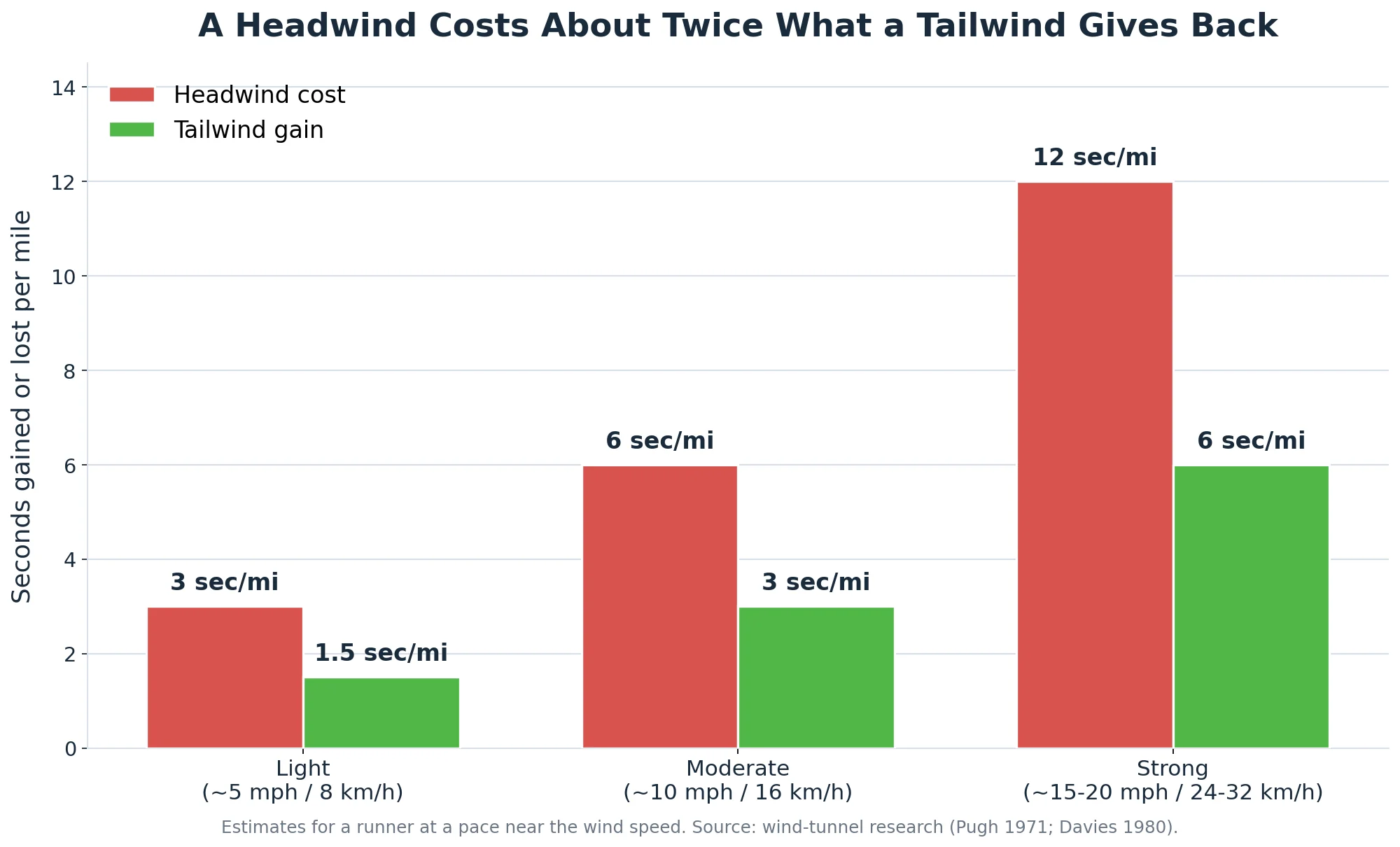
Bar chart showing a headwind costs about twice the seconds per mile that an equal tailwind gives back, at light, moderate, and strong wind speeds

When Is It Too Windy to Run?

Most easy runs are fine in wind up to about 20 mph, where the real questions are comfort and footing rather than raw pace.

Below a moderate breeze, the metabolic effect stays small enough to ignore.

A 2024 Loughborough University study found that wind only changed a runner’s oxygen use and heart rate once it reached about 4 meters per second, close to 9 mph or 14 km/h.

So a 6 mph wind barely deserves a thought, while a sustained 15 to 20 mph wind is where your effort and pacing need a real plan.

Move your run indoors when gusts exceed about 30 to 40 mph, when trees or power lines are down, or when wind chill pushes the real feel into dangerous cold.

Crosswinds deserve respect too, since a hard side gust can shove you toward traffic on an open road.

How Do You Run Into a Headwind Without Blowing Up?

Run a headwind by effort rather than pace, and let your watch show a slower number without trying to force it back down.

Holding goal pace into a strong wind burns energy you will need later in the run or race.

Shorten your stride and keep your cadence quick, which gives the wind less of your body to push against.

Lean a touch more from the ankles so you cut less profile into the air.

On an out-and-back or a loop, spend your effort on the homeward leg once the wind is at your back, rather than forcing the pace into the headwind.

Save your hardest effort for the tailwind section, where every bit of energy converts directly into speed.

The same effort-first approach that protects your race pacing on a hot day protects it on a windy one.

Should You Draft Behind Another Runner in the Wind?

Tucking in a meter behind another runner is the single most effective way to beat a headwind.

The runner in front breaks the air and leaves a pocket of calmer air for you to run in.

research
Classic wind-tunnel work by physiologist L.G. Pugh found that drafting close behind another runner removed up to 80% of wind resistance and cut the energy cost of that pace by about 6%.

That saving is why the pros run in packs on windy days, and why professional pacers line up to shield a record attempt.

You get most of the benefit within a meter or two, and even a partial shield from a taller runner helps.

In a race, share the work by rotating to the front for short stretches so no single runner carries the whole group into the wind.

Does Running in the Wind Help Cool You Down?

On a hot day a headwind is not purely a penalty, because moving air pulls heat off your skin and helps you hold your pace.

Still air trapped against your body on a windless day is one of the fastest ways to overheat.

The same Loughborough research that tracked oxygen use also showed that wind meaningfully changed how much heat runners shed while working hard.

A brisk headwind on a hot day can protect your pace more than it costs it by keeping your core temperature down.

This trade-off flips with the weather, so the wind you curse in cool conditions may be the wind that saves your hot weather running in summer.

Read the day before you judge the wind, then set your effort by the mix of heat and air rather than by either one alone.

Does running in wind actually slow you down?

Yes. The energy cost of pushing through moving air rises with the square of the wind speed, so a headwind slows you more than its speed alone suggests. Doubling the wind roughly quadruples the resistance you have to overcome. The effect is small in a light breeze and large in a strong wind, and it hurts your faster running more than your easy running because you displace more air every second at speed.

How much does a headwind slow you down per mile?

A substantial headwind, one blowing about as fast as you are running, costs a typical runner close to 12 seconds per mile, or roughly 7 to 8 seconds per kilometer. A lighter wind of around 10 mph costs closer to 6 seconds per mile. These are estimates rather than precise figures, since gusts, terrain, and drafting all change the number on any given day.

Is 6 mph wind a lot for running?

No. A 6 mph wind is barely worth a second thought for most runs. Research found that wind only started to change a runner’s oxygen use and heart rate once it reached about 9 mph, or 4 meters per second. Below that, the metabolic effect is small enough to ignore, and you should run your normal effort without adjusting anything.

When is it too windy to run?

Most easy runs are fine in wind up to about 20 mph, where the main concerns are comfort and footing rather than pace. Move your run indoors when gusts exceed about 30 to 40 mph, when trees or power lines are down, or when wind chill pushes the real feel into dangerous cold. On open roads, treat strong crosswinds with extra caution, since a side gust can push you toward traffic.

How do you run into a strong headwind?

Run by effort instead of pace and let your watch show a slower number without chasing it. Shorten your stride slightly, keep your cadence quick, and lean a touch from the ankles to cut a smaller profile into the air. On an out-and-back route, spend your energy on the homeward leg once the wind is at your back rather than fighting to hold pace into the headwind.

Does drafting behind another runner help in the wind?

Yes, and it is the most effective thing you can do. Tucking in about a meter behind another runner removes up to 80% of wind resistance and cuts the energy cost of that pace by roughly 6%. The runner in front breaks the air and leaves a calmer pocket for you to run in. In a race, rotate to the front for short stretches so the group shares the work.

Does a tailwind make up for a headwind?

Not fully. An equal tailwind gives back only about half of what the headwind took away, so an out-and-back route always runs slower on a windy day. The headwind mile costs you more than the tailwind mile pays back. This is why races on windy days tend to produce slower times overall, even for runners who face the wind for only half the course.

Does running in the wind help you cool down?

On a hot day, yes. Moving air pulls heat off your skin and helps hold your core temperature down, which can protect your pace more than the wind costs it. Still air trapped against your body on a windless, humid day is one of the fastest ways to overheat. The trade-off flips with the weather, so the same wind that slows you in cool conditions may help you in the heat.

Jeff Gaudette, M.S. Johns Hopkins University

Jeff is the co-founder of RunnersConnect and a former Olympic Trials qualifier.

He began coaching in 2005 and has had success at all levels of coaching; high school, college, local elite, and everyday runners.

Under his tutelage, hundreds of runners have finished their first marathon and he’s helped countless runners qualify for Boston.

He's spent the last 15 years breaking down complicated training concepts into actionable advice for everyday runners. His writings and research can be found in journals, magazines and across the web.

Pugh, L. G. C. E. “The Influence of Wind Resistance in Running and Walking and the Mechanical Efficiency of Work against Horizontal or Vertical Forces.” Journal of Physiology, vol. 213, no. 2, 1971, pp. 255-276.

Davies, C. T. M. “Effects of Wind Assistance and Resistance on the Forward Motion of a Runner.” Journal of Applied Physiology, vol. 48, no. 4, 1980, pp. 702-709.

da Silva, Edson Soares, Rodger Kram, and Wouter Hoogkamer. “The Metabolic Cost of Emulated Aerodynamic Drag Forces in Marathon Running.” Journal of Applied Physiology, vol. 133, no. 3, 2022, pp. 766-776.

Yamashita, Naoyuki, Cynthia L. Ly, James W. Smallcombe, Simon Hodder, and George Havenith. “Air Speed and Direction Affect Metabolic and Thermoregulatory Responses during Walking and Running in a Temperate Environment.” Journal of Applied Physiology, vol. 137, no. 3, 2024, pp. 553-566.

Picture of Who We Are

Who We Are

Your team of expert coaches and fellow runners dedicated to helping you train smarter, stay healthy and run faster.

We love running and want to spread our expertise and passion to inspire, motivate, and help you achieve your running goals.

4 Responses

Leave a Reply

Your email address will not be published. Required fields are marked *