

You’re at mile 20 of your marathon. Your legs feel like concrete blocks.
Your goal pace has felt manageable all day, but suddenly your quads are disconnected from the rest of your body. You try to push, but your legs won’t respond.
Dead legs are distinct from cramping, where your muscles involuntarily seize. They’re also different from bonking, where you hit complete glycogen failure and lose mental clarity.
Dead legs are what happen when your quadriceps specifically become so fatigued and depleted that they cannot generate the power and speed you need to maintain your goal pace. The good news is that dead legs aren’t inevitable.
They’re the result of specific physiological failures that you can prevent with the right training, nutrition, and race strategy.
So, in this article you’re going to learn the research-backed practical advice on:
- Why your quads specifically fatigue in the final miles of a marathon
- How glycogen depletion causes dead legs and how to prevent it with early fueling
- The role downhill running and eccentric muscle damage play in quad fatigue
- How strength training actually makes your legs resistant to dead leg fatigue
- Why your race pacing in the first 10K determines your leg health at mile 20
- The hydration and electrolyte strategy that prevents cramping and muscle fatigue
- Your personalized race-day fueling formula to keep your legs fresh when it matters most
Why Do Your Legs Go Dead During a Marathon?
Your quadriceps are the most powerful muscles involved in running. They absorb the impact of each footfall and generate the forward propulsion that moves you down the road.
During a marathon, your quads do more cumulative work than any other muscle group in your body. Dead legs happen because your quads reach a point where they cannot sustain the work you’re demanding of them.
This fatigue comes from three places working together: glycogen depletion, accumulated eccentric muscle damage from downhill running, and electrolyte imbalance.
Most runners experience dead legs around mile 18–22, not miles 5–10. This is because glycogen stores in the muscles last roughly 90 minutes of running at marathon pace.
For a runner completing a marathon in three to four hours, mile 18–20 is exactly when glycogen becomes critically low. Your quads are also the primary target of downhill running damage.
Early in most marathons, miles 10–16 often include net downhill elevation. Downhill running requires eccentric contractions, where your quads lengthen while actively resisting gravity.
This causes microscopic tears in muscle fibers that accumulate throughout the race. When glycogen depletion meets accumulated muscle damage and hydration imbalance, your quads fatigue faster and more completely.
The dead leg sensation is the end result of all three mechanisms working against you.
What Role Does Glycogen Depletion Play in Dead Legs?
Your muscles store carbohydrate as glycogen, which is the fastest, most efficient fuel for running. A well-fed marathoner stores roughly 90 minutes worth of glycogen at marathon race pace, which translates to approximately 20 miles.
Research has shown that marathon runners who depleted glycogen from slow-twitch muscle fibers showed a significant increase in quadriceps fatigue during consecutive contractions, even when maximal single-contraction strength remained intact.
Your quads preferentially use glycogen during running, especially at harder intensities. When glycogen runs low, your quads cannot generate the same force output they did earlier in the race.
Your muscles have enough contractile machinery to run faster than your goal pace, but without glycogen as fuel, they cannot generate the force output you’re demanding.
By mile 18–20, if you haven’t fueled consistently throughout the race, your quadriceps are competing with your cardiovascular system, your nervous system, and your other working muscles for whatever glycogen remains. Your quads lose that competition.
Your fueling strategy in miles 1–10 directly determines how your legs feel at mile 20.
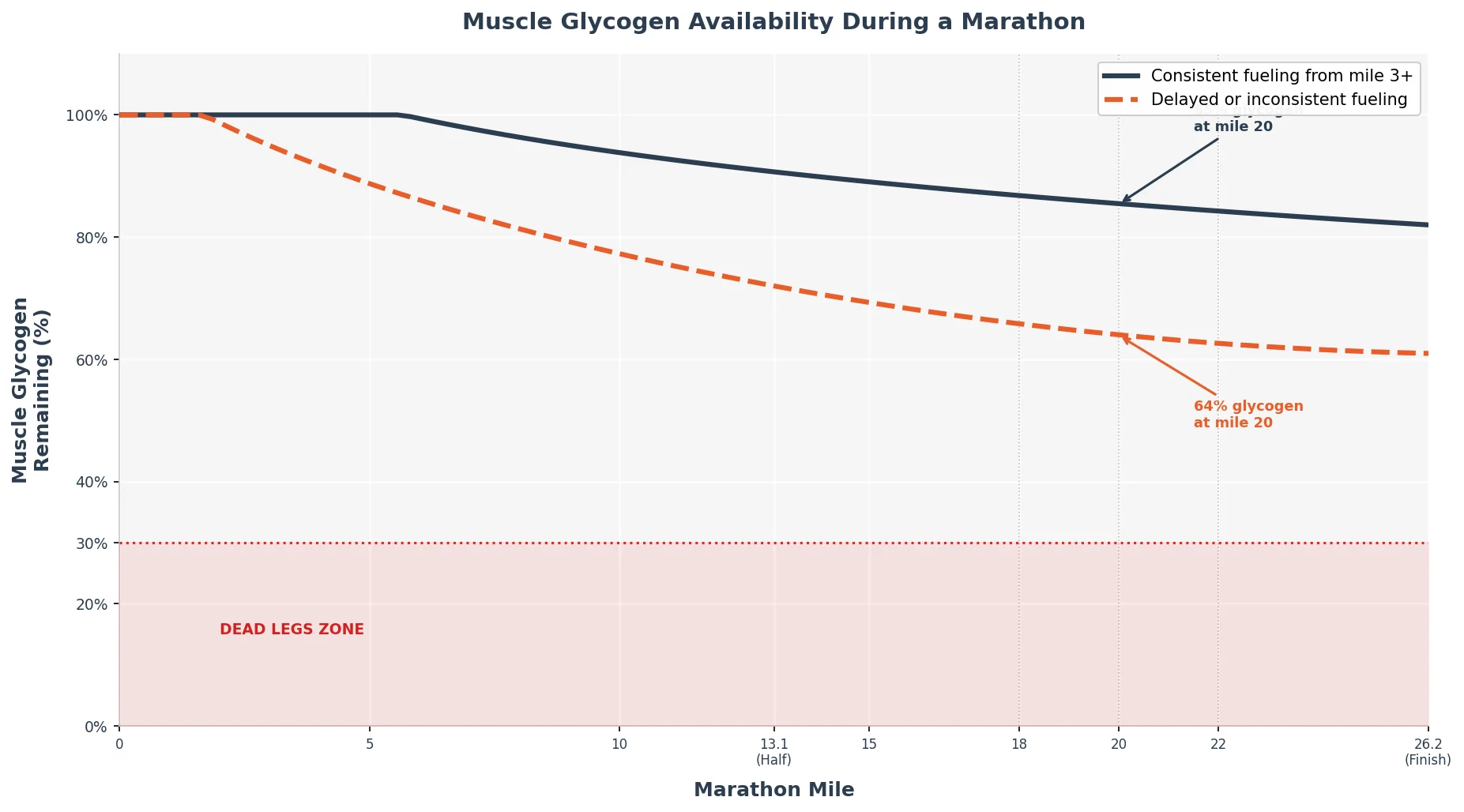
Most runners make the same mistake: they start racing without adequate fueling, thinking they’ll make up for it later. By the time they realize their legs are dying, they try to eat more.
But by mile 20, your quads have already burned through most of their glycogen stores and cannot absorb and utilize carbohydrates as efficiently as they could have earlier. The solution is deliberately frontloading your carbohydrate intake.
This doesn’t mean eating a huge amount at the start line. It means beginning to fuel at mile 3–4 while your quads are still strong and can efficiently process carbohydrates.
Consistent fueling from the early miles maintains glycogen levels in your muscles rather than waiting until you’re in crisis mode to refill empty tanks.
Ready For More?
Then start our FREE Race Day Fueling email course!
You’ll learn how to calculate when you’ll bonk, how to hydrate, what foods to eat during your race, and more! From case studies to scientific research, we’ll help you learn how to best fuel for your next race.
How Does Downhill Running and Eccentric Damage Destroy Your Quads?
Downhill running places your quads in a disadvantaged position. When you run downhill, your quads must control your body’s descent against gravity.
This requires eccentric muscle contractions, where the muscle is actively lengthening while it’s contracting to resist that movement. Eccentric contractions cause microscopic damage to muscle fibers.
This damage is different from the metabolic fatigue caused by glycogen depletion. It’s physical damage to the muscle structure itself.
In a marathon, most of the downhill miles occur in the first half of the race, typically between miles 10 and 16. Your quads accumulate damage from these miles, and inflammation builds throughout the race.
By mile 18, your quads are already fatigued from the damage and inflammatory cascade caused by earlier downhill running. Damaged muscle tissue cannot store or access glycogen as efficiently.
The inflammatory response in your quads creates a secondary fatigue signal independent of glycogen availability. A quad that’s been damaged by eccentric loading is primed to fail when it also encounters glycogen depletion.
This is why race day dead legs are so often severe in marathons with significant early downhill sections. Your quads are working with a double disadvantage: accumulated eccentric damage plus depleted glycogen reserves.
Does Strength Training Actually Prevent Dead Legs?
Yes, and the mechanism is direct. Strength training increases the eccentric strength of your quads, which means your muscles can better resist the damage caused by downhill running and by the repetitive impact of 26 miles.
Strength training increases eccentric strength, which protects against downhill damage. It also improves glycogen storage capacity in your muscle tissue, giving you more fuel to start with.
Strength training also raises your muscle’s fatigue threshold, meaning your quads can sustain higher workloads before failure.
The key is eccentric-emphasis strength work, not general muscle building.
Exercises like back squats, walking lunges, step-downs from a box, deadlifts, and single-leg hip thrusts with slow, controlled lowering phases directly train the exact muscle actions your quads need to resist marathon fatigue.
Two strength sessions per week for 12 weeks before your marathon can meaningfully reduce quad fatigue in the final miles.
The timing of strength training matters. You want to build your strength base 8–12 weeks before race day.
In the final 4 weeks of marathon training, your volume increases significantly. Adding heavy strength training during peak mileage weeks creates too much cumulative fatigue.
The goal is to have strong, resilient quads going into your race, not to be fatigued from recent heavy lifting. Integrate strength sessions on your easy or recovery running days, never on the same day as hard workouts or long runs.
A typical week might have strength training on Tuesday and Friday, with hard running efforts on Wednesday and Saturday.
How Does Race Pacing Impact Dead Legs Later in the Marathon?
Race pacing directly determines quad fatigue severity. Running too fast in the first 10K accelerates glycogen depletion in your quads and increases the intensity of eccentric damage from early downhill miles.
At faster paces, your quads burn glycogen preferentially over fat. A marathoner who runs the first 10K at 30 seconds per mile faster than goal pace will deplete quad glycogen significantly faster than someone running an even split from the start.
By mile 15, that runner has already burned through a disproportionate amount of their quad fuel reserves.
Faster pacing early in the race also increases impact forces, which means greater eccentric loading on your quads during the downhill miles.
Faster running on downhill sections creates more muscle damage than conservative running on the same terrain.
Even 30 seconds faster per mile in miles 1–10 means meaningfully accelerated glycogen depletion and greater muscle damage by mile 15.
The pacing strategy that best preserves your quad health is an even-split or negative-split approach. This means running the first half of the marathon at the same pace as the second half, or actually running the second half faster than the first half.
This approach keeps your quads from burning through glycogen too quickly early on and reduces the eccentric loading on your quads during the inevitable downhill sections. If your goal is to run a 3:45 marathon, that means targeting 8:33 per mile for the entire race, not racing the first 10K at 8:15 pace.
The runner who executes the even-split strategy has much fresher quads at mile 20 than the runner who burned through their glycogen and accumulated damage in the first 10K.
What Role Do Hydration and Electrolytes Play in Dead Legs?
Dehydration reduces blood flow to your working muscles. When you’re dehydrated, your quads cannot access glycogen as efficiently because blood transport of carbohydrate to the muscle is compromised.
Dehydration also elevates your core temperature and accelerates fatigue signaling from your nervous system to your muscles.
Electrolytes, particularly sodium and potassium, regulate muscle function.
As you sweat during a marathon, you lose both water and electrolytes. If you replace water without electrolytes, your blood sodium concentration becomes diluted.
This impairs muscle contraction quality and increases cramping risk in large muscles like your quads. Quads are particularly vulnerable to electrolyte-related fatigue because they’re large muscles that generate significant force.
When your sodium levels drop and potassium becomes depleted, your quads are among the first muscles to seize up or to feel heavy and disconnected.
Aim for 16–20 oz of fluids per hour with electrolytes included, not plain water alone.
The interplay between dehydration, electrolyte loss, and glycogen depletion is important. Dead legs often feel worse in races where runners have fueled with carbohydrates but ignored hydration and electrolytes.
The carbohydrate is available, but without adequate hydration and electrolytes, your quads cannot efficiently utilize that fuel. Your hydration strategy should include consistent sodium intake, roughly 300–600 mg per hour.
This can come from sports drinks, electrolyte capsules, or real food like pretzels and salted foods at aid stations. The combination of steady hydration, consistent carbohydrate intake, and electrolyte replacement maintains the physiological conditions your quads need to keep producing power through mile 26.
How Should You Fuel on Race Day to Keep Your Legs Fresh?
Your race-day fueling strategy is the single most important factor you can control on race day to prevent dead legs. Most runners delay their fueling too long, trying to preserve calories or avoid stomach discomfort.
By the time they start eating, their quads have already burned through significant glycogen stores and cannot efficiently absorb and utilize the carbohydrates they consume. Begin fueling at mile 3–4, not mile 8 or mile 10.
At this point in the race, your quads are still strong and can efficiently process carbohydrates. Early fueling doesn’t mean eating a massive amount at one time.
It means starting a consistent, moderate feeding schedule while your digestive system is still functioning optimally and your quads can still use the fuel effectively. Target 60–90g of carbohydrates per hour, adjusted for your body weight and pace.
A 140-pound runner should aim for roughly 60–70g per hour. A 180-pound runner might need 80–90g per hour.
These numbers aren’t universal because they depend on your specific physiology, your pace, and your gut capacity.
Your carbohydrate sources should be a mix: gels provide dense carbohydrates in small volumes. Sports drinks deliver both carbohydrates and hydration simultaneously.
Real food like bananas, pretzels, and peanut butter packets offer variety that can prevent boredom and stomach issues from consuming only gels. Aim for a mix of simple and slightly more complex carbohydrates to sustain energy and improve palatability.
Include electrolytes with every fueling opportunity. Sports drinks naturally contain sodium, but gels often have minimal electrolytes.
If you’re consuming gels and water, add an electrolyte tablet or capsule to your water or consume salty food alongside the gel to ensure adequate sodium intake.
If you want those numbers dialed in for your specific pace and physiology instead of guessing from a chart, our Marathon Nutrition Blueprint has calculators that build an individualized fueling plan: carbs per hour, hydration, electrolytes, and carb-loading macros based on your data.
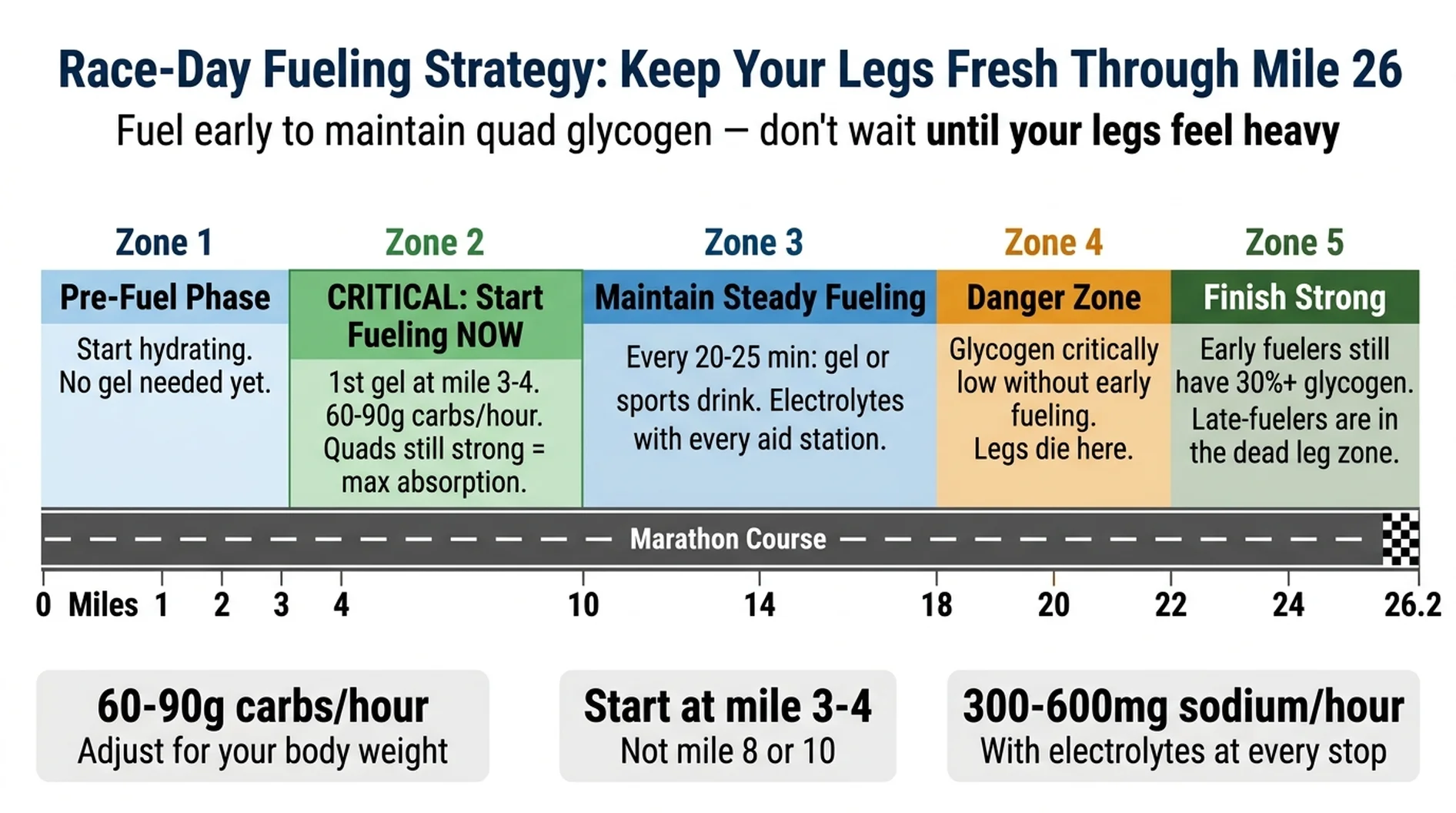
Your fueling strategy at miles 0–10 is the single biggest factor determining dead leg severity at mile 20.
The common mistake is trying to catch up on calories late in the race. By mile 18, if you haven’t fueled consistently, your quads cannot efficiently absorb carbohydrates.
Eating a huge amount at mile 20 won’t save your legs because your quads are already glycogen-depleted and cannot process fuel as rapidly or completely as they could earlier in the race. The solution is deliberate, consistent, front-loaded fueling.
Your quads need fuel early and steadily throughout the race. When your fuel is consistent from mile 3 onward, your glycogen stores never drop to critically low levels, your quads maintain their power output, and dead legs never develop.
What Strength Work Should You Do in the 4 Weeks Before Your Marathon?
In the final 4 weeks before your marathon, shift your strength training focus to heavy eccentric loading.
The goal is priming your quads to resist 26 miles of impact, downhill eccentric loading, and late-race glycogen depletion. Perform two strength sessions per week, focused on these exercises: back squats or leg press with emphasis on slow, 3–4 second eccentric lowering phases.
Add walking lunges with forward emphasis to load the quads. Include step-downs from an 18–24 inch box to train eccentric quad control.
Add Romanian deadlifts or conventional deadlifts for whole-leg strength, and single-leg hip thrusts with controlled eccentric descents. Use heavy load: weights that allow 6–10 reps per set with controlled form on the lowering phase.
Perform 3–4 sets per exercise. Rest 2–3 minutes between sets to maintain strength.
This is not endurance training. This is heavy strength work.
Heavy eccentric strength training in the final 4 weeks specifically prepares your quads for the downhill miles and glycogen-depleted final miles of your marathon.
Integrate these sessions on your easy or recovery days, never combined with hard running efforts. A typical week might look like strength on Tuesday and Friday, with easy running Monday and Thursday, a tempo run or workout Wednesday, and a long run Saturday.
Keep strength and high-intensity running on different days to avoid excessive cumulative fatigue. In the final week before your race, reduce the volume of strength work but maintain the load.
Perform one full session Monday or Tuesday, then drop to maintenance work Thursday if you need movement. Mostly rest and taper.
This protocol doesn’t require a gym. Pistol squats, jump squats with slow landings, and step-down drills using stairs all provide heavy eccentric loading for your quads with minimal equipment.
The key is the eccentric emphasis and the heavy load, not the specific exercise or equipment.
Ready For More?
Then start our FREE Race Day Fueling email course!
You’ll learn how to calculate when you’ll bonk, how to hydrate, what foods to eat during your race, and more! From case studies to scientific research, we’ll help you learn how to best fuel for your next race.
Can You Completely Prevent Dead Legs in Your Next Marathon?
Dead legs aren’t a badge of honor for pushing hard in a marathon. They’re a physiological failure that indicates inadequate preparation in one or more areas: strength training, race pacing, or fueling strategy.
The runner who prevents dead legs is the one who approaches the final 10K of a marathon with quads that are fresh, glycogen-supplied, and primed to produce power. This runner built eccentric strength in the weeks leading up to the race.
They paced conservatively in the first 10K to preserve glycogen. They fueled consistently and aggressively from mile 3 onward.
They maintained hydration and electrolytes throughout. Your next marathon doesn’t need to include dead legs.
Use the prevention strategies in this article: strength training now, pacing discipline on race day, and a fueling plan that starts early and stays consistent. Your quads will thank you at mile 22 when you still have power and speed instead of concrete legs holding you back from your goal.