

Within a few days of finishing a marathon, it’s normal to start looking at the race calendar again.
A great race makes you want to see how far your new fitness can go, and a disappointing race makes you want a second shot as soon as possible.
But your legs are still repairing muscle damage for weeks after the soreness is gone, and a second marathon squeezed in too soon leaves little time to get any fitter.
So, how long should you wait between marathons, and how many can you run in a year and still keep improving?
To answer that, here’s the research-backed practical advice on:
- How long your muscles take to recover after a marathon
- How many weeks to leave before your next marathon
- Why running the same marathon block on repeat stalls your progress
- How many marathons a year is healthy if you want to keep setting personal records
How Long Does It Take to Recover From a Marathon?
Your leg muscles take weeks to fully repair after a marathon, even though the soreness fades in a few days.
In a 1984 study, trained runners who set personal records in a marathon still had weaker leg muscles a full week later, even when they did no running at all that week.
Runners in the same study who ran 20 to 45 minutes a day at easy effort recovered their leg strength more slowly than the runners who rested.
The muscle damage behind that weakness is visible under a microscope.
Muscle biopsies from marathon runners showed damaged muscle fibers and mitochondria for days after the race, and that damage took 3 to 4 weeks to repair.

That means feeling fine 4 days after your marathon only tells you the soreness is gone.
Your muscle fibers still need weeks of repair before they’re ready for hard workouts and long runs.
Your risk of getting sick also rises after the race. A survey of Los Angeles Marathon runners found that 12.9% of finishers got sick in the week after the race, compared with 2.2% of similarly experienced runners who skipped it.
Easy running a couple of days after the race is fine. In a 2021 trial of 64 marathon finishers, runners who did 3 runs of 40 minutes at a comfortable aerobic effort, starting 2 days after the race, cleared the muscle damage markers from their blood just as fast as runners who rested completely.
The runners in that trial also jumped higher 4 days after the race than the runners who rested.
The 1984 study tracked leg strength over the full week, so the safest reading of both studies is that a few short, easy runs are fine, while anything harder waits.
So, after a marathon, give yourself 2 to 3 weeks of nothing but easy running before any workouts or long runs, and use a marathon recovery plan to bring your mileage back gradually.
RunnersConnect Bonus
Download your FREE Marathon Recovery Schedule for Runners.
It’s a PDF showing how to recover correctly in the 3 weeks post marathon, plus our cross training guide with over 20 sample workouts for the most common cross training types
How Long Should You Wait Between Marathons?
If you want to run your next marathon faster than your last one, leave at least 16 weeks between them.
Those 16 weeks have to cover 3 separate jobs: 2 weeks of recovery, at least 12 weeks of real marathon training, and a taper of about 2 weeks before the race.
Recovery and taper weeks don’t build fitness, so in a 16-week gap only the middle 12 weeks count as training.
As an example, schedule 2 marathons 10 weeks apart and the math leaves you just 6 weeks of training between your recovery and your taper.
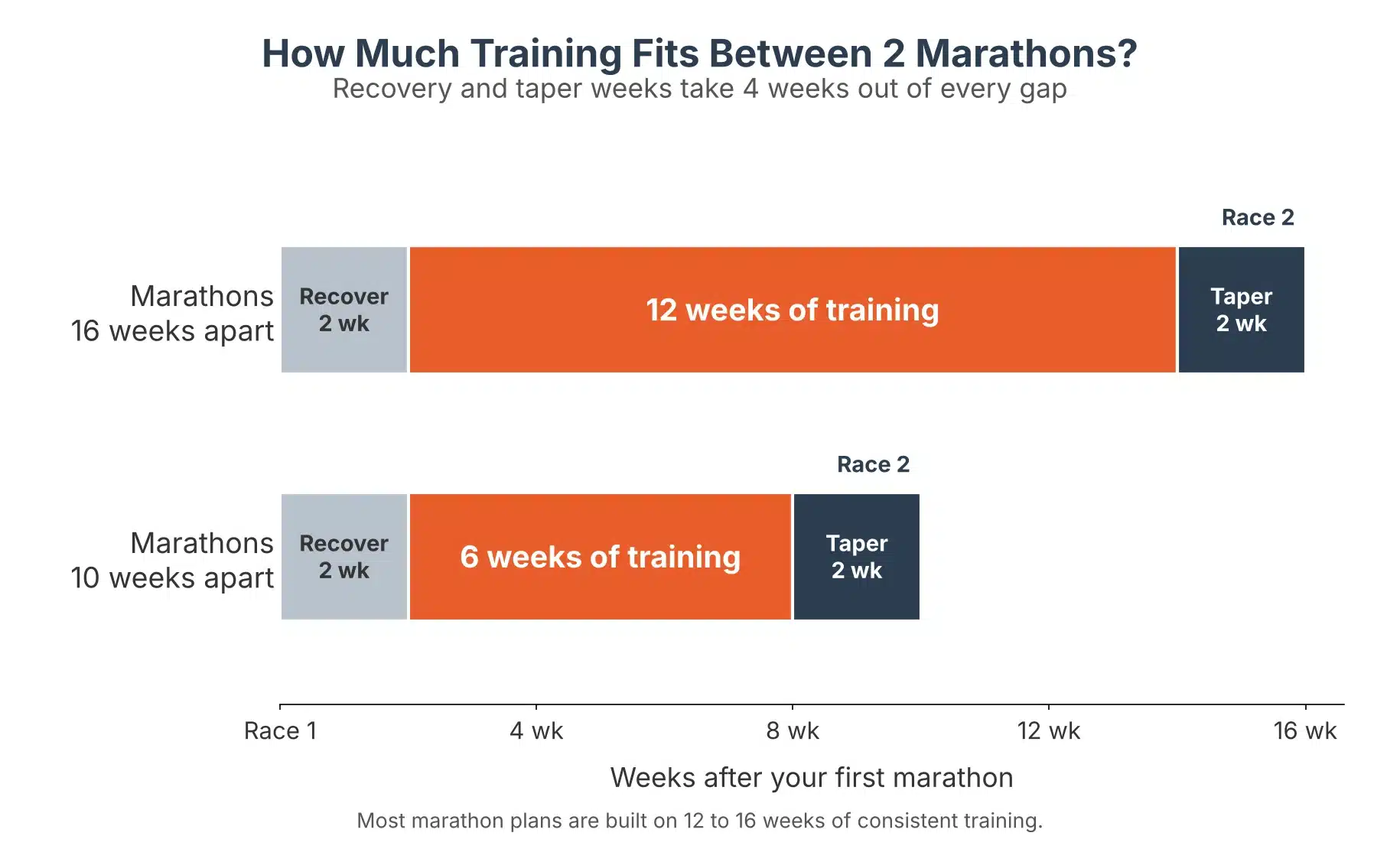
Those 6 weeks are enough for a few long runs and workouts, but they’re less than half of the 12 to 16 weeks of consistent training a marathon build usually takes.
A short gap also leaves no room for anything to go wrong. In an analysis of 300,000 recreational marathoners, runners who missed 7 or more days of training in the 16 weeks before a marathon finished 5 to 8% slower than they did in a marathon where they kept training consistently.
For a 4:00 marathoner, a 5% slowdown is about 12 minutes.
Plan on 16 weeks between marathons you want to race well: 2 weeks of recovery, 12 weeks of training and 2 weeks of taper.
Here is what different gaps between marathons leave you to work with:
| Weeks between marathons | Recovery | Training left | Taper | Best used for |
|---|---|---|---|---|
| 4 to 6 weeks | 2 weeks | 0 to 2 weeks | 1 to 2 weeks | Running the second race for fun or for the experience |
| 8 to 10 weeks | 2 weeks | 4 to 6 weeks | 2 weeks | A second shot at a time goal after a race that went wrong |
| 16 weeks or more | 2 to 3 weeks | 12 weeks or more | 2 weeks | Racing to set a new personal record |
Why Does Running Marathons Close Together Stall Your Progress?
Back-to-back marathon blocks train the same systems over and over, and your body stops adapting to a stimulus it has already adjusted to.
Marathon training focuses on your aerobic threshold, muscular endurance and fuel efficiency, with only a small amount of VO2max and speed work.
Researchers have measured how quickly fitness stops improving when the training stays the same.
A 1981 study found that people training 40 minutes a day, 6 days a week, raised their VO2max for the first 3 weeks and then stopped improving until the training got harder.
That means repeating the same marathon schedule and only changing the paces gives your body very little it hasn’t already adapted to.
Over a few years, a VO2max and running speed that never improve put a limit on how fast you can run a marathon, however many long runs you do.
Running a few months of shorter races between marathons fixes this, because 5K, 10K and half marathon training work directly on your VO2max and speed, which marathon training rarely does.
How Many Marathons Can You Run in a Year?
If you want to keep improving, plan on 1 or 2 marathons a year, or 3 marathons in 2 years.
That spacing gives you time to recover fully, build a complete marathon block for each race, and spend a few months on speed in between.
Racing a lot also adds to your injury risk.
In a study of 694 male marathon runners, 28% reported an injury in the month before or during their marathon.
The runners who had raced more than 6 times in the previous 12 months had 1.66 times the odds of getting injured as the runners who raced less often.
That means a crowded race calendar is one injury risk you can control when you plan your year.
Your legs bounce back from a half marathon much sooner, so you can race them more often.
In a 2020 study of recreational runners, jump height and muscle soreness were back to pre-race levels 48 hours after a half marathon, although peak leg force was still below normal.
That’s why half marathons, 10Ks and 5Ks fit well into the speed blocks between your marathons.
If your only goal is to finish, have fun and travel to new races, you can run more marathons than this, as long as you treat most of them as long training runs rather than all-out races.
For marathons you want to run fast, 2 a year is the limit that leaves room to recover, train fully and work on your speed.
What Does a Year With 2 Marathons Look Like?
A fall and spring marathon fit into one year with a recovery block and a speed block after each race.
Here’s what that cycle can look like:
| Months | Training focus |
|---|---|
| August to October or November | Marathon training, with mileage, aerobic development and marathon-specific workouts |
| November to December | Recovery, then building back to a good general level of fitness with strength work and strides |
| January to February | A short 4 to 5 week speed phase with a few 5K races and shorter, faster workouts while your mileage builds |
| February to April or May | Marathon training for your spring marathon |
| May to June | Recovery, then building back to general fitness with strength work and strides |
| July to September | Speed development or 5K and 10K training to work on your VO2max |
| September to December | Half marathon training to raise your anaerobic threshold before the next marathon cycle |
This cycle gives you one short and one longer block to work on your speed and VO2max each year.
The races in those blocks also give you a change from marathon training, so you start your next marathon build fitter and with fresher legs.
Can You Run 2 Marathons a Few Weeks Apart?
You can run 2 marathons 6 to 10 weeks apart, and plenty of elite and non-elite runners make it work.
This works best once, or maybe twice in a row, because the short block between the races only maintains your fitness rather than building it.
Treat the time between them as recovery followed by a few quality sessions and a short taper, and adjust your training using this guide to running back-to-back marathons.
After the second race, take your full 2 to 3 weeks of easy recovery and a speed block before you start your next full marathon build.




6 Responses
I found an inconsistency between this article and the one linked in the VO2 link above, where you say that VO2 is not important for marathon runners… ???
Not an inconsistency. You can’t just work on marathon specific systems/workouts all the time. You need to increase your general level of fitness as well. See the window blinds example.
Hi, I’ve just completed the Melbourne Marathon. I am doing my first ultra marathon in 3 months. It’s 56K. I am keen to start training asap as I only have 12 1/2 weeks of training left. How long should I wait before I run a 24k training run again. Also is it ok to go swimming this week when I’ve only just ran the marathon 2 days ago. Would appreaciate your help. Thanks.
Im way too late on this. But, I would have said go for it. The article makes a lot of good points and I agree with them. At the very same time I am getting ready to run my 5th marathon in six weeks. (Only real problem is I just get over a cold before the next run and promptly get another cold because my immune system is always getting slammed).
Give yourself enough time not to get ill and go for it! Cross training like swimming is also pretty easy on the body. (Its a hard activity but you should be able to do a bit of it!)
I hope your 56K was a success! I am about to do a 100k in January. (My first too) but you get 16 hours so my strategy is to run 10-12km an hour the first two hours than take a run 6.25 KM walk as much as I can every hour. (You need to average a 6.25km to finish but I will have built a pocket in the first two hours of about 1 hour 30 minutes.)
Good luck!
Hey! I have been looking for an article for awhile about running multiple marathons in the span of each week.
I know its possible now because I have officially run 4 marathons in 5 weeks. With two more in the next two weeks (6 in 7 weeks).
But, there are legit no articles about that kind of running.
What I have noticed so far is that im always sick for a few days.
I have also found that instead of getting slower I am getting faster. Well, at least with the last one.
Kanazawa – 4:44:54
Ibibgawa (Mountain run – 4:50:24 (Expected to be even slower only about 40% who started even finished).
Kobe – 4:53:?? – I had to use the bathroom over 12 times because I didnt see the running map and overconsumed water (They have like 30 stations and Im used to like 10 and thats part of my running strat but really screwed myself).
Fuji marathon (Another hilly run) 4:28:37
So, I was curious about the effects, training advice, etc for running back 2 back 2 back 2 back 2 back 2 back.
But, seriously NO ONE writes about it.
Another thing I have noticed is that now my legs feel like I havent ran at all the very next day which freaks me out.
They hurt after Kanazawa – Ibigawa and stopped hurting after Kobe and after Fuji. It felt like I had just done a normal training run. Its getting freaky.