

Swapping a run for a bike ride is one of the easiest ways to add aerobic training to a marathon build without adding more pounding to your legs.
But it’s fair to wonder whether an hour on the bike counts toward your marathon, or whether it only trains you for cycling.
The research answers that well for a few weeks of training, and less clearly for the long runs that decide how your last 6 miles (10 km) go.
So, in this article you’re going to learn the research-backed practical advice on:
- How much running fitness cycling builds
- Which runs you should never move to the bike
- How many runs a week you can safely swap
- When to drop the bike before race day
Is Cycling Good for Marathon Training?
Cycling builds aerobic fitness that carries over to running, as long as each ride is hard enough and long enough.
In a 1993 study, moderately fit runners trained 4 days a week for 5 weeks, either running every session or alternating runs with bike rides at the same heart rate.
Research has shown that runners who swapped half their sessions for cycling improved their VO2max and their 5,000 m (3.1 mile) time as much as runners who only ran.

Both groups raised their treadmill VO2max by about 3 ml/kg/min, and both could run faster at the same heart rate afterward.
A 2026 meta-analysis pooled 7 trials that compared running-only training with cycling or mixed training.
It found no meaningful difference in treadmill VO2max, or in time trials from 1 mile (1.6 km) to 5,000 m (3.1 miles).
So a ride at the right effort raises the same VO2max number your marathon fitness is built on.
The catch is that those trials lasted weeks rather than a full marathon build, and none of them tested a race longer than 5,000 m (3.1 miles).
Why Can’t Cycling Fully Replace Your Running?
Fitness from the bike carries over to running, but only partly, because your muscles adapt to the exact movement you train.
A 1994 review of cross-training studies found that the gains from training in another sport never exceed the gains from training in your own sport.
Runners also reach a higher VO2max on a treadmill than on a bike, and a 2009 review of triathletes concluded that more fitness likely transfers from running to cycling than from cycling to running.
Even a different sport adds some running fitness. As an example, an 8-week trial had well-trained runners increase their training by 10% a week, either by running more or by adding swim sessions.
The runners who added more running cut 26.4 seconds from their 2-mile (3.2 km) time trial, while the runners who added swimming cut 13.2 seconds.
Swimming is less like running than cycling is, yet it still added about half as much as the same extra time spent running.
Running is also the only training in your week that loads your bones, tendons and calves the way a marathon will.
Use the bike to add aerobic work or to replace an easy run, and keep the runs that teach your legs to race.
How Much of Your Running Can You Swap for Cycling?
Replacing 1 easy run a week with a ride is a conservative swap, and even replacing half your easy running held most of runners’ speed in one small study.
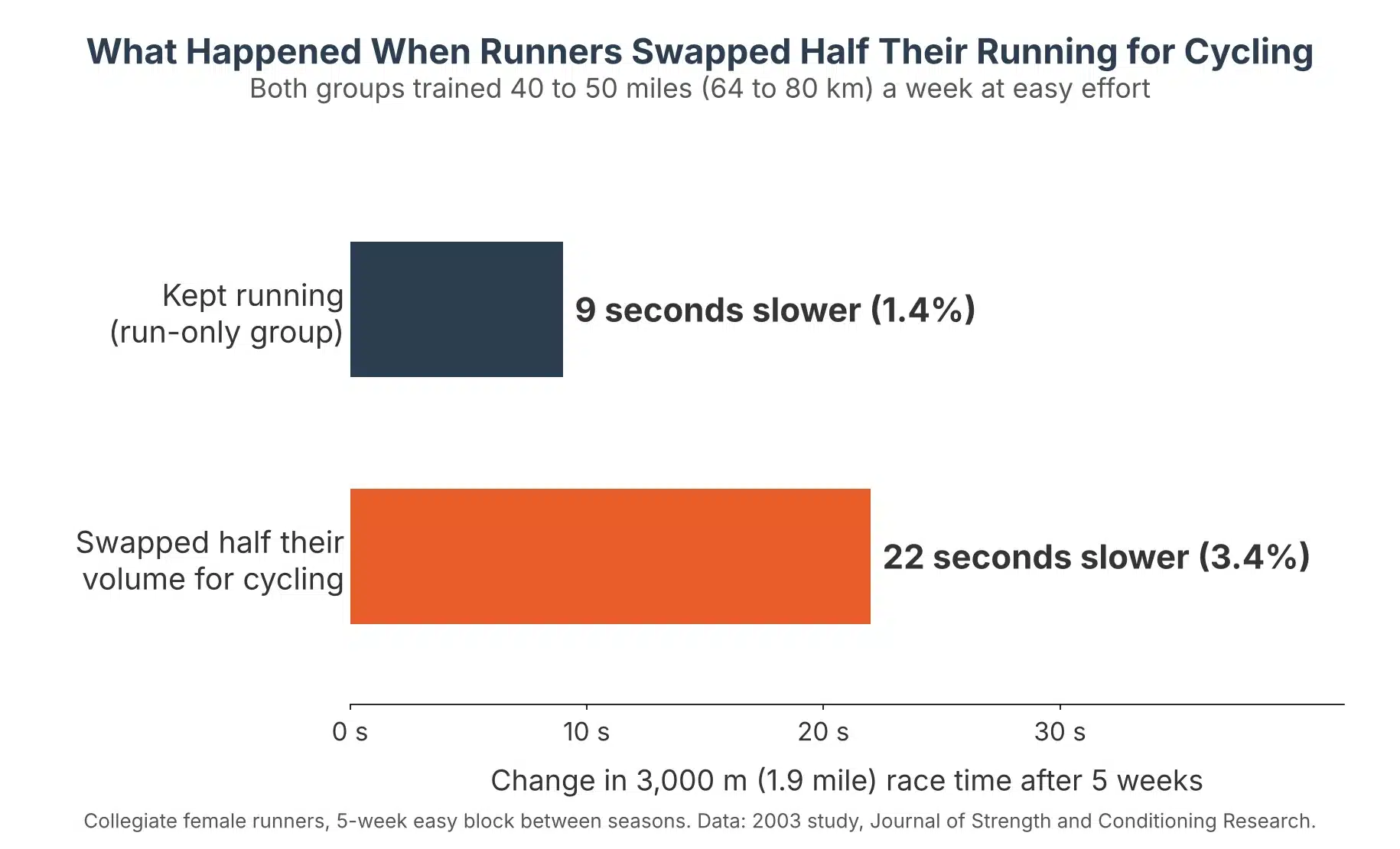
In a 2003 study, collegiate female runners kept training 40 to 50 miles (64 to 80 km) a week at easy effort for 5 weeks, and one group did half of that volume on a bike.
The runners who only ran were 9 seconds (1.4%) slower over 3,000 m (1.9 miles) at the end of the 5 weeks.
The group that cycled half its volume lost 22 seconds (3.4%).
That means a big swap at easy effort held most of the runners’ speed, although the cycling group lost a little more.
The runners in the 5-week study who alternated runs and rides kept improving, but every session was hard, at 85% to 90% of maximum heart rate, and the block lasted only 5 weeks.
For a marathon build, start by replacing 1 easy run a week with a ride of the same length and effort, or by adding 1 or 2 rides on top of your running.
Keep your long run, your marathon-pace work and at least 3 or 4 runs a week on your feet.
Can You Do Hard Workouts on the Bike?
Hard sessions on the bike improved 5 km (3.1 mile) time trials as much as the same sessions run on a track.
In a 1998 study, 20 well-trained runners kept their normal running and added 3 extra sessions a week for 6 weeks, either running them or riding them.
Two of the 3 extra sessions were intervals, including 5 repeats of 5 minutes at more than 95% of VO2max, and the third was a 50 to 60 minute steady effort.
One study found that runners who did their added sessions on a bike ran a 5 km (3.1 mile) time trial as fast as runners who did the same sessions running.
Long rides also leave your legs fresher than long runs.
The same 2009 review of triathletes found that long efforts cause more loss of leg strength and more fatigue in the nervous system after running than after cycling.
So a bike session, hard or long, can stand in for a midweek run when your legs are beaten up, but your marathon-pace runs and long runs should stay on the road.
Count a hard ride as one of your hard days, and put an easy day between it and your next quality run.
Can Cycling Keep Your Marathon Fitness When You’re Injured?
Cycling held running fitness for 6 weeks.
In a 1993 study, 32 trained young adults spent 6 weeks running, cycling or water running at the same frequency, duration and intensity.
All 3 groups lost a small amount of VO2max.
None of them got slower over 2 miles (3.2 km).
That means if an injury keeps you off the road but lets you pedal without pain, riding the same time and effort as your planned runs protects most of the fitness you’ve built.
Riding also cuts the hours you spend exposed to running injuries.
A 2015 meta-analysis found that everyday runners average 7.7 injuries for every 1,000 hours of running.
If the bike isn’t pain-free for your injury, this guide to the best cross-training for injured runners covers the other options.
RunnersConnect Bonus
Had to take some time off recently with an injury? Download our one-of-a-kind Performance Decline Calculator to find out what your estimated performance decline would be for any race distance.
When Should You Stop Cycling Before Your Marathon?
Cut your rides first when your taper starts, and keep your runs, including some at marathon pace, through race week.
A 2007 meta-analysis of 27 tapering studies found the best results came from a 2-week taper that cut training volume by 41% to 60% while keeping intensity and frequency the same.
None of those taper studies tested cycling.
So the research only tells you how much total training to cut, and it leaves the choice of which sessions to drop to you.
Because the bike adds less to your race than running does, the rides are the easiest volume to drop, and dropping most or all of them first lets you keep your runs while still making that cut.
A short, easy spin early in your taper is fine if your legs feel stale, but it doesn’t need to be there.
The rest of the process is in this guide on how to taper for a marathon.
In the last 2 weeks before your marathon, drop the bike before you drop any runs.
What Does a Marathon Training Week With Cycling Look Like?
Use this table to plan the bike in each phase of a marathon build.
| Phase | Rides per week | How to use them | Runs to keep on your feet |
|---|---|---|---|
| Base | 1 to 2 | Easy or steady rides added to your running, or in place of 1 easy run | Long run and most easy runs |
| Build | 1 | Replace 1 easy run with a ride of the same time and effort, or do 1 interval session on the bike when your legs are sore | Long run, marathon-pace run and 1 quality session |
| Peak | 0 to 1 | Easy ride only, on a recovery day | Every key run |
| Taper (last 2 weeks) | 0 to 1 | Cut rides first, and keep any ride short and easy | Shorter runs, with some at marathon pace |
| Injured (pain-free on the bike) | As many as your planned runs | Match the time and effort of the runs you’re missing | None until you’re cleared to run |