

One of the questions I get asked most often, from both new and experienced runners alike, is what to do during the rest period between hard interval repeats.
Do you stand around, walk for a bit, or just keep right on running?
The answer depends on how long your rest is and how hard the repeat was, and researchers have tested each option.
Here’s what you’ll learn about resting between intervals:
- How long to rest between intervals for different workouts
- When to stand, walk or jog during your recovery
- The best way to catch your breath, according to a 2019 study
- What to change when a workout isn’t going well
How Long Should You Rest Between Intervals?
For hard repeats of around 4 minutes, about 2 minutes of rest between each one is enough to hold your pace.
Researchers tested this with well-trained runners doing 6 repeats of 4 minutes on a treadmill set to a 5% incline, with 1, 2 or 4 minutes of rest between each one.
Research has shown that runners ran their 4-minute repeats faster with 2 minutes of rest than with 1 minute, and 4 minutes of rest made them no faster than 2.

With 1 minute of rest, the runners averaged 14.4 km/h, or about 6:42/mi (4:10/km).
With 2 or 4 minutes of rest, they averaged 14.7 km/h, or about 6:34/mi (4:05/km).
When the same runners picked their own rest without seeing a clock, they took an average of 118 seconds.
That means rest beyond about 2 minutes made the repeats feel a little easier without making them any faster.
How much rest you need also depends on what the workout is meant to train.
On VO2max repeats and threshold intervals, shorter rest keeps your heart rate and breathing up between repeats, so more of the workout is spent at the effort you’re training.
On short, fast repeats meant to build speed, a longer rest lets you run each one quickly and with good form.
The length of your rest changes what you should do during it:
| Rest length | What to do | Why |
|---|---|---|
| 30 to 60 seconds | Stand for 15 to 30 seconds, then get back to the start line | Standing still let people keep going more than twice as long on 15- and 30-second intervals |
| 1 to 3 minutes | Catch your breath, then walk slowly | Walking keeps blood moving through your legs without adding effort |
| 3 to 5 minutes | Catch your breath, then jog at a shuffle | An easy jog clears lactate from your blood faster than standing |
RunnersConnect Bonus
Stop guessing at workout paces. Enter your goal 5K time and get the exact splits for your intervals, tempo runs, easy days, and long runs.
Should You Stand, Walk or Jog Between Intervals?
Unless your training schedule says otherwise, what you do during the rest portion of your interval session should be based on how long the rest is and how you feel.
There are three things you can do during rest: stand, walk, or jog.
When Should You Stand Still During Your Rest?
Standing, or more accurately the hunched-over, hands-on-your-knees, sucking air pose, is the right choice when your rest is short, say 30 to 60 seconds.
In that case, standing for 15 to 30 seconds is a fine option, especially if you’re having a tough time with the workout.
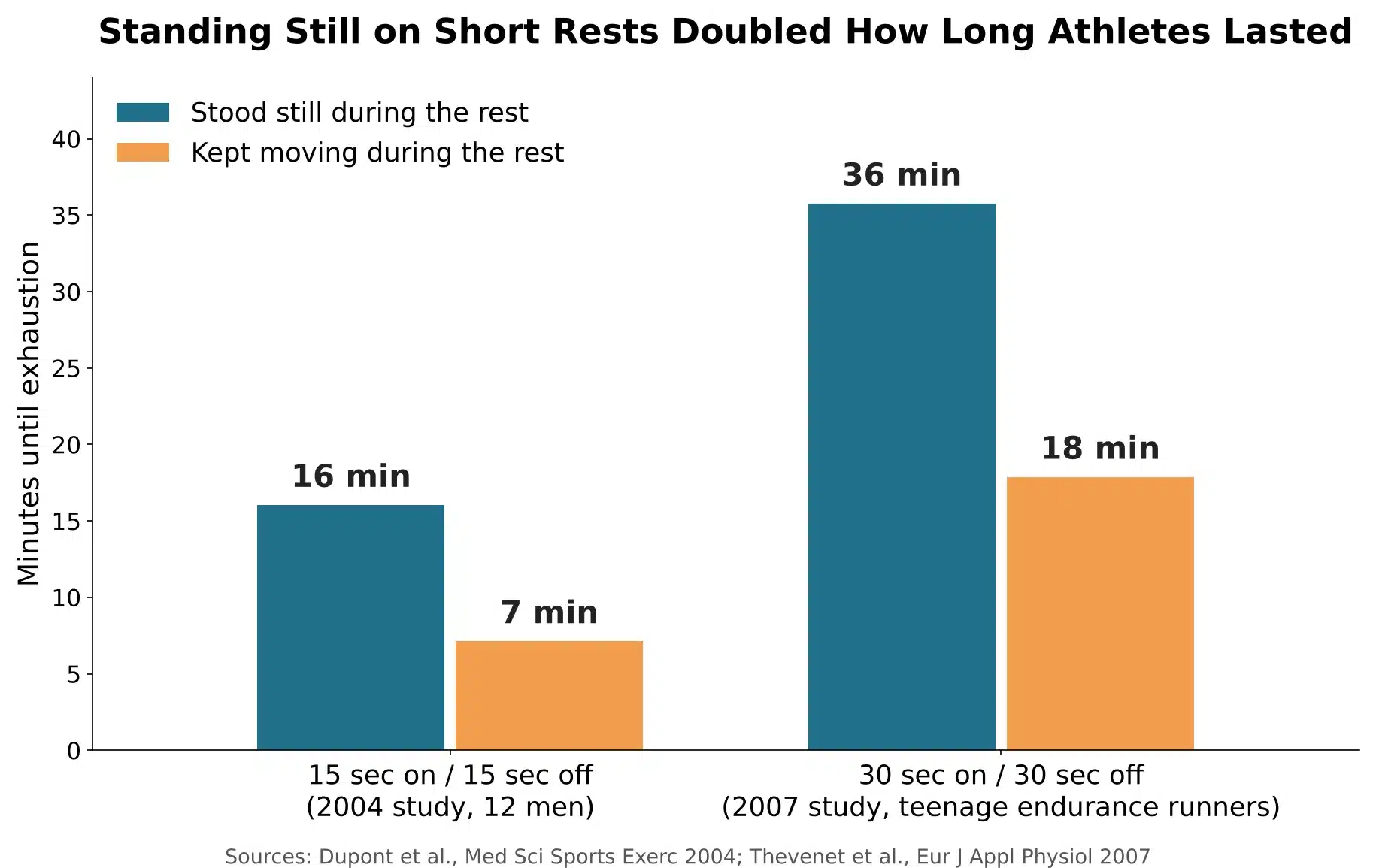
Researchers have even tested whether moving during short rests helps.
In a 2004 study, 12 men alternated 15 seconds of hard exercise with 15 seconds of rest until they couldn’t keep going.
When they stood still during the rest, they lasted about 16 minutes, or 962 seconds.
When they kept moving at a light effort during the rest, they lasted about 7 minutes, or 427 seconds.
Oxygen levels in their working muscles also fell more slowly over the workout when they stood still between efforts.
A 2007 trial in teenage endurance runners found the same thing with 30-second repeats and 30 seconds of rest.
The runners lasted about 36 minutes with standing rest and about 18 minutes when they jogged during the rest, and they spent about the same total time above 90% of their VO2max either way.
That means on rests of 30 seconds or less, standing still lets you finish more of the workout while getting the same training effect.
When Is Walking the Best Way to Rest?
Walking is usually the best option for rest periods between 1 and 3 minutes.
After the initial fatigue from finishing the previous repeat dissipates, begin to walk around slowly to help keep the blood flowing to your muscles.
Walking also makes it easier to catch your breath once you’re up off the hands-on-knees position.
When Should You Jog Between Intervals?
Sometimes you might have a rest that is anywhere from 3 to 5 minutes long, in which case a very slow jog after you’ve caught your breath is the best option.
A slow jog keeps blood flowing through your legs, and it clears lactate from your blood faster than standing still.
A 2010 study had runners recover from 5-minute repeats at 90% of their VO2max at different efforts, from standing still up to their lactate threshold.
Blood lactate dropped fastest when the runners kept moving at 80 to 100% of their lactate threshold effort, and slowest when they stood still.
The study measured lactate, not how fast the runners ran their next repeat, so I still keep the recovery jog slow.
In terms of pace, the jog should be more like a shuffle than a run.
Your goal during a recovery jog is to get as recovered as possible for the next repeat, not to set records or prove how tough you are.
I often find that a pace about 1 or 2 minutes per mile slower than your normal easy pace (about 35 to 75 seconds per km slower) is a good fit.
For some intervals, you’ll find that you don’t finish all that out of breath and don’t feel that fatigued, and this can be by design.
If this is the case, and you have longer than 90 seconds to rest, jogging is a good way to stay moving and make the workout feel more continuous.
Should You Put Your Hands on Your Knees or Your Head After a Repeat?
Bending over with your hands on your knees helps you recover faster than standing up straight with your hands on your head.
A 2019 study compared the 2 positions in 20 female college soccer players during the rest periods of a sprint interval workout.
Researchers found that during the first minute of rest, heart rate dropped by 53 beats per minute with hands on knees, compared with 31 beats per minute with hands on head.
The athletes also took in more air with each breath when their hands were on their knees.
The study was done in soccer players rather than distance runners, but the rest periods between sprints look a lot like the rest between hard running repeats.
So, for the first 30 to 60 seconds after a hard repeat, it’s fine to bend over with your hands on your knees until your breathing settles, then stand up and start walking.
What Should You Do If an Interval Workout Isn’t Going Well?
If the workout isn’t going well, you’re not able to hit the paces, you’re feeling terrible, or you just don’t have enough time to recover between repeats, you have 3 options.
- Slow down during the hard interval
- Lengthen the rest
- Quit altogether
Contrary to our intuition, in most cases, I think the best option is to slow down the repeat.
Unless the sole purpose of the workout is to develop your speed or to practice running at a certain pace, slowing down the interval and keeping the rest the same will better ensure that the workout hits the proper physiological systems.
Lengthening the rest also does less than you’d expect, because in the 2005 treadmill study, doubling the rest from 2 to 4 minutes didn’t make the runners any faster.
Remember, when a coach or training plan assigns a pace to a workout, it’s merely an approximation or guide for the effort you need to put in.
If the effort feels too hard, adjust the pace, not the rest.
Unless you feel that you’re going to die if you keep going, or you really know something is off, I don’t suggest quitting on the workout.
If you do have to bag it, don’t be too hard on yourself, because it happens to the best of us.
The important thing is to put the workout behind you and not dwell on it.
Don’t try to squeeze it in later in the week or make it up on another run.
If the workout went bad enough for you to have to stop, it means your body was giving you a sign.
If you have a coach, tell him or her and readjust the game plan if needed.



2 Responses
What about light stretching between interval repeats? Isn’t that an option?
Hello, yes that is definitely an option, as long as you do not spend too much time doing so. It is better for your muscles to keep moving around, unless you have a specific area that is giving you trouble. It will take you a little longer to get going again if you do stop to stretch. But if it works for you, keep doing it!