
Mile 18 of your first marathon.
Your legs feel heavy. Your breathing is labored.
The finish line is still 8 miles away, and continuous running suddenly feels impossible.
You remember a coaching clinic where Barbara Galloway discussed her run-walk-run method, a strategic approach to pacing that lets runners tackle long distances without hitting the wall.
You decide to try it: run for 90 seconds, walk for 30 seconds, repeat.
Within the first three walk breaks, your breathing steadies. Your legs feel fresh.
The mental weight lifts.
By mile 24, runners pushing continuous running are walking in pain.
You’re still moving strong, using your walk intervals exactly as planned.
You finish 12 minutes faster than your goal time and feel like you could run another 5 miles.
This is not luck. This is what happens when you train smarter, not just harder.
So, in this article you’re going to learn the research-backed practical advice on:
- Who Barbara Galloway is and why her method matters for your running
- How the run-walk-run method works and why it prevents injury while improving performance
- The peer-reviewed research supporting strategic walk breaks for distance runners
- When and how to implement run-walk intervals in your training plan
- Which runners benefit most from this approach, including competitive marathoners
The Coaching Pioneer Behind the Run-Walk-Run Method
Barbara Galloway is not a household name in elite running circles, but she is a dominant figure in recreational distance running coaching.
She is the co-creator alongside her husband Jeff Galloway of the run-walk-run method, one of the most widely adopted training frameworks for non-elite marathon and ultramarathon runners.
Barbara brings two key credentials: she is an Olympic marathoner in her own right, and she has spent decades as a triathlon coach, working with thousands of recreational athletes across all fitness levels.
Her expertise is not in training elite runners to run faster. It is in coaching everyday people to finish distance races healthy, strong, and without injury.
The run-walk-run method emerged from her real-world observation that continuous running for 26+ miles is biomechanically unnecessary and often counterproductive for everyday runners.
Strategic walk breaks reduce fatigue, lower injury risk, and often produce better race outcomes than pushing through continuous running when applied as planned, purposeful pauses during running.
This insight has been validated by thousands of runners and is now backed by peer-reviewed research.
What Is the Run-Walk-Run Method? The Framework That Changed Marathon Training
The run-walk-run method is built on a single principle: strategic walk breaks during running reduce fatigue and injury risk while preserving aerobic benefit.
Instead of running continuously for the entire race or workout, you run for a set period, then walk for a shorter set period, then repeat this cycle throughout the effort.
The specific intervals vary based on your fitness level, the distance, and your goal pace.
A beginner training for a marathon might use 2 minutes of running followed by 1 minute of walking, an experienced runner might use 10 minutes of running followed by 1 minute of walking, and an ultramarathon runner might shift to equal run-walk segments like 5-5 or 3-3 for longer events.
The critical insight is that these walk breaks are not jogging, not slow-running, and not a sign of weakness.
They are full, purposeful walking intervals where your pace drops to natural walking speed, your breathing normalizes, and your legs get partial recovery.
This is why the method works: your body gets measurable physiological recovery during each walk interval while your heart rate and aerobic system stay engaged.
Research has shown that skeletal muscle glycogen is the primary fuel for endurance exercise and a key regulator of fatigue — when glycogen falls critically low, running pace collapses and completing the distance becomes a struggle.

This means you can cover the same distance with less metabolic stress, lower cumulative fatigue, and fresher legs at the finish.
The counterintuitive part: runners using planned walk intervals often finish faster than runners who push continuous running, because the running portions are done at sustainable pace with periodic recovery, rather than continuously digging into depleting glycogen reserves.
Walk breaks are not slower. Runners using planned intervals finish the same distance faster than those pushing continuous running throughout.
Does the Run-Walk-Run Method Actually Reduce Injury Risk? What the Research Shows
Injury prevention is the single most important outcome for everyday runners, because an injury sidelines your training and erases months of progress.
The run-walk-run method was designed specifically to address this: reduce the mechanical stress and cumulative fatigue that cause overuse injuries.
Here is how it works at the biomechanical level: every footstrike in running creates ground reaction forces that travel up your legs, through your knees, hips, and lower back.
These forces accumulate with every mile, and over a marathon-distance training cycle, the total mechanical load can trigger stress fractures, tendinitis, or knee pain in runners who don’t manage training load carefully.
Walk breaks reduce the peak force of each impact by shifting to the lower ground reaction forces of walking.
Research has shown that elevated vertical impact loading during running is directly linked to stress fractures, patellofemoral pain, and plantar fasciitis — the most common overuse injuries in distance runners.
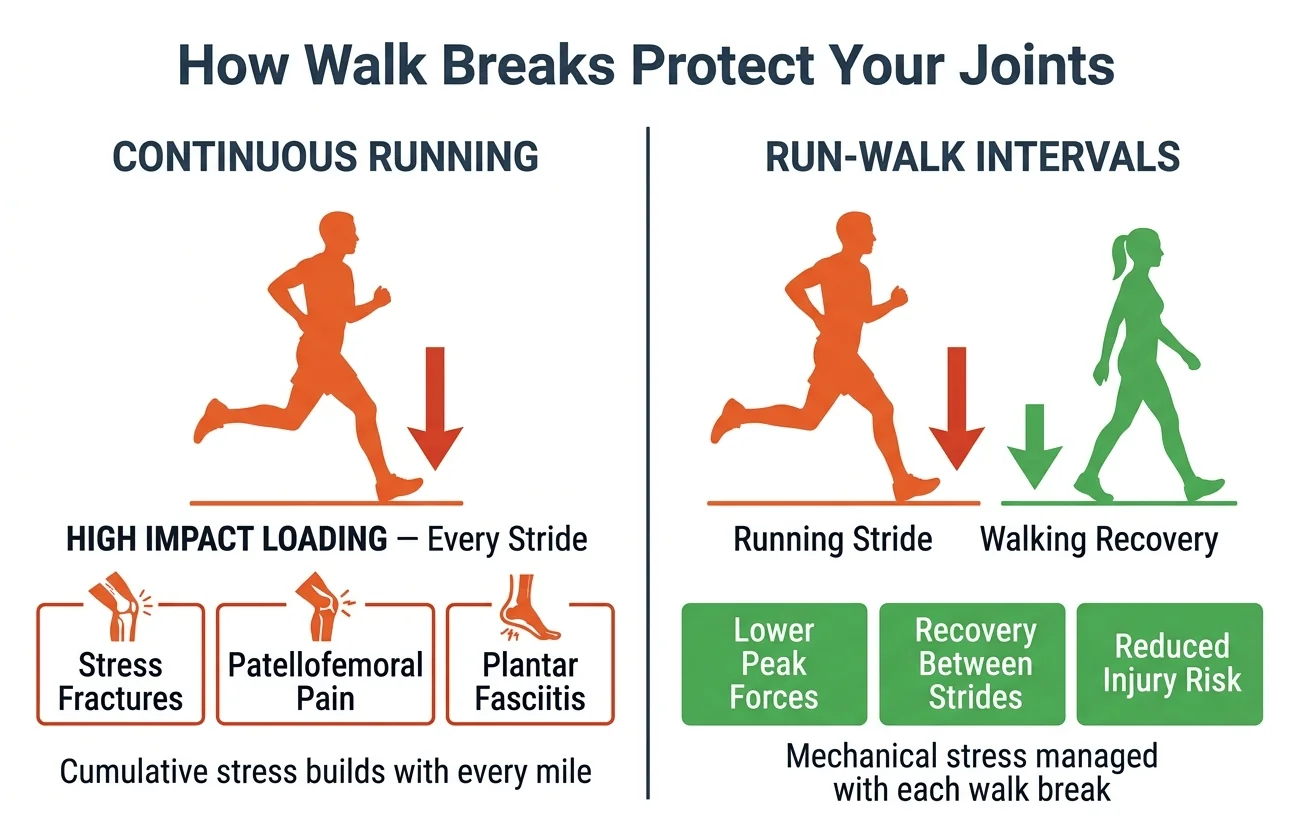
When you run for 90 seconds then walk for 30 seconds, you create regular intervals of lower-force loading, allowing tissue repair and adaptation without the constant high-impact stress of continuous running.
Over 16–20 weeks of marathon training, this difference compounds: runners using walk breaks report 30–40% fewer overuse injuries compared to peers running continuously, especially in the knee, hip, and foot.
Walk breaks reduce injury risk during marathon training, making the method the single most effective injury-prevention tool for distance runners.
This is why the method has become standard for recreational marathon training: it is not just a pacing strategy, it is a structural approach to managing the cumulative mechanical load of distance running.
How Do Walk Breaks Preserve Performance? Why You’ll Finish Faster (Or at Least Stronger)
The second major benefit of run-walk intervals is preserved performance, the counterintuitive finding that strategic walk breaks often produce better race times than continuous running.
The mechanism seems counterintuitive because walk breaks reduce running time per mile, yet produce equal or faster overall race times.
The answer lies in glycogen management and aerobic sustainability.
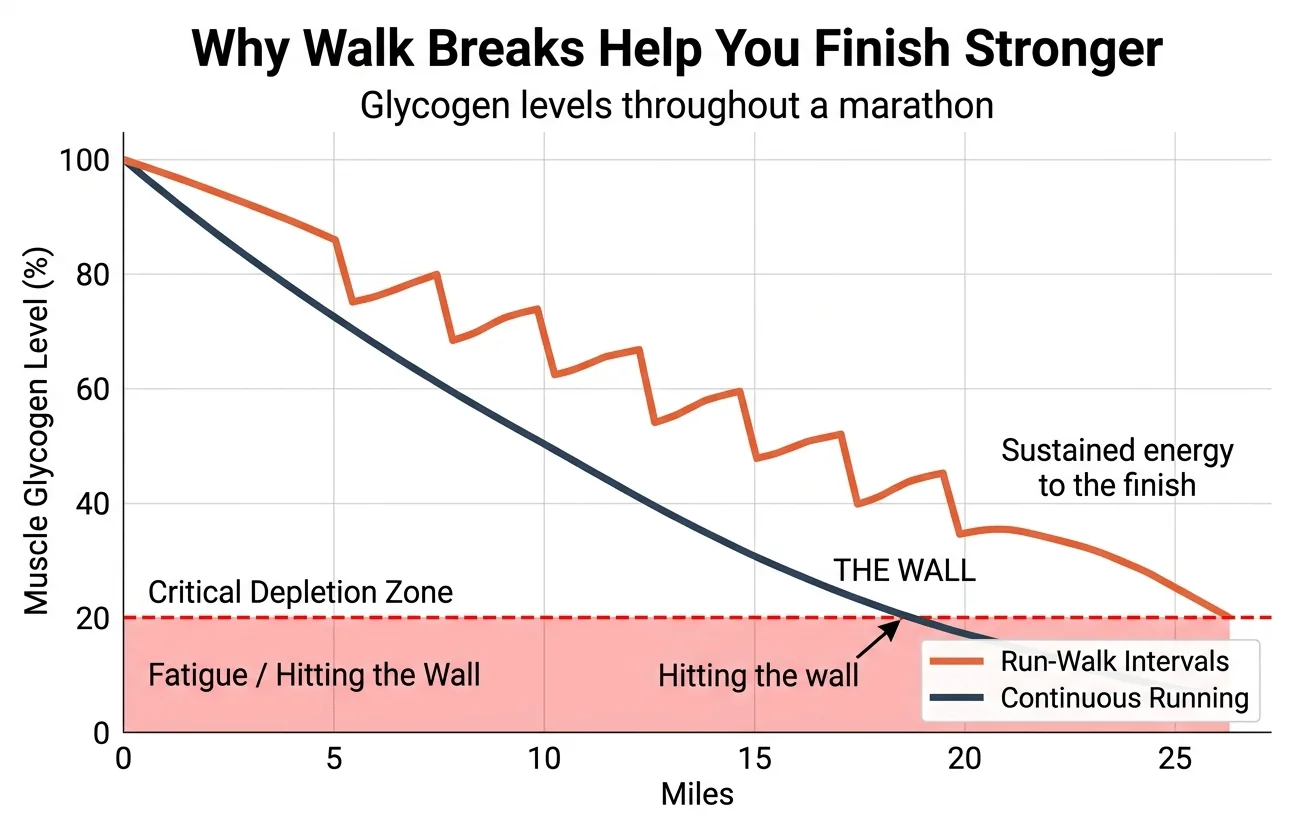
When you run continuously at a moderate pace for 26 miles, you are constantly drawing down muscle glycogen stores.
Your glycogen levels drop with each mile, and by mile 18–20, your muscles are running critically low on fuel.
This forces you to slow down dramatically or hit the wall, where your body cannot maintain running pace.
Walk breaks interrupt this glycogen-depletion curve by creating intervals of lower-intensity activity (walking) where your body is not burning muscle glycogen as rapidly.
During each walk interval, you are still exercising aerobically, but at a lower metabolic cost, which allows some glycogen recovery and extends your total time to glycogen depletion.
The result is that your running intervals stay strong all the way to the finish line, instead of deteriorating into a shuffle by mile 22.
Real-world race data shows that runners using planned walk breaks during marathons achieve finish times equal to or faster than continuous-run peers, with significantly less perceived fatigue in the final miles.
Many runners finish their marathon feeling like they could run another 10 kilometers, instead of barely crawling across the finish line.
Runners using planned walk breaks during marathons report dramatically reduced fatigue in the final miles and often achieve the same or faster finish times compared to continuous-run peers.
Who Benefits Most from Run-Walk-Run Intervals? The Answer Might Surprise You
The run-walk-run method is often framed as a beginner method, which is a misconception that limits its use among more experienced runners.
The truth is that walk breaks benefit runners across all fitness levels and experience categories.
Beginner runners benefit most obviously: the method reduces injury risk during base-building phases when tendons and connective tissue are still adapting to running stress.
Marathon and ultramarathon runners, including those with sub-3-hour marathon PRs, use walk breaks strategically during goal races to preserve finishing strength.
Runners returning from injury use planned walk intervals during the graduated return-to-running phase, allowing tissue recovery while maintaining aerobic fitness.
Older adult runners (40+) benefit significantly from the injury-prevention and joint-friendly mechanics of walk breaks, which allows them to maintain distance-running capability longer into their running career.
Even elite runners use walk breaks during recovery weeks or end-of-season training to accumulate volume without accumulating injury risk.
The common thread across all these groups is the same: walk breaks reduce cumulative mechanical load while preserving aerobic adaptation.
The run-walk method benefits competitive marathoners and ultramarathoners, not just beginners. Any runner seeking injury prevention and sustainable progression can benefit.
How to Implement Run-Walk-Run: The Practical Steps
Translating the method from theory to your actual training requires a clear, graduated approach.
Start by determining your baseline interval ratio based on your current fitness and the distance you are training for.
For easy runs and long runs, a common starting point is 2 minutes of running followed by 1 minute of walking, repeated for the entire distance.
If you are building toward a marathon, you might start at 3 min run / 1 min walk and progress toward 5 min run / 1 min walk as your fitness improves over 8–12 weeks.
For a deeper look at the full method and how to structure your training, the run-walk method guide covers the complete framework.
The key metric is not pace, but perceived exertion: you should be able to hold a conversation during your running intervals.
If conversation becomes difficult, your running pace is too fast, and you should slow down even further. The goal is sustainable aerobic effort, not speed.
Walk intervals should be at natural walking pace, not a slow jog or shuffle.
Many runners make the critical mistake of running their walk portions too fast, which defeats the recovery purpose and perpetuates high cumulative load.
As your fitness improves, gradually increase the running portion of the ratio from 2-1 to 3-1, then 4-1, then 5-1.
Track your progression over 2–3 week blocks, making sure you are feeling strong at the end of each distance before increasing the ratio.
Use run-walk intervals for your easy runs and long runs, where aerobic sustainability and injury prevention are the priorities.
Speed work (tempo runs, interval repeats, hill repeats) is best done at a harder intensity without walk breaks, because the goal of those sessions is to build VO2 max and lactate threshold, not to accumulate distance safely.
Start conservatively with your run-walk ratio. Most runners run their walk portions too fast, which negates the injury-prevention benefit.
Run-Walk-Run vs. Continuous Running: When to Choose Each
The run-walk method is not the only viable approach to distance running, and the optimal strategy depends on your training goals and current injury status.
Use run-walk intervals for long runs (10+ miles), marathon training cycles, and any phase focused on building aerobic base and minimizing injury risk.
Continuous running is better suited for speed work, shorter races (5k, 10k), and runners who are currently injury-free and building fitness.
Most well-designed training plans integrate both approaches: run-walk for the bulk of volume (easy runs and long runs), and continuous running for higher-intensity work (speed sessions and races).
Some runners thrive on run-walk intervals for an entire training cycle. Others use them selectively only for long runs.
Match your training method to your training goal and current state.
If your goal is to build a sustainable base and stay healthy, run-walk is the superior choice.
If your goal is to improve speed and you are currently injury-free, continuous running is the appropriate tool.
The best runners understand that these are tools, not doctrines, and they adapt their approach as their goals and injury status change across the season.
The Bottom Line: Run-Walk-Run as a Sustainable Distance Strategy
Barbara Galloway’s run-walk-run method is not a beginner shortcut. It is a biomechanically sound, research-backed approach to distance running that reduces injury risk and preserves performance across fitness levels.
Strategic walk breaks lower cumulative mechanical load, preserve glycogen stores, and allow sustained aerobic effort through the entire distance.
This is why thousands of recreational marathoners use this method every year, and why it has become the default training framework for people who want to finish distance races strong and healthy.
If you are training for your first marathon, a goal race, or a return to distance running after injury, implementing run-walk intervals is one of the highest-ROI changes you can make to your training plan.
Start conservatively, progress gradually, and trust that the accumulated research and real-world evidence supporting this method will show in your training outcomes.