You know the feeling.
Mile three of a tempo run where suddenly your breathing settles, your stride smooths out, and everything just clicks.
That magical race where you negative split without trying, running the second half faster than the first while feeling less effort.
The long run where ten miles vanish like three, and you finish wondering if you could’ve kept going indefinitely.
Research shows [1] that during these peak performances, athletes report experiencing complete absorption where time disappears and running feels effortless, a phenomenon psychologists call “flow state.”
If you’ve experienced even a glimpse of flow during running, you know it’s transformative.
If you haven’t, you’re probably wondering if you’re broken or if flow is reserved for elite athletes with unlimited training time.
Here’s the good news: flow experiences don’t just feel incredible, they’re associated with improved performance, increased motivation, and the sustainable joy that keeps you running for decades.
Better still, flow isn’t mystical magic reserved for the gifted few.
It’s a specific neurobiological state with identifiable triggers and conditions, which means you can learn to access it more consistently.
What Is Flow State, and What Does It Feel Like?
Flow state is the experience of being so absorbed in running that the effort seems to carry itself.
The psychologist Mihaly Csikszentmihalyi named the state after interviewing athletes and artists who described the same thing: full immersion in a task that runs almost on its own.
For a runner, flow shows up as a handful of specific sensations rather than a vague good mood.
Your attention narrows to the next stride and the next breath, and the mental chatter about pace and how far you still have to go goes quiet.
Action and awareness merge, so you stop feeling like you are commanding your legs and start feeling like you are watching them work.
Time stretches or compresses, which is why a hard tempo can pass in what feels like minutes.
Control feels effortless even at a pace that would normally demand gritted teeth.
The self-critic that usually narrates your run fades out, and with it the second-guessing that drains a hard effort.
Flow is available at every level of fitness.
It is a state of attention, so any runner who can match a challenge to a real skill can drop into it.
What Actually Happens in Your Brain During Flow
Let’s start with the mechanism that makes flow feel so extraordinary.
During flow, the part of your brain responsible for self-criticism and overthinking, your prefrontal cortex, temporarily quiets down.
Think of it as your brain’s efficiency exchange.
Instead of wasting energy on that nagging inner critic analyzing every stride, your brain redirects that power toward heightened attention and awareness.
This is why your movements suddenly feel automatic and effortless, your mind gets out of the way and lets your trained body do what it already knows how to do.
Even better, your fear center shuts down during flow, which explains why runners in this state report feeling fearless and capable beyond their normal limits.
But the brain changes are only half the story.
Your body also floods your system with performance-enhancing neurochemicals, endorphins, dopamine, anandamide, and others, that boost everything from reaction time to focus.
That cocktail is what creates the euphoric, almost effortless sensation.
The kicker? Recent research [2] shows that endocannabinoids (yes, similar to cannabis) spike dramatically during running, twice as high compared to walking, and correlate directly with feelings of euphoria.
Unlike endorphins, these molecules actually cross into your brain where they reduce anxiety and create that “don’t worry, be happy” feeling runners chase.
This explains why flow doesn’t just feel good, it’s a specific neurological state that simultaneously enhances performance while creating intrinsic reward.
Runner’s High vs. Flow State: What’s the Difference?
These states feel similar on the road, but runner’s high and flow are separate events in separate systems.
The high itself is a chemical event.
Your body releases its own opioids and endocannabinoids during sustained effort, and those molecules produce the warm, floaty euphoria that can wash over you late in a long run.
Brain imaging research has shown that a two-hour run releases the body’s own opioids inside the brain, and the more they reached the mood-regulating regions, the stronger the euphoria runners reported.

Flow state is an attention event.
It is the cognitive state where your focus locks onto the task and your movement turns automatic, which can happen with or without the chemical buzz of a runner’s high.
Adrenaline is the third piece people confuse with both.
That surge is your short-term stress response, sharpening your senses at the start line or when someone passes you in the final mile.
It raises your heart rate and primes your muscles for a hard effort, but it never creates the absorbed, time-bending quality that defines flow.
The difference matters for how you chase each one.
You can trigger adrenaline with a hard surge and often coax a runner’s high out of a long enough easy effort, but flow only shows up when the challenge of the run matches the skill you bring to it.
| State | What it is | What sets it off | How it feels |
|---|---|---|---|
| Runner’s high | A neurochemical release of opioids and endocannabinoids | Sustained moderate effort, often past 30 minutes | Warm, floaty euphoria with reduced pain |
| Flow state | An attentional state where movement turns automatic | Challenge matched to skill, with clear focus | Total absorption, effortless control, distorted time |
| Adrenaline | A short-term stress and arousal response | Competition, fear, or a sudden hard surge | Sharpened senses and a racing heart, without absorption |
Is Flow State Real, or Just Runner’s Hype?
Flow state is real enough that researchers can watch it happen on brain-recording equipment.
The skepticism is fair, because flow gets described in language that sounds like wishful thinking about effortless miles.
When people drop into flow, EEG recordings show a consistent brainwave signature, a rise in frontal theta activity paired with a moderate alpha rhythm, rather than a vague sense of feeling good.
That signature is the mark of a brain that has shifted attention away from self-monitoring and toward the task in front of it.
It lines up with what runners report from the inside, the quiet mind and the automatic stride.
Flow is not a personality trait or a reward for talent, so you are not broken if you have never felt it on a run.
It is a repeatable brain state, and the conditions you set up around a run decide how often it arrives.
The Challenge-Skill Balance: Your Flow Zone
Here’s where most runners get flow wrong.
They assume flow happens during easy runs when everything feels comfortable.
Or they push into the pain cave during brutal workouts and wonder why flow never materializes.
Flow emerges when you’re pushed to your limits and have the expertise to accomplish your goal, it’s a balance between skills and challenge.
Too easy? Boredom. Too hard? Anxiety. Just right? Flow.
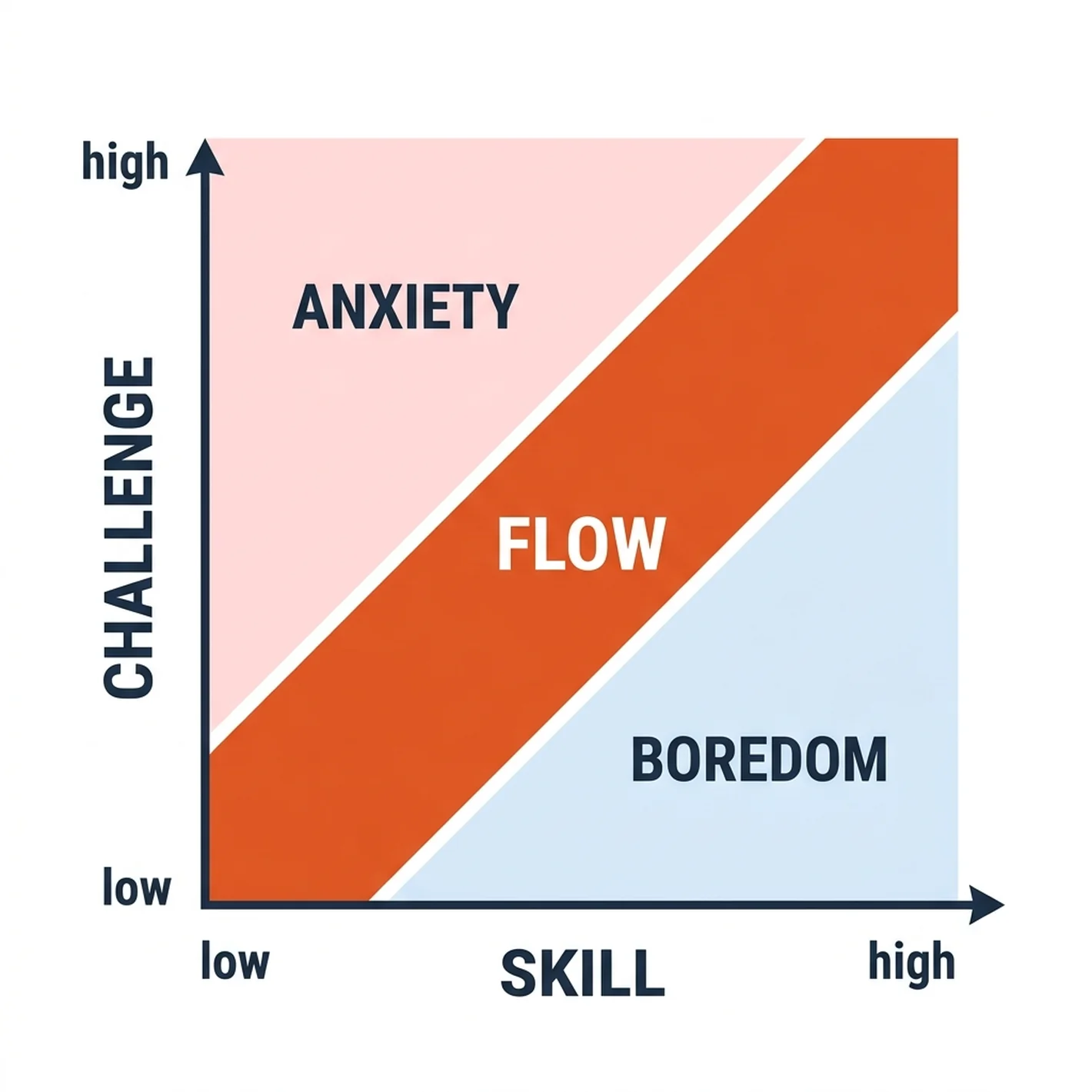
The flow state is most enjoyable when demands are high and your skills meet those demands, which is why tempo runs, progression runs, and well-paced races are flow factories while recovery jogs rarely produce the same effect.
A meta-analysis [3] of 28 studies found that challenge-skill balance was a robust contributor to flow along with clear goals and sense of control.
The practical implication? Structure your training with workouts that stretch but don’t break you.
For most recreational runners, this sweet spot lives in threshold training, efforts around 70-85% of maximum heart rate sustained for 20-40 minutes.
Research indicates [4] that moderate intensity and moderate duration endurance exercise maximizes endocannabinoid release, specifically at 70-85% of age-adjusted maximal heart rate.
This is precisely the tempo run zone.
Individual variation matters here.
Your flow zone differs from your training partners’ based on current fitness, recovery status, and even mindset going into the workout.
When challenges are too low, return to flow by increasing them.
When challenges are too great, return to flow by developing new skills.
RunnersConnect Bonus
Download our Heart Rate Calculator to find out what your individual heart rate zones are.
Environmental Factors That Facilitate Flow
Not all running environments are created equal for flow experiences.
Exercising in natural versus built environments [5] has been linked with enhanced performance, lower perceived effort, and decreased feelings of tension.
There’s something about trails, parks, and open spaces that primes your brain for flow.
When people are active outdoors, it creates a focus, mindfulness and mind quieting that looks similar to what happens if you train in meditation, for decades people experience this spontaneously when they run in nature.
But environment extends beyond physical surroundings.
Athletes identify preparation (both physical and mental), confidence, focus, how the performance feels and progresses, and optimal motivation and arousal level as key factors influencing flow.
This is why your pre-run routine matters.
Athletes begin with physical warm-up to activate their bodies, with duration depending on body sensations, followed by mental preparation.
Create a ritual that signals your brain: we’re about to do something that demands focused attention.
Unfavorable environments, anxiety, and impatience all hinder flow emergence, which explains why trying to squeeze in a quality workout between stressful meetings rarely produces flow, no matter how fit you are.
Training Practices That Cultivate Flow
Flow is trainable, but not in the way most runners think.
Flow emerges [6] as a result of gradual accumulation of confidence during performance, a constructive first event leads to positive feedback, increases confidence, and repeats until reaching total confidence that allows entering flow.
This confidence accumulation model has profound implications for how you structure training.
During base building, flow experiences are rare because you’re focused on adaptation, not performance.
That’s fine. You’re building the fitness foundation that will support flow later.
Threshold development is prime flow training territory, tempo runs and sustained efforts where your fitness matches the challenge create ideal conditions.
Research on ultramarathon runners [7] found flow state increased significantly after 1 hour of running but decreased during following hours, suggesting there’s an optimal duration for flow experiences.
For most runners, this window is 20-60 minutes of focused effort.
The mindfulness connection is powerful here.
Higher mindfulness traits correlate with higher scores for flow dispositions including challenge-skill balance, concentration, and loss of self-consciousness.
This doesn’t mean you need to become a meditation guru.
It means practicing present-moment awareness during running, tuning into breath, footfalls, and body sensations rather than ruminating about yesterday’s meeting or tomorrow’s to-do list.
Mindfulness enhances concentration, allowing runners to block out distractions and zero in on goals, achieving a flow state where everything else fades away.
The Path Forward
Flow states aren’t random gifts from the running gods.
They emerge predictably when specific conditions align: appropriate challenge matched with developed skill, optimal arousal levels, focused attention, and supportive environmental factors.
The neuroscience reveals [8] that flow represents a transition from explicit to implicit information processing, where the prefrontal cortex temporarily downregulates to allow trained movement patterns to execute automatically.
Your job isn’t to force flow, it’s to create the conditions where flow can emerge naturally.
Structure training with workouts that stretch your current capabilities without overwhelming them.
Practice mindfulness techniques that train sustained attention.
Choose environments that support focused effort.
Build confidence through progressive challenges.
The runners who experience flow most consistently aren’t necessarily the fastest or most talented.
They’re the ones who understand how to align training structure, mental state, and environmental conditions.
Flow experiences make running sustainable over decades because they provide intrinsic reward beyond external validation or race results.
Every runner has access to flow states, the question is whether you’re creating the conditions that allow them to emerge.
The neuroscience is on your side.
Time to put it into practice.