

You’ve watched a 13:30 5K runner glide through the first kilometer like it’s effortless, then shift into another gear entirely as the pace builds in the final mile.
It doesn’t look hard because they’re not fighting their physiology. They’ve spent years building it to work at a level most everyday runners never approach.
So, in this article you’re going to learn the research-backed practical advice on:
- How to identify which physiological factors actually limit your 5K performance
- Why training volume and intensity follow a specific formula for elite runners
- How to scale elite training principles to your own fitness level
- What you can do in the final kilometers when mental fatigue peaks
- The concrete workouts and realistic timelines that produce measurable 5K gains
Why Is VO2 Max the Foundational Requirement for Elite 5K Speed?
VO2 max is the maximum amount of oxygen your body can utilize during intense exercise, measured in milliliters of oxygen per kilogram of body weight per minute (ml/kg/min).
It’s the gating mechanism for elite 5K performance. Without enough aerobic engine capacity, no amount of training will close the gap.
Research has identified VO2 max, fractional utilization of VO2 max, and running economy are the three critical physiological factors that determine elite distance running performance. VO2 max sets the absolute ceiling that the other two factors work within.
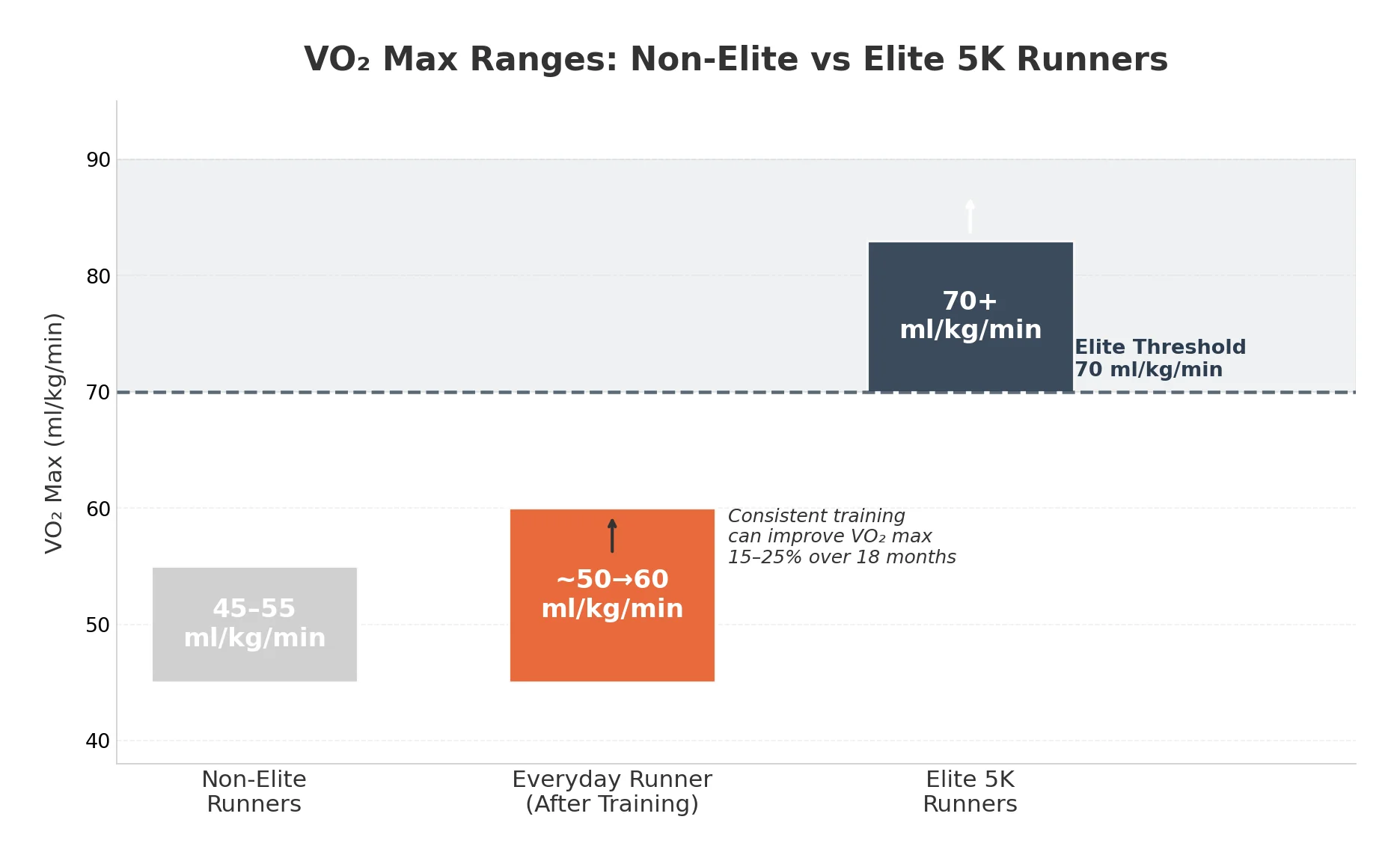
Most non-elite runners have VO2 max values in the 45-55 ml/kg/min range. Elite 5K runners operate well above that.
A runner at 50 ml/kg/min can improve to 60 ml/kg/min through consistent training, but bridging the gap to elite-level aerobic capacity requires genetic predisposition, years of adaptation, and training volume most everyday runners can’t sustain.
Elite runners run that much mileage because their high VO2 max lets them sustain the workload that further drives aerobic development upward, a self-reinforcing cycle.
VO2 max determines the speed ceiling of your aerobic system. Without the physiological capacity to support it, a 13:30 5K is mechanically impossible.
How Does Lactate Threshold Training Shape Elite 5K Performance?
Lactate threshold is the running pace at which lactate begins to accumulate in your blood faster than your body can clear it. This is the point where your muscles start shifting toward anaerobic metabolism.
For most runners, lactate threshold occurs at roughly 85-90% of VO2 max.
Since a 5K race is 19-20 minutes of sustained, near-maximal effort, your ability to run fast at lactate threshold directly determines your 5K pace.
Elite runners structure these workouts differently than non-elite runners do.
An elite runner training at lactate threshold might run 2 x 10 minutes at 3:50-4:00 per kilometer (6:10-6:26/mile) pace with 3 minutes recovery, or a single 20-minute effort at steady state.
An everyday runner with the same lactate threshold pace might run the same workout at lower volume, or break it into smaller repeats, because their body recovers differently from this intensity.
The mechanism is the same: training your body to clear lactate faster and to sustain a higher percentage of VO2 max for longer.
Elite runners simply tolerate higher doses of this stress.
What Is Running Economy and Why Do Elite 5K Runners Make It Look Easy?
Running economy is the energy cost of running at a given speed. It measures how efficiently your body converts fuel into forward motion.
Two runners with identical VO2 max values can have wildly different 5K times if one is significantly more economical than the other.
This is where strength training enters the elite 5K formula.
A runner with superior hip stability, ankle stiffness, and glute activation uses less energy per stride because their muscles are organized to transfer force efficiently.
Structured strength work builds the neuromuscular coordination that lets elite 5K runners hold 3:50 per kilometer (6:10/mile) pace with what appears to be minimal effort.
An everyday runner at 3:50/km might be at 95% of their aerobic capacity, already accumulating lactate.
An elite runner at the same pace might be at 78% of their capacity, which is why it looks effortless.
Running economy explains why faster runners look smooth: they burn fewer energy units per kilometer, leaving more capacity in reserve.
How Much Should You Train to Build Elite 5K Fitness?
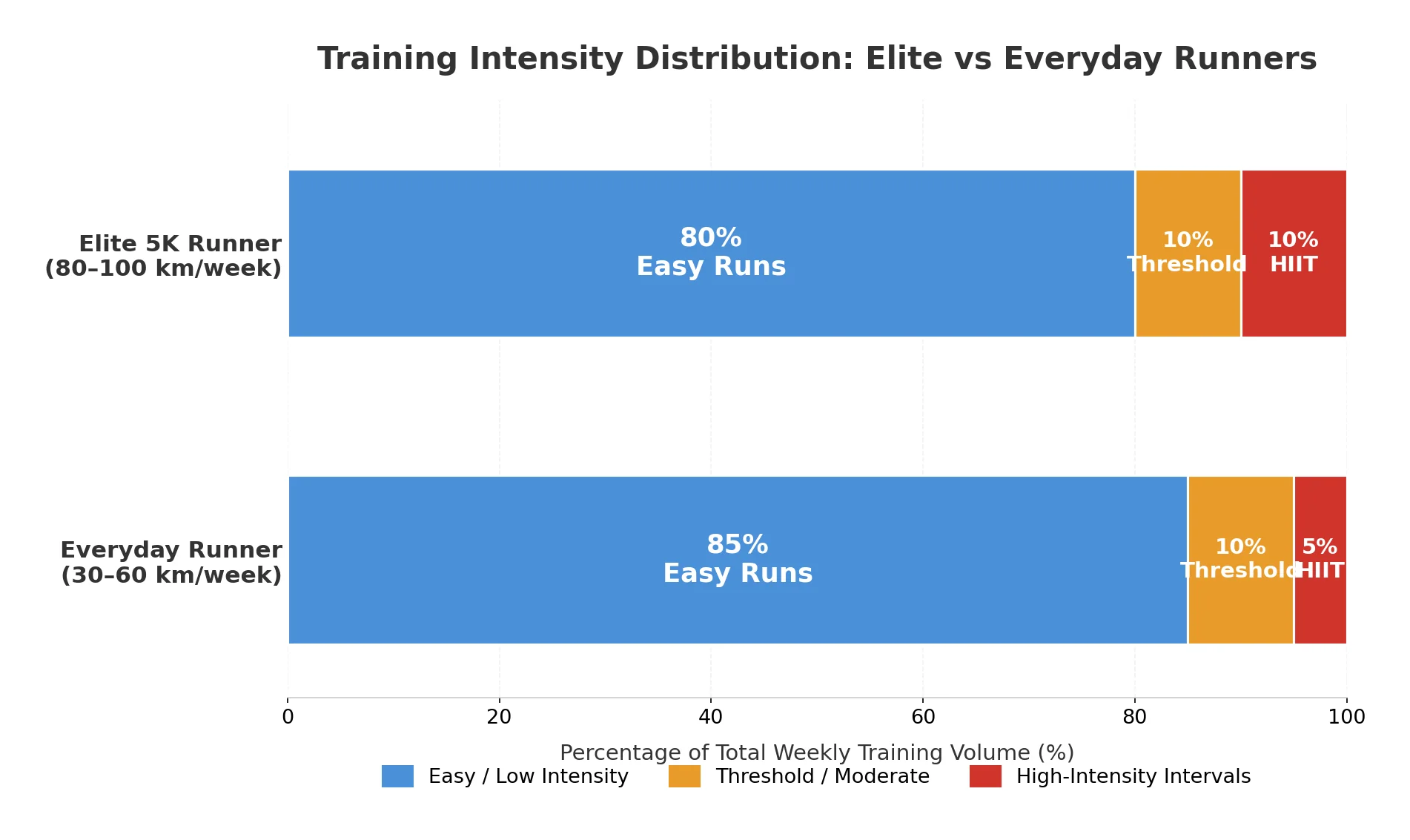
Elite 5K runners typically log 80-100 kilometers (50-62 miles) per week, a training load most everyday runners can’t sustain without injury or overtraining.
The distribution of that volume matters more than the total number.
The split reflects a biomechanical necessity.
The easy-run volume builds aerobic base, improves running economy through accumulated time at pace, and creates the metabolic adaptations (mitochondrial density, capillary density) that support higher absolute speeds.
The threshold work trains your lactate-clearing system directly.
The high-intensity work builds VO2 max and trains your central nervous system to produce power at race pace.
A non-elite runner might train 50 km (31 miles) per week at an 85/10/5 split, with more easy volume and less intensity to protect recovery capacity and reduce injury risk.
Elite runners can tolerate higher total training intensity because their running economy is far better. At the same absolute pace, they’re working at a much lower percentage of their capacity.
What Interval Workout Structure Builds Elite 5K Speed?
High-intensity interval training is the most specific stimulus for 5K performance, directly stressing the systems that determine 5K race pace.
Elite 5K runners typically complete 2-4 high-intensity sessions per week, spaced with at least one easy day in between to allow central nervous system recovery.
Research on high-intensity interval training found that repeated efforts at VO2 max pace produce significant improvements in 3000m and 5000m performance in well-trained runners.
The most common elite protocol is 8-10 repetitions of 3-5 minutes at 95-105% VO2 max pace, which translates to roughly 3:45-4:05 per kilometer (6:02-6:34/mile) for a 13:30 5K runner.
The recovery between repeats (typically 60-90 seconds) is short enough to keep heart rate elevated, but long enough to hit target pace on the next repeat.
An elite runner might structure a typical VO2 max session as: warm-up, then 8 x 4 minutes at target pace with 90 seconds jog recovery, then cool-down.
An everyday runner doing a similar 5K-specific workout might do 6 x 4 minutes at their own VO2 max equivalent, or reduce the repeat length to 3 minutes, because they recover differently from this intensity.
VO2 max intervals are the single most powerful tool for improving your 5K pace, but they demand proper recovery. Running them twice per week instead of three times is better than overtraining.
Why Do Elite 5K Runners Succeed in the Final 1-2 Kilometers?
Central fatigue, the cognitive strain from intense sustained effort, impairs your ability to judge pacing and respond to race dynamics in the final 1-2 kilometers of a 5K.
Most everyday runners hit kilometer 4 running on fumes, relying on willpower to hold pace rather than active tactical decision-making.
Elite runners manage this through 2 distinct advantages:
- Superior running economy means they’re not as physiologically depleted as a non-elite runner at the same absolute pace, leaving more cognitive and physical capacity in the final kilometers.
- Pre-planned race scripts reduce in-race decision-making by creating a pacing plan before the gun goes off, conserving mental resources for actual running when fatigue peaks.
A simple pre-race script: run the first kilometer at 95% race pace to settle in, the second and third at race pace, and the final two at maximum sustainable effort with a surge at 4.5km.
Following a script means you’re not deciding when to push. You’re executing a plan.
What Can Everyday Runners Actually Borrow From Elite 5K Training?
Most non-elite runners cannot sustainably train at 80-100 km per week. Recovery capacity, injury risk, and time constraints all limit the load they can handle.
The principles underlying elite 5K training are scalable to any ability level.
- Restructure your intensity distribution. Shift toward more easy-run volume and less random moderate-intensity work. If you’re training 30-40 km per week with no structure, targeting 85% easy and 15% hard (threshold plus high-intensity) will improve your 5K without adding mileage.
- Limit high-intensity sessions to twice per week. Non-elite runners recover differently than elite runners. One VO2 max session (6-8 x 3 minutes at hard effort with 60-90 seconds recovery) plus one threshold session (2 x 8 minutes at sustained effort) is a complete weekly quality prescription.
- Add 1-2 strength sessions per week. Focus on hip stability, glute activation, and ankle stiffness. These are the foundations of running economy that elite runners prioritize. This is the highest-return investment for runners who never strength train.
- Set realistic improvement timelines. Moving from a 22-minute 5K to 20 minutes is a 9% improvement, which typically takes 12-18 months of consistent, structured training. An elite runner improving from 13:30 to 13:00 (3.7%) might need 2-3 years, because gains get harder as you approach your physiological ceiling.
You don’t need to run 90 km per week to benefit from elite 5K training principles. Volume distribution, periodization, and running economy gains translate directly to your own level.
| Training Factor | Elite 5K Runner | Everyday Runner Adaptation |
|---|---|---|
| VO2 Max | 70+ ml/kg/min (genetic ceiling) | Improve via consistent interval training over 12-24 months |
| Lactate Threshold | 85-90% of VO2 max; trained with sustained 20-30 min efforts | 2 x 8-10 min tempo efforts once per week |
| Running Economy | 10-15% more efficient than non-elite runners | Strength training 1-2x/week for hip, glute, ankle work |
| Weekly Volume | 80-100 km/week, 75-85% easy pace | 30-60 km/week, 85% easy pace target |
| Interval Structure | 8-10 x 4 min at VO2 max, 2-4x/week | 6-8 x 3 min at hard effort, 1-2x/week |
| Race Execution | Pre-scripted pacing plan, low cognitive load | Same approach: write a pacing script before race day |