

You know the feeling: you’re 60-something, still crushing workouts three days a week, and someone mentions that “older athletes need more recovery.”
You nod along, wondering if they’re right, then push back another run anyway.
Both assumptions miss what your body actually needs as you get older.
So, in this article you’re going to learn the research-backed practical advice on recovery and training for older runners:
- How your body’s recovery processes change with age
- The exact recovery timeline your muscles need between hard workouts
- Why intensity matters as much as frequency
- A concrete weekly training structure that works for runners 60 and beyond
Why Do Recovery Times Change With Age?
Your cells slow down at a molecular level as you age, and this affects how quickly you bounce back from hard training.
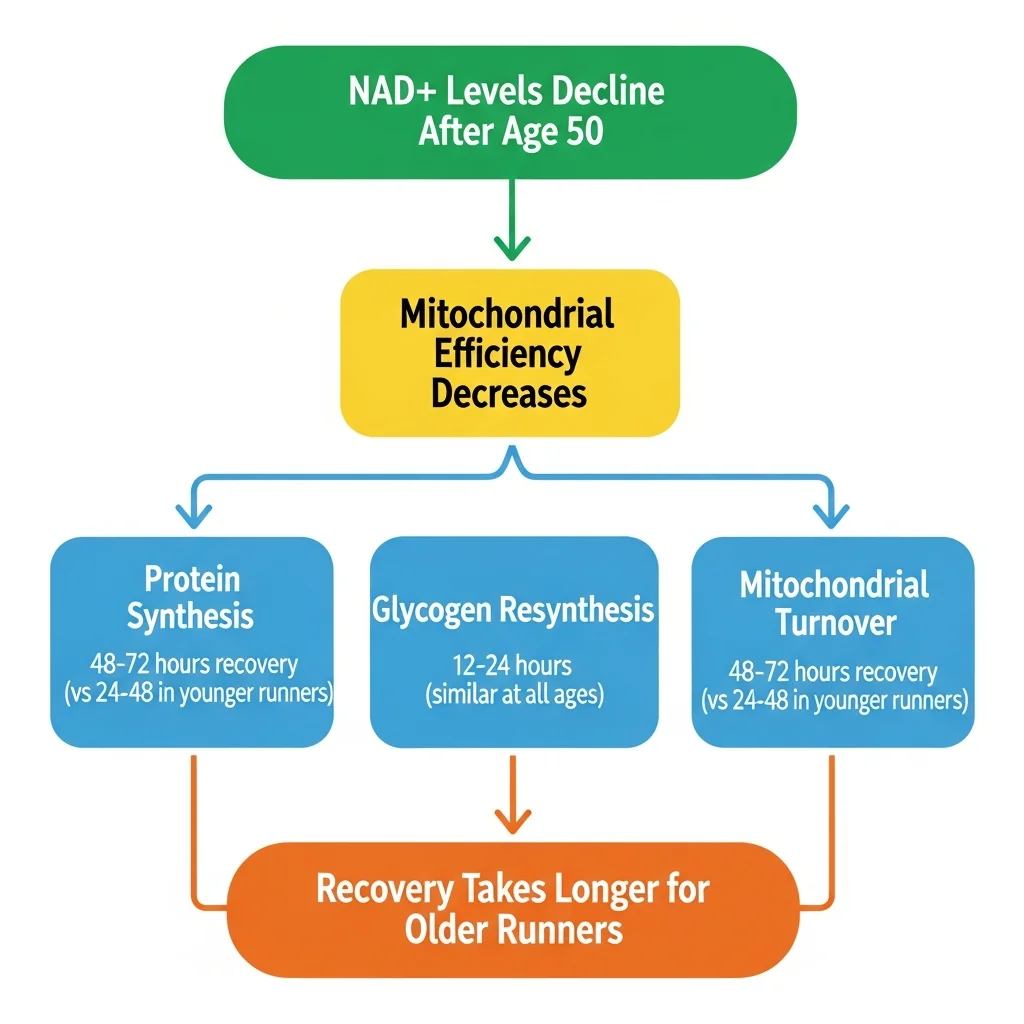
Research has shown that healthy aging and muscle function are positively associated with NAD+ abundance in humans.
NAD+ is a molecule that powers mitochondrial energy production: the engine inside your muscle cells that converts food and oxygen into usable power.
When NAD+ levels drop (which they do significantly after age 50), your mitochondria become less efficient at processing the training stimulus you create.
This efficiency loss affects three specific recovery processes: protein synthesis (building new muscle fibers to adapt to training), glycogen resynthesis (refilling muscle fuel tanks), and mitochondrial turnover (replacing old, damaged energy factories).
Younger runners can complete all three in roughly 24 to 48 hours with adequate sleep and nutrition.
Older runners need closer to 48 to 72 hours for the same adaptations to settle in.
The issue is not that your body can’t adapt to hard training anymore: it absolutely can: but that adaptation takes longer and is more easily disrupted by incomplete recovery.
How Fast Can Older Runners Actually Recover From a Hard Workout?
A hard workout is only hard for about 24 hours in physiological terms.
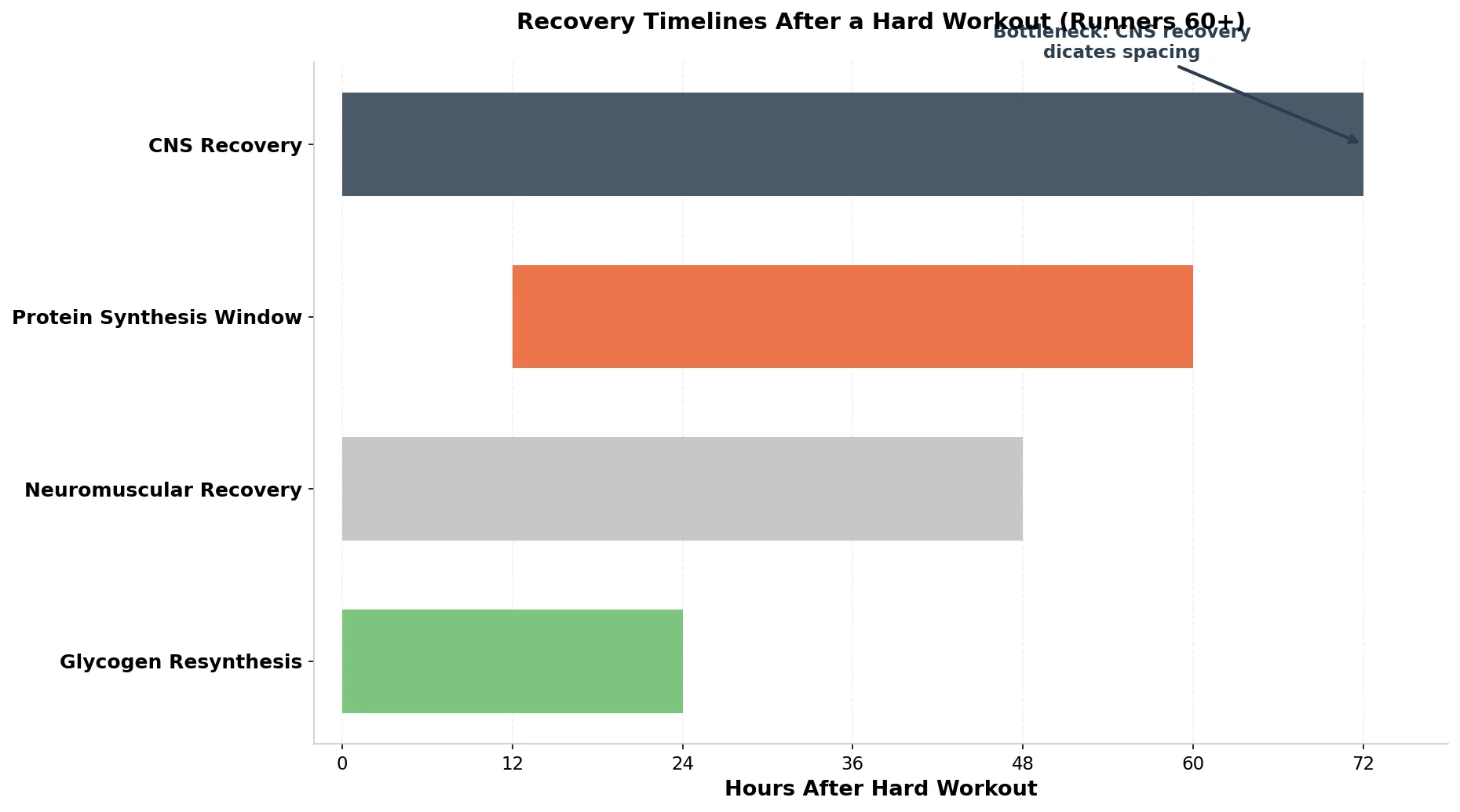
Neuromuscular fatigue (the heaviness and reduced power output you feel) peaks around hour 24 and subsides by hour 36 to 48, roughly the same timeline as in younger runners.
Glycogen stores (your muscles’ stored carbohydrate fuel) recharge just as fast in older runners as in younger ones:about 12 to 24 hours with adequate carbohydrate intake.
The bottleneck is protein synthesis.
The muscle-building window opens about 12 hours after your hard workout, compared to 4 to 6 hours in younger runners.
It stays open for about 48 hours instead of 72.
This means your body is still building from yesterday’s workout during today’s easy run: which is fine: but doing another hard workout tomorrow would interrupt that building process.
The real recovery constraint, though, is the central nervous system (CNS).
Your nervous system manages force output, coordination, and pace regulation, and when you hammer it hard, it needs 48 to 72 hours to fully recover in older runners.
Back-to-back hard days destroy CNS recovery more than they slow protein synthesis, which is why spacing matters more than absolute rest days.
RunnersConnect Bonus
Wondering how your current fitness stacks up for your age? The age-grading calculator shows your performance relative to age-standard benchmarks.
Input your current race times across any distance, and see your age-adjusted percentile ranking plus equivalent times at younger ages.
Can Older Runners Still Do Quality Workouts? (Or Is It All Easy Running?)
Quality is not something you give up as you age.
It’s something you redistribute.
VO2 max (your body’s ability to use oxygen) does decline with age, but the decline is almost entirely in your aerobic capacity: not in your ability to work at high percentages of that capacity.
A 65-year-old runner can still do a 400-meter repeat at 95% of their max heart rate, just like they did at 35.
The max heart rate itself is lower, but the intensity percentage stays similar.
The misconception is that older runners need to do fewer hard sessions because they have less total aerobic capacity.
The truth is simpler: doing two quality sessions per week (instead of three or four) still triggers the adaptation signals your body needs, plus it leaves recovery time for the adaptations to happen.
Most runners age 60+ benefit more from two well-executed VO2 max or threshold sessions per week than from three mediocre hard workouts squeezed around poor recovery.
Quality over quantity works not because hard work hurts older runners, but because spacing hard work creates time for adaptation: and adaptation is what sustains fitness.
What’s the Ideal Weekly Training Frequency for Runners 60+?
Four to five training days per week is the sweet spot for most runners 60 and older who are already established in their running habits.
This frequency gives you enough stimulus to maintain fitness (and even improve) while providing enough recovery time between sessions for physiological adaptations to happen.
The typical structure is: one VO2 max session (4 to 6 repeats of 3 to 4 minutes at hard effort), one threshold or tempo session (20 to 30 minutes at steady hard effort), one moderate-paced run (60 to 90 minutes at conversational effort), and one to two easy runs (30 to 45 minutes at truly easy pace).
One session is a full rest day: not active recovery, but actual off.
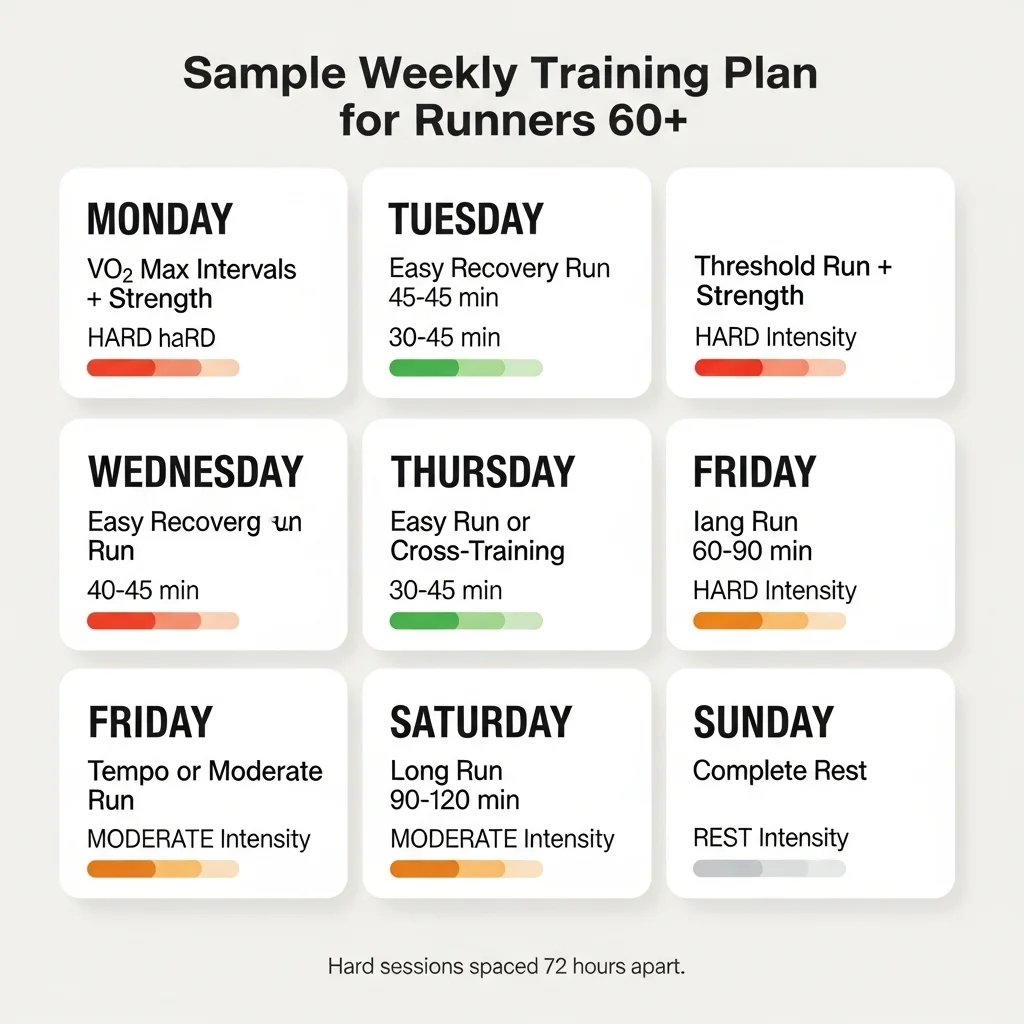
Spacing matters more than the specific days, but a practical pattern is Hard (Monday) → Easy (Tuesday) → Moderate (Wednesday) → Easy (Thursday) → Hard (Friday) → Mixed (Saturday) → Off (Sunday).
This pattern spaces your hard sessions 72 hours apart and ensures you never have back-to-back intensity.
Research on training frequency in masters athletes consistently shows that runners doing four to five structured days outperform those doing six or seven days (even when total volume is similar) because the six-to-seven-day runners sacrifice recovery time and adaptation quality.
Five quality days per week beats seven mediocre days for every single adaptation measure: fitness maintenance, race performance, and injury rate.
How Does Nutrition and Supplements Impact Recovery Speed?
Nutrition doesn’t speed up the speed of recovery as much as it enables recovery completeness.
Protein intake matters more for older runners than younger ones because your muscles are less responsive to the training signal (“anabolic resistance”), so you need adequate amino acids available when that window of adaptation opens.
Aim for 25 to 30 grams of protein within a few hours after your hard workouts (the timing is less critical in older runners than used to be thought, but having protein available sometime post-workout is non-negotiable).
Carbohydrate refueling works the same way at 65 as at 35: if you run hard, refuel with carbs within 30 to 60 minutes, and your glycogen stores recharge as expected.
Sleep is the single most powerful recovery tool you have, and it’s where most aging runners fall short.
Fragmented sleep, early waking, and shorter total sleep duration are epidemic in the 60+ population (and not entirely unavoidable), but even a 6- to 7-hour commitment is better than a 5-hour one for recovery: and the gap gets larger as you age.
Beyond standard nutrition, your cells’ ability to recover is limited by mitochondrial function, which depends on NAD+ availability.
As NAD+ declines, your mitochondria struggle to convert the training stimulus into adaptive signals: slower oxygen processing, slower fuel turnover, and slower response to the work you just did.
That’s why we partnered with NAD+ supplementation designed for runners to support the cellular recovery processes that naturally slow with age.
Emerging research shows that NAD+ precursors (like NMN or NR) can partially restore mitochondrial efficiency and accelerate the recovery timeline back toward what younger athletes experience.
Nutrition enablement matters, but sleep and proper spacing matter more:focus on those first, then add nutritional support if you’re still feeling recovery-limited.
What About Overtraining? How Do You Know You’re Doing Too Much?
Overtraining in older runners shows up as persistent fatigue despite sleep, elevated resting heart rate (10+ bpm above your normal baseline), mood changes, and soreness lasting beyond 48 hours.
Older runners are more susceptible to overtraining because you have less total recovery capacity, not because you’re fragile:just because you have a smaller recovery budget to spend.
If you’re doing five quality days and feeling recovered, that’s not overtraining.
That’s training matched to your capacity.
If you’re doing four days but waking up tired, irritable, and stiff, that’s overtraining:meaning your recovery window is too tight for the stimulus you’re creating.
The fix is not “do less”.
The fix is “space better” or “reduce the intensity of one session.”
Tracking your resting heart rate is the single most useful biometric for this.
Measure it five days in a row during a normal week (first thing after waking, before getting up), establish your baseline (e.g., 58 bpm), then monitor for elevation above that.
An elevation of 10+ bpm is the oldest, most reliable marker that your nervous system is still fatigued.
Elevated resting heart rate is not a sign that you’re weak: it’s a sign that your recovery stimulus and recovery time don’t match.
Putting It Together: A Sample Weekly Plan for Older Runners
Here’s a concrete example of a five-day week that works for most runners 60+.
Monday: VO2 Max Session : Warm up 10 to 15 minutes, then 4 to 6 repeats of 3 to 4 minutes at hard effort (around 90 to 95% max heart rate) with 2 to 3 minutes easy recovery between, then cool down 5 to 10 minutes. Add lower-body strength work (squats, lunges, step-ups) after running or on a separate time.
Tuesday: Easy Run : 30 to 45 minutes at truly easy pace (you should be able to hold a conversation).
Wednesday: Threshold Session : Warm up 10 to 15 minutes, then 20 to 30 minutes at threshold pace (hard but sustainable, around 80 to 85% max heart rate), then cool down. Add upper-body or core strength work after or later in the day.
Thursday: Easy Run or Cross-Training : 30 to 45 minutes easy, or a low-impact cross-training day (cycling, swimming, elliptical).
Friday: Hard or Moderate Run : Either another hard session (tempo, fartlek, or shorter repeats) if you’re feeling fully recovered, or a moderate-paced run (60 to 90 minutes at conversational effort) if Friday volume is your limit.
Saturday and Sunday: One moderate run plus one off day – A 90-minute to 2-hour easy-moderate run on one day, and a complete rest day on the other. If Saturday is a hard week and you’re tired, two rest days is fine.
This is a template, not a law.
Adjust based on your work stress, sleep quality, injury history, and life load.
A runner who works high-stress hours might do better with Mon/Wed/Fri hard and Tue/Thu easy, plus two full rest days.
A retired runner might do Mon/Tue hard, Wed easy, Thu hard, Fri easy, Sat long, Sun off.
The principle holds: hard sessions spaced 48 to 72 hours apart, one full rest day, and total volume that doesn’t exceed what your recovery system can handle.
Consistency matters more than perfection: a sustainable five-day routine beats a burned-out six-day sprint.
Does Age Affect How Quickly Your Fitness Declines?
Fitness declines faster in older runners when training stops entirely, but the difference is smaller than most assume.
A complete week of inactivity costs older runners about 2 to 3% of aerobic fitness (VO2 max), while younger runners lose about 1 to 2%.
If you’re gone for two weeks, the gap widens: older runners might lose 4 to 6%, younger runners 2 to 4%.
But here’s the key: a planned week of reduced training is not the same as a week off.
Cutting volume in half while maintaining intensity (fewer repeats, shorter duration, same intensity percentage) preserves fitness almost completely in runners of all ages.
This is why planned down weeks don’t cause fitness loss when done strategically after hard blocks.
They cause recovery and adaptation consolidation.
Older runners often fear taking down weeks because they worry about losing fitness, but the real risk is not taking them, which leads to accumulated fatigue, elevated injury risk, and eventual forced breaks (injury or illness) that cost much more fitness than a planned week ever would.
Planned rest prevents unplanned injury-forced breaks that drain fitness far more than a strategic recovery week.
RunnersConnect Bonus
Planned down weeks are an investment, not a loss. This calculator shows exactly how much fitness you’ll retain based on your age and break duration.
Input your age, how long you’ll be off, and why, then see your predicted fitness loss percentage and recovery timeline for getting back to baseline.
Bringing It All Together
The original question:”How many days a week should a 70-year-old run?”:has a more nuanced answer than a simple number.
Four to five quality days, spaced properly, with one full rest day, beats six to seven mediocre days for every measure that matters: fitness gain, race performance, longevity in the sport, and injury prevention.
Your recovery is not broken.
It just works differently: slower to start, faster to decline if you stop, and more sensitive to spacing and sleep.
The solution is not to run less.
It’s to run smarter by prioritizing recovery quality, maintaining intensity, and building in the full rest days that your nervous system needs.
Start with one adjustment: identify where your recovery is weakest, whether that’s sleep, nutrition timing, or workout spacing.
Then solve for that specific constraint before adding more training volume.
Once that’s locked in, the rest:running four to five quality days, feeling recovered, and improving year after year:follows naturally.