
You started running a few weeks ago, and now your legs hurt in ways they never did before.
Your calves feel like concrete the morning after a run, and your quads ache every time you head down stairs.
A dull soreness settles into your shins, and you catch yourself wondering whether you are getting fitter or breaking something.
That worry is the real problem, because it is hard to train when you can’t tell an everyday ache from the first sign of an injury.
The good news is that most of what new runners feel is normal and short-lived, and a few reliable signals tell you when it is not.
So, in this article we’re going to look at:
- Why your legs get so sore when you first start running
- How to tell normal soreness apart from an injury that needs attention
- When the soreness fades, and how to recover and keep it from derailing your training
Why Do Your Legs Hurt After You Start Running?
Hard or unfamiliar running makes your muscles sore because it causes tiny amounts of physical damage inside the muscle fibers, and your body repairs that damage so the muscle can handle the same load next time.
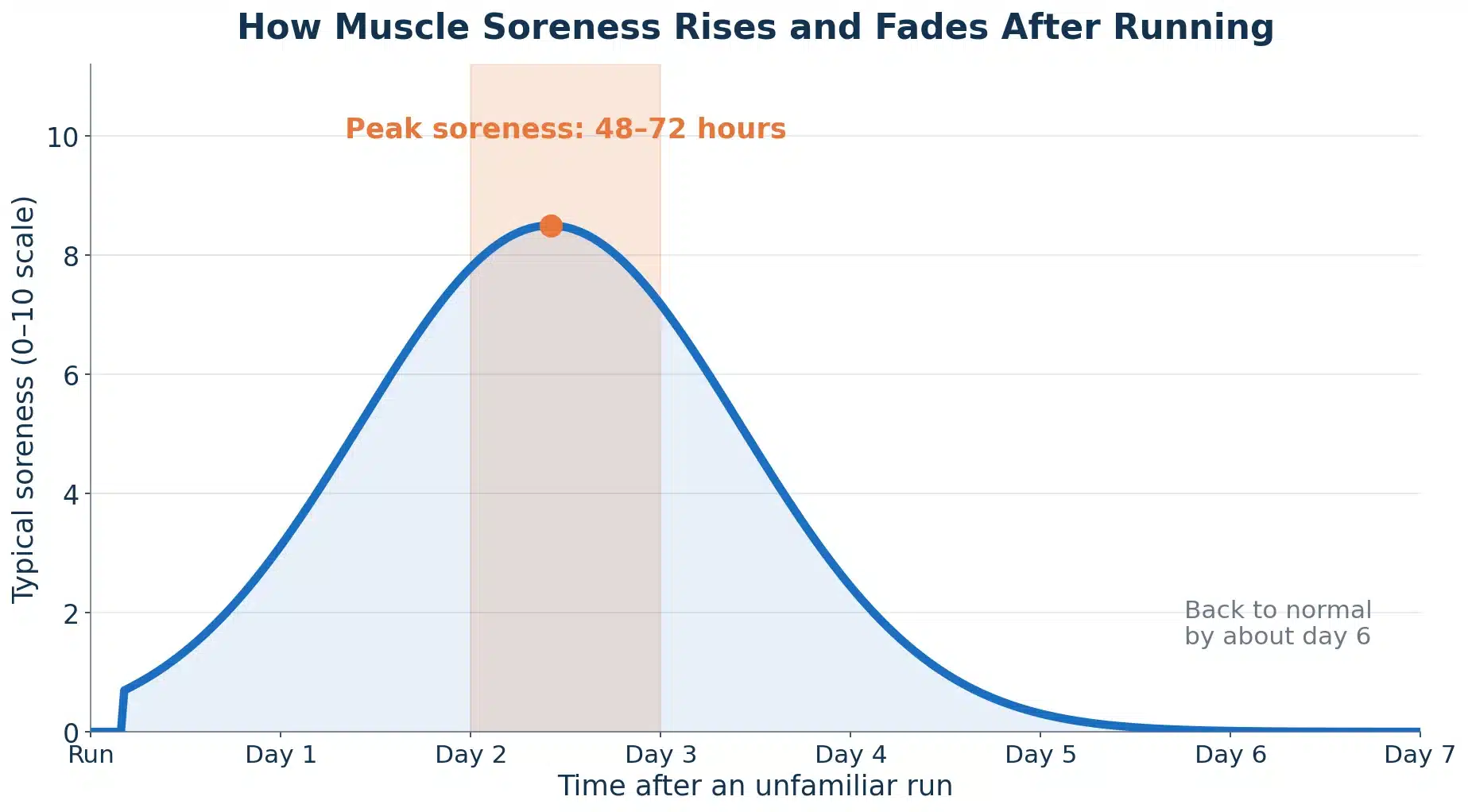
Research on muscle soreness classes it as a mild muscle injury from eccentric or unfamiliar exercise, with the soreness peaking 48 to 72 hours after you run.

The soreness comes from eccentric contractions, which happen when a muscle lengthens while it is still working, like when your quads absorb impact on every downhill step.
Those contractions create microscopic tears in the muscle, and as your body repairs them it produces inflammation, which is the stiffness and ache you feel a day or 2 later.
This damage sounds alarming. But it is the normal signal that your body is adapting to a demand it has not met before.
It also explains the delay that confuses so many new runners, because the run itself can feel fine while the worst soreness arrives 2 days afterward.
An early review of exercise soreness found that the drop in strength and comfort is temporary and leaves no permanent damage, so the heavy-legged feeling passes as the muscle rebuilds.
Where Do New Runners Feel the Soreness Most?
A few spots take the brunt of your first weeks of running, and knowing which is which tells you how much to worry.
Your calves and quads lead the list. They absorb the most impact and do the most eccentric work on every stride.
That soreness spreads across the whole muscle, shows up on both legs, and fades over a few days, which is the classic signature of normal adaptation.
The front of your shins is the area to keep an eye on, because a deep ache along the shin bone can be early shin splints rather than ordinary soreness.
Shin pain that stays sharp, sits on one leg, or hurts when you press along the bone is worth resting and checking, since it is one of the overuse injuries that catch new runners most often.
Your knees and hips can feel stiff early on as well, though pain that locks into one joint and worsens run over run belongs in the injury column rather than the soreness one.
Is Soreness After Running Normal, or a Sign of Injury?
Normal soreness and a developing injury feel different in 3 ways you can check after any run.
The first is location, because general muscle soreness usually shows up on both sides of your body at once.
When both calves or both quads ache evenly, that even, two-sided ache points to ordinary adaptation rather than injury.
Pay closer attention to pain in one spot on a single leg, above all when it sits on a joint, a bone, or a tendon.
You can also watch how the discomfort behaves while you move.
Normal soreness eases once you warm up and keep running, while an injury sharpens as the run goes on.
Pain that grows during a run and forces you to change your stride is the clearest sign to stop and treat it as an injury rather than soreness.
Finally, watch the clock, because muscle soreness follows the 2-day pattern and then fades, while injury pain lingers, returns to the same spot, or shows up sharply the moment you start.
Everyday soreness should still let you walk normally and get through your day, even if you feel stiff.
RunnersConnect Bonus
Download your FREE Injury Assessment and Prediction Video now.
A good injury prevention program starts with assessing where you’re weak and where you might be tight or inhibited. In the video I’ll demonstrate the six mobility tests you need to perform to assess what you need to begin working on.
When Does Running Stop Hurting?
The soreness fades faster than most beginners expect, because your muscles adapt quickly to the specific demand of running.
Your first few runs produce the worst soreness, and each similar run after that produces less.
Muscle researchers call this the repeated bout effect, where a single bout of exercise protects the muscle against damage and soreness from the bouts that follow.
The protection builds fast, which is why the easy run that flattened you at the start barely bothers you a month in.
Most new runners find the sharp, widespread soreness settles within the first 2 to 3 weeks of consistent running.
The earlier review of soreness reached the same practical point, that repeating the activity that made you sore is what trains the soreness away.
That means the fastest route through the sore phase is steady, repeatable running rather than one heroic effort followed by a week off.
Should You Run Through Soreness, or Rest?
You can usually keep running through ordinary soreness, as long as you judge it by how the pain behaves rather than by whether it is present at all.
Researchers built a simple pain-monitoring model to answer exactly this question.
In a controlled trial of runners with sore tendons, the group that kept running while holding pain to an acceptable level recovered just as well as the group that stopped completely.
The model uses a 0 to 10 pain scale, where discomfort up to about 5 is acceptable during the run if it settles by the next morning.
Keep running when soreness stays moderate and calms down overnight, and back off when pain climbs past a 5, lingers into the next day, or worsens run over run.
On a sore day, that usually means an easy run at a conversational effort rather than a hard workout.
Slowing down keeps you moving and adapting without adding new damage to muscles that are still repairing.
How Likely Are You to Get Injured as a New Runner?
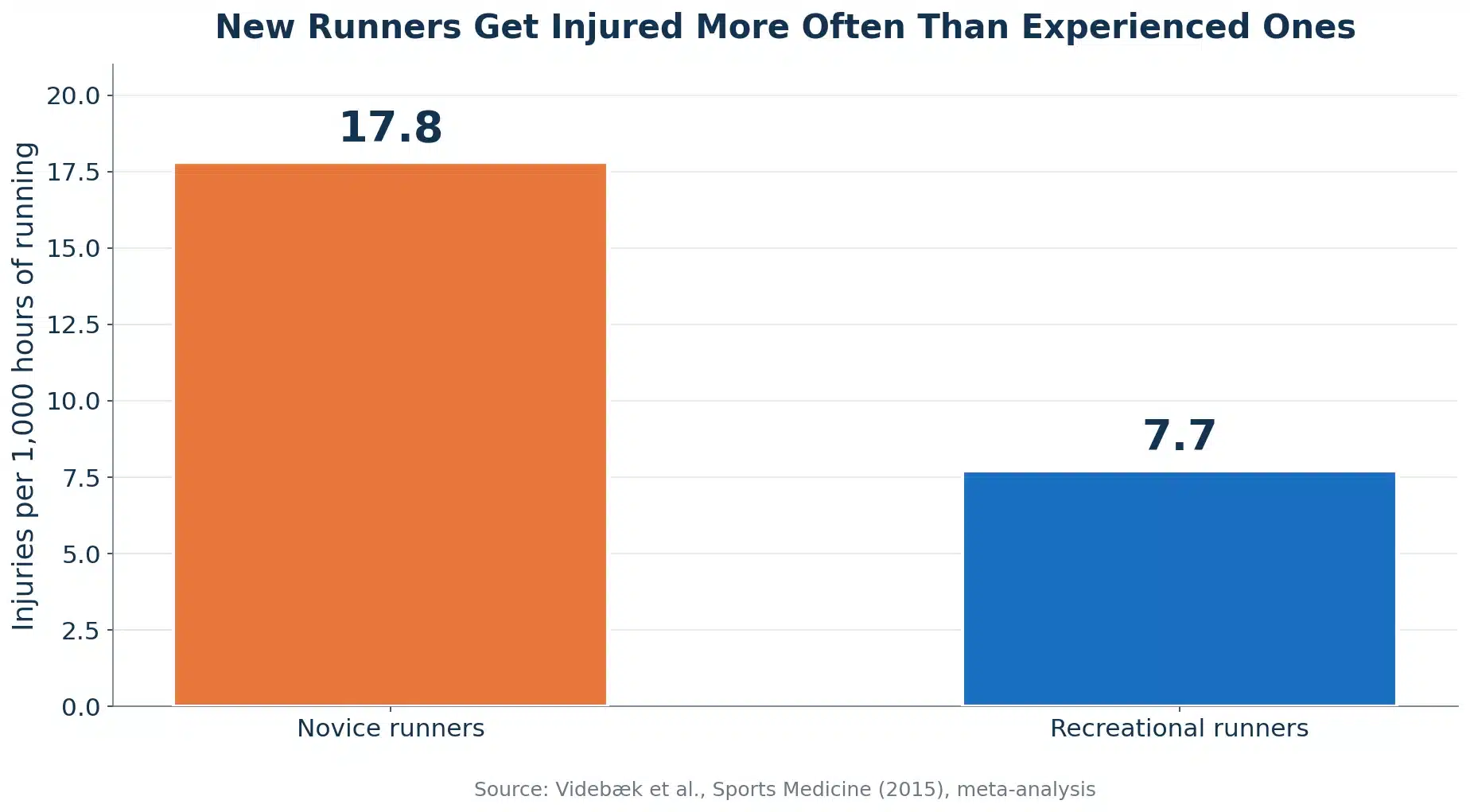
New runners do get injured more often than experienced ones, which is worth knowing so you can respect the risk without fearing every ache.
A review of injury rates in runners found 17.8 injuries per 1,000 hours of running in novices, against 7.7 per 1,000 hours in recreational runners.
New runners get hurt for a simple reason: your muscles and connective tissue need weeks to strengthen, and doing too much before they do is what leads to injury.
Most running injuries build up gradually from doing too much too soon.
The strongest thing you can do about that risk is to raise your running volume slowly and give your body weeks, not days, to adapt.
Our guide to increasing your weekly mileage safely lays out how much to add and how often.
How Do You Recover From Sore Legs After Running?
The best short-term fix for sore legs is gentle movement.
The soreness review found that light activity relieves the ache better than sitting still, even though the soreness returns for a while afterward.
An easy walk or a slow, short run increases blood flow to the muscle and eases the stiffness without adding real strain.
Keep moving gently on sore days, sleep enough to give the muscle time to rebuild, and eat enough protein and carbohydrate to supply the rebuild with raw material.
Space your hard efforts so a sore muscle gets a day or 2 to recover before you tax it again.
For more ways to speed up the process, our roundup of how to get rid of muscle soreness after a run covers the methods that help most.
Handled this way, the sore beginner phase becomes a short chapter rather than a reason to quit.
| Signal | Normal soreness | Possible injury |
|---|---|---|
| Location | Both legs, spread across the muscle | One spot on one leg, often a joint or bone |
| During the run | Eases as you warm up | Sharpens and alters your stride |
| Timing | Peaks 48 to 72 hours, then fades | Lingers, returns, or hits sharply at the start |
| Daily life | Stiff but you move normally | Limits normal walking |