

Carbohydrate loading is a nutrition strategy that maximizes stored muscle glycogen before a long race.
For most runners, carb loading means a big pasta dinner the night before a marathon.
That version of carb loading works poorly, and the difference between doing it correctly and doing it casually can cost you several minutes on race day.
When Does Carb Loading Actually Work?
Carbohydrate loading is effective for endurance events lasting longer than 90 minutes, including marathons, ultras, and full-distance triathlons.
During intense continuous effort, your muscles deplete stored glycogen after roughly 90 minutes, and once that fuel runs low your body forces a pace reduction.
Carb loading extends that window by filling your muscles to maximum glycogen capacity before the race starts.
Carbohydrate loading does not benefit the 5K or 10K because the effort ends before glycogen stores are meaningfully depleted, and any extra glycogen can cause muscle heaviness that hurts performance at shorter distances.
For events at or below the 90-minute mark, the temporary 2-4 pound water-weight gain that accompanies glycogen loading is not a worthwhile tradeoff.
How Does Carb Loading Improve Race Performance?
Muscle glycogen is the primary fuel source during marathon-pace running.
As glycogen runs low, your body shifts into a conservation mode that most runners call hitting the wall.
Pace drops, perceived effort spikes, and the final miles feel nothing like the opening ones.
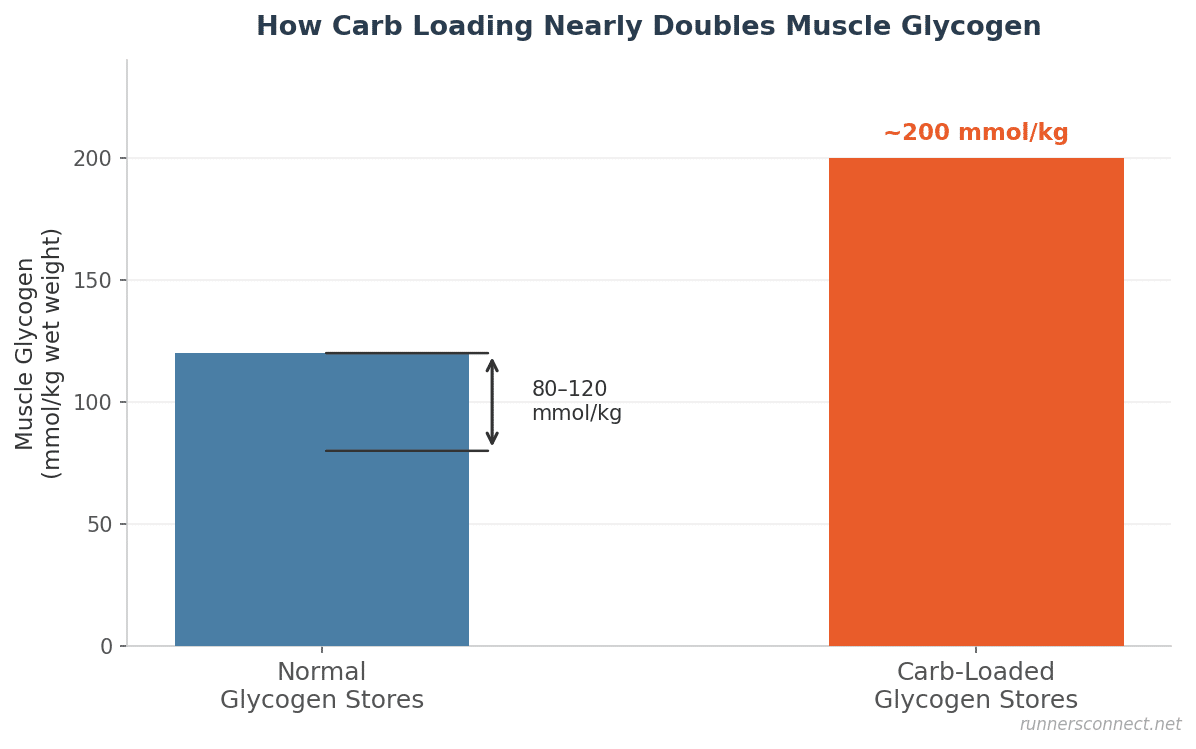
The more glycogen stored at the start of the race, the later that wall appears and the stronger your finish.
Under normal training conditions, your muscles store glycogen at a capacity of about 80-120 mmol/kg.
When carb loading is executed correctly, that capacity nearly doubles to approximately 200 mmol/kg.
Carb Loading Method 1: Long Taper
With the long taper approach, your final hard training session occurs about three weeks before race day.
During the two-week taper that follows, you eat 3-5 grams of carbohydrate per pound of body weight daily while reducing fat intake to offset the lower total energy burn.
Your muscles convert the surplus carbohydrate into glycogen that accumulates because your training load no longer depletes it.
This method suits runners following a traditional marathon taper and has decades of research behind it.
Carb Loading Method 2: 6-Day Protocol
The 6-day protocol begins with a glycogen-depleting workout six days before race day, using the same muscle groups you will race with.
The following three days consist of a normal mixed diet of 2-3 grams of carbohydrate per pound, alongside tapered training.
Three days before competition, training stops or reduces to nearly zero, and carbohydrate intake climbs to about 4.5 grams per pound of body weight.
The depletion-then-loading sequence causes your muscles to store more glycogen than high carbohydrate intake alone would produce.
Carb Loading Method 3: Rapid 24-Hour Loading
Rapid loading suits runners who maintain high training volume up to race week and cannot afford a prolonged taper.
You perform an intense glycogen-depleting workout 24 hours before race day, then immediately consume 5-6 grams of carbohydrate per pound of body weight across the rest of that day.
A 150-pound runner needs approximately 750-900 grams of carbohydrate, which equals roughly 3,000-3,600 calories, so fat and protein intake must drop sharply to make room.
Research shows the rapid approach produces glycogen storage comparable to longer protocols in trained runners, provided the carbohydrate target is met.
Choose your method based on your training schedule, race calendar, and how your gut responds to high-carbohydrate days. Always test it at least once in training before relying on it for a goal race.
RunnersConnect Bonus
Download your FREE Marathon Nutrition During Your Taper Guide.
The guide contains a plan of exactly what you should be eating in the 5 days to 3 hours before your race. We give specific food recommendations to make sure you are ready on race day.
What Are the Best Foods for Carb Loading Before a Marathon?
White rice, pasta made from refined flour, and plain white bread are the most reliable carb loading foods because they are calorie-dense, fast to digest, and contain minimal fiber.
Research has shown that effective pre-competition loading requires 10-12 grams of carbohydrate per kilogram of body weight per day for 36-48 hours before the race.

For a 150-pound (68kg) runner, that target is 680-820 grams of carbohydrate per day, roughly the equivalent of 15 cups of cooked white rice spread across your meals.
The best choices pack the most carbohydrate with the least fiber and fat.
White rice delivers about 45 grams of carbohydrate per cooked cup and is one of the lowest-fiber grains available.
White pasta, plain bagels, white sandwich bread, bananas, boiled potatoes without the skin, and low-fiber cooked cereals are equally reliable options.
Sports drinks, fruit juices, and energy gels can help close the gap when appetite becomes an obstacle during the final loading day.
Foods to avoid during the loading phase include anything high in fiber, high in fat, or unfamiliar to your digestive system.
High-fiber foods like cruciferous vegetables, beans and lentils, bran cereals, and whole grain breads add bulk to the digestive tract and accelerate gut motility in ways that can disrupt race morning.
High-fat meals slow gastric emptying and displace the carbohydrate your body needs to convert into glycogen.
Restaurant meals and unfamiliar cuisines introduce ingredients your gut has not been conditioned to handle in training.
Only eat foods you have tested many times in training. Unfamiliar ingredients are the single most preventable cause of race-morning GI distress.
Spread your carbohydrate intake across four to five smaller meals rather than trying to hit the daily target in one or two large sittings.
A sample 48-hour loading day for a 150-pound runner might look like: large rice and chicken bowl at lunch (120g carbs), a banana and sports drink mid-afternoon (60g), pasta with tomato sauce for dinner (120g), a glass of juice and white bread toast before bed (60g), and oatmeal with honey at breakfast the next morning (80g).
Your pre-race dinner and breakfast are maintenance meals, not loading meals. The glycogen-filling work happens in the 36-48 hours before those meals.
Does Carb Loading Cause Stomach Problems?
Carb loading can cause GI discomfort, but the discomfort is almost always predictable and avoidable.
The most common symptom runners notice is a heavy or full feeling in the legs and gut during the opening miles of the race.
Your body stores roughly 3 grams of water alongside every gram of glycogen it packs away, so a successful carb load increases body weight by 2-4 pounds in the days before race day.
That weight is temporary and disappears as you deplete glycogen during the race.
Do not panic about the scale, and do not try to cut the weight with fluid restriction.
Diarrhea, cramping, and bloating are more serious problems, and they almost always trace back to one of three specific mistakes.
The first mistake is eating high-fiber foods during the loading window.
Fiber accelerates gut motility on its own.
Adding a sudden surge of carbohydrate on top of normal fiber intake creates an unpredictable intestinal environment heading into race morning.
Cut fiber-heavy foods like broccoli, beans, whole grains, and raw vegetables in the 48 hours before the race to give your digestive system time to stabilize.
The second mistake is waiting until the night before the race to begin loading.
A large pasta dinner the evening before a marathon gives your muscles roughly 8-10 hours to convert food into stored glycogen before the gun goes off, not nearly enough time to complete the process.
Starting the loading phase two to three days before the race gives your muscles the full window they need and lets you consume moderate amounts at each meal rather than forcing down enormous portions in a single evening.
The third mistake is eating foods you have not tested in training.
Race-week meals should be repetitive and predictable.
If you have not eaten something at least several times during your training cycle, it has no place in your pre-race nutrition plan.
When in doubt, the safest race-week meal is the one you have eaten so many times it feels boring.
Practical Carb Loading Tips for Race Week
Always test your chosen loading method during a long training block before relying on it for a goal race.
Continue eating 0.6-0.7 grams of protein per pound of body weight throughout the loading period. Protein supports glycogen synthesis and serves as a secondary fuel source during the marathon.
Keep fiber intake moderate during regular training weeks, then reduce it sharply in the final 48 hours as carbohydrate intake climbs.
Eat your largest carbohydrate-dense meals in the middle of the day during the loading phase rather than at night.
Large meals eaten close to sleep disrupt rest quality and put your digestive system to work when it should be recovering.
Plan your race-day fueling strategy independently of your carb loading plan.
Stored glycogen gives you a larger reserve, but marathons lasting over three hours will still require additional carbohydrate from gels, sports drinks, or aid station nutrition to sustain pace through the finish.



4 Responses
the information has helped me get answers to my questions in my degree of sports science and management.thank you
I asked to find the marathon runner’s carbohydrates but they gave me everything but that.
Hi Neyne, we did link to an article which had the best sources of carbohydrates for runners, here it is https://runnersconnect.net/running-nutrition-articles/best-carbohydrates-for-runners/ the article you read was focused on why it is important, as many runners wish to know this. Hope this article I just sent is beneficial for you!
Big fan of method three, which I think is often referred to as the Western Australian CHO Loading protocol.
As long as you’re comfortable with doing such an effort the day before a marathon, that would be my preferred option.