

Watch a group of runners come toward you on a treadmill or a track and one or two will stand out. Their feet don’t land in two neat lines.
They land almost on top of each other, as if they’re running along a tightrope.
That narrow, one-foot-in-front-of-the-other pattern is a crossover gait, and for some runners it sits right at the root of stubborn IT band pain on the outside of the knee.
Correcting it won’t fix every case. For the right runner, though, a small change to how wide you land can do what months of stretching and foam rolling couldn’t.
Here’s what you’ll learn:
- What a crossover gait is and how to spot it in your own running
- Why a narrow stride loads the IT band and the hip
- The on-the-run drill and strength work that widen your gait
- How long it takes for a new stride pattern to stick
What is a crossover gait?
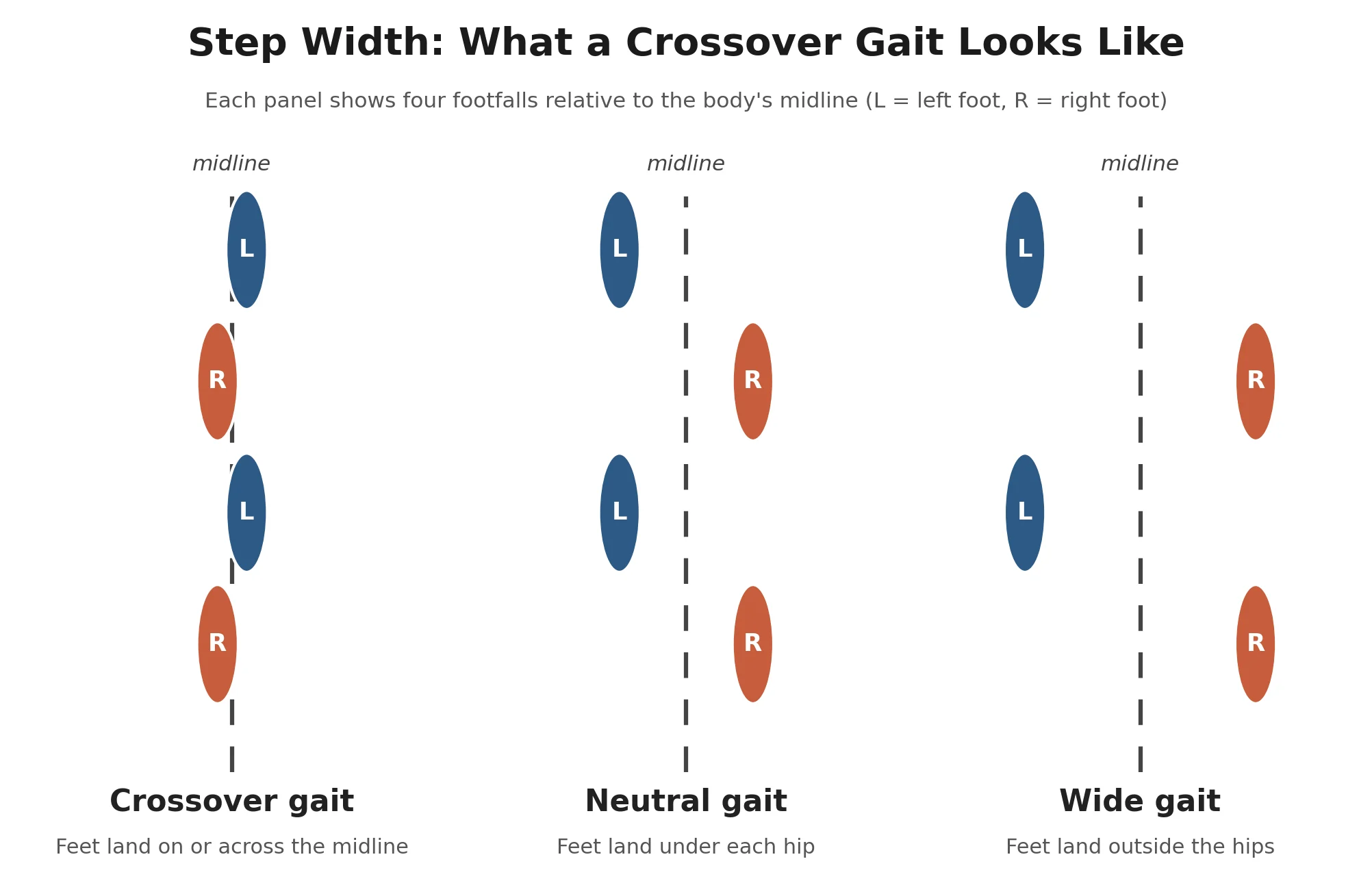
A crossover gait is when your feet land on or across an imaginary line running down the middle of your body, creating a very narrow stride.
Picture yourself running straight down the painted center line of a quiet road. If each foot lands on that line, or crosses to the other side of it, you have a crossover gait.
The wider your stride, the further each foot lands from that midline. The narrower it gets, the closer your steps come to stacking one on top of the other.
The tell is simple: run down a straight line and watch whether your feet keep crossing it on each landing.
Plenty of runners land narrow and never feel a thing. A crossover gait is a risk factor, not a diagnosis, and it matters most when it shows up alongside knee or hip pain that won’t settle.
Does a crossover gait cause IT band pain?
A narrow stride increases the strain on your iliotibial band, the thick band of tissue that runs down the outside of your thigh to your knee.
Researchers at Iowa State found that narrowing step width by about 5% of leg length significantly raised iliotibial band strain, with strain increasing steadily the narrower runners landed.

The same study found the reverse held true. Widening the stride lowered IT band strain, and the biggest gains came for runners who started out landing very narrow.
This matches what shows up in the clinic. IT band syndrome is one of the most common overuse injuries in distance runners, and a 2023 review reported it strikes women about twice as often as men.
A crossover gait doesn’t explain every case. Not every runner with IT band pain lands narrow, and not every narrow lander gets hurt.
When the two travel together, widening the gait is worth a serious try.
RunnersConnect Insider Bonus
Download our free Top 5 IT Band Prevention Exercises guide.
It’s a PDF with the 5 best exercises to help you prevent IT band syndrome.
What causes a crossover gait?
Most articles would hand you a tidy table of muscles to stretch and muscles to strengthen. Running form doesn’t work that cleanly.
That’s why runners who follow a stretch-and-strengthen plan to the letter often find the pain still there. The exercises can make a muscle stronger or looser without changing the pattern the brain actually selects when you run.
Weakness in the hip is part of the picture, especially the gluteus medius that keeps your pelvis level when you’re balanced on one leg.
A Stanford study of runners with IT band syndrome found the injured side was weaker in the hip abductors, and a 6-week strengthening program returned most of them to pain-free running.
That result isn’t a one-off. A systematic review pooling the evidence found hip abductor weakness tracked with IT band syndrome more consistently than with any other running injury.
Strength alone isn’t the whole answer. Running is a single connected motion, and how your leg swings through the air decides how it lands a moment later.
A leg that draws inward during the swing tends to land across the midline. Your brain has to learn a new landing position, not just carry stronger muscles, before the pattern changes for good.
How do you fix a crossover gait?
You fix a crossover gait by teaching your body to land wider, then giving the newly loaded muscles time to handle the change.
That takes two things working together: a cue you practice while running, and strength work that supports the new position. Formal gait retraining usually pairs a movement change with feedback from a coach or a mirror, and the widening cue is simple enough to practice on your own.
Widen your stride on the run
Find a straight line on the ground, like the edge of a bike lane, and run along it for a few strides.
If your feet keep crossing the line, spend 20 seconds landing a little wider so each foot stays on its own side. Then let your stride return to normal.
Keep each widening rep to about 20 seconds, not the whole run, so you don’t overload muscles that aren’t used to the new position.
Drop a few of these short reps into an easy run. Short and frequent beats long and forced when you’re rewriting a movement habit.
Save the drill for easy running, not races or hard workouts, when you have the spare attention to feel where your feet land.
Retrain the pattern with wider lunges
Most runners who cross over while running cross over when they lunge too, drifting the front foot toward the midline.
Practice a lunge with the feet set wider than usual, keeping each knee tracking over its own foot. The sudden wobble you feel is your body meeting a movement it hasn’t organized before.
A useful picture is lunging along a railway line rather than a tightrope. Wide and stable, not narrow and balanced.
Build hip and glute strength
Strength work gives the new stride something to stand on, and it builds the tolerance those muscles need to take on load they’ve been avoiding.
A focused block of hip and glute strengthening targets the same abductors the research keeps flagging in IT band syndrome.
Vary where and how you run
Running the same route at the same pace loads the same tissue the same way every time.
Rotate your shoes, change the surface, and run the occasional bend instead of a dead-straight line. Spreading the load across different tissues keeps any single structure from taking the full hit day after day.
| Fix method | What it does | How to apply it |
|---|---|---|
| Widen your stride on the run | Teaches the brain a wider landing | 20-second reps along a line during easy runs |
| Wider lunges | Retrains the pattern off the run | Feet set wide, each knee over its own foot |
| Hip and glute strength | Builds tolerance for the new load | A focused hip and glute block, 2 to 3 times a week |
| Vary your running | Spreads load off any single tissue | Rotate shoes, surfaces, and the odd bend |
How long does it take to fix a crossover gait?
Changing a running pattern takes weeks, not runs, because you’re rebuilding a habit your brain has drilled thousands of times.
Give the process a slow, progressive return to normal running. The muscles now taking on more load need time to adapt, and pushing the new width too hard too soon just trades one overload for another.
There’s an upside worth knowing. A follow-up study found that widening step width also lowered stress on the shin bone, so a wider gait eases load on more than the IT band alone.
Stay patient and keep the strength work going while the new stride settles in. Once your brain can pick the wider landing on its own, without you thinking about it, the change has taken hold.



5 Responses
Part of my overcoming of ITBS has been to slow down alot for 60% of weekly distance, 6:30min/km or slower than 10min/mile. Ive noticed that its very difficult to run with excessive crossover when running that slow and in a couple of weeks ive noticed a change for less crossover in my faster paces as well.
Thanks for posting this! I never understood how strengthening my hips could help with ITBS until I realized that I have a cross-over gait as well. This post has saved me!
I’m confused by this article. I’ve seen similar on other websites such as “thegaitguys,” critical of a crossover gait, and on a crusade to elimimate this evil that’s infecting running, etc. My confusion, possibly, comes from a slight lack of clarity in these presentations. There are a number of websites, books, and elite marathon and ultra marathon runners that advocate “fox running” or “in line running”. They are pretty clear about NOT “crossing over” the center line, but rather maintaining a level pelvis (front to back and side to side), while rotating the hips forward with the leg to better maintain the body over it’s center of gravity, while avoiding side to side movement trying to balance the body over two separate tracks or lines, to either side of the center. Is there really a conflict here? Or is there a lack of clear communication on a difference between running down a single line, which some say is the most natural style of running used by children, and “crossing over” that single line? In your other materials you emphasize that running is a game of inches, that’s it’s the little things that make a champion. Please help clarify for me. I’m not doning “in line running” yet, but I’ve been studying it, and watching my 15 month old grandson run as he matures, but he’s not old enough yet to see what happens yet.
In the recent popular book “Unbroken” about Louis Zamperini, who died recently at age 97, the author notes on page 17 “Louie had a rare bio-mechanical advantage, hips that rolled as he ran; when one leg reached forward, the corresponding hip swung forward with it, giving Louie and exceptionally efficient, seven-foot stride. After watching him from the Torrance High fence, cheerleader Toots Bowersox needed only one word to describe him: “Smoooooth.”
I’m a 67 year old, widowed, retired grandpa whose trying to get back into running again starting at age 62, after giving it up almost completely since age 20 due to a college injury. I’ve read about a dozen books on barefoot and minimalist running, and I’ve been very cautiously nibbling at it. I go barefoot around the house, and on easy walks, but only run maybe every other day and usually only 1 to 3 or 4 miles barefoot on in very minimalist zero drop shoes. My goal is not competitive, but to just be able to run and not damage myself. There is certainly a lot of debate about how to do that. My podiatrist says that the whole barefoot / minimalist thing is a fad, and he’ll be happy to make orthotics for me and get me into motion control shoes, etc.
I do have “Morton’s Foot” with the ball of my second toe longer than the ball of my big toe. I have had some difficulty getting enough weight over on to the balls of my big toes and not too much on the balls of the second toes, where I can get calluses if I’m not careful. I’ve tried hard to learn and use techniques to do this, without reverting to pads and orthotics, and after 5 years I think I’m just starting to get it. Finding good advice on this specific problem has been difficult.
I used to have knee pain and pain behind my left heel (bone spur there), but they have both gone away completely for 5 years doing what I’m doing. Now it’s mostly the struggle spreading weight over the balls of my feet and not getting too much on the balls of the second toe.
Also curious what the percentage of the GENERAL U.S. population is with longer second toes (not just Morton’s Foot) but anyone with longer second toes. The answers are all over the map, from 5% to more than 50%. And I’ve heard that 80% of foot problems that send people to podiatrists, etc. seem to come from people with longer second toes.
how to change and widen your stride as a soccer player with it band issues. second time, suffered from right it band (surgery) two years ago.
Peter, if you follow the suggestions in this post, it should help. You need to be careful not to over-stride though, then you will reduce your inefficiency, and put yourself at a greater risk of injury. Sounds like you have been through enough! This may help you also https://runnersconnect.net/running-injury-prevention/it-band-injury-runners-stretches-exercies-treatments/