Most runners I talk to are using HRV wrong.
They wake up to a red readiness score, skip the workout on the schedule, and do the same thing the next time the score is red.
Three weeks later they wonder why race day felt so hard.
So why is this the wrong approach and how should you be using your HRV score?
To give an evidence-based answer, let’s look at the research-backed practical advice on…
- What HRV measures in your body and why a swing of 10 to 20% from one day to the next is normal
- Why one morning’s HRV reading told researchers almost nothing about a runner’s 10K, while the weekly average tracked it closely
- The 4 HRV trends that deserve a change in your training, including the one where a green score hides fatigue
- A decision table for when a low HRV should change your workout and when to run it as planned
- How to measure HRV so the trend means something
What Does HRV Actually Measure?
Heart rate variability is the change in time from one heartbeat to the next, measured in milliseconds.
A heart beating 60 times a minute does not beat exactly once a second.
One gap between beats lasts 0.95 seconds, the next lasts 1.05 seconds, and HRV is the size of those differences.
Most watches and rings report a version of HRV called RMSSD, which is the average beat-to-beat difference across the reading.
Those differences come from your parasympathetic nervous system, the branch that slows your heart and runs digestion, sleep and recovery.
The parasympathetic system slows your heart through the vagus nerve, and it does so unevenly, speeding the heart slightly as you breathe in and slowing it as you breathe out.
The more active your parasympathetic system is, the larger those beat-to-beat differences get and the higher your HRV reads.
Stress of any kind does the opposite.
A hard workout, a poor night of sleep, a cold or a rough week at work all activate your sympathetic nervous system, the fight or flight branch.
When the sympathetic system is more active, your HRV drops.
A review of heart rate monitoring in athletes reported that a single hard session lowers HRV for 24 to 48 hours.
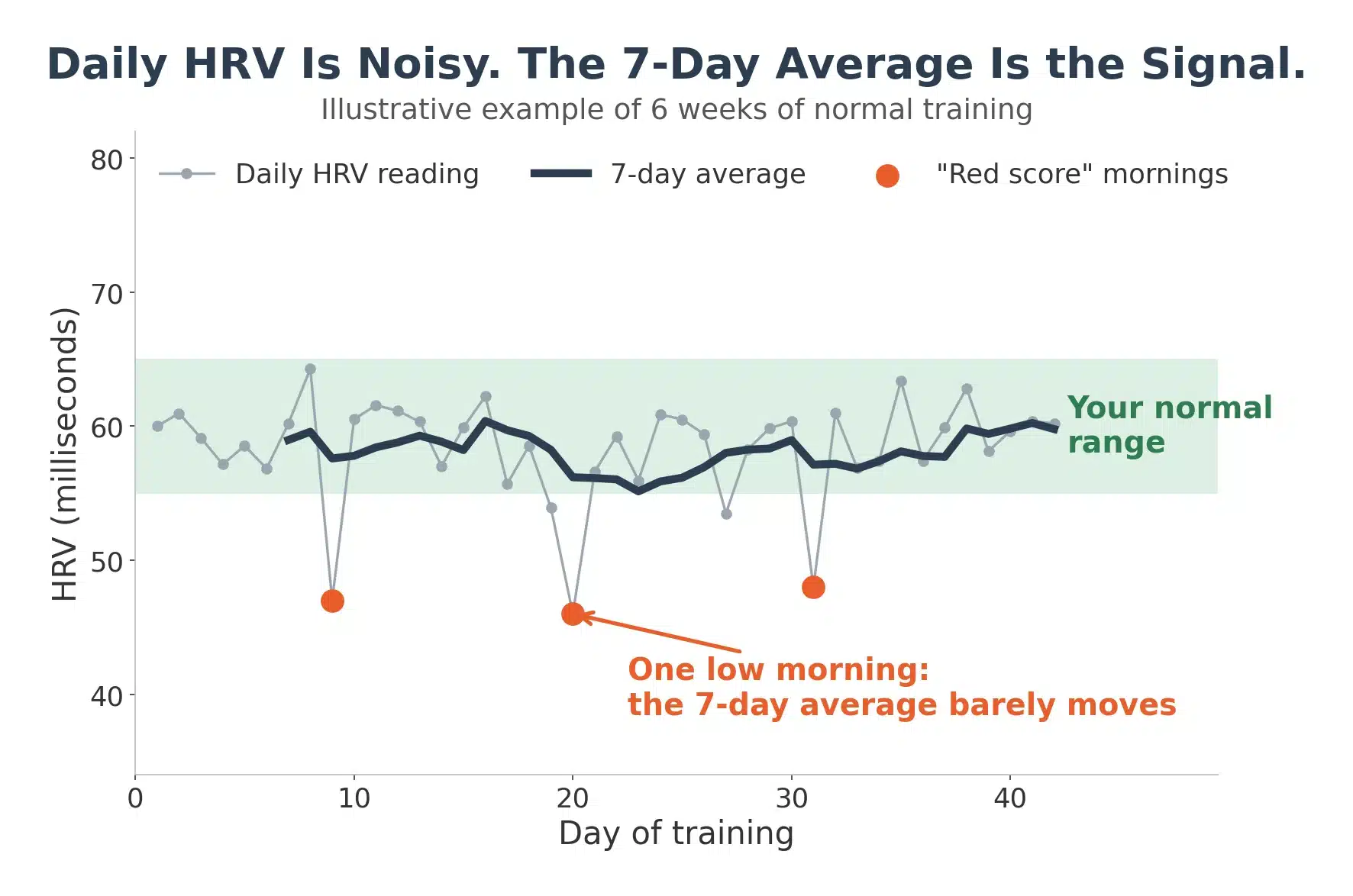
The same review found that HRV swings 10 to 20% from one day to the next in athletes whose training is going well.
That means a runner who averages 60 milliseconds can read 50 one morning and 70 the next with nothing wrong.
HRV also differs widely from one person to another, so the only useful comparison is against your own numbers from the past few weeks.
Why Does Your Readiness Score Get HRV Wrong?
First off, it’s not because your watch isn’t measuring your HRV accurately.
A 2024 study measuring the Oura ring vs. a medical-grade ECG found that overnight HRV readings only differed from the ECG by an average of 2.5 to 3.8 milliseconds. So, your watch is likely reading correctly.
Researchers have also tested how much one day of that accurate data tells you.
A 2013 study followed 10 runners through 9 weeks of training and compared the change in each runner’s HRV with the change in their 10K time.
A single morning’s HRV reading scored 0.17 out of 1 for tracking how much a runner’s 10K improved, while the weekly average of the same readings scored 0.76.

That means the same data went from useless to useful when the researchers stopped looking at one day at a time.
Your readiness score does the opposite, because it grades you on the most recent night.
A red score the morning after a hard workout is the 24 to 48 hour drop described above, which is your body responding to the training the way it should.
Things that have nothing to do with training move a single night just as much.
A 2026 analysis tracked alcohol and overnight HRV in 20,968 wearable users across 5.1 million days.
One drink more than a person’s usual amount lowered overnight HRV by 3.3 milliseconds in men and 3.8 milliseconds in women.
The same extra drink raised overnight resting heart rate by 2.4 to 2.8 beats per minute.
A glass of wine with dinner, a late meal or a night in a hotel bed can turn your score red.
None of them say anything about whether your legs are ready for Tuesday’s tempo run.
Which HRV Trends Actually Matter?
So, if you are going to use HRV, you need to look at trends and not just one-off scores.
Here are 4 HRV patterns with research behind them and why you need to look at them over weeks, not just days.
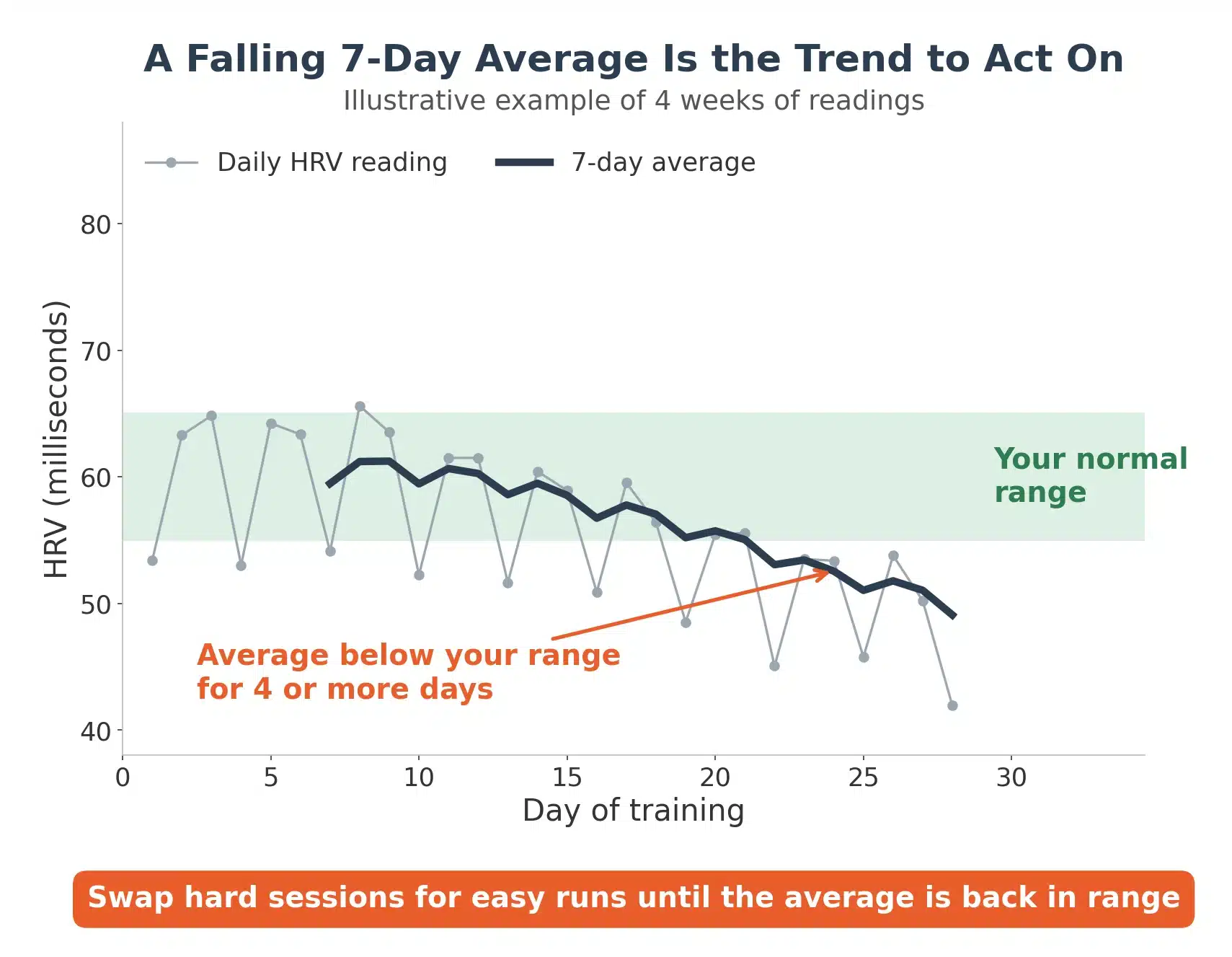
Is your 7-day average falling while your resting heart rate climbs?
A 7-day HRV average that keeps dropping while your resting heart rate rises is the pattern that came before a failed race in the research.
A case comparison tracked two elite triathletes every morning for roughly 10 weeks before a major race.
The first athlete’s 7-day average held steady for the full 10 weeks, and he raced well.
The second athlete’s 7-day average fell week after week while her resting heart rate climbed about 3 beats per minute each week.
She did not finish the race, and she needed an extended break from training afterward.
Act when your 7-day average sits below your normal range for 4 or more days and your resting heart rate is up.
Replace your hard sessions with easy running until the average returns to your range.
A slide that continues through a full week of easy running is the point to read up on the other symptoms of overtraining in runners.
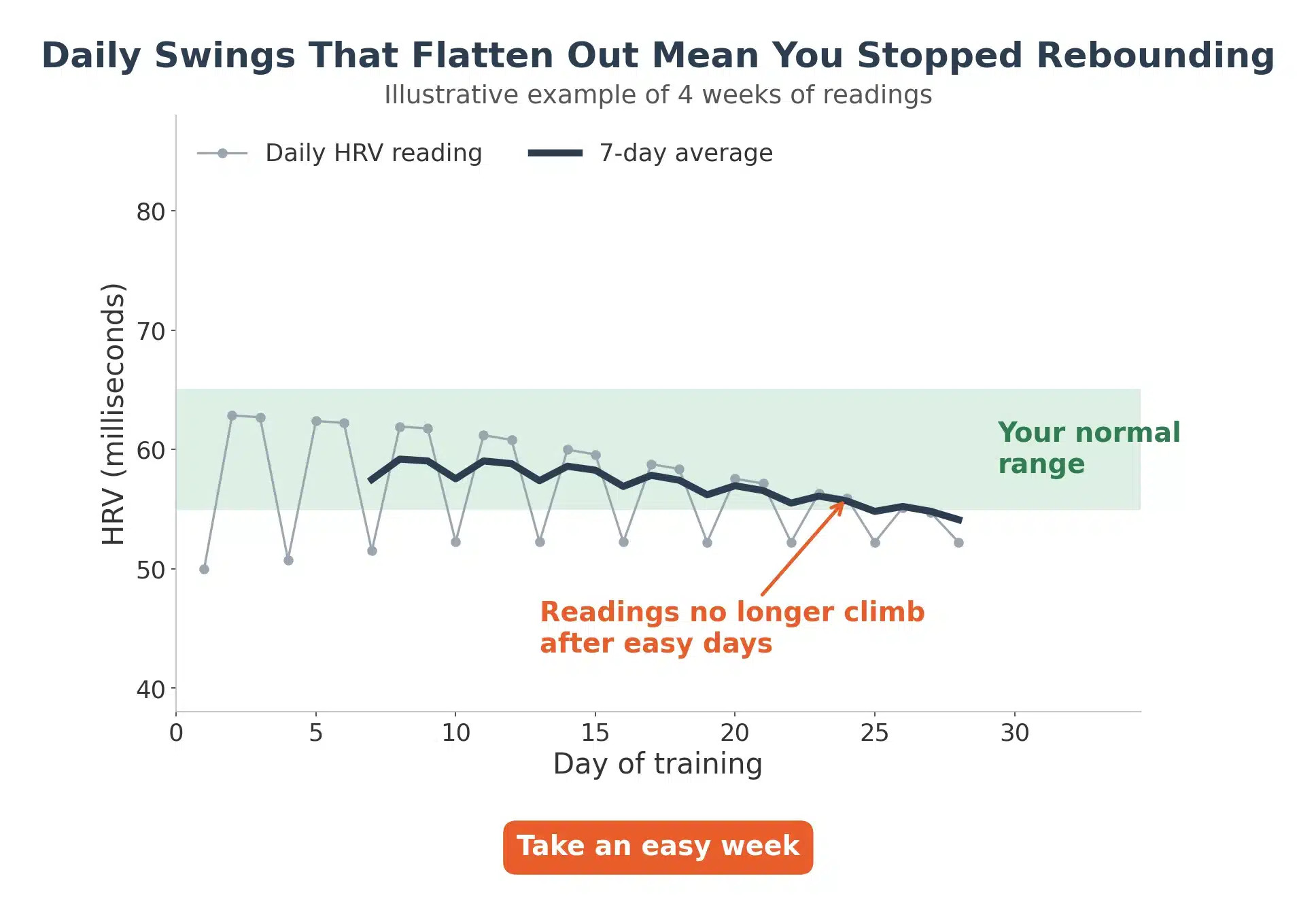
Have your day-to-day swings flattened out?
Healthy HRV bounces, dropping the morning after a hard session and climbing back after an easy day.
In the same case comparison, the overreached triathlete’s daily swings shrank steadily as her fatigue built.
Her readings stopped rebounding after easy days and settled into a flat line at the low end of her range.
The athlete who raced well kept the full pattern of dips and rebounds throughout his training.
If your readings have stopped rising after easy days, treat it the same way as a falling average and take an easy week.
Is your HRV rising while your running gets worse?
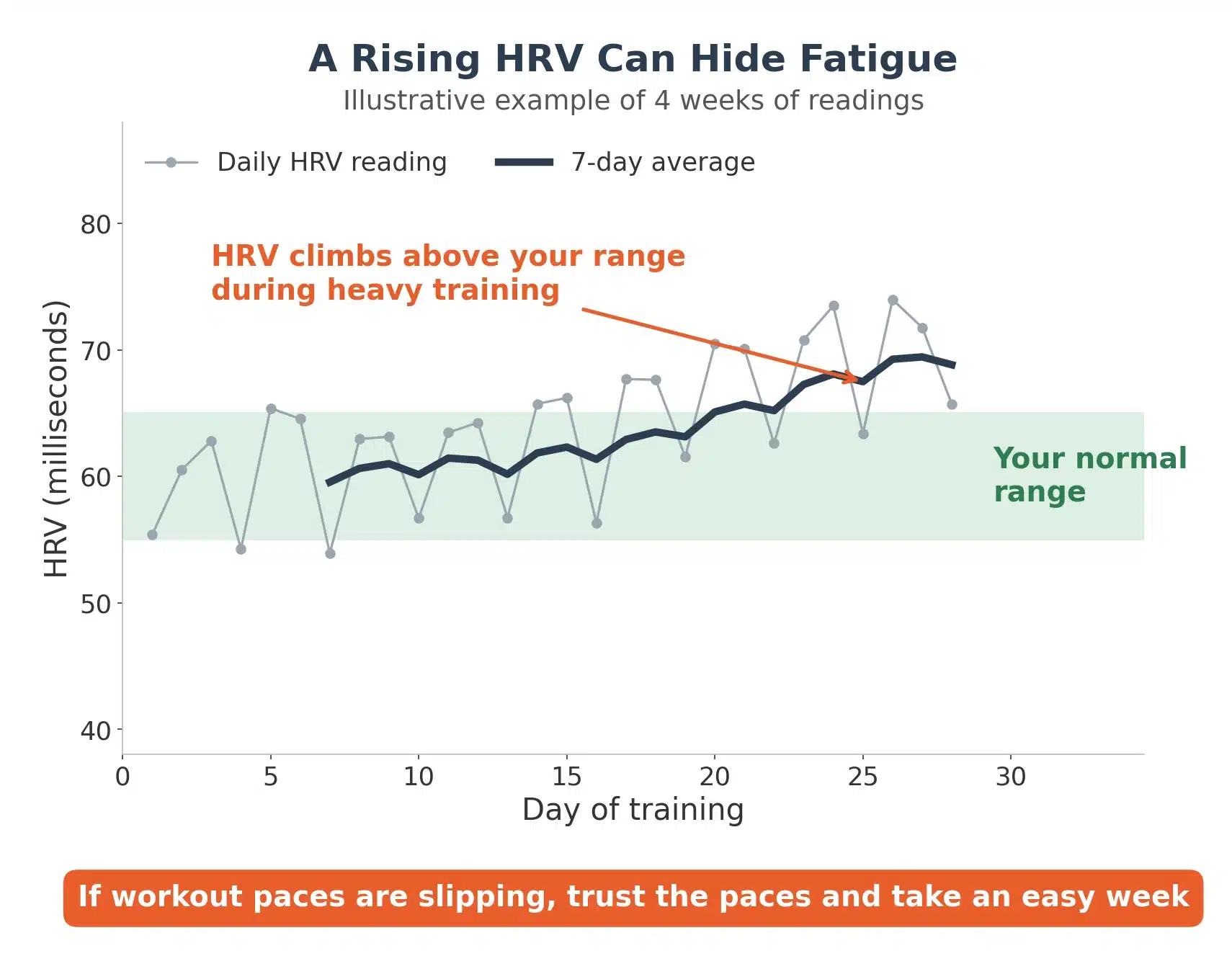
A high HRV does not prove you are absorbing your training.
A 2020 study took 11 runners averaging 29 miles, or 46 kilometers, a week and nearly doubled their training load for 2 weeks.
Their resting HRV went up during those 2 weeks.
Their average 5K time trial slowed from 19:35 to 19:57, and they rated the training as harder to tolerate.
After a 10-day taper their HRV came back down and their 5K time dropped to 19:09.
That means a week of green scores during your heaviest training can sit on top of real fatigue.
When your HRV is high and your workout paces are slipping at the same effort, believe the paces.
Does HRV drop during your taper?
HRV in elite endurance athletes often falls in the weeks before a major competition while their performance keeps improving, according to the review cited earlier.
That evidence comes from elite athletes, and nobody has run the same study on everyday marathoners.
It is still enough reason to leave your taper alone when race-week nerves, travel and a lower HRV all show up together.
When Should a Low HRV Change Your Workout?
A low HRV should change your workout only when your resting heart rate and how you feel agree with it.
A 2025 trial tested this in 28 experienced cyclists over 31 days.
One group had their hard, easy and rest days set by HRV alone, and their 20-minute power did not change by a measurable amount.
Another group had their days set by HRV, resting heart rate and a morning rating of their sleep, fatigue, soreness and stress.
That group raised their 20-minute power from 261 watts to 285 watts, a gain of about 9%.
The groups were small at 8 riders each, so treat the 9% as a direction more than a precise number.
Here is how to put HRV, resting heart rate and how you feel together on a given morning.
| What you see | What it usually means | What to do |
|---|---|---|
| One low reading and you feel fine | Normal daily swing or yesterday’s hard session | Run the workout as planned |
| One low reading and you feel lousy | A short night, a drink, a cold starting or life stress | Jog the first 10 minutes of the warm-up and decide then |
| 7-day average below your range for 4 or more days and you feel fine | Training load is building | Run the workout and check your resting heart rate and workout paces |
| 7-day average below your range, resting heart rate up and you feel flat | You are not recovering between sessions | Swap hard sessions for easy runs until the average is back in range |
| HRV high but workout paces slipping | Fatigue the score is hiding | Take an easy week |
| HRV dips during your taper | Common before a race | Keep the taper as written |
The 10-minute warm-up in the second row is covered step by step in the guide on whether to skip a workout when you’re tired.
Only two rows in the table take hard sessions away, and neither one is triggered by a single low reading.
How Should You Measure HRV So the Trend Means Something?
A trend is only as good as the consistency of the readings behind it, so measure under the same conditions every time.
- Use one method and stick with it. Wear your watch or ring to bed every night, or take a 1 to 2 minute reading each morning right after you wake up.
- Get enough readings. Researchers who monitor elite athletes recommend a minimum of 3 readings a week to build a weekly average, and daily readings are the target.
- Look at the 7-day average against your own baseline. Most apps show this on a separate trend screen, plotted against a shaded band that marks your normal range.
- Give a new device 4 weeks before you act on it. Your normal range cannot be drawn until the app has about a month of your readings.
- Write down the obvious causes. Note alcohol, late meals, travel and illness so a single low night has an explanation before it worries you.
If checking a trend screen every morning is more than you will keep up with, ignore the daily score and look at your 7-day average once a week on the same day.
Check Your 7-Day HRV Trend Once a Week and Run the Workouts in Between
Your HRV reading is accurate, and one day of it says almost nothing about your fitness or your readiness to train.
The weekly average compared with your own normal range is what the research supports.
Change your training when that average stays low for 4 or more days and your resting heart rate and your legs agree with it.
On every other morning, including the red ones, run the workout on your schedule.
Start this week by finding the 7-day HRV screen in your app and picking one day to check it.
| HRV trend | What the research found | What to do |
|---|---|---|
| One low morning reading | A single day’s HRV scored 0.17 out of 1 for tracking 10K improvement. Daily swings of 10 to 20% are normal. | Run the planned workout. |
| 7-day average inside your normal range | Runners who scheduled hard days this way ran 3000 meters 2.1% faster on 13 hard sessions in 8 weeks. | Do your hard sessions as scheduled. |
| 7-day average falling with resting heart rate rising | An elite triathlete with this pattern for 10 weeks did not finish her race. | Replace hard sessions with easy runs until the average is back in range. |
| HRV rising while paces slip | Runners who nearly doubled their training for 2 weeks saw HRV rise while their 5K slowed by 22 seconds. | Trust the paces and take an easy week. |
| HRV dip during the taper | HRV often falls in elite athletes before competition while performance improves. | Keep the taper as written. |