

You’re standing at a crossroads.
You’ve mapped out two training schedules: running 3 miles every single day, or running 6 miles every other day.
Both add up to about 21 miles per week.
Both feel doable.
But which one will make you faster, keep you healthier, and fit better into your life?
The answer matters because the schedule you choose shapes your entire training cycle.
So, in this article you’re going to learn the research-backed practical advice on whether running shorter distances every day or longer distances every other day builds better fitness, keeps you injury-free, and actually works for your lifestyle.
- Why your body adapts differently to running frequency versus running duration
- The research on which schedule produces better aerobic fitness
- Recovery and injury risk for each approach
- How to pick the schedule that fits your goals and life
- The total weekly volume that matters most
How Your Body Responds to Running Frequency vs. Duration
Your body doesn’t care whether you run one long run or many short ones. What matters is the stimulus you create and how often you repeat it.
When you run every day, you deliver an aerobic training signal to your cardiovascular system on a 24-hour cycle.
This daily frequency means your heart, lungs, and capillaries stay under constant low-level pressure to adapt.
Your mitochondria sense this repeated stimulus and respond by building more aerobic enzymes and improving oxygen processing efficiency with each successive run.
The advantage of daily running is consistency of signal: your aerobic system never fully “rests,” so adaptation becomes cumulative across the week.
Capillary growth, VO2 max improvements, and aerobic enzyme upregulation happen through accumulated daily stimulus rather than through a few hard sessions per week.
Every-other-day running, by contrast, delivers a larger aerobic stimulus per session because each run is longer.
A 6-mile easy run creates a bigger VO2 max training stimulus than a 3-mile easy run, and it raises your heart rate higher for a longer duration in the same zone.
The trade-off is frequency: your body gets 48 hours between sessions, which allows for deeper recovery and glycogen repletion.
This recovery window is significant because it means your next run starts from a position of higher readiness, allowing you to push intensity harder on designated workout days.
The choice isn’t about which stimulus is better. Both work.
It’s about which aligns with your current fitness, schedule, and injury history.
Does Running Every Day Build More Fitness Than Running Every Other Day?
The research answer is nuanced: if total weekly volume is equal, running every day and running every other day produce nearly identical fitness gains.
If volume differs, total mileage wins.
Research on recreational runners shows that weekly aerobic adaptations depend on total weekly distance, not session frequency.
A runner doing 20 miles in two 10-mile runs adapts the same as a runner doing 20 miles in four 5-mile runs, provided recovery and intensity are matched.
This finding surprises most runners because it seems like daily running should produce more fitness.
It doesn’t, because the training stimulus is proportional to the work done, not how many times you do it.
What does change between schedules is consistency and how volume accumulates.
Daily runners often accumulate their weekly target mileage more easily because the habit is stronger. Missing a single run is more noticeable when you run every day.
Every-other-day runners sometimes skip a session because the commitment feels less binding, which means they end the week short of their mileage goal.
If you run every day and stick to it, you’re more likely to hit 20–30 miles per week than if you run every other day and miss one or two sessions.
In that scenario, daily running does produce more fitness. This is not because frequency is superior, but because volume accumulation is higher.
The intensity distribution also matters.
Every-other-day runners get deeper recovery between sessions, so they can handle harder workouts (tempo runs, intervals) with lower injury risk.
Daily runners often need to keep intensity low to recover between runs, which means their weekly training stimulus is spread across easy paces rather than concentrated in harder work.
Running every day produces the same fitness gain as running every other day when total weekly mileage is identical. The difference lies in consistency, recovery, and how you distribute intensity.
Recovery and Injury Risk: Which Schedule Is Safer?
Every-other-day schedules allow fuller recovery.
Daily schedules accumulate mechanical stress faster.
Neither is inherently “safer.” The safe schedule is the one that respects your body’s adaptation timeline.
Running every day means no hard tissue recovery day.
Repetitive impact load is continuous.
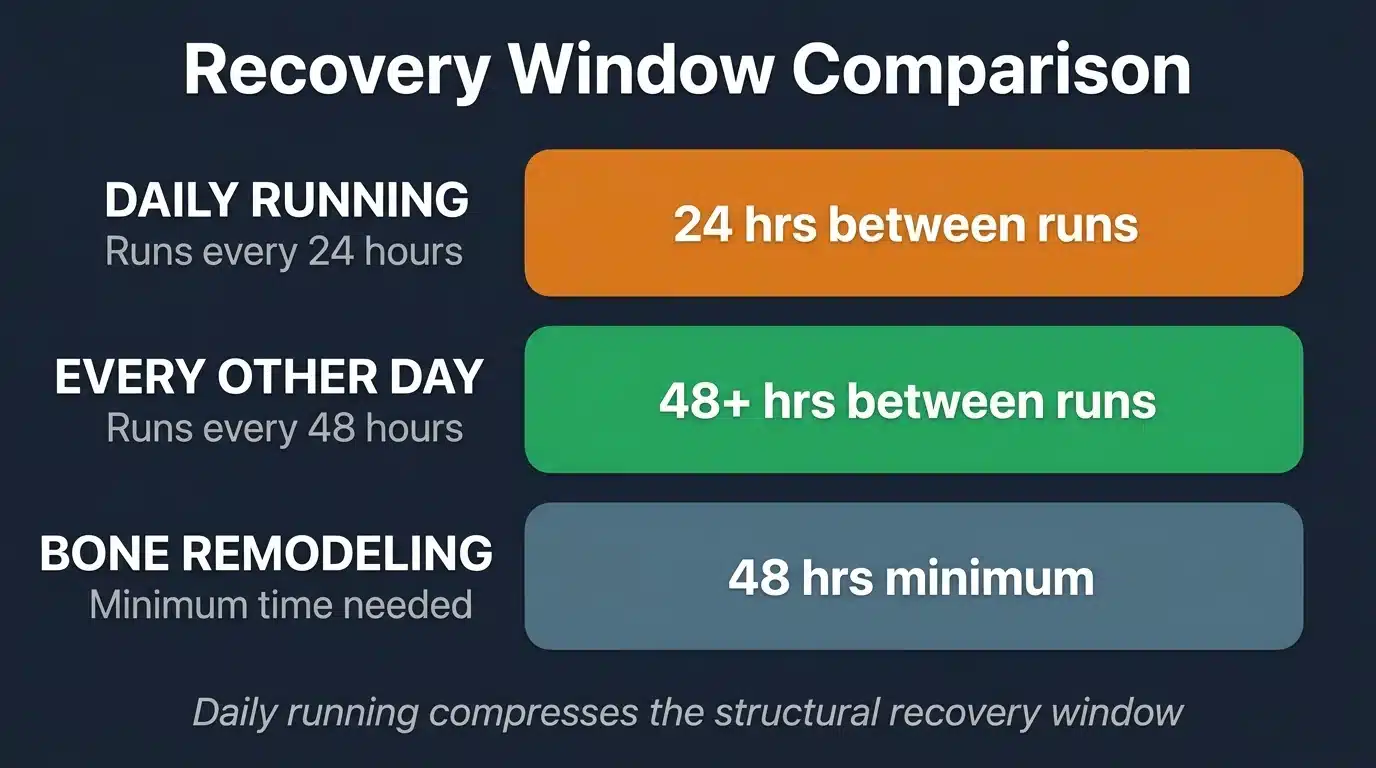
Your tendons, ligaments, and bones need 48+ hours to fully remodel and strengthen after a run.
When you run daily, you’re compressing this window into 24 hours, which means structural adaptation happens more slowly relative to the training stimulus you’re applying.
This is why stress fracture risk rises with high-mileage daily running: bone can’t fully remodel before the next impact load hits.
Daily running works fine for low-intensity base-building runners. These are people doing 3–4 miles at conversational easy pace with total weekly volume under 25 miles.
For mileage-heavy daily runners (40+ miles per week), injury risk becomes a serious concern.
Every-other-day schedules allow 48-hour recovery windows, during which glycogen fully replenishes, nervous system downregulation occurs, and structural tissues (bone, tendon, cartilage) undergo remodeling and strengthening.
This deeper recovery window is why every-other-day runners can sustain harder workouts without elevated injury risk.
A 6-mile tempo run on an every-other-day schedule is safer than a 3-mile tempo run on a daily schedule because the runner has had 48 hours to recover fully.
It’s also why cross-training fits naturally into every-other-day schedules: you use off days for cycling, swimming, or strength work, which maintains fitness without repetitive running impact.
Every-other-day schedules allow deeper recovery and lower injury risk for mileage-focused runners. Daily running is safer only if kept at conversational easy pace and total weekly volume is moderate (under 30 miles).
Total weekly mileage is the single strongest predictor of injury risk. Frequency alone is not the determining factor.
A runner doing 50 miles per week on an every-other-day schedule faces lower injury risk than a runner doing 50 miles per week daily.
But a runner doing 20 miles daily faces similar injury risk to a runner doing 20 miles every other day (assuming intensity distribution is equal).
The intensity distribution across the week matters too.
Most injuries come from threshold/VO2 work and long runs, not easy running.
If you’re doing high-intensity workouts multiple times per week, recovery depth becomes critical. This favors every-other-day schedules.
If your running is predominantly easy-paced (zone 1–2 training), daily running is low-risk.
Which Schedule Works Better for Different Runners
The best schedule isn’t the one that sounds harder or produces faster fitness.
It’s the one that fits your life, recovery capacity, and injury history.
For new or returning runners building a base, daily easy running works exceptionally well.
Your weekly mileage naturally stays low (3–4 miles per day), so injury risk is minimal at conversational pace.
Recovery demands are modest because intensity is low.
Daily running is sustainable without elite-level sleep or nutrition habits.
The daily habit also matters: it’s psychologically easier to commit to “I run every day” than “I run every other day and might skip a session.”
Daily running builds the ritual and consistency that turns a schedule into a lifestyle.
Most new runners should aim for 12–16 weeks of daily 3–4 mile easy runs to establish aerobic base fitness before adding intensity or every-other-day structures.
For experienced runners doing moderate mileage (25–40 miles per week), every-other-day structures pair well with intensity-based training.
You can designate run days for speed work (tempo, intervals, long runs) and recovery is deep enough to support harder efforts.
Off days become natural opportunities for cross-training, strength work, or active recovery. All of these address running-specific weaknesses without adding impact load.
This schedule also frees up time for other life demands and reduces decision fatigue (you don’t have to ask “should I run today?” every morning).
Most intermediate runners perform best on a 3–4 run every-other-day schedule with one long run, one tempo or interval session, one easy run, and one conversion day (cross-training or strength).
High-mileage or injury-prone runners need every-other-day structures to stay healthy.
At 40+ miles per week, daily running increases stress fracture risk, overuse injuries, and cumulative fatigue that degrades performance.
If you’re committed to daily running at this volume, reduce total weekly mileage by 15–20% and keep all running at conversational easy pace.
Layer in cross-training on off days to maintain fitness without impact load.
Runners with a history of stress fractures, chronic tendinitis, or overuse injuries should default to every-other-day structures and use off-day cross-training to maintain volume.
These runners also benefit from dedicated strength and mobility work, which fit naturally into rest days.
How to Choose Your Running Schedule
Choose based on three factors: your total weekly mileage, your injury history, and your life schedule.
Use this framework to decide.
| Factor | Daily Running Works Better | Every-Other-Day Works Better |
|---|---|---|
| Weekly mileage | Under 30 miles | 30+ miles |
| Current injuries | None | History of stress fractures or overuse |
| Intensity preference | Conversational easy pace | Mix of easy and tempo/interval work |
| Life schedule | Every day is consistent (gym, work routine) | Flexibility to group running days |
| Recovery support | Limited sleep or nutrition support available | Strong recovery habits (7+ hours sleep, consistent nutrition) |
| Running experience | New or returning to running | 6+ months consistent running |
| Goal race distance | 5K, 10K | Half-marathon, marathon |
Start with the schedule that feels sustainable for 12 weeks.
If you’re missing runs or injury creeps in, switch schedules and try again.
Track your weekly mileage, how your body feels, and any niggles (minor aches that aren’t full-blown injuries).
The signal that you should switch schedules is consistent: you either skip workouts, or nagging injuries appear within 2–3 weeks.
Remember that total weekly mileage matters more than the split.
20 miles is 20 miles, regardless of whether you run 4 times a week or 7 times a week.
The question to ask yourself is not “which schedule is faster?” but “which schedule can I stick to consistently.