
You wake at 5 AM to squeeze in a run before work.
Your stomach is empty, you have 45 minutes before you need to be out the door, and you’re facing the same question most morning runners face: eat something quick, gulp down coffee, or just run on empty?
Your body spent the last 8–10 hours asleep, essentially fasting.
Your liver glycogen, the carbs your liver converts to blood glucose to feed your brain and muscles, has already dropped significantly overnight.
Your blood sugar is lower than it was at dinner, your muscles are partially depleted, and running in this state is where most early-morning runners hit a wall: they bonk halfway through their workout, feel sluggish or dizzy, or end up cutting the run short.
But here’s the catch: you don’t always have time for a full breakfast before you run.
So, in this article you’re going to learn the research-backed practical advice on how to fuel your body for early morning runs.
By the end, you’ll know:
- Why your body starts the morning in a depleted state and what that means for your run
- Whether fasted running is actually a fat-burning advantage, and why the research is more complicated than the headlines suggest
- How long you need to digest different foods before heading out
- Exact food options for every time window, from “I have 15 minutes” to “I have 90 minutes”
- How to decide what’s right for your run based on duration and personal tolerance
Why Does Your Body Start the Morning with Depleted Glycogen?
While you sleep, your body keeps burning through carbohydrate stores.
Your brain runs on glucose around the clock.
Your muscles continue to consume oxygen and fuel, even at rest.
Unlike fat stores, which are large and nearly inexhaustible, your carbohydrate reserves are small and finite.
Research has shown that sleeping with reduced carbohydrate availability the night before exercise significantly lowers muscle glycogen stores, which affects how your muscles perform the following morning.

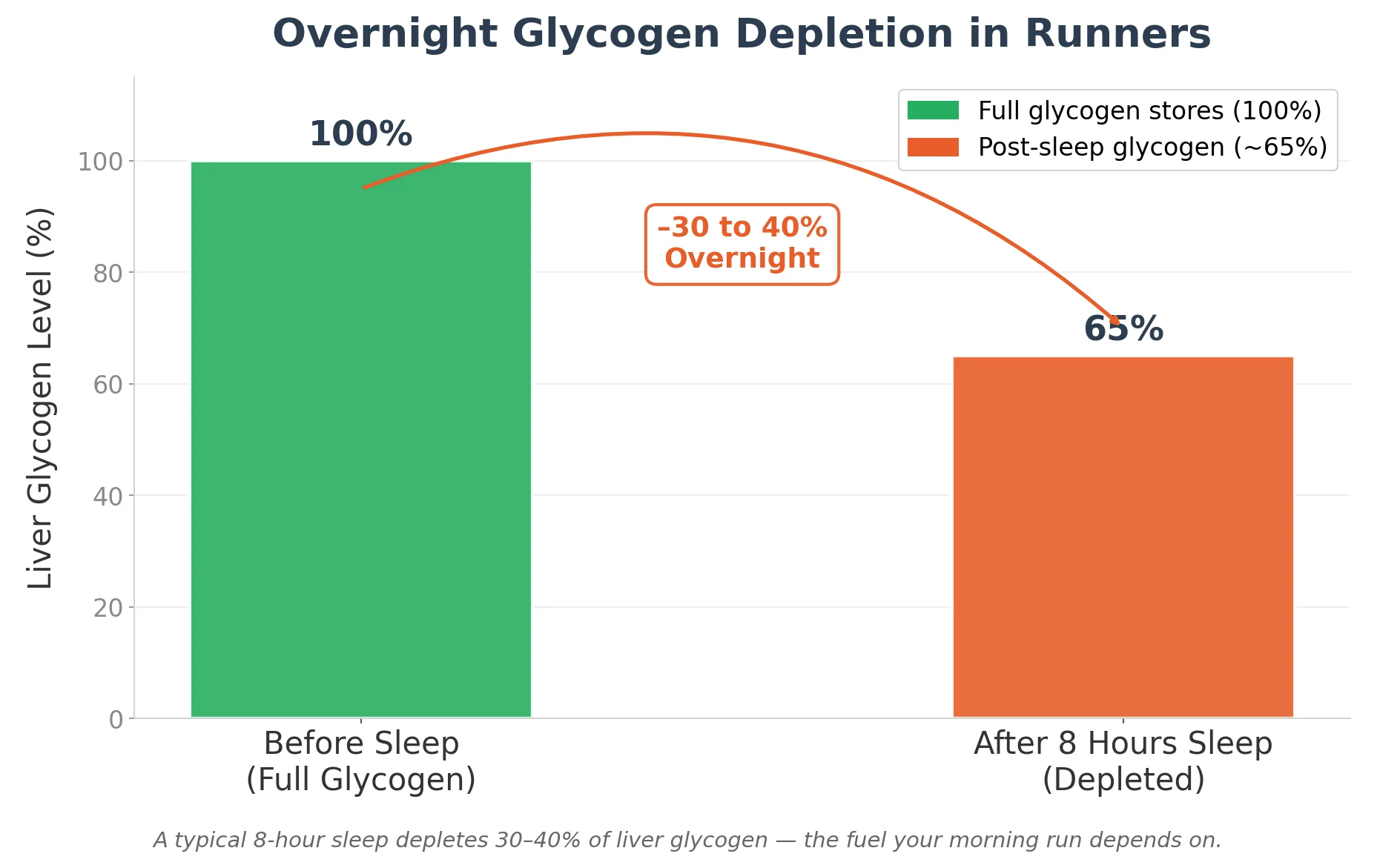
After a typical 8-hour sleep, you’ve lost roughly 30–40% of your liver glycogen.
Your muscle glycogen is also partially depleted, even though your body spares it somewhat during sleep.
Your blood glucose has dipped below its daytime level.
This is the core constraint of morning running: you don’t start from a full tank.
You start from roughly 60–70% capacity.
That’s why morning runs often feel harder than the same workout in the afternoon: your fuel stores are already reduced before you step outside.
Does Fasted Running Burn More Fat?
If you run without eating, your body shifts toward burning fat for fuel instead of carbs.
That makes fasted running sound like the ultimate fat-burning strategy.
The research shows the tradeoff is more complicated, though.
Fasted running does shift your fuel mix toward fat.
Your body, lacking fresh glucose from food, taps into fat stores more readily.
Your performance takes a hit from the missing carbohydrates, though.
You run slower, feel the effort harder, and can’t sustain your target pace.
The total fat burned per workout often ends up the same or less, because you’re running at lower intensity and for a shorter time.
Total energy expenditure matters more for fat loss than fuel source.
A run fueled by carbs that you complete at goal pace burns more total calories than a fasted run cut short by fatigue.
For most runners, the performance cost of fasted morning running outweighs any fat-burning benefit.
Fat adaptation, the theory that regular fasted training makes your body more efficient at burning fat, shows only marginal benefits in recreational runners and isn’t recommended as a primary training strategy.
RunnersConnect Bonus
Download your FREE Guide where we share the Best Foods to Eat Before Running.
How Much Time Do You Need to Digest Food Before Running?
Different foods require different digestion times, and the window you have between waking and running determines what you can realistically eat.
A full meal like eggs, toast, and a banana requires 2–3 hours to move through your stomach and reach your small intestine.
Eat that 45 minutes before running and you risk stomach sloshing, cramping, or feeling uncomfortably full mid-run.
A light meal like toast with honey or a bowl of cereal needs 60–90 minutes.
A small snack like a banana or a sports gel needs only 15–30 minutes.
Timing varies by person, though.
Your gut sensitivity, run intensity, and how quickly your digestive system moves can all shift these numbers by 15–30 minutes in either direction.
There’s also the opposite risk: reactive hypoglycemia.
If you eat something sugary too close to running, within 20 minutes for some runners, your blood insulin spikes, your blood glucose drops rapidly, and you bonk 10 minutes into the run feeling worse than if you’d eaten nothing at all.
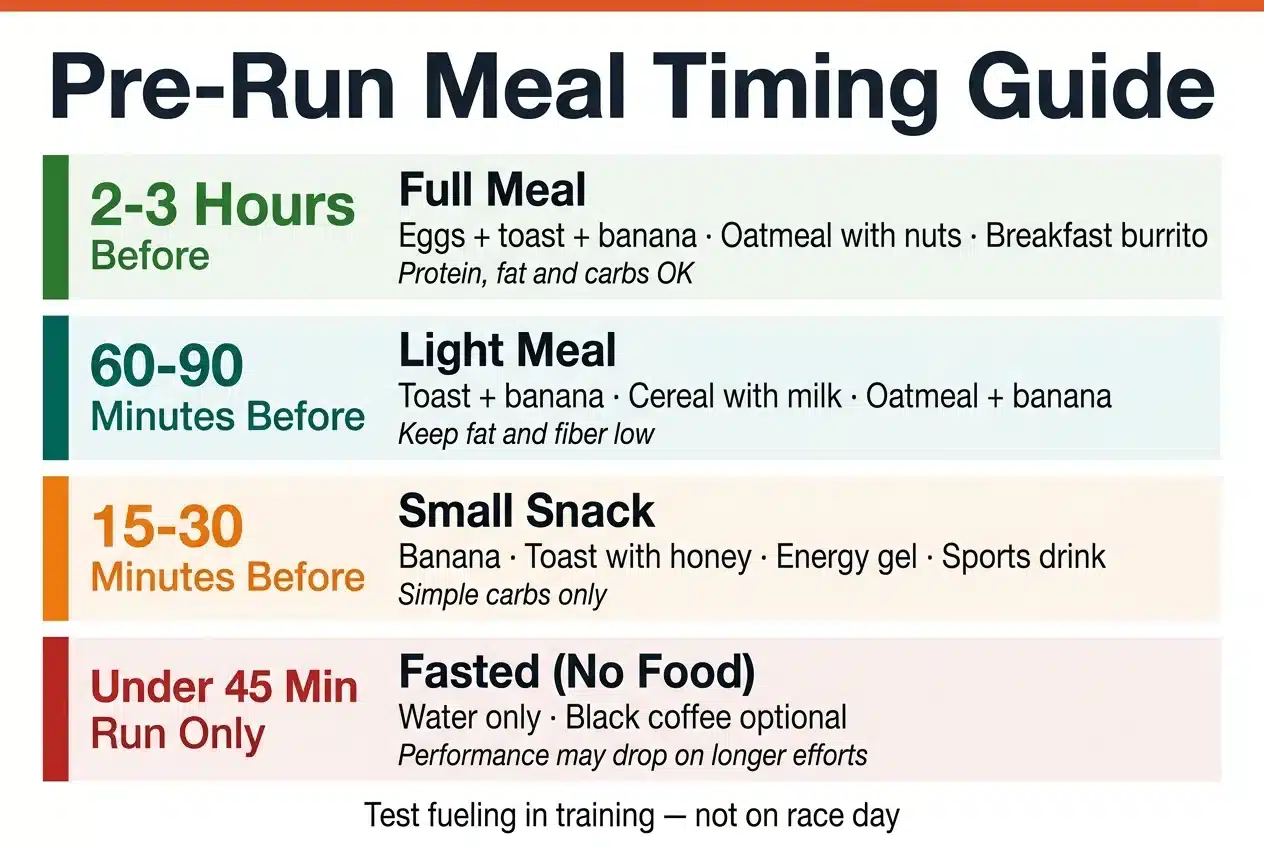
Time your eating by portion size: small snacks need 15–30 minutes, light meals need 60 minutes, and full meals need at least 2 hours before you run.
What Should You Eat If You Have Less Than 30 Minutes?
With less than 30 minutes before your run, you need fast-digesting carbs and almost nothing else.
Avoid protein, fat, and fiber since all three slow digestion and can sit uncomfortably in your stomach during the run.
Your targets: 15–30 grams of simple carbs consumed with plenty of water.
Best options:
- 1 medium banana
- 2 slices of toast with jam or honey
- A handful of dates
- 1 energy gel with 8 oz water
- 8 oz of sports drink
- 1 applesauce pouch
- Rice cakes with a thin spread of honey
These foods move quickly because they’re simple sugars with minimal fiber.
Simple carbs require almost no breakdown before absorption in the small intestine.
They absorb within 30 minutes of eating.
By the time you’re 5 minutes into your run, fuel is already reaching your bloodstream.
What If You Have 30–60 Minutes?
A 30–60 minute window opens up more options.
You can eat slightly more and include a small amount of protein or fat without major digestion risk.
Your targets: 30–50 grams of carbs, minimal fat and fiber.
Good options:
- 1 slice of toast with a banana
- A bowl of cereal (Cheerios or Rice Krispies) with milk
- 1 bagel with jam
- Oatmeal (half cup dry) with a banana
- A cereal bar with a banana
- Pancakes with honey (hold the butter)
- Plain yogurt with granola and berries
Drink a full water bottle now without worry.
Starting your run even mildly dehydrated makes fatigue hit harder and your heart rate climb faster, especially on empty-stomach mornings.
The difference between this window and the sub-30-minute window is volume and variety: you have time for your body to absorb more fuel and settle with a slightly more complete meal.
What If You Can Wait 60–90 Minutes?
If you can wake earlier or shift your schedule, a 60–90 minute window is the sweet spot for morning running fuel.
Now you can eat a real breakfast: eggs, whole-grain toast, a banana, or a bowl of oatmeal with nuts.
You have time for protein and fat to digest, giving you sustained energy throughout the run.
Your targets: 60–100 grams of carbs plus 15–25 grams of protein.
Examples of solid 60–90 minute pre-run breakfasts:
- 2 eggs with toast and a banana
- Oatmeal (1 cup cooked) with granola and milk
- Pancakes with a tablespoon of peanut butter and berries
- A bagel with cream cheese and a banana
- Cereal with milk and a banana
- Breakfast burrito with eggs and toast
This window delivers the best performance for longer morning runs of 60 minutes or more.
Your muscles get a full glycogen top-up.
Your blood sugar stays stable throughout the run.
Your digestive system has enough time to settle before you head out.
The longer your morning run, the more this advantage matters.
A 60–90 minute window isn’t always realistic, but when you have it, use it.
Should You Have Coffee Before Your Morning Run?
Nearly every morning runner drinks coffee, and the question is whether it helps or hurts your performance.
The science is clear: caffeine improves endurance performance and effort perception.
You run faster, feel less tired, and your aerobic system works more efficiently.
The effect kicks in 30–60 minutes after consumption, peaks at about 1 hour, and lasts 3–5 hours depending on your caffeine sensitivity.
Black coffee is the best option: zero calories, zero sugar, just caffeine.
A standard cup provides 95–200 mg, enough to produce the ergogenic effect without overdoing it.
The caveat: caffeine increases GI sensitivity.
If you’re already running on a stomach sloshing with food, adding caffeine can increase cramping and the urge to find a bathroom mid-run.
High-fat lattes are worse because the fat slows digestion and you’ll feel heavier running.
Caffeine is also a mild diuretic, so drink plenty of water alongside your pre-run snack, especially on warm mornings.
Drink black coffee 30–60 minutes before your run with plenty of water, and test it in training first because individual caffeine tolerance varies widely.
Some runners can drink coffee and run hard immediately.
Others need 60+ minutes for their stomach to settle and caffeine to peak.
Find your own window through training runs, not on race morning.
How Long Should Your Morning Run Be on an Empty Stomach?
For runs under 45 minutes, glycogen availability isn’t usually the limiting factor.
Your depleted-but-not-empty glycogen stores can support a moderate-effort run that short.
If you feel okay running on empty, a 5K or short 4-miler is doable without fuel.
At 45–75 minutes, you enter a zone of individual variation.
Some runners feel fine well past the 45-minute mark.
Others hit a wall right around that point.
Your fitness level, running pace, and personal gut tolerance all play a role.
Beyond 75 minutes, fueling becomes a real performance factor.
Your glycogen stores deplete further as the run continues.
Your pace drops and you can’t maintain goal intensity without carbohydrates.
Understanding fueling needs by run type helps you make smarter decisions as your morning distances grow.
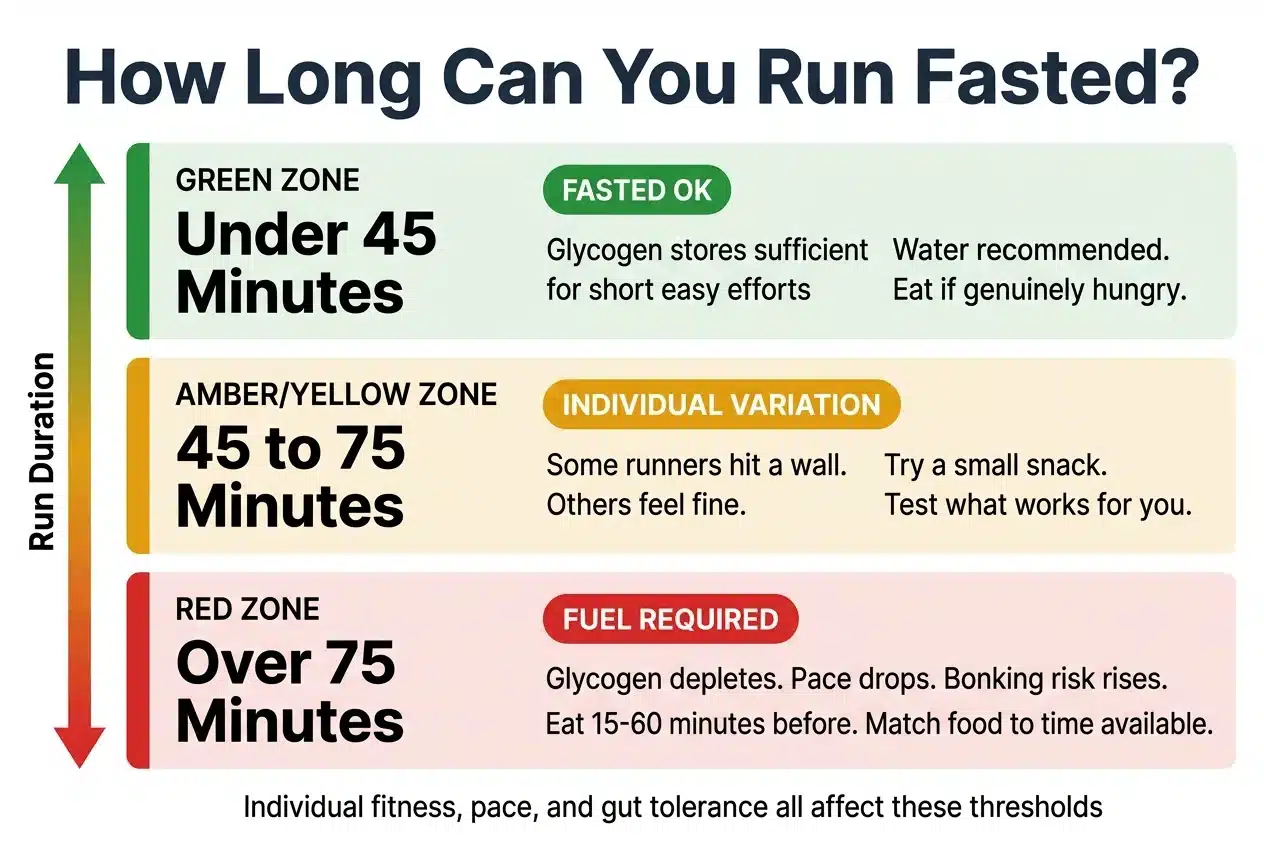
Runs under 45 minutes work fine fasted, runs of 45–75 minutes depend on individual tolerance, and anything over 75 minutes almost always benefits from pre-run fuel.
RunnersConnect Bonus
Download your FREE Guide where we share the Best Foods to Eat Before Running.
Your Fueling Approach Depends on Run Duration and How You Feel
There is no one-size-fits-all pre-run breakfast for morning runners.
The research shows huge individual variation in glycogen depletion rates, digestion times, and stomach sensitivity.
You can build a decision framework around three questions.
How long is my run today? Longer runs need more fuel.
How much time do I have before running? Time determines what can digest in time.
How do I feel right now? Hunger, energy level, and stomach comfort all matter.
For a short 5K when you feel good, a banana and some water works fine.
For a 10-miler, eat a full breakfast 60–90 minutes before your run or you’ll bonk.
For an easy 3-miler when you’re hungry, eat something because you’ll run better on fuel than on empty.
Your nervous system and stress level also affect digestion speed.
Race-day jitters suppress appetite and speed gastric emptying.
A calm training run lets you eat and digest normally.
For a full breakdown of pre-run fueling across every workout type, the guidance shifts based on intensity and distance.
Test every fueling strategy during training runs, not on race day.
Once you know your window, mornings become simple.
Your body wakes depleted after 8 hours of sleep, with glycogen stores down 30–40%.
Running on empty shifts fuel toward fat but cuts performance: a fed run at goal pace burns more total calories than a fasted run cut short by fatigue.
Time your eating by portion size: small snacks need 15–30 minutes, light meals need 60 minutes, and full meals need at least 2 hours before you run.
For under 30 minutes before a run, eat simple carbs like a banana, toast with honey, or a gel.
For 30–60 minutes, add cereal or oatmeal.
For 60–90 minutes, eat a full breakfast with protein and fat.
Runs under 45 minutes work fine fasted.
Runs of 45–75 minutes depend on your individual tolerance.
Runs over 75 minutes almost always benefit from pre-run fuel.
Caffeine helps: drink black coffee 30–60 minutes before your run.
Test everything in training first because your personal fueling needs are your own.