
You’ve trained through winter in 20°F snow. Your race forecast says 90°F.
Your body has never done this.
The typical cold-climate runner logs most of their training mileage in low temperatures where cardiovascular load is predictable and thermoregulation is simple. When you’re cold, you run faster and warm up.
Heat changes everything.
A hot race demands physiological adaptations your winter training never built. Your heart works harder, your sweat response lags, your core temperature climbs faster, and your gut rebels.
The good news: you don’t have to live in a hot climate to prepare for one.
Research shows that passive heat exposure (saunas, hot baths, heated rooms, overdressing) triggers the same cardiovascular and thermoregulatory adaptations as training in heat. The difference is that you can do it on your schedule, without months of weather-dependent training.
So, in this article you’re going to learn the research-backed practical advice on:
- Why your body struggles in heat when you’ve trained in cold
- How fast heat acclimation actually works and how much time you need
- Passive heat training methods that work without moving to a hot climate
- Which heat method fits your schedule and life
- When to start and how to integrate heat training with your race taper
Why Does Racing in Heat Hit Cold-Climate Runners Harder?
When you race in heat without heat acclimation, your body treats high temperature as a stressor it has no protocol for.
Your cardiovascular system prioritizes two tasks simultaneously: delivering oxygen to working muscles and shunting blood to the skin to cool you down.
In cool conditions there is no conflict, because most blood stays in the working muscles. In heat, it becomes a trade-off.
Research has shown that untrained runners racing in heat experience a 10-15% reduction in cardiovascular efficiency, forcing their hearts to work harder for the same power output.

This is why your heart rate climbs even when your pace feels moderate.
Your sweat response is not optimized either.
You don’t sweat efficiently at the start of the race, sweating onset is delayed, and the total volume is lower than the heat stress demands.
This creates a lag where core temperature rises before your cooling system fully activates.
Dehydration compounds the problem. In heat, you lose more fluid through sweat, but your thirst mechanism lags behind the actual deficit, so you naturally under-drink.
Plasma volume (the liquid portion of your blood) drops, making every drop of blood thinner and less efficient at carrying oxygen and nutrients.
Heat also disrupts digestion and nutrient absorption, which explains why your stomach tightens in hot races even when you’ve trained your fueling.
For a cold-climate runner racing hot, these cascades happen at once: cardiovascular strain, delayed sweat onset, core temperature climbing, dehydration accelerating, and gut dysfunction all stacking on top of the aerobic demands of racing.
This is why runners who’ve never trained in heat regularly report that their race-day pace feels 45-60 seconds per mile slower than their fitness dictates.
How Long Does Heat Acclimation Actually Take?
Heat acclimation isn’t an on-off switch. Your body adapts in stages, and the timeline depends on both how much time you have and what adaptations matter most for your race.
Partial acclimation starts fast: 3-5 days of daily heat exposure produces measurable improvements in sweating onset and early thermoregulatory efficiency.
Full acclimation (the point where your cardiovascular system, plasma volume, and thermoregulation are optimized) takes 10-14 days of consistent daily heat exposure.
Research from heat acclimation studies found that 6 consecutive days of post-exercise heat exposure improved time-trial performance in heat by 4.9%, with resting core temperature dropping 0.27°C and sweat onset occurring earlier in the exercise bout.
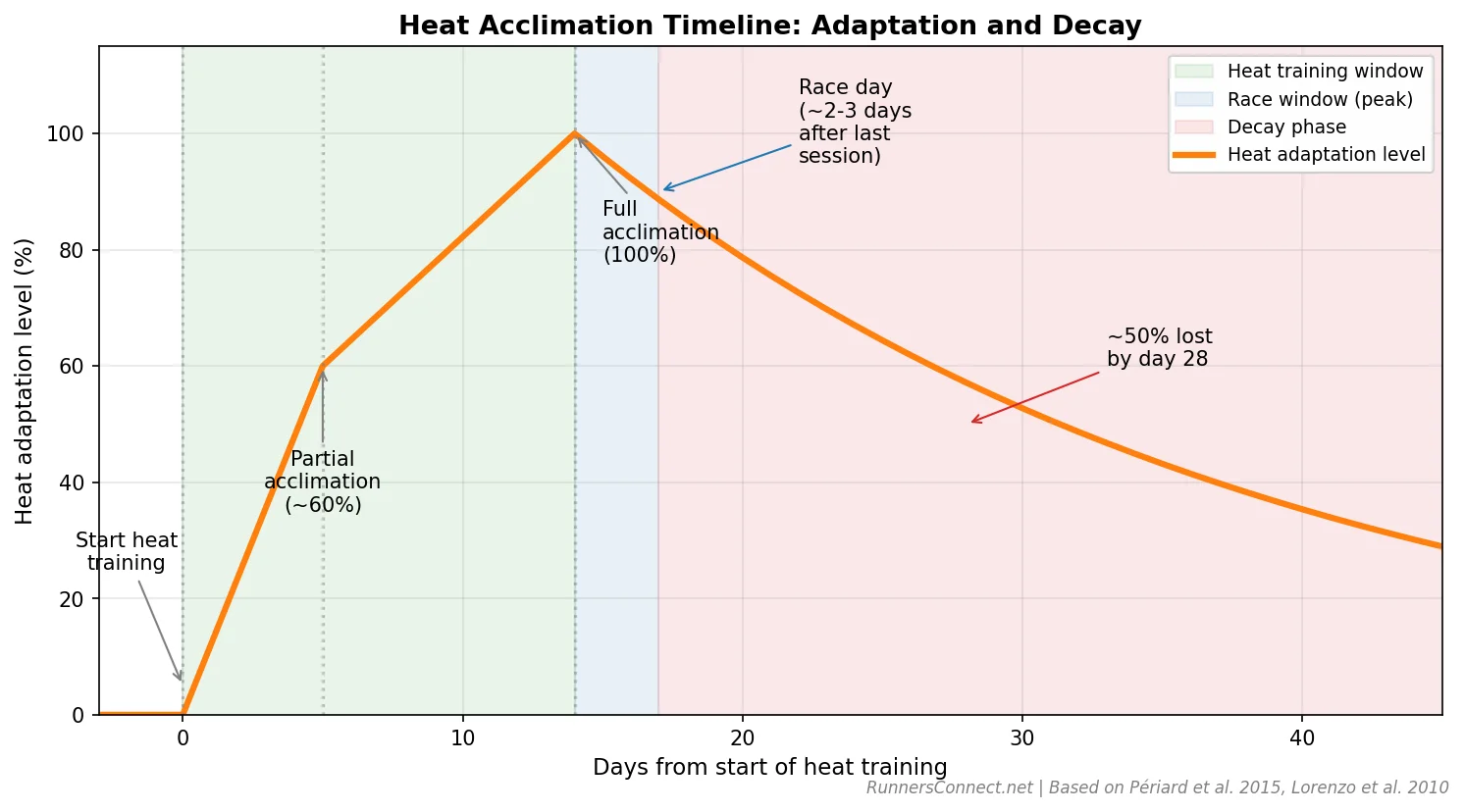
If you start 14 days before your race and hit 10-12 consecutive days of heat exposure (with 1-2 rest days), you’ll arrive at the start line with most adaptations intact.
The problem: heat acclimation benefits decay.
After your last heat exposure, you lose roughly 50% of your adaptations within 2-3 weeks, with complete loss by 4 weeks of no heat exposure.
This is why timing matters.
Starting heat training 21 days before race day is too early, because adaptations will fade before you toe the line.
Starting 5 days before race day is too late, because you’ll only trigger partial adaptations and add fatigue when you should be tapering.
The optimal window is 10-14 days before race day, with heat exposure happening daily or nearly daily (5-6 days per week) during that window.
Can You Heat-Acclimate Without Training in the Heat?
Yes. This is the key insight that changes everything for cold-climate runners.
Heat acclimation works through two parallel pathways: exercise in heat (active acclimation) and heat exposure alone (passive acclimation).
Both trigger the same cardiovascular adaptations: increased plasma volume, improved sweating efficiency, reduced core temperature at rest and during exercise, and faster heart rate recovery.
The difference: with passive acclimation, you get the adaptations without the fatigue of training in heat.
A sauna or hot bath after your normal run adds the heat stimulus while your legs recover from the workout.
Heated yoga or a hot room session decouples heat exposure from training intensity.
This matters because cold-climate runners preparing for a hot race are often deep in a training block, building mileage or sharpening workouts. Adding training heat stress on top would compromise those runs and raise injury risk.
Passive acclimation lets you build fitness in conditions you can control (cool, during normal winter training) while adapting your cardiovascular system to heat in 30-45 minutes of additional daily heat exposure.
A comprehensive review of heat acclimation research confirms that post-exercise hot water immersion at 40°C for 40 minutes produces the same heat acclimation markers as doing the entire workout in heat: resting temperature drop, earlier sweating, and reduced heart rate during heat stress.
So your 7-mile run in winter happens at 30°F in perfect conditions for your aerobic development.
Immediately after, you spend 40 minutes in a 104°F bath and trigger the same cardiovascular adaptations you’d get from running that same 7 miles in 90°F weather.
You get the benefits of both without the downsides of either.
RunnersConnect Bonus
Don’t guess on the protocol. Get the exact sauna training parameters from the peer-reviewed research on one printable sheet.
Includes session safety checklist, workout pairing guide, and the 7-10 day pre-race stop schedule.
Which Passive Heat Method Works Best for Cold-Climate Runners?
No single method wins universally, because the right choice depends on logistics, time, and your tolerance for heat stress.
Post-exercise sauna.
The research is strongest here: 20-30 minutes in a dry sauna (80-90°C / 176-194°F) immediately after a run produces robust heat acclimation adaptations with minimal injury risk.
The advantage: saunas are accessible (most gyms have them), short, and well-studied across hundreds of athletes.
The drawback: dry heat is intense psychologically and harder to tolerate than wet heat for most people. Session duration also tops out around 20-30 minutes because dehydration risk climbs sharply beyond that.
Post-exercise hot bath (40°C / 104°F).
Immersion in 40°C water for 30-45 minutes after running is equally effective and produces identical heat acclimation markers as sauna.
The advantage: water is psychologically easier to stay in longer, dehydration risk is lower, and the session can run 40+ minutes to maximize heat exposure time.
The drawback: water at 40°C feels surprisingly cool when you climb in, which is the point. The temptation is to crank the dial to 42-43°C (warmer than the research protocols) and create excessive fatigue without any added adaptation benefit.
Hot yoga or heated fitness class (38-40°C / 100-104°F).
Yoga in a heated room produces heat acclimation with the added benefit of mobility and mental decompression, fitting naturally into an athlete’s recovery week.
The advantage: it’s a full-body activity that addresses tightness and mobility alongside heat exposure, and it’s easier to sustain for 60+ minutes because the intensity is lower.
The drawback: room temperature at 38°C is slightly lower than sauna or bath temperatures. Total exposure time needs to run longer to match sauna or bath adaptations.
Treadmill in a heated garage (passive space).
Running on a treadmill in a garage you’ve heated to 80-85°F produces active heat acclimation while keeping training intensity under control.
The advantage: you can run hard enough to maintain fitness while gaining heat exposure, and you’re not dependent on gym access.
The drawback: controlling room temperature is difficult without proper ventilation. Overheating risk climbs quickly because exercise adds metabolic heat on top of environmental heat, and the psychological difficulty of running hard in a hot confined space is substantial.
Overdressing for outdoor winter runs.
Wearing significantly more insulation than conditions warrant (e.g., a heavy winter coat and layers when it’s 25°F) creates core heat stress during running.
The advantage: it’s free and requires no gym access.
The drawback: the thermal stress is moderate and hard to control. Shedding a layer when overheated kills the stimulus, and the adaptations are weaker than structured sauna or bath protocols because the session doesn’t replicate the prolonged post-exercise heat stimulus that triggers maximum adaptations.
For runners on a strict timeline (10-14 days before race), post-exercise sauna or hot bath (40°C for 30-45 minutes) are the most reliable methods because they’re time-efficient, well-researched, and produce measurable adaptations in the shortest window.
| Method | Time per session | Strength of adaptation | Best for |
|---|---|---|---|
| Post-exercise sauna (80-90°C) | 20-30 min | Strong | Gym-access runners on a tight 10-14 day window |
| Post-exercise hot bath (40°C) | 30-45 min | Strong | Home-based runners who tolerate water immersion |
| Hot yoga / heated room (38-40°C) | 60-75 min | Moderate | Runners who want mobility work alongside heat exposure |
| Treadmill in heated garage (80-85°F) | 30-60 min | Strong (active heat) | Runners willing to train hard in heat for sport-specific adaptation |
| Overdressing on outdoor runs | 45-90 min | Weak | Runners with no gym access, as a supplement only |
When Should You Start Heat Training Before Your Race?
The timeline is non-negotiable: start 10-14 days before race day and hit 5-6 days per week of heat exposure.
Here’s the logic: you need enough time to trigger near-full acclimation, but not so much time that adaptations decay before you race.
Starting 3 weeks out puts you past the decay window. You’ll hit maximum adaptations early, then watch them partially fade before race day arrives.
Starting 1 week out gives you only partial acclimation with no safety margin.
The optimal protocol: 10-12 consecutive days of daily heat exposure, finishing 2-3 days before race day.
This gives your body time to recover from the heat training stimulus while keeping adaptations fresh.
If your schedule can’t accommodate daily heat exposure, 5 days per week over a 14-day window still produces 70% of the adaptations you’d get from full daily exposure, with slightly more time between sessions for recovery.
Integration with taper matters.
Typical tapers cut mileage 40-50% in the final 2-3 weeks: fewer long runs, shorter workouts, and more easy running.
During your heat training window, shift heat exposure into that reduced mileage time: shorter run (say, 6 miles instead of 12) followed by 40 minutes of sauna or hot bath.
The total training volume stays the same, with run time getting swapped for run-plus-heat sessions.
This keeps your focus on freshness and recovery while still triggering heat adaptations during taper.
Heat training happens within your taper mileage. A 40-minute sauna after a 45-minute easy run replaces an equivalent easy-run session at the same total time cost.
What if Your Heat Prep Was Limited? Race-Day Strategy Adjustments
Life happens. Race dates move, travel plans shift, or you simply didn’t prioritize heat training until race week.
If you’ve done no heat training, acknowledge it now and adjust race strategy rather than hoping to “power through” on race day.
First adjustment: conservative early pacing.
Without heat acclimation, your cardiovascular system hits its strain threshold earlier than acclimated runners do, typically by miles 4-6 in a marathon and miles 1-2 in a 5K or 10K.
Start 30-45 seconds per mile slower than goal pace and settle into race pace only after the first 20 minutes when your thermoregulation system has activated and your sweat response has normalized.
This prevents the catastrophic early pace drop unprepared runners experience when they start at goal pace and hit the wall at miles 7-10.
Second adjustment: electrolyte and fluid strategy.
Without heat acclimation, your sweat losses will be higher (less efficient sweating), dehydration will develop faster, and plasma volume will drop further than in acclimated runners.
Increase sodium intake 200-300 mg per aid station from a sports drink or electrolyte tablet, and drink to thirst plus roughly 20% more than normal (150-200 ml per 15 minutes instead of 125-150 ml).
Third adjustment: pre-race cooling.
Night before: cool shower to drop core temperature 0.3-0.5°C before sleep, helping you start race day with a slightly lower baseline temperature.
Morning of race: drink an ice slurry (50:50 ice and sports drink blended into a slushy) 60-90 minutes before the start, sipped over 10-15 minutes.
This cools you from the inside and reduces the initial thermal shock when you start running in heat.
Fourth adjustment: pacing flexibility on the course.
Without heat adaptation, your perceived exertion at goal pace will be significantly higher than a heat-trained runner’s perceived exertion at the same pace.
If your RPE (rate of perceived exertion) hits 8-9 out of 10 by mile 5-6, drop pace by another 15-30 seconds per mile.
The race is long, and holding back early is less costly than bonking late.
Finally: don’t use race day as your heat training.
If you have 5-7 days before your race and haven’t done heat training, use that time for 1-2 focused heat sessions (sauna or hot bath) to trigger at least partial acclimation, not for running itself.
A single sauna session won’t deliver full acclimation, but 2-3 sessions across 5-7 days will improve your thermoregulatory efficiency enough to make a measurable difference.
You’ll still face heat stress on race day, but you won’t be starting from zero.
RunnersConnect Bonus
Download your FREE Temperature Calculator now.
It will help estimate how much your times will be impacted by hot weather. Find out exactly how much to adjust your summer workout and race paces.
Key Takeaway
Heat acclimation doesn’t require moving to a hot place or training in heat.
Passive heat exposure (saunas, hot baths, or heated rooms) triggers the same physiological adaptations in 10-14 days that active heat training takes weeks to build.
Start your heat exposure 10-14 days before race day, commit to 5-6 days per week, and integrate it into your taper rather than on top of it.
If timing is tight or heat prep was limited, adjust your race-day pacing, fueling, and expectations rather than risking blown-up performance by racing unprepared.