
The most common warm-up is a few minutes of slow jogging at the start of a run.
Before an easy run, that is close to all you need.
Before a tempo run, an interval session or a 5K, adding dynamic stretches and strides to that jog gets your muscles ready for workout or race pace.
So, in this article you’re going to learn the research-backed practical advice on:
- Whether a slow jog counts as a warm-up, and when you need more than one
- A 20 to 30 minute routine you can use before any workout or race
- How long to warm up for easy runs, hard sessions and every race distance from 5K to the marathon
Why Should You Warm Up Before Running?
A warm-up raises the temperature of the muscles you are about to run with, and muscle temperature has a measurable effect on how hard those muscles can work.
A 2010 review of temperature and muscle function found that performance in brief efforts improves by 2% to 5% when muscle temperature rises by 1°C (1.8°F).
Studies across many sports show the same benefit.
Research has shown that warming up improved performance in 79% of the performance measures tested across 32 high-quality studies.

That means a warm-up improves most of the performance measures researchers test.
The same review found little evidence that warming up does any harm.
The injury evidence is less clear than the performance evidence.
A 2006 review of randomized trials found that 3 of 5 trials showed fewer injuries when athletes warmed up, and the other 2 found no difference, so the weight of the evidence favors warming up.
In runners specifically, a 1993 trial of recreational runners found that a 16 week warm-up, cool-down and stretching program did not lower injury rates.
The runners on the program had 5.5 injuries per 1,000 hours of running, and the runners in the control group had 4.9 injuries per 1,000 hours.
In the lab, a 2016 study on rat muscle found that it took less impact energy to tear muscle at 32°C (90°F) or colder than at normal core temperature of 37°C (99°F).
That means a warm-up is worth doing before every hard run, and it matters most in cold weather.
Is Jogging a Good Warm-Up Before Running?
An easy jog is the best single warm-up for running, because it raises muscle temperature with the exact movement you are about to do.
Before an easy run, 5 to 10 minutes of slower running at the start is your whole warm-up.
Before a workout or race, follow the jog with strides.
A 2009 study of distance runners compared no warm-up, a jog, and a jog followed by strides before a hard run to exhaustion.
After the jog with strides, anaerobic metabolism, the system that produces lactate, supplied 7.0% of the runners’ energy in the hard run.
After no warm-up, it supplied 9.1%.
That means a warm-up of jogging plus strides shifts more of the work at the start of a hard effort onto your aerobic system, compared with no warm-up.
How long the runners lasted in the hard run didn’t change by a reliable amount.
A slow jog is a complete warm-up for an easy run, and before a workout or race you add drills and strides on top of it.
What Is the Best Warm-Up Routine Before a Run?
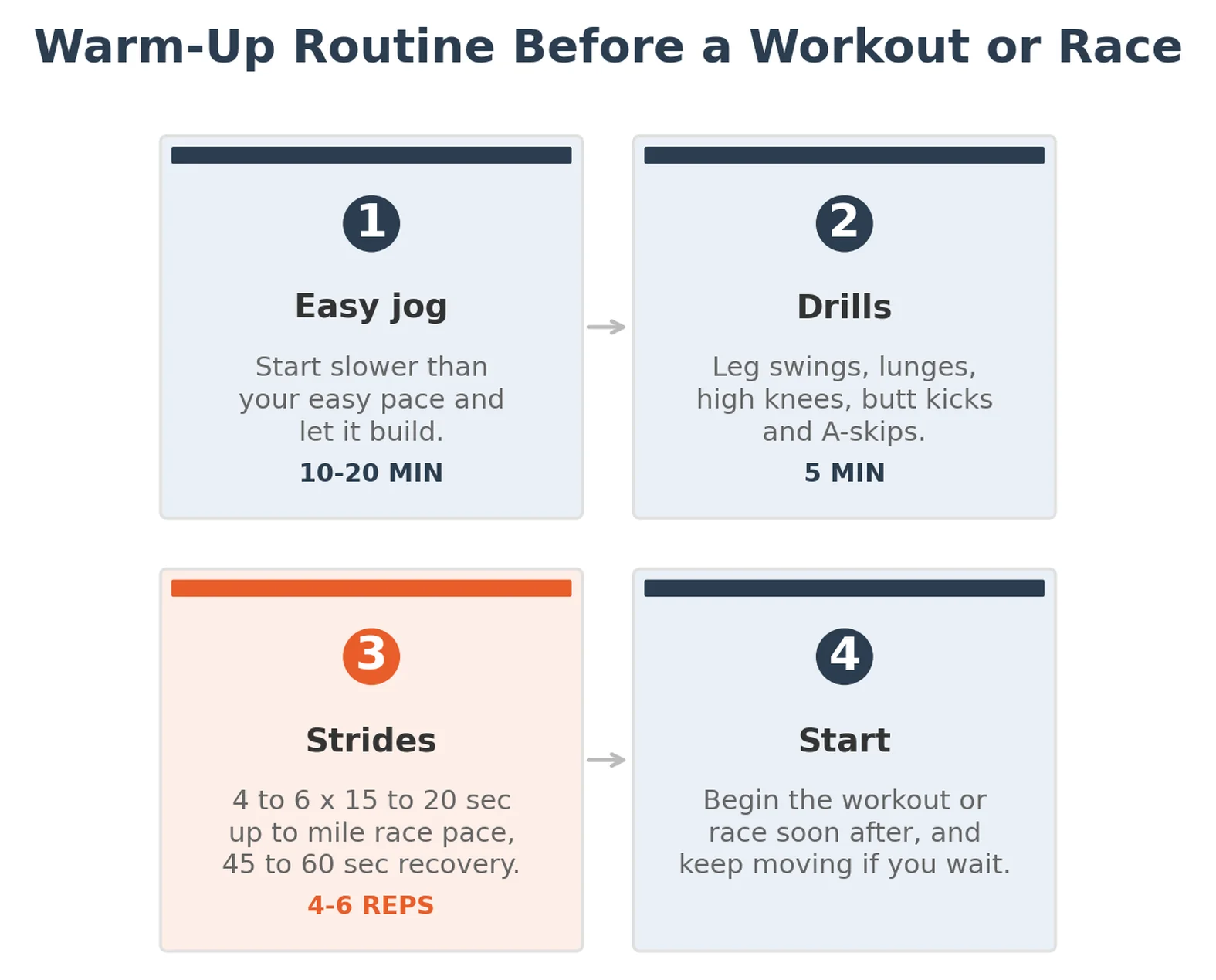
The routine below takes 20 to 30 minutes and works before any tempo run, interval session or race.
Before an easy run, jog the first 5 to 10 minutes of step 1 and skip the rest.
- Jog easy for 10 to 20 minutes. Use the table at the end of this article for the length, and start slower than your normal easy pace.
- Do 5 minutes of dynamic stretches and drills. Pick 4 or 5 from the list below and do each one for 20 to 30 seconds or 10 to 15 reps.
- Run 4 to 6 strides. Accelerate smoothly for 15 to 20 seconds up to about your mile race pace, then walk or jog for 45 to 60 seconds.
Dynamic stretching means moving a joint through its range of motion instead of holding one position.
A 2024 study of recreational distance runners compared 15 minutes of running alone with 5 minutes of running plus 10 minutes of dynamic stretching.
After the dynamic stretching, the runners used less oxygen at a moderate pace and lasted longer in a run to exhaustion than they did after running alone.
The 5 minutes of drills in this routine is a shorter dose, so add more leg swings and lunges if you have the time.
These are the dynamic stretches and drills to choose from:
Leg swings, front to back. Hold a wall or fence and swing one leg forward and back 10 to 15 times, letting the range grow with each swing.
Leg swings, side to side. Face the wall and swing one leg across your body and back out to the side 10 to 15 times.
Walking lunges. Take 10 lunges per leg, keeping your front knee over your ankle and your chest upright.
High knees and butt kicks. Move forward for 20 seconds of each, driving your knees up to hip height and then bringing your heels up toward your glutes.
A-skips. Skip forward for 20 to 30 meters (22 to 33 yards), driving one knee up to hip height and placing your foot under your hips.
If you want more options, this dynamic stretching routine for runners covers the full set of moves with video demonstrations.
Jog for 10 to 20 minutes, do 5 minutes of drills, then run 4 to 6 strides before any workout or race.
RunnersConnect Bonus
Download our Active Stretching Maintenance Routine
It’s a PDF and video with images and descriptions of the most effective active stretches for runners.
Should You Stretch Before Running?
Dynamic stretches belong in your warm-up, and a short static stretch has little effect on your run if you jog or do drills after it.
Static stretching means holding one position, such as a hamstring or calf stretch.
Research has shown that static stretches held for 60 seconds or longer per muscle lowered performance by about 4.6%, compared with about 1.1% for holds under 60 seconds.
The same review found no clear drop in performance when athletes did dynamic activity after stretching.
That means a 20 to 30 second stretch for a tight calf or hip is fine, as long as you jog or do drills after it.
A 2021 study of recreational runners compared 15 minutes of jogging with 10 minutes of jogging plus 5 minutes of stretching.
Both static and dynamic stretching improved running economy.
The runners also rated the run as easier than after jogging alone.
In the 2024 study of recreational distance runners, 60 second static holds per leg didn’t improve running economy or how long the runners lasted.
So keep any static holds short, and make dynamic stretching the default in your warm-up.
How Long Should You Warm Up Before Running?
The harder and shorter the run, the longer your warm-up should be.
Easy runs and long runs need only 5 to 10 minutes of slow running at the start, and that time can be part of the run itself.
Tempo and threshold runs need 10 to 15 minutes of jogging, your drills and 4 strides.
Intervals and hill repeats start fast from the first step, so jog for 15 minutes, do your drills and run 4 to 6 strides.
Race warm-ups follow the same rule, so a 5K needs the longest warm-up and a marathon needs the shortest.
For a 5K or 10K, jog for 15 to 20 minutes, do your drills, and finish with 4 to 6 strides or a few short efforts at race pace.
Research has shown that trained runners ran a 5K 6.4 seconds faster when their warm-up included three fast 250 meter (273 yard) efforts instead of easy ones.
A half marathon needs 10 to 15 minutes of jogging, your drills and 3 or 4 strides.
Before a marathon, jog easy for 5 to 10 minutes and run 2 or 3 strides.
Then use the first mile (1.6 km) at a controlled pace as the rest of your warm-up.
The full race-morning timeline is in this guide on how to warm up for a race.
How Soon Before a Race Should You Finish Warming Up?
Finish your warm-up as close to the start as you can, because muscle temperature starts falling as soon as you stop moving.
A 2013 study of cyclists found that a 15 minute warm-up raised thigh muscle temperature by about 2.5°C (4.5°F).
The riders then sat for 30 minutes before a sprint test.
When they wore electrically heated pants during the wait, their muscles stayed warmer and they produced 9.6% more peak power than when they wore regular tracksuit pants.
That means a long wait in a start corral lets your muscles cool before the race begins.
Plan your warm-up so you finish your strides just before you enter the corral, and keep moving with small jogs or leg swings while you wait.
Your muscles start cooling as soon as you stop moving, so finish your warm-up as close to the start as the corral allows.
What Warm-Up Should You Do for Each Run?
| Run | Easy jog | Drills | Strides |
|---|---|---|---|
| Easy or long run | 5 to 10 minutes, as part of the run | Optional | None |
| Tempo or threshold run | 10 to 15 minutes | 5 minutes | 4 |
| Intervals or hill repeats | 15 minutes | 5 minutes | 4 to 6 |
| 5K or 10K race | 15 to 20 minutes | 5 minutes | 4 to 6, or short efforts at race pace |
| Half marathon | 10 to 15 minutes | 5 minutes | 3 or 4 |
| Marathon | 5 to 10 minutes | Optional | 2 or 3 |