
You’re 6 months into your run-walk training.
You’ve completed three 5Ks using Jeff Galloway’s method (2 minutes running, 1 minute walking), and your times have dropped every race.
Your fitness is clearly improving, and your running feels stronger each month.
Deciding when to drop the walk breaks is one of the most common questions runners face at this stage in their training.
Continuous running does feel like the logical next step, and getting there is absolutely possible.
The transition is about understanding when your body is truly ready and how to make the shift without breaking down.
So, in this article you’re going to learn the research-backed practical advice on:
- Whether run-walk intervals actually limit your racing performance
- How your body adapts and signals readiness to run continuously
- The exact progression framework for phasing out walk breaks
- Why dropping walk breaks too fast is a common failure point
Does Run-Walk Actually Work, or Does It Limit Your Performance?
The run-walk method works.
The research on this is clear and consistent.
Research has shown that high-intensity interval training, which includes alternating bouts of running and recovery, produces aerobic fitness gains equivalent to continuous steady-state running.
The structured approach of run-walk intervals creates a type of interval training that builds your aerobic system efficiently.
Interval training, including the structured run-walk format, builds your aerobic base as effectively as continuous running does, but with lower injury risk.
Your aerobic system doesn’t distinguish between running continuously and running hard with structured recovery breaks. Both stress your cardiovascular system enough to trigger adaptations.
The difference between run-walk intervals and continuous running comes down to cumulative load on your joints and nervous system, not fitness ceiling.
When you run continuously at the same pace, every step stresses your joints and muscles for the full duration.
When you use run-walk intervals, you reduce that stress load while maintaining aerobic adaptations, which is why the method is so effective for beginners and returning runners.
Elite endurance runners often use interval training strategically in their peak training phases because it’s so effective.
The same principles that make interval training effective for all runners are at work in your run-walk sessions.
Your run-walk training is giving you the same aerobic adaptations that elite runners chase with structured interval work, just packaged in a beginner-friendly format.
Understanding this reframes the real question from whether the method works to when your body is ready to move beyond it.
Why Your Body Stops Needing Walk Breaks
Your aerobic system undergoes specific changes as you train.
Over 8 to 12 weeks of consistent run-walk training, your body becomes more efficient at extracting oxygen from the air and delivering it to your muscles.
This efficiency is the reason walk breaks feel less necessary as weeks pass.
Your run segments at 70 or 75 percent effort today feel easier in week 10 because your aerobic system is performing better, not because the segments have changed.
The adaptation happens at the cellular level through mitochondrial density improvements and capillary expansion that increase oxygen delivery to muscle tissue.
A second adaptation happens to your lactate threshold, the speed at which your muscles produce lactate faster than your body can clear it.
As your aerobic base strengthens, your lactate threshold increases, meaning you can sustain faster paces without accumulating lactate that causes that heavy-legs sensation.
Why aerobic training strengthens your base is the foundation that makes the transition to continuous running possible.
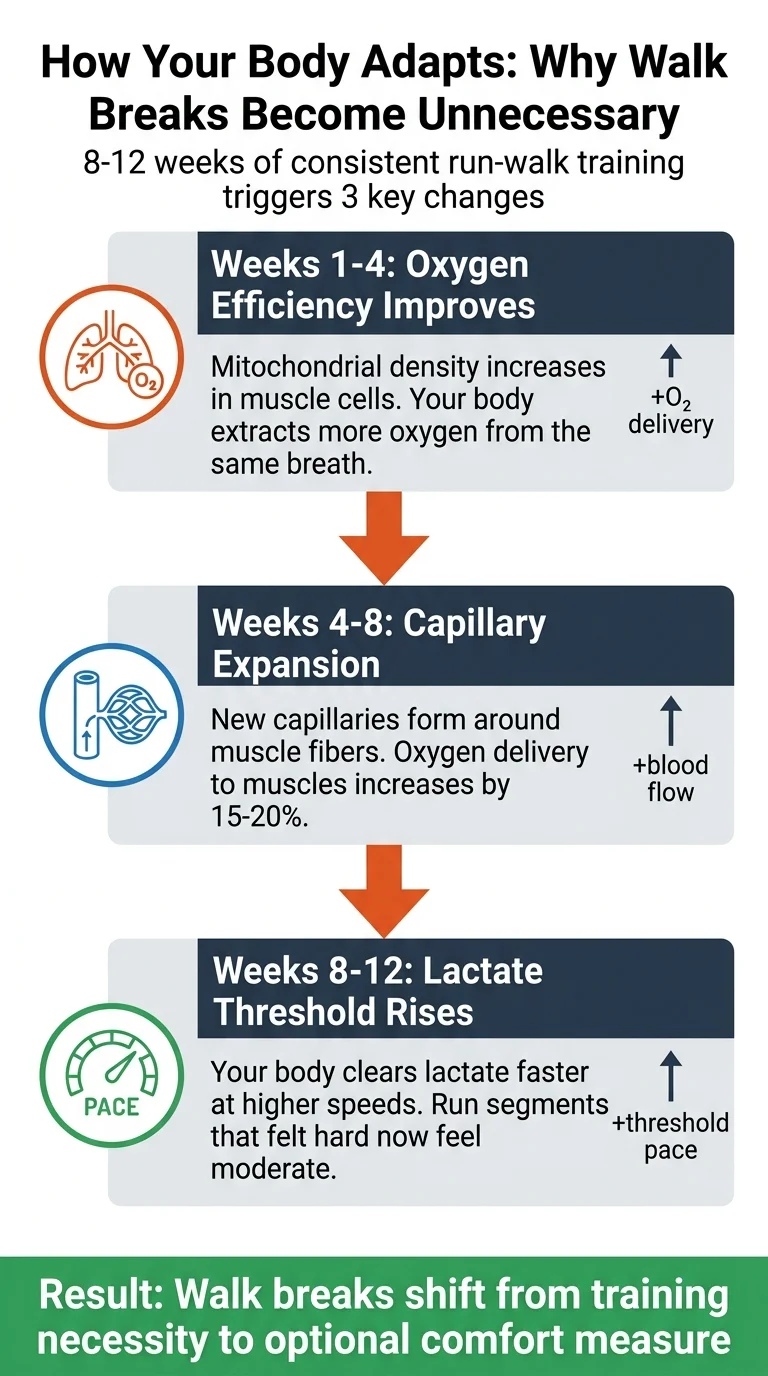
When both of these systems improve in parallel, walk breaks shift from being a training tool to an optional comfort measure.
The Signs You’re Ready to Transition
You don’t need to guess when to shift away from walk breaks.
Heart rate recovery.
During your current run-walk training, note your heart rate at the end of a run segment and again at the end of your walk break.
As your aerobic fitness improves, your heart rate will drop significantly during those walk breaks, showing that your cardiovascular system isn’t struggling.
Pace sustainability.
Look at your easy run pace during the run segments of your workouts.
If that pace is now faster than your original run-walk pace (or feels lighter at the same speed), your aerobic base has widened.
Your easy pace is faster than your old run-walk pace, and that’s the primary signal that your body is ready to shift toward continuous running.
Perceived effort.
During early run-walk training, the run segments felt hard and the walk breaks felt like relief.
After 8 to 12 weeks, the run segments should feel moderate, not hard, if you’ve been keeping them easy enough.
If you’re consistently running these segments below what feels like hard effort, your body is signaling readiness for the next phase.
Use the talk test as your guide: you should be able to speak a short sentence without gasping for breath during your run segments.
If you’re huffing and puffing during easy run segments, you’re running too hard or not yet ready to transition.
But if you’re cruising comfortably, managing your breath, and only feeling moderate effort, you have the aerobic capacity to handle continuous running.
Ignoring these signals leads to the most common failure point in the transition: staying on run-walk longer than necessary, which can create boredom and loss of motivation.
To track these signals objectively, keep simple notes in your training log during the 2 weeks before you plan to transition.
This logging period is crucial for making a data-informed decision about readiness.
Record your heart rate at the end of run segments and at the end of walk breaks to see the recovery gap.
Note your easy run pace on 2-3 workouts to establish a baseline.
This baseline shows you objectively whether your pace has improved from your original run-walk speed.
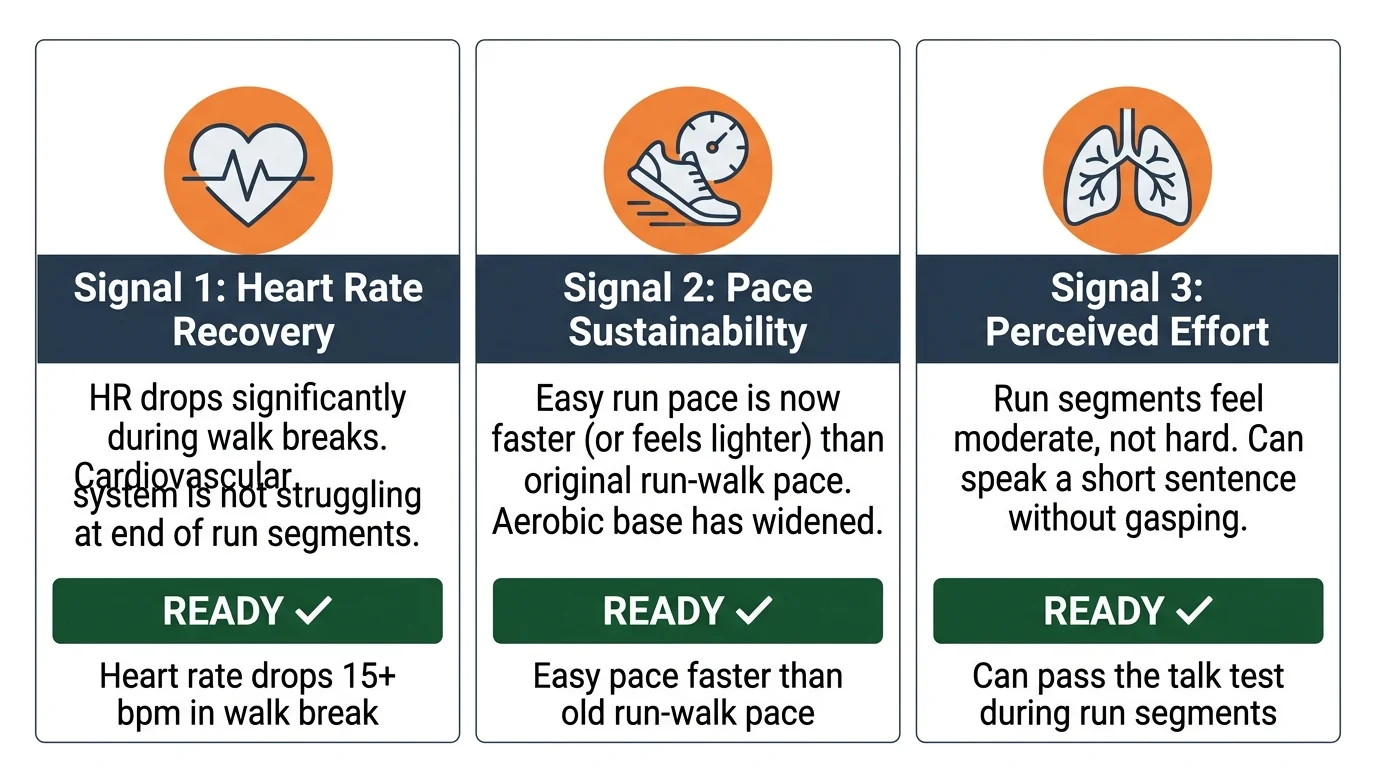
When all three signals align (good HR recovery, faster easy pace, moderate perceived effort), you have strong evidence that your body is ready.
RunnersConnect Bonus
Download your FREE Long Run and Aerobic Pacing Calculator now.
Need help converting your race times to your optimal easy and long run pace? Download our FREE calculator and we’ll do the math for you.
The Safe Transition Framework
Transition is a ratio game, not a binary switch.
Instead of deciding “today I’ll run the whole way,” you shift the ratio of running to walking in small, predictable steps.
Start with your current run-walk pattern (for example, 2 run, 1 walk).
In week 1 and 2, increase the run segment by 30 seconds while keeping the walk segment the same: 2:30 run, 1 walk.
This small increase shouldn’t feel much harder than your original pattern. If it does, you’re not ready yet.
Stay at this new ratio for 2 to 3 weeks before advancing again.
This timing gives your body time to adapt to the new stress load without triggering injury.
After 2 to 3 weeks, shift to 3 minutes run, 1 walk.
Then progress to 3:30 run, 1 walk, then 4 run, 1 walk.
Each step builds on the previous one and allows adaptation to accumulate without overwhelming your system.
Once your run segments are 5 to 6 minutes with only 1-minute walk breaks, your aerobic system is capable of handling continuous running on most easy days.
At this point, you’ve transitioned nearly all your easy running to continuous, with just small walk breaks as optional comfort measures.
You’re ready to eliminate the walks entirely or save them only for the very end of long runs when fatigue sets in.
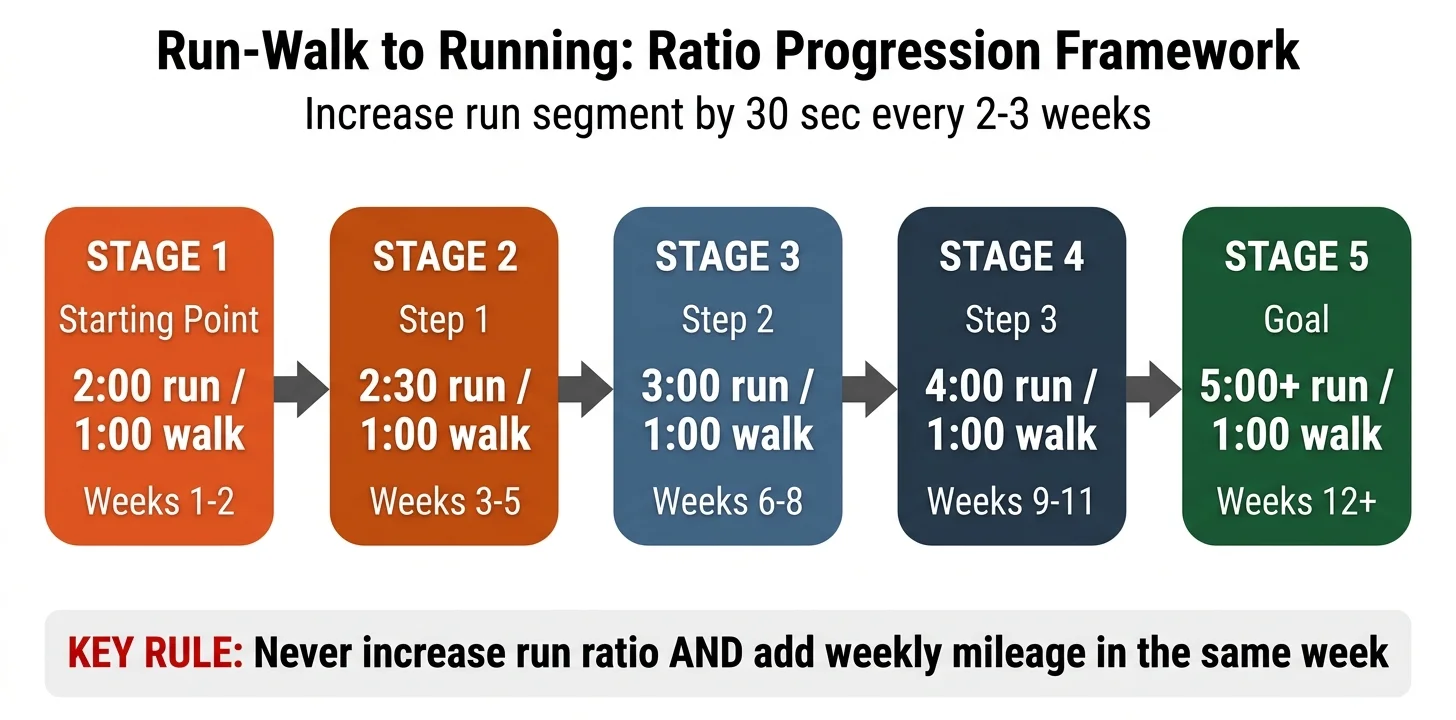
Never increase your run ratio and increase your weekly mileage in the same week.
The single biggest mistake is layering both stressors in the same training window.
Your body can handle either stimulus alone, but layering them creates an injury risk that derails most transitions.
Once you’ve reached mostly continuous running on easy days, you’re ready to begin occasionally adding harder efforts while still running continuously.
Don’t change your speed work format. If you were doing tempo runs or intervals during your run-walk phase, continue those in their original format.
The transition applies to easy running only.
This framework prevents the injury spike that derails most runners attempting the transition because it honors your body’s adaptation timeline and doesn’t compress multiple stressors into the same window.
What to Do If You Hit a Wall
Hitting a wall during the transition doesn’t mean the method isn’t working for you.
The three most common walls are joint pain, chronic fatigue, and run-walk segments that suddenly feel impossible.
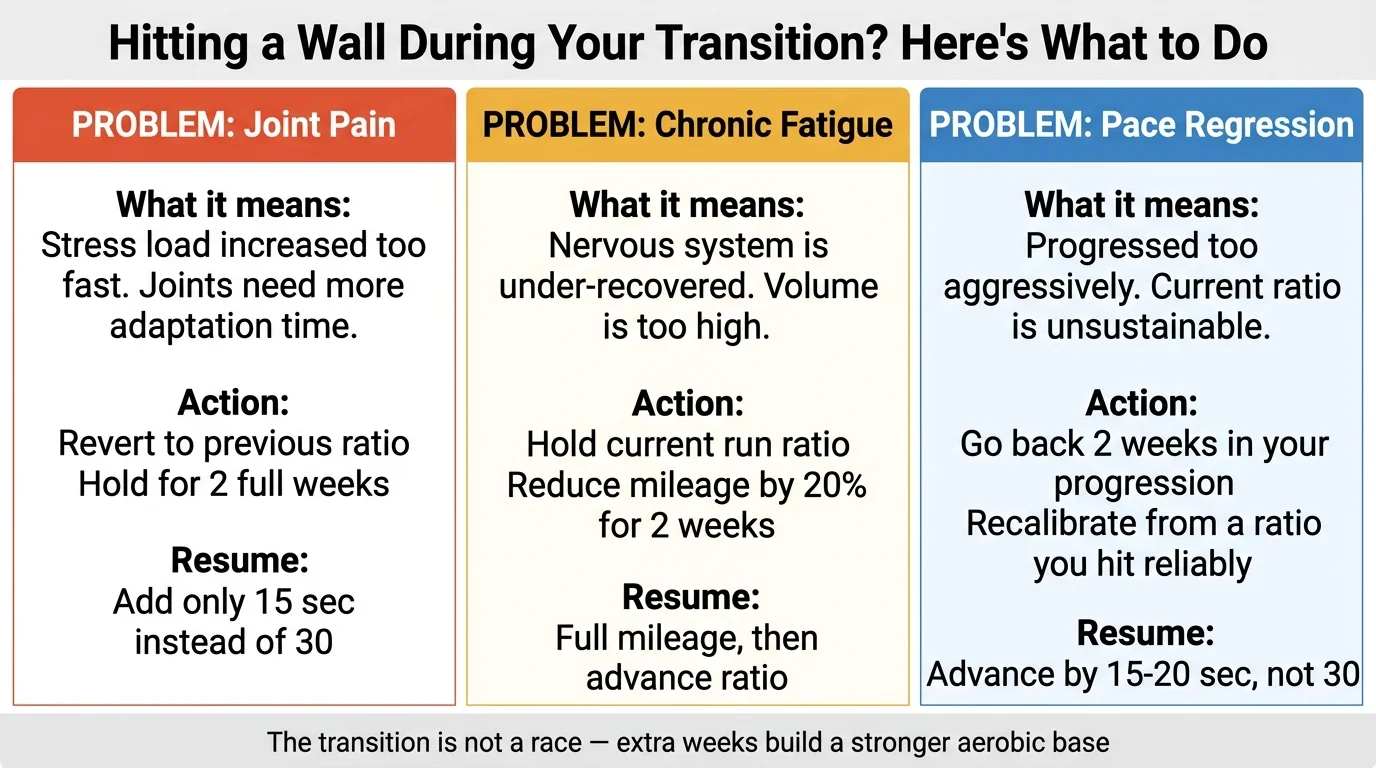
If you experience knee or ankle pain during your transition, revert to your previous ratio for 2 full weeks without advancing.
Pain is a signal that the stress load increased too fast, and your joints need extra adaptation time.
This is not failure but rather finding your pace of progression.
After 2 weeks at the previous ratio, try advancing again with only 15 seconds added instead of 30 seconds.
Sometimes your joints need a slower timeline, and that’s completely normal.
If you notice persistent fatigue that carries into your rest days, hold your current run ratio and reduce your overall mileage by 20 percent for 2 weeks.
Fatigue means your nervous system is under-recovered.
Maintaining volume while reducing intensity helps you adapt without pushing harder and gives your central nervous system time to recover.
This is different from pain, which requires you to revert your ratio. Fatigue requires you to hold your position but reduce the workload.
If you’ve advanced your ratio too aggressively and suddenly can’t sustain even your previous run-walk ratio, go back to the ratio you were consistently hitting 2 weeks ago.
This is recalibration, not failure.
Resume from that point, then progress more gradually, adding only 15 to 20 seconds to your run segments every 2 to 3 weeks instead of 30 seconds.
The transition from run-walk to continuous running is not a race.
Even runners who take an extra 4 to 6 weeks to complete the transition end up at the same place: running continuously with a stronger, more resilient aerobic base than if they’d rushed.
Your job is to recognize the signals your body is sending and respect the pace of adaptation.
RunnersConnect Bonus
Download your FREE Long Run and Aerobic Pacing Calculator now.
Need help converting your race times to your optimal easy and long run pace? Download our FREE calculator and we’ll do the math for you.