
You’re 6 miles into a planned 12-mile long run when your legs feel heavy and the rest of your day fills up.
The obvious workaround is to run 6 miles now, another 6 tonight, and count the total as your long run.
Whether that works comes down to which run you’re splitting, and the split helps one type far more than the other.
An easy run breaks into two separate sessions with almost no cost to the training benefit.
A long run works differently, because what makes a run “long” is the deep glycogen depletion that only shows up after 60 to 90 minutes of continuous effort.
Split that effort in half and you erase the exact state the long run exists to create.
So, in this article you’re going to learn the research-backed answer on:
- Whether splitting a long run keeps the same training benefit
- Why easy runs and long runs respond so differently to a split
- The specific adaptations you lose when you break a long run in two
- When splitting makes sense, and when it wrecks the workout
- How long the gap between sessions needs to be
Can You Split a Long Run in Two?
Splitting a long run means running two separate sessions on the same day with a recovery break between them, rather than spreading those miles over two calendar days.
Your instinct about total volume is half right, because weekly mileage does drive a large share of your aerobic fitness.
A 12-mile continuous run and two 6-mile runs add up to the same distance on paper.
They do not deliver the same stimulus, because the long run’s value comes from what happens after 60 to 90 minutes of unbroken effort.
That gap barely matters for easy runs and matters a great deal for long runs.
Understanding why the two respond so differently is what separates a smart training decision from a well-meaning mistake.
Split an easy run freely, but keep your long run in a single unbroken effort when you can.
What Makes a Long Run “Long”?
A long run is defined by sustained physiological demand rather than by a number on your watch.
The training effect you want comes from the metabolic stress of prolonged effort, and it builds only after 60 to 90 minutes of continuous running.
The first big shift arrives around that 60 to 90-minute mark.
Your muscle glycogen, the carbohydrate your muscles store for fuel, drops low enough to push you toward fat as a backup energy source.
Time spent in that low-fuel state builds metabolic flexibility, your ability to switch between carbohydrate and fat without your pace falling apart.
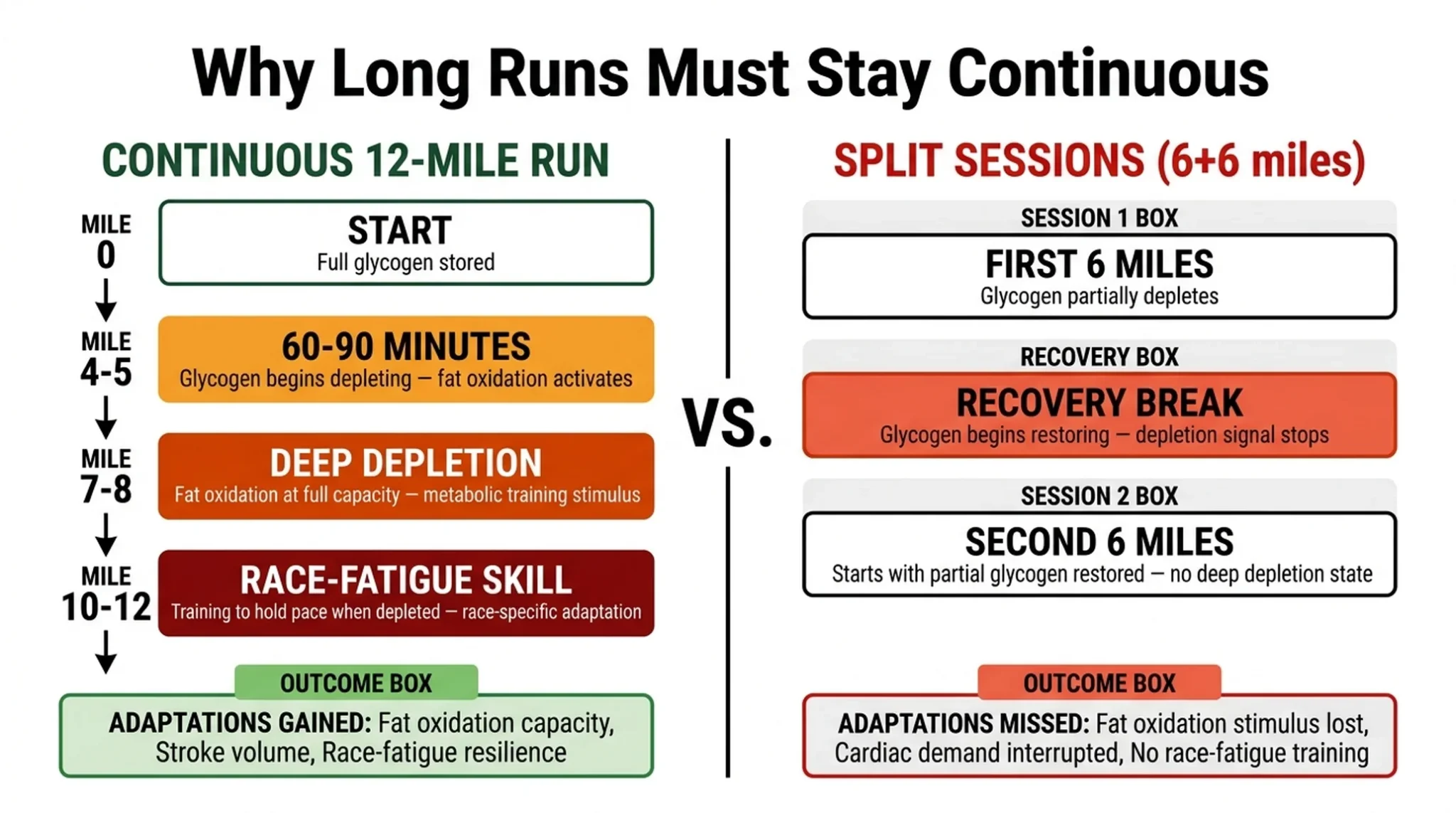
Split the run and you cut that fuel signal short.
Run 6 miles, rest an hour, eat some carbohydrate, and your second 6 miles begins with refilled glycogen and none of the depletion the adaptation depends on.
One training study found that runners who trained through periods of low carbohydrate availability improved their running economy at lactate threshold, while runners who trained with high carbohydrate throughout showed no such gain.
Sustained effort also loads your heart in a way two short runs cannot.
Stroke volume, the amount of blood your heart pumps per beat, rises in response to long stretches of steady cardiac output.
Break the long run into two split bouts and you cut the stretch of high cardiac demand your heart needs to grow its stroke volume.
The last piece is a skill: holding pace while your legs and mind are running on empty.
Deep into a long run, as glycogen runs low, your form and turnover start to break down, and learning to hold pace through that is what carries you through the final miles of a race.
Your body also rehearses clearing lactate and steadying form once glycogen is low, and that rehearsal only happens when the effort runs unbroken past the 90-minute mark.
A split session skips all of this, because your second run starts fresh, before any real depletion.
RunnersConnect Bonus
Download your FREE Long Run and Aerobic Pacing Calculator now.
Need help converting your race times to your optimal easy and long run pace? Download our FREE calculator and we’ll do the math for you.
Can You Split an Easy Run?
An easy run splits cleanly, with no meaningful loss.
Easy runs serve a different goal than long runs, and they respond to a different stimulus.
The point of an easy run is to build aerobic volume at a gentle intensity, without the deep fatigue of a hard session.
Aerobic fitness improves from a steady stimulus repeated over weeks, and the length of any single run barely matters.
The adaptations you want from easy running, a richer capillary network and more mitochondria, respond to the total load of many moderate efforts across the week.
Two 4-mile easy runs on the same day, spaced 6 to 8 hours apart, give you close to the same aerobic stimulus as one 8-mile easy run.
Refueling with carbohydrate between the runs is the variable that decides how close you get.
Your muscles need roughly 4 to 6 hours to rebuild meaningful glycogen after an easy run.
Run the second session only 2 hours later and it begins on a half-empty tank, which nudges the stimulus away from what you planned.
Space two easy sessions at least 6 to 8 hours apart, refuel with carbohydrate between them, and the aerobic benefit holds.
What Do You Lose When You Split a Long Run?
Splitting a 12-mile long run into two 6-mile runs strips out the one thing that makes the long run valuable: sustained depletion.
The moment you stop, your muscles start restocking glycogen, so your second run begins before you ever reach a deep low-fuel state.
The fat-adaptation signal depends on progressive depletion over the length of the run, and a mid-run break resets it.
Your first 6 miles only partly empty your glycogen, and the recovery hour tops you back up.
Your heart adapts to steady, prolonged output differently than to two brief bursts.
Two split efforts compress that demand into two short windows and weaken the stimulus that grows your stroke volume.
You also miss the hormonal side of a long run, where a sustained effort of 2 hours or more shifts your fuel-regulating hormones in a way a pair of hour-long runs won’t.
The last loss is race-specific.
As glycogen drops deep into a long run, your running form shifts in ways that test your ability to hold pace and stay efficient.
Training through that depleted state is what prepares you to hold goal pace in the final miles.
A split run never gets there, because the second half starts fresh, before meaningful depletion.
A race is a single continuous effort, so splitting your long-run training costs you race-day fitness.
When Does Splitting a Run Make Sense?
Splitting is the right call in a few specific situations, and each is about protecting something more important than a perfect stimulus.
Is It Safe to Split Runs in Extreme Heat?
In dangerous heat or humidity, splitting a run cuts your total heat exposure while you still bank useful volume.
Safety wins over the ideal adaptation every time, and you can rebuild the depletion stimulus next week once the heat breaks and conditions turn safer again.
Can Splitting Help While You’re Injured?
If you’re managing a bone stress injury, tendinopathy, or a soft-tissue load problem, two shorter runs may stress the tissue less than one long grind.
Running less to protect an injury beats skipping the run and losing the fitness.
What About Time Crunches on Easy Days?
If a 6-mile easy run won’t fit into one block, split it and move on.
Easy aerobic work doesn’t care whether the miles arrive in one piece.
Splitting is the wrong answer for:
- Your weekly long run in a normal training block
- Quality workouts like tempo or threshold sessions, where the accumulating fatigue is the point
- Any run during peak weeks, when the long run anchors your race prep
Use splitting for a genuine constraint, and keep it out of your normal long-run rotation.
How Long Should the Gap Between Split Sessions Be?
The gap between two split sessions matters more than runners expect.
Glycogen rebuilds fastest in the first few hours after you stop.
Your muscles restore roughly 5 to 7 percent of their glycogen per hour early on, reach about 50 percent by 4 hours, and approach full stores only after 20 to 24 hours.
Run again 2 hours after the first session and you start the second with a real glycogen deficit.
That can be a deliberate low-fuel workout, but done by accident it only adds fatigue without the payoff of a planned depletion session.
6 to 8 hours is the practical floor for a same-day split.
Those hours let glycogen rebuild and give your cortisol, which climbs during exercise, time to settle before you run again.
Stretch the gap to 12 hours or more and your body treats the two split runs as separate training days.
That’s fine for easy runs, and it’s worth knowing because it changes how you plan fueling and warm-up.
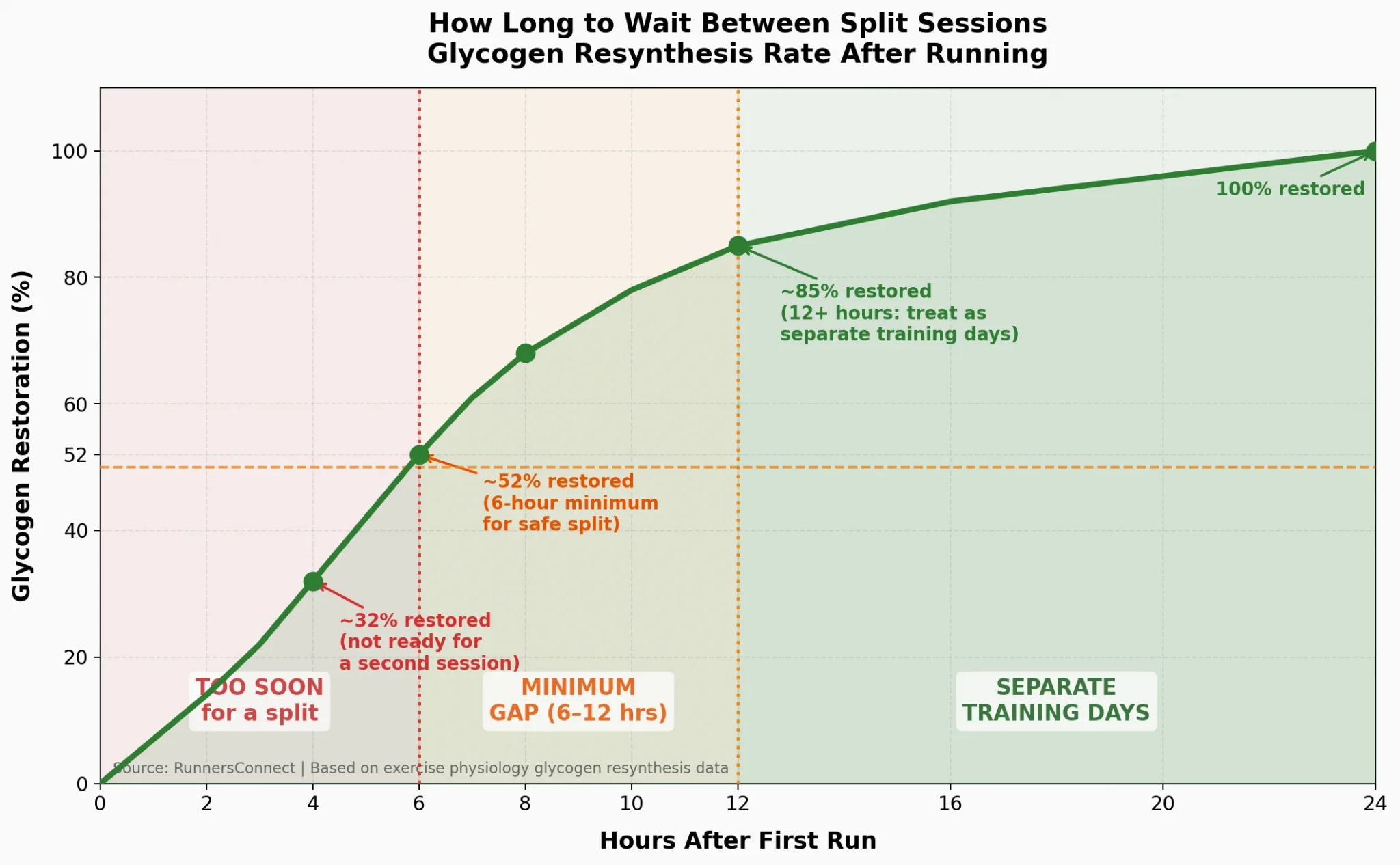
With less than 6 hours between runs, refuel fast with quick-digesting carbohydrate right after the first session to close the gap before the second.
Can You Do Two Long Runs in One Week?
This is a different question from splitting, and the answer shifts with your experience and your race.
For a runner training for a 5K through a marathon, one long run a week is plenty.
Higher-mileage marathoners sometimes add a second, midweek medium-long run of 8 to 12 miles.
That second effort stays controlled and never turns into a second race-pace grind on tired legs.
A midweek medium-long run keeps your long-run legs sharp without a second dose of deep depletion.
Two maximal long runs in the same week is where injury risk climbs fast, because your muscles need 48 to 72 hours to recover from each one.
Build a second long run in gradually, and only once your weekly long run already feels routine.
Why Don’t Elite Runners Split Their Long Runs?
The best endurance runners train 5 to 6 days a week and log high weekly mileage.
Even at that volume, they run one long effort a week.
The reason is recovery cost.
A true long run carries a recovery cost that takes your muscles 48 to 72 hours to clear.
Doing a second long run before those 48 to 72 hours pass doesn’t double the benefit.
It raises injury risk and drags down the quality of the rest of your week.
One well-run continuous long run per week does more for you than two split halves of the same distance.
RunnersConnect Bonus
Download your FREE Long Run and Aerobic Pacing Calculator now.
Need help converting your race times to your optimal easy and long run pace? Download our FREE calculator and we’ll do the math for you.
| Run Type | Can You Split It? | What You Lose by Splitting | Minimum Gap If You Do |
|---|---|---|---|
| Easy run | Yes | Nothing meaningful with proper recovery | 6 to 8 hours, with carbohydrate refueling |
| Long run | Not recommended | Glycogen-depletion adaptations, sustained cardiac demand, race-fatigue skill | Not a substitute at any gap |
| Quality workout (tempo, threshold) | Only in structured formats | The accumulating fatigue that makes the workout work | Requires specific coaching guidance |