You’ve checked the AQI before a run during wildfire season and watched the number climb into the 300s or 400s, wondering whether it’s safe to head out.
That number is the Air Quality Index, and it tells you how much fine particulate and ozone is in the air and how hard it is on your lungs to exercise in it.
Checking it before you head outside is the right instinct. The gap is the air you breathe for the eight hours before you run.
Your bedroom air the night before a race carries PM2.5 you can’t see, carbon dioxide you exhale all night, humidity you’ve never measured, and a room temperature you’ve probably been getting wrong.
A 2026 study published in Scientific Reports monitored bedroom air quality for 183 runners the night before a physical fitness test and found that even sleeping in air the EPA classifies as “good” caused a measurable drop in next-day running performance.
So, in this article you’re going to learn what the AQI numbers mean for runners and how the air you sleep in shapes your next-day performance:
- What every AQI number from 0 to 500 means and when it’s too dangerous to run outside
- How much a single night of poor bedroom air quality can slow your race pace
- Why PM2.5 particles disrupt the deep sleep your body uses to recover from training
- How CO2 accumulates overnight and what it does to your sleep quality
- What temperature and humidity ranges support the best recovery sleep
- Specific steps to clean up your bedroom air before your next race or hard workout
What Do the AQI Numbers Actually Mean for Runners?
The Air Quality Index runs from 0 to 500, and each range maps to a health category that tells you how safe it is to train outside.
The index is driven mostly by fine particulate, the same PM2.5 that reaches deep into your lungs when you breathe hard.
The categories below come from the U.S. EPA’s AirNow Air Quality Index, with running guidance added for each band.
| AQI Range | Category | What It Means for Running |
|---|---|---|
| 0–50 | Good | Air is clean. Train as normal. |
| 51–100 | Moderate | Fine for most runners. If you have asthma or react to pollution, watch how you feel on hard efforts. |
| 101–150 | Unhealthy for Sensitive Groups | Sensitive runners should cut intensity or move key workouts indoors. Everyone else can still run easy. |
| 151–200 | Unhealthy | Reduce hard outdoor efforts. Shorten the run, drop the pace, or move it indoors. |
| 201–300 | Very Unhealthy | Avoid outdoor running. Move workouts to a treadmill in filtered air. |
| 301–500 | Hazardous | Do not run outside. Health agencies advise everyone to avoid all outdoor exertion. |
An AQI of 400 or 500 sits in the Hazardous band at the top of the scale, where the EPA advises everyone to avoid all outdoor physical activity.
A reading in that range is an emergency-level air quality event, usually driven by wildfire smoke or severe industrial pollution, and no training benefit is worth that exposure.
You don’t need a hazardous number to lose performance.
The 2026 bedroom study found that air rated “good,” an AQI under 50, still cost runners measurable speed when they slept in it, which is where the rest of this guide focuses.
How Much Does Bedroom Air Quality Actually Affect Your Running Performance?
The effect is larger than most runners would guess, and it starts at air quality levels the EPA considers safe.
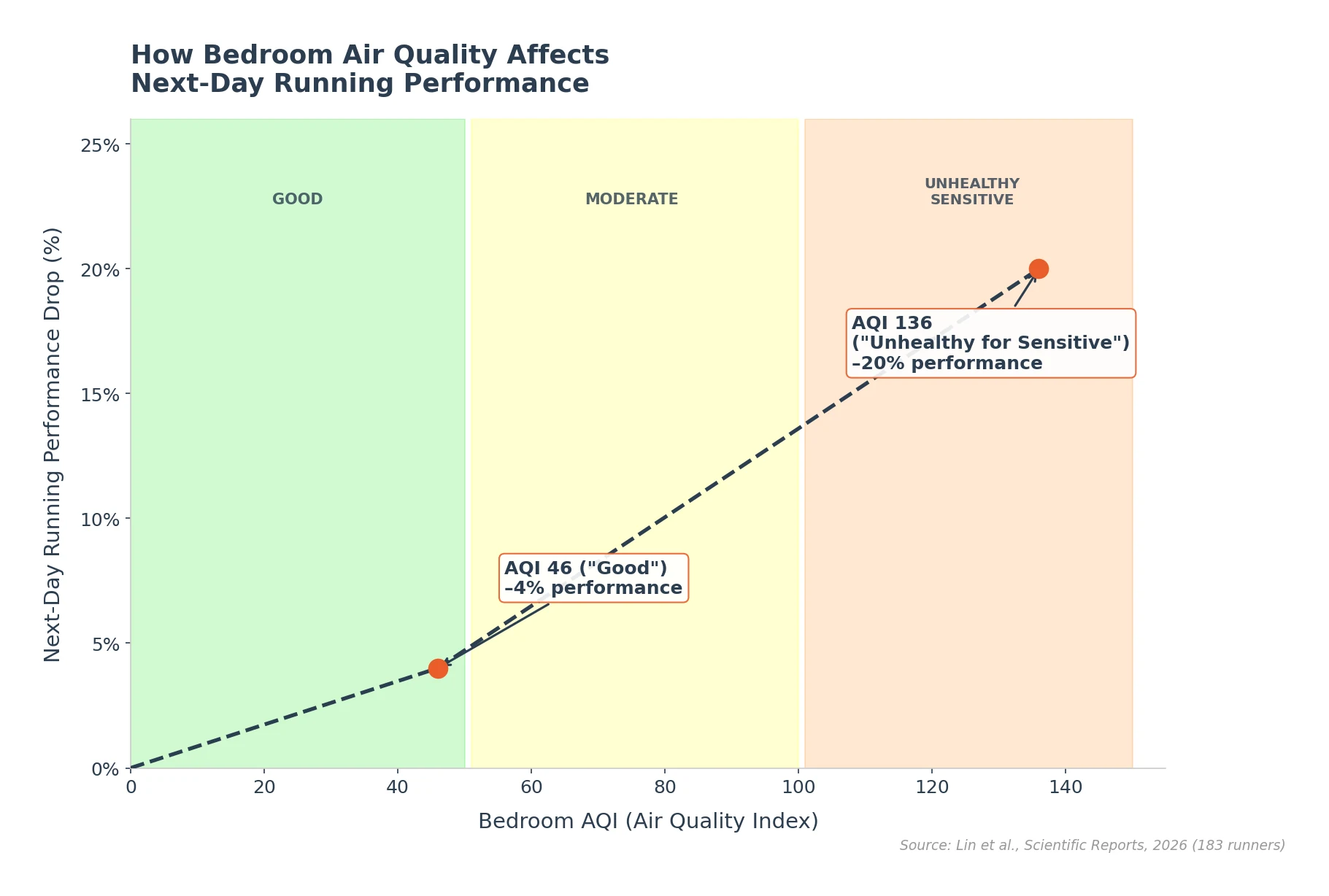
A 2026 study in Scientific Reports found that sleeping in bedroom air at an AQI of 46, still inside the EPA’s “good” zone, reduced next-day running performance by 4%.

That 4% doesn’t sound like much until you convert it into pace.
The study used a Chinese physical fitness scoring table that’s highly non-linear: a 4% drop in score corresponds to roughly a 7-second-per-mile (about 4-second-per-kilometer) slowdown for runners finishing around 7:00 per mile (4:21/km).
For a 3-hour marathoner, that’s about 3 minutes of lost time, or roughly 4 seconds per kilometer, from one night of air quality at the top end of “good.”
At the highest PM2.5 levels in the study, equivalent to an AQI of 136, running performance dropped by 20%.
For a 3-hour marathoner, that’s roughly 15 minutes of lost race time from air quality the night before that falls in the “unhealthy for sensitive groups” range.
The bedroom air you breathe the night before a race has a larger direct effect on your next-day running performance than the outdoor AQI you’ll check on race morning.
The study recruited 183 undergraduate students at Shanghai Jiao Tong University, outfitting their dorm rooms with continuous air-quality monitors and each student with a Fitbit to track sleep quality the night before a mandatory physical fitness test.
The fitness test included a 1,000-meter time trial for men and an 800-meter time trial for women, and this was the element most strongly affected by bedroom air quality among all the assessments.
This wasn’t a lab study with artificially polluted air. Outdoor air pollution is well studied in runners, but this research captured what actually happens in real bedrooms on real nights before real performance tests.
The students were also highly motivated to perform well, since poor scores on the test can prevent graduation in China’s university system, which means the underperformance recorded was real, not a product of low effort.
What Is PM2.5 and Why Does It Hit Runners the Hardest While They Sleep?
PM2.5 refers to airborne particles smaller than 2.5 microns in diameter, about 30 times thinner than a human hair.
At that size, these particles bypass the filtration your nose and upper airway provide for larger dust and debris.
They reach the deepest parts of your lungs where gas exchange happens, and from there they can enter the bloodstream.
During sleep, your respiratory rate slows and you stop moving, which means the same concentration of PM2.5 in your bedroom air stays in close contact with your airways for hours without interruption.
The most direct effect on next-day running performance runs through sleep architecture.
PM2.5 particles trigger low-grade inflammation in the airways, which disrupts the nervous system signaling that regulates sleep stages, specifically the deep slow-wave sleep where physical adaptation and hormone release occur.
Deep sleep is where your body releases human growth hormone, consolidates neuromuscular patterns from training, and repairs muscle tissue, and PM2.5 disrupts that stage directly.
Everyday runners are more vulnerable than elites to these air quality effects. Research from the Great North Run found that amateur runners are significantly more affected by air pollution during half marathons than elite runners, likely because elites have more physiological reserve to compensate.
That same dynamic applies to bedroom air. A runner already training near their capacity has less buffer when sleep quality is compromised by overnight particulate exposure.
RunnersConnect Bonus
Download our free Pre-Race Bedroom Air Quality Checklist — an 8-point checklist covering PM2.5, CO2, temperature, humidity, and combustion sources so you can optimize your sleep environment the night before your next race.
How CO2 Builds Up Overnight (And What It Does to Your Deep Sleep)
Every breath you exhale in a closed bedroom raises the carbon dioxide concentration in the air around you.
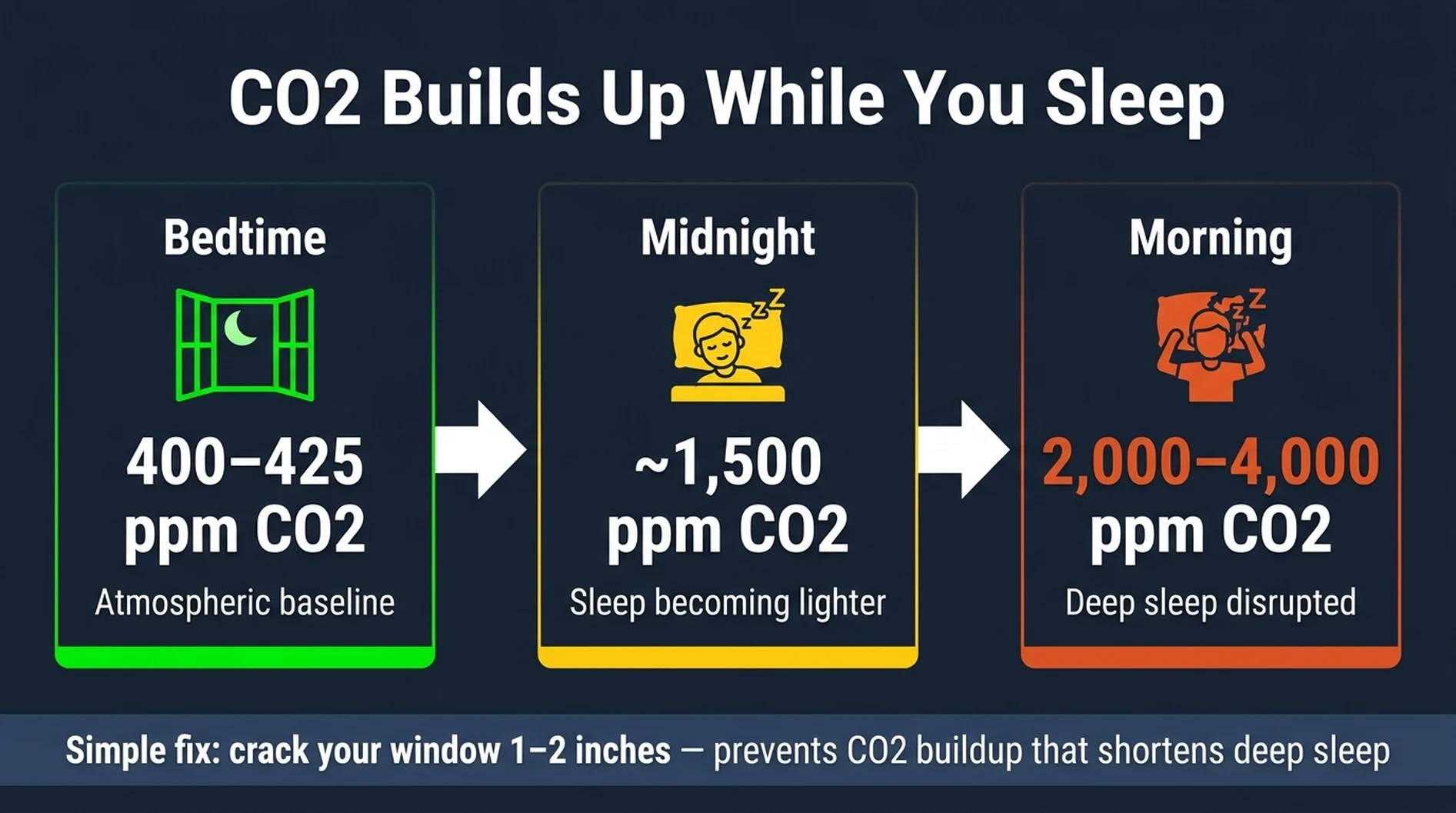
In a well-ventilated room, CO2 stays near the atmospheric baseline of around 400–425 parts per million (ppm).
In a small, sealed bedroom with one or two people sleeping, CO2 can climb past 2,000 ppm by morning, and the 2026 Shanghai study found some dorm rooms reaching 4,000 ppm.
A controlled bedroom study found that sleep quality at 3,000 ppm CO2 was only 80.8% of sleep quality at 800 ppm, with higher CO2 directly shortening deep sleep and extending the time it takes to fall asleep.
The mechanism is straightforward: elevated CO2 subtly activates your sympathetic nervous system, keeping your body in a lighter, more alert state rather than dropping into the slower, restorative cycles of deep sleep.
This matters for runners because the training adaptations you’re working toward, including cardiovascular efficiency, muscle repair, and glycogen restoration, are concentrated in those deep sleep cycles.
Running on poor sleep isn’t just about feeling groggy the next morning. It means your body hasn’t fully processed the previous day’s training stimulus before you go out and add the next one.
A field study of 29 bedrooms found that increasing ventilation rate improved both sleep quality and next-morning cognitive performance in rooms where CO2 was measurably reduced, without any other changes to the bedroom environment.
Cracking your window 1–2 inches while sleeping provides enough fresh air exchange to prevent the overnight CO2 buildup that cuts into your deep sleep.
If outdoor air quality is poor during wildfire smoke events, an air purifier with a HEPA filter can handle PM2.5 while you keep the window closed, though you’ll lose the CO2 ventilation benefit.
Does Temperature and Humidity in Your Bedroom Matter for Next-Day Running?
Temperature and humidity don’t act as primary threats to running performance on their own, but they amplify the damage from PM2.5 and CO2 when conditions are off.
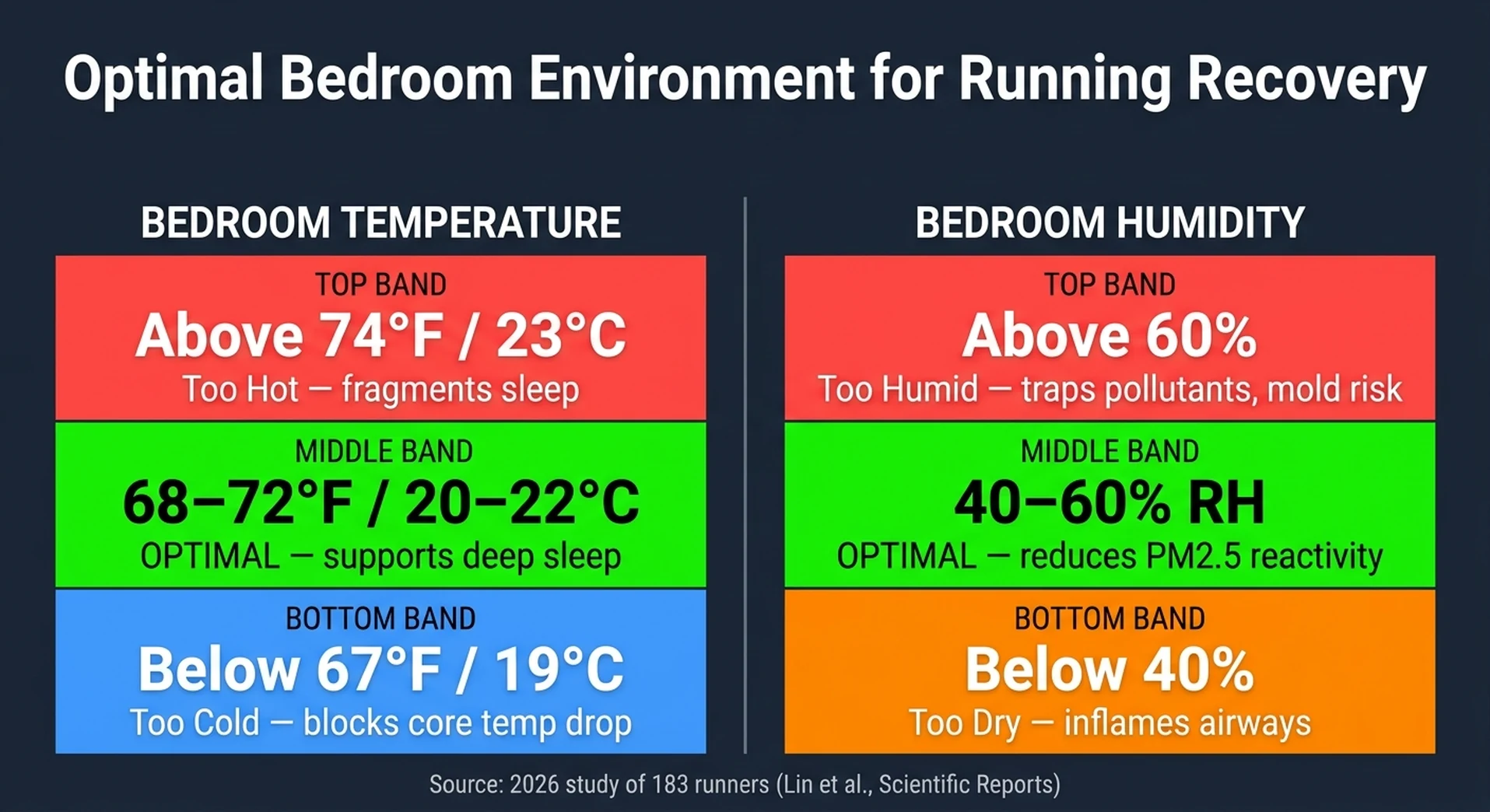
The Shanghai study found that both extremes of humidity, too dry and too high, magnified the effect of PM2.5 on next-day running scores.
Dry air causes mild airway inflammation that makes the lungs more reactive to particles, while excessively humid air tends to trap pollutants at higher concentrations and can promote mold growth in the bedroom environment.
The temperature finding in the study was counterintuitive: within the range examined (67°F to 74°F), slightly warmer was associated with better performance, not cooler.
The same study found that warmer bedroom temperatures within the 67–74°F range support better sleep quality because a comfortably warm environment keeps skin blood vessels from contracting, which facilitates the core body temperature drop that drives the deepest sleep stages.
Your core body temperature needs to fall about 1–2 degrees Fahrenheit to initiate and sustain deep sleep.
When your bedroom is too cold, blood vessels near the skin constrict to conserve heat, which partially blocks that core temperature drop and keeps you in lighter sleep stages.
This doesn’t mean hotter is always better. The study range topped out at 74°F, and temperatures above that consistently produce sleep disruption from overheating.
For most runners, the target bedroom temperature is 68–72°F, warm enough to keep your skin vessels open for core cooling and cool enough to avoid the overheating that fragments sleep.
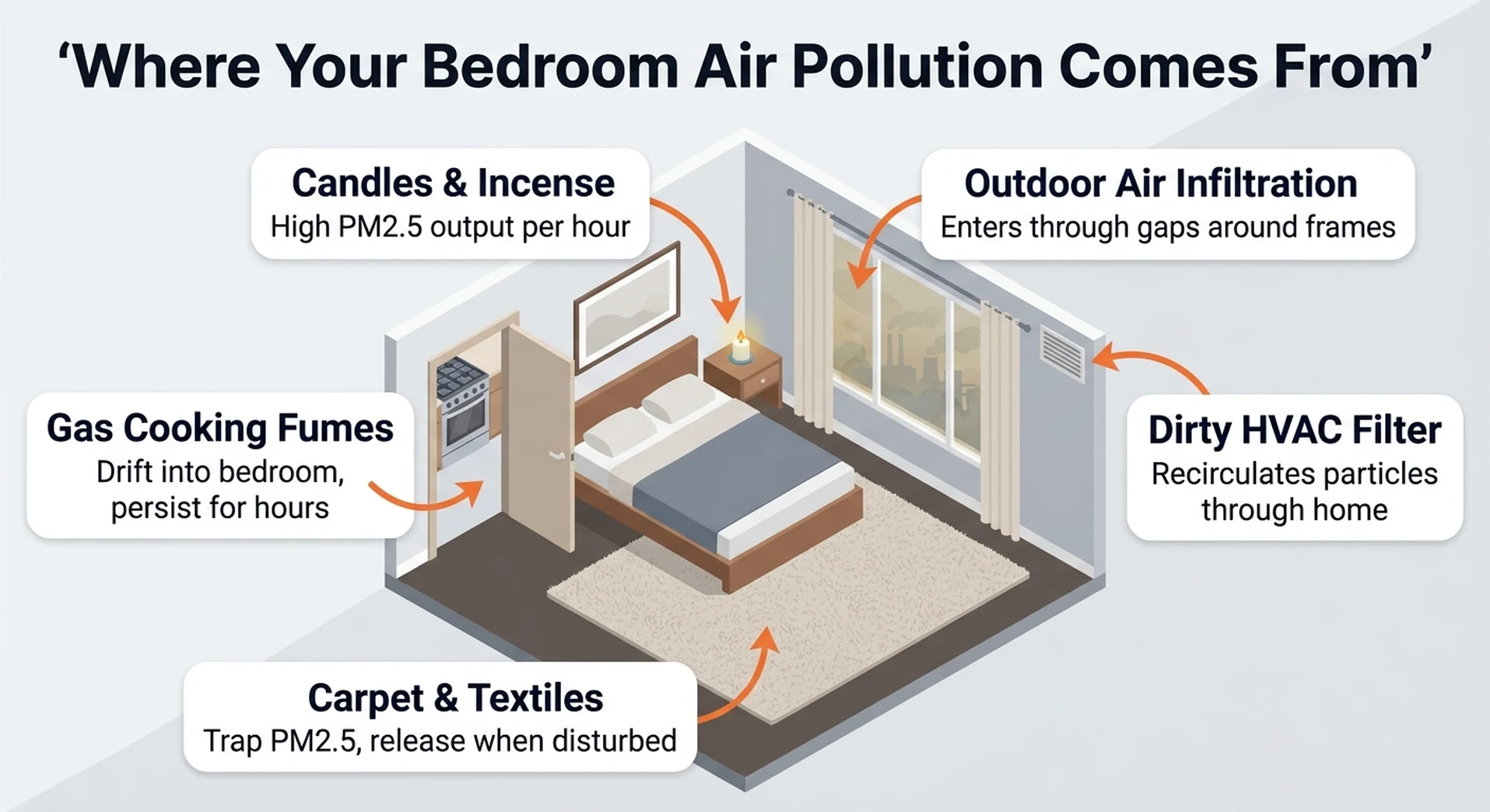
What’s Polluting Your Bedroom Air Without You Realizing It?
Most runners assume poor bedroom air is an outdoor problem: wildfire smoke forcing its way through window seams, traffic pollution in an urban neighborhood.
Outdoor infiltration is real, but some of the most common sources of bedroom PM2.5 are inside your home.
Candles and incense are among the highest-output sources of indoor PM2.5 in residential environments. A single scented candle burning for an hour can raise indoor particulate levels well above the “good” AQI threshold in a poorly ventilated room.
Gas stoves and ovens release nitrogen dioxide and fine particles during combustion. If your bedroom door is open or your home has poor air circulation, cooking emissions can drift into sleeping areas and persist for hours.
Carpeting and textiles trap PM2.5 that enters from outside and re-release it when disturbed. Vacuuming, making the bed, or walking across an old carpet can spike particle counts right before sleep.
HVAC systems and air filters can either help or hurt depending on how well the system is maintained.
A system with a dirty or low-rated filter recirculates particles throughout the home, including into bedrooms. A properly maintained system with a high-rated MERV filter actively reduces indoor PM2.5.
Outdoor pollution infiltrating through gaps around windows and doors is the other major pathway, especially in urban areas or on days with elevated outdoor AQI.
Checking your local outdoor AQI before opening bedroom windows at night is a simple protective step, the same instinct runners already have for their morning routes.
RunnersConnect Bonus
Download our free Pre-Race Bedroom Air Quality Checklist — an 8-point checklist covering PM2.5, CO2, temperature, humidity, and combustion sources so you can optimize your sleep environment the night before your next race.
How to Improve Your Bedroom Air Quality for Better Running Performance
The most impactful changes to bedroom air quality cost nothing or very little.
The steps below are ordered by impact, starting with what the research supports most directly.
- Crack your window before sleep. A 1–2 inch opening flushes out the CO2 you’ve been exhaling and prevents it from accumulating to the levels that cut into deep sleep. Do this on nights when outdoor AQI is good. On high-pollution days, rely on an air purifier instead.
- Run an air purifier with a true HEPA filter. HEPA filters capture PM2.5 particles at 99.97% efficiency. Position it 3–6 feet from your bed and run it for at least an hour before sleep to clear particles that accumulated during the evening. A unit rated for your bedroom’s square footage, typically a CADR of 200 or higher for an average bedroom, is sufficient.
- Keep your bedroom temperature between 68 and 72°F. This is the range where the core temperature drop that drives deep sleep is most reliably supported. A fan helps both with temperature and air circulation.
- Control humidity. A bedroom humidity level of 40–60% is the target. Below 40%, dry air increases airway reactivity to particles. Above 60%, you’re creating conditions for mold and higher pollutant concentrations. A basic hygrometer costs under $15 and tells you exactly where you stand.
- Eliminate combustion sources before sleep. Blow out candles and incense at least 30 minutes before bed and ventilate the room. Avoid using gas stoves close to bedtime if your home’s ventilation is limited.
- Vacuum carpets and textiles regularly with a HEPA-filter vacuum. Focus on the area around your bed where you’ll be breathing for the next 7–9 hours.
The night before a race or hard workout, treat your bedroom as a controlled environment: run your air purifier, check outdoor AQI before opening windows, set your thermostat to 68–72°F, and eliminate candles and incense from your pre-race evening routine.
| Bedroom Factor | What It Does to Running Performance | Target Range / Fix |
|---|---|---|
| PM2.5 (fine particles) | Disrupts deep sleep; AQI 46 = 4% performance drop; AQI 136 = 20% drop | Run HEPA air purifier; CADR 200+ for average bedroom |
| Carbon dioxide (CO2) | Activates sympathetic nervous system; shortens deep sleep cycles | Crack window 1–2 inches on low-pollution nights; target under 1,000 ppm |
| Bedroom temperature | Too cold constricts skin vessels and blocks core temp drop; too hot fragments sleep | 68–72°F (20–22°C) |
| Humidity | Too dry increases lung reactivity to PM2.5; too high traps pollutants and promotes mold | 40–60% relative humidity |
| Combustion sources (candles, gas stoves) | Generate PM2.5 and nitrogen dioxide that persist for hours in enclosed rooms | Eliminate 30+ minutes before bed; ventilate after use |