
You spent 16 weeks building fitness for your marathon, following a structured plan, hitting every long run, and nailing your workouts.
Then you tapered 4 weeks out, backed off the mileage, took extra rest days, and felt strong.
But on race day, your legs felt heavy, your pace felt sluggish, and you finished nowhere near your goal time.
What happened is that your body peaked weeks before the actual race, long before you had a chance to use that fitness.
Peaking too early is one of the most common race preparation mistakes runners make, and it costs you when you need your best performance most.
- Why your body peaks before race day if you time it wrong
- When peak performance actually occurs during the taper window
- What your Garmin’s Peaking status actually tells you about your race timing
- How to identify signs that you’ve peaked too early
- How to align your peak with your actual race date
Why Runners Peak Too Early
Peaking too soon happens because of how your body adapts to training stress.
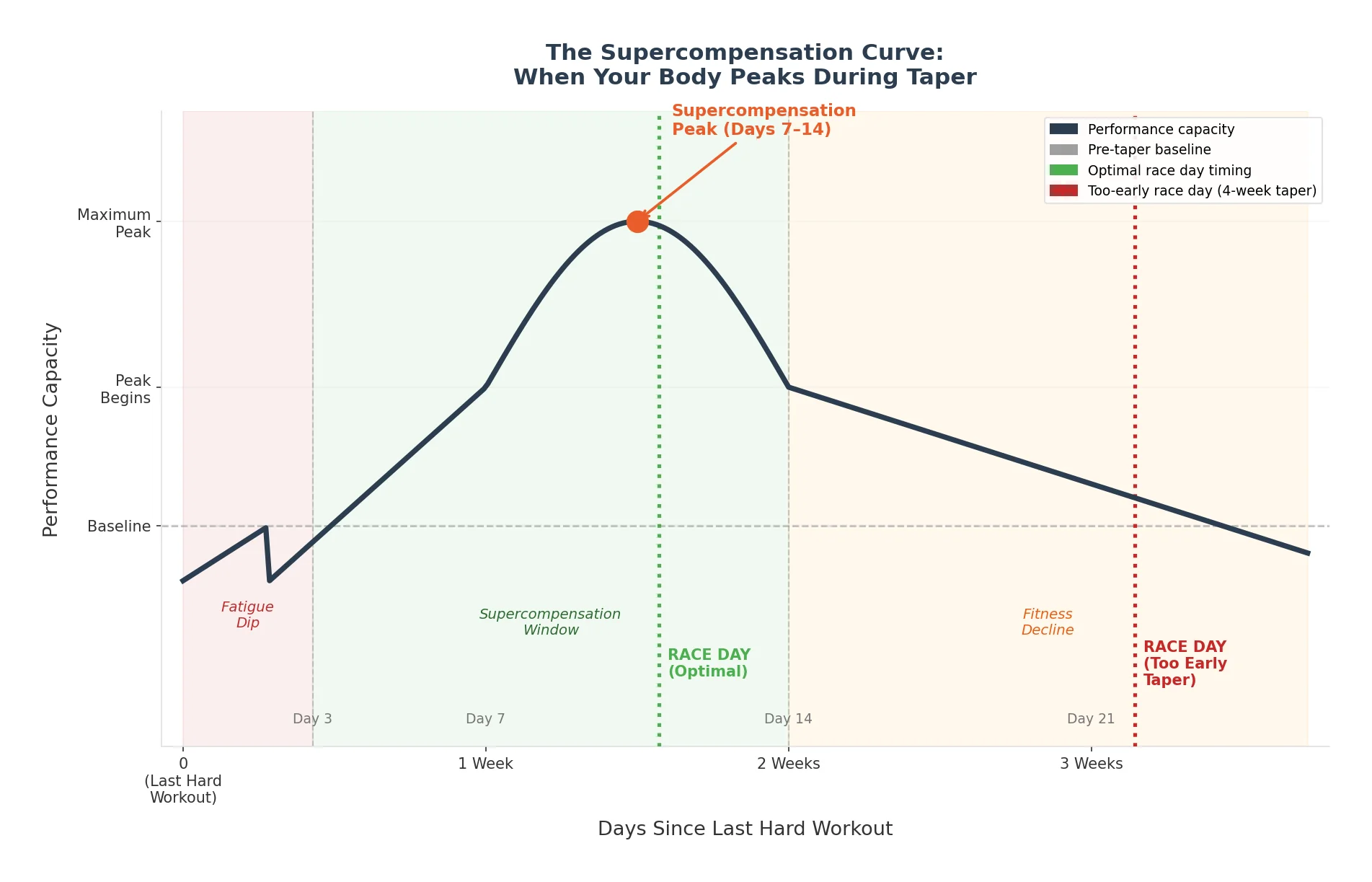
When you finish your build phase and begin to reduce training volume, your nervous system and muscles experience supercompensation.
Your body doesn’t just recover from the stress of hard training.
It overshoots and becomes stronger than it was before.
This adaptation is powerful and happens quickly, often within the first 7 to 14 days of significantly reduced training load.
If you taper 4 weeks out, your peak performance occurs around week 2 or 3 of that taper window.
By race day 4 weeks later, your nervous system has fully adapted to the reduced training, and you’ve started to lose some of the gains you made during the taper.
This pattern is one reason why the timing of your taper matters so much.
You’re peaking too soon because you’ve extended the taper too far from race day.
On top of this, many runners taper too aggressively, cutting their mileage by 60 to 80 percent instead of 20 to 30 percent.
Large volume reductions cause your body to decondition slightly while also cutting the stimulus your nervous system needs to stay sharp.
You feel recovered and energized in week 2 or 3 of the taper, so you think that’s when you’re ready to race.
But once that peak passes, your fitness begins a slow decline that you won’t fully notice until race day arrives and your legs don’t respond the way you expected.
Understanding the Taper Window
The taper window is the period between when you reduce training volume and when your race occurs.
During this window, your body goes through predictable phases: nervous system fatigue dissipates, muscles recover from cumulative damage, and aerobic power increases.
Research on elite distance runners shows that peak performance occurs at very specific points during the taper, not at the end of it.
Research has shown that 60 to 83 percent of peak performance occurs within the first two weeks of taper.

This means if you start your taper 4 weeks before race day, you’re likely to peak around days 7 to 14 of that taper window.
If you then race 2 to 3 weeks later, your peak performance window has already passed.
A landmark 10-day taper study found that runners improved performance by 3 to 4 percent, but the improvement was concentrated in the early taper phase, not spread evenly across the full 10 days.
This is why elite runners tailor their taper length to match their race distance.
The longer the race, the longer the recovery you need before peak performance arrives.
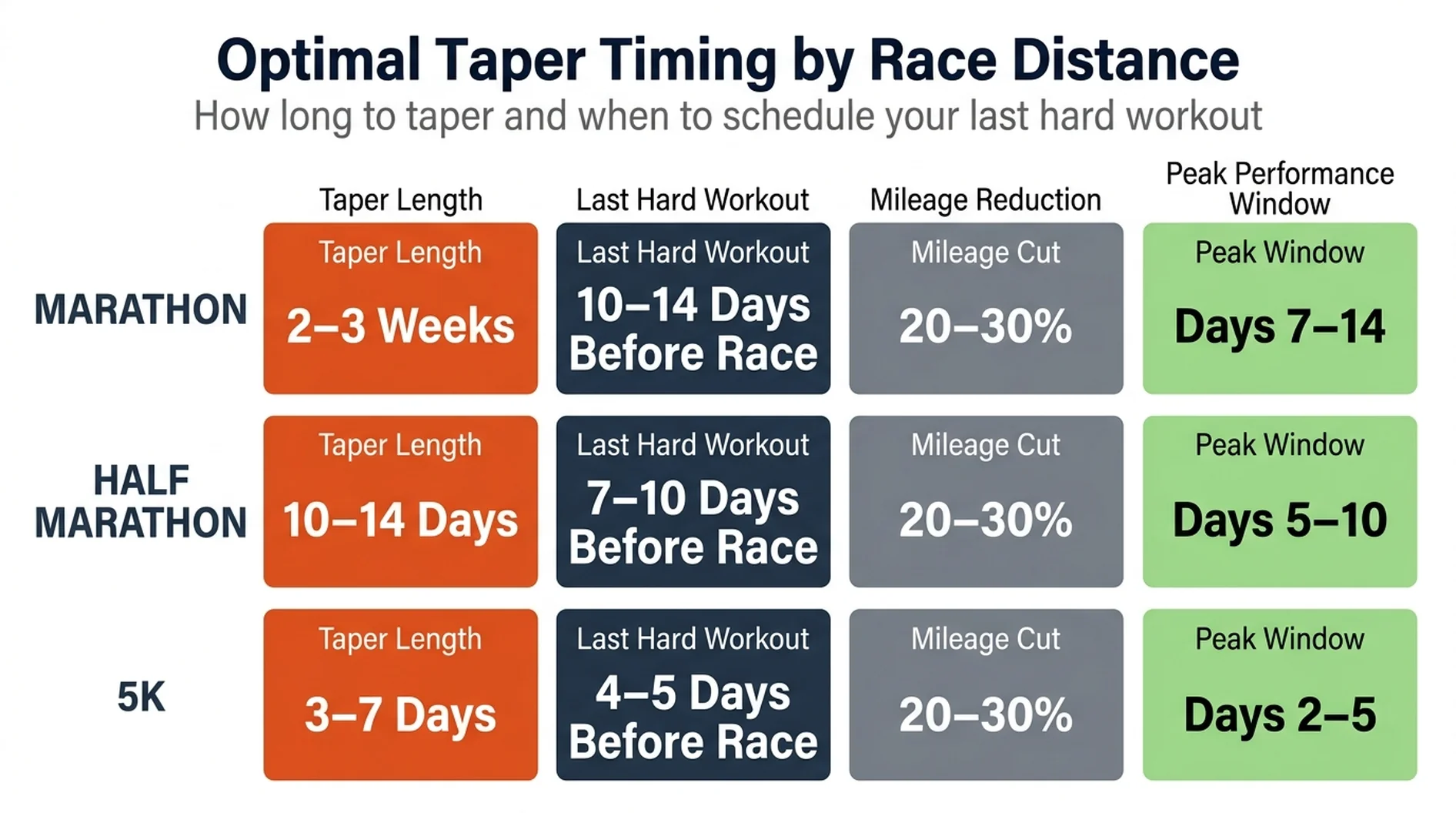
Marathon runners benefit from 2 to 3 week tapers, half-marathoners from 10 to 14 day tapers, and 5K runners from 3 to 7 day tapers.
Your peak performance arrives early in your taper, not late, which is why timing your taper to end a few days before race day is essential.
RunnersConnect Bonus
Download your FREE Marathon Nutrition During Your Taper Guide.
The guide contains a plan of exactly what you should be eating in the 5 days to 3 hours before your race. We give specific food recommendations to make sure you are ready on race day.
The Role of Training Volume and Intensity Distribution
How you structure your training leading up to the taper determines whether you’ll peak on time or weeks early.
Throughout your build phase, your training should follow a polarized intensity distribution, which means doing most of your running at easy pace and a smaller amount at hard pace, with very little in the middle.
Studies show that elite distance runners perform approximately 80 percent of their training at low intensity throughout the entire year.
This distribution matters because high-intensity work triggers the greatest amount of nervous system fatigue and muscle damage.
If you cluster your hardest efforts too close to race day, you won’t have enough time in the taper to recover from that damage before peak performance begins.
Your final high-intensity workout should occur at least 7 to 10 days before race day, giving your nervous system a full recovery window.
During the final two weeks before race day, nearly all of your running should be at easy pace, with only short 30 to 60 second repeats at marathon or race pace to keep your legs sharp.
This means building your fitness progressively during the build phase, not front-loading hard work and hoping the taper will save you.
Runners who spike their training volume or intensity too close to race day often peak before the taper even begins, then spend the entire taper in a slow fitness decline.
By understanding when your highest-stress sessions should occur, you can reverse-engineer your entire training block to peak when it matters most.
Supercompensation and When Your Body Peaks
Supercompensation is the scientific principle that explains why peaking at a specific time is possible.
The theory works like this: training stress damages muscle tissue and depletes your nervous system’s capacity to produce force.
Your body senses this damage and begins adapting in response.
During recovery, your muscles repair themselves and build new protein, while your nervous system restores its fatigue resistance.
But the adaptation overshoots the original damage level, creating a period of above-baseline performance.
This overshoot is supercompensation, and it’s the reason you feel stronger after a day off than you did the day before you rested.
The problem is that supercompensation doesn’t last forever.
If you don’t apply a new training stress during this window, your performance begins to decline as your body adapts to the reduced stimulus.
This is why race-day timing matters: if you taper too early, you’ll hit your supercompensation peak while still 3 to 4 weeks away from the race, then watch it decline during the remaining taper weeks.
Once supercompensation passes, you lose the neural efficiency and strength that were elevated during the peak, and you return to a baseline closer to where you were before the taper.
The best-timed tapers end with race day occurring during or immediately after the supercompensation peak, when your nervous system is maximally efficient and your muscles are fully recovered.
Recognizing Signs You’re Peaking Too Soon
If you notice certain physiological signals during your taper, you may have already peaked or will peak before race day.
The most obvious signal is a spike in energy and motivation around days 7 to 14 of your taper.
You feel like you could run fast right now, your legs feel light, and your enthusiasm for training is highest.
This is supercompensation arriving, and if this feeling shows up more than a week before your race, you’ve tapered too early.
Sleep patterns often change during this phase too.
You may sleep fewer hours but feel more rested, or experience unusually deep sleep and vivid dreams as your nervous system recovers.
Watch for mood elevation or increased motivation that feels out of proportion to what you’d expect.
Another marker is an increase in resting heart rate or heart rate variability if you track it, signaling that your parasympathetic nervous system has shifted out of recovery mode.
The key is timing: if these signs appear with more than 10 days left until race day, your peak has already arrived and will decline before the race.
This is also why monitoring how you feel during the taper matters more than following a fixed taper length.
If you’re feeling flat or fatigued in the final days before the race, it often means the peak has already passed and you’re in the decline phase.
A runner who peaks correctly will feel strong and energized on the 2 to 3 days immediately before race day, not flat.
What Does Garmin’s “Peaking” Training Status Mean?
If you train with a Garmin watch, you may have seen a “Peaking” label appear under your training status.
This status appears when your training load has dropped into the recovery zone and your recent performance estimates have improved.
It’s Garmin’s automated version of detecting the supercompensation window: your body has recovered from accumulated training stress and hit an above-baseline performance state.
The question that matters is how far away your race is when Peaking appears.
The Peaking status typically shows up 7 to 14 days into a reduced training load, which aligns with the early-taper supercompensation window described above.
If Garmin shows Peaking but your race is still 3 to 4 weeks out, your body is ahead of schedule.
That early signal means you tapered too soon and the peak will decline before race day.
When Garmin shows “Peaking” more than 10 days before your race, treat it as a warning that your training load dropped too early, not a green light to rest through the remaining weeks.
The right response is to maintain easy running volume without adding hard sessions, so your body stays stimulated without accumulating new fatigue.
When Peaking appears within 7 days of your race, that’s ideal timing.
Your nervous system has hit its high point exactly when you need it.
If the Peaking status never appears before your race at all, check whether your final hard workouts ended too early or whether your easy running volume was too low to maintain the training stimulus during the taper.
How to Nail Your Taper Timing for Race Day
The key to avoiding an early peak is matching your taper length to your race distance and timing race day to fall during the supercompensation window.
For marathons, plan your taper to begin 2 to 3 weeks before race day.
Your final long run should occur 2 to 3 weeks out, and your last hard workout (tempo run or speed work) should be 10 to 14 days before the race.
This timing allows the first major supercompensation wave to arrive during the final 7 to 14 days before race day, when you’ll need it most.
During those final 2 weeks, reduce your total weekly mileage by 20 to 30 percent compared to your peak build-phase weeks, not 60 to 80 percent.
Many runners cut too much volume, which causes detraining adaptations to begin.
Your goal is to recover from fatigue while maintaining the stimulus your body needs to stay sharp.
For half-marathons, compress your taper into 10 to 14 days.
Your last hard workout should be 7 to 10 days before race day, with final week intensity dropping to easy runs plus short 30 to 60 second repeats at goal race pace.
For 5K races, a 3 to 7 day taper is sufficient because recovery happens faster with shorter distances.
Your last hard effort can be 4 to 5 days out, and the final 3 days should be easy with a short shakeout run 1 or 2 days before the race.
The common thread across all distances is that your final race-pace effort should be 3 to 7 days before race day, giving your nervous system just enough time to recover and peak without declining.
Adjust these ranges based on how you personally respond to taper and recover from hard work.
Some runners need a full 3 weeks for marathons.
Others peak well with just 10 days of reduced load.
Use your training data and how you felt in previous tapers to find your personal optimal window.
The Common Mistake: Trying to Stay Peaked for Multiple Races
Many runners make the opposite error: trying to extend their peak across multiple races or holding it for too long.
Some plan to race a half-marathon 3 weeks before their target marathon, thinking they can stay peaked for both.
This doesn’t work because supercompensation is temporary and each race applies a new stress that resets the peak cycle.
If you race hard 3 weeks before your goal race, you’re essentially starting a new training stimulus that requires days to recover from.
This recovery period overlaps with the taper window for your second race, compressing your supercompensation peak and making it difficult to peak for both events optimally.
The same problem occurs if you try to hold your peak through multiple attempts at the same distance.
Once supercompensation begins its decline, your only option is to apply a new training stress (usually in the form of your actual race effort), restart recovery, and let supercompensation arrive again.
You cannot extend the peak indefinitely by reducing training further.
This is why experienced runners prioritize a single goal race and build their entire training cycle around peaking for that one event.
If you need to run multiple important races, space them at least 4 to 6 weeks apart so that you have a full recovery and rebuild cycle between them.
Trying to peak for two races closer together than that will guarantee suboptimal performance at one or both.
| Race Distance | Taper Length | Last Hard Workout | Volume Reduction |
|---|---|---|---|
| Marathon | 2–3 weeks | 10–14 days before race | 20–30% of peak mileage |
| Half-marathon | 10–14 days | 7–10 days before race | 20–30% of peak mileage |
| 5K | 3–7 days | 4–5 days before race | 20–30% of peak mileage |