
You cross the finish line of your first marathon, catch your breath, and someone mentions Boston.
You look up the qualifying time for your age group, run the math on your pace, and the gap feels enormous.
You search online for how long it actually takes most runners to get there, and you get the same answer every time: “It depends.”
A runner on Reddit decided to do better than that.
After posting in two major running communities and gathering responses from over 150 people, a self-reported data analysis emerged with real numbers: a distribution table, a median timeline, individual improvement histories, and a comparison of runners with and without athletic backgrounds.
The sample has real limitations, which this article addresses directly.
Everyone who responded had either already qualified or was close to qualifying, the data is self-reported and unverified, and only 54 responses had enough detail to analyze.
But the patterns are still worth understanding, and when you combine them with what exercise science tells us about endurance adaptation, a clearer picture of the BQ journey emerges than you’ll find anywhere else.
So, in this article you’re going to learn the research-backed practical advice on how long it takes to qualify for the Boston Marathon.
- Exactly how long most runners take to BQ, with a real distribution table and a median you can actually plan around
- Why prior athletic background is the single variable with the biggest impact on your timeline
- Why your first marathon time predicts less about your journey than you might expect
- The critical survivorship bias problem in this data and what it means for your own odds
- How to use all of this to set a realistic, personalized BQ planning horizon
How Long Does It Actually Take to BQ? What the Data Says
The median time from the start of structured training to a Boston qualifying time is about 3.5 years.
That number comes from a community survey collecting self-reported timelines from runners in r/AdvancedRunning and r/Marathon_Training, with 54 responses containing enough detail to analyze.
The distribution looked like this:
| Time to BQ (from start of structured training) | Runners | Percentage |
|---|---|---|
| Under 1 year | 4 | 7% |
| 1–2 years | 10 | 19% |
| 2–3 years | 13 | 24% |
| 3–5 years | 15 | 28% |
| 5–10 years | 9 | 17% |
| 10+ years | 4 | 7% |
The most common single range was 3–5 years, claimed by 28% of respondents.
The 2–3 year bucket was nearly as large, at 24%.
Combined, roughly half of all respondents in this dataset hit their BQ time within 2–5 years of starting structured marathon training.
The extremes are real on both ends.
4 runners qualified in under a year, and nearly all of them had strong aerobic backgrounds coming in.
4 runners took over a decade, and their paths involved injury, life interruptions, and years of training at low volume before committing fully.
The full range spans from 9 months to 19 years, which tells you something important: individual variation dominates this data.
The median is a useful anchor, but it describes the middle of a very wide distribution.
RunnersConnect Bonus
Racing Boston marathon this year? Download your FREE Boston Marathon Pace Calculator now.
Why Your Athletic Background May Cut Your BQ Timeline in Half
The single clearest pattern in the community data wasn’t training volume, age, or starting fitness level.
It was athletic history.
Among respondents with enough context to categorize, the average time to BQ broke down like this:
- Runners with a prior aerobic background (cycling, soccer, D1 sport, triathlon): average ~2.1 years
- Runners without a prior athletic background: average ~5.8 years
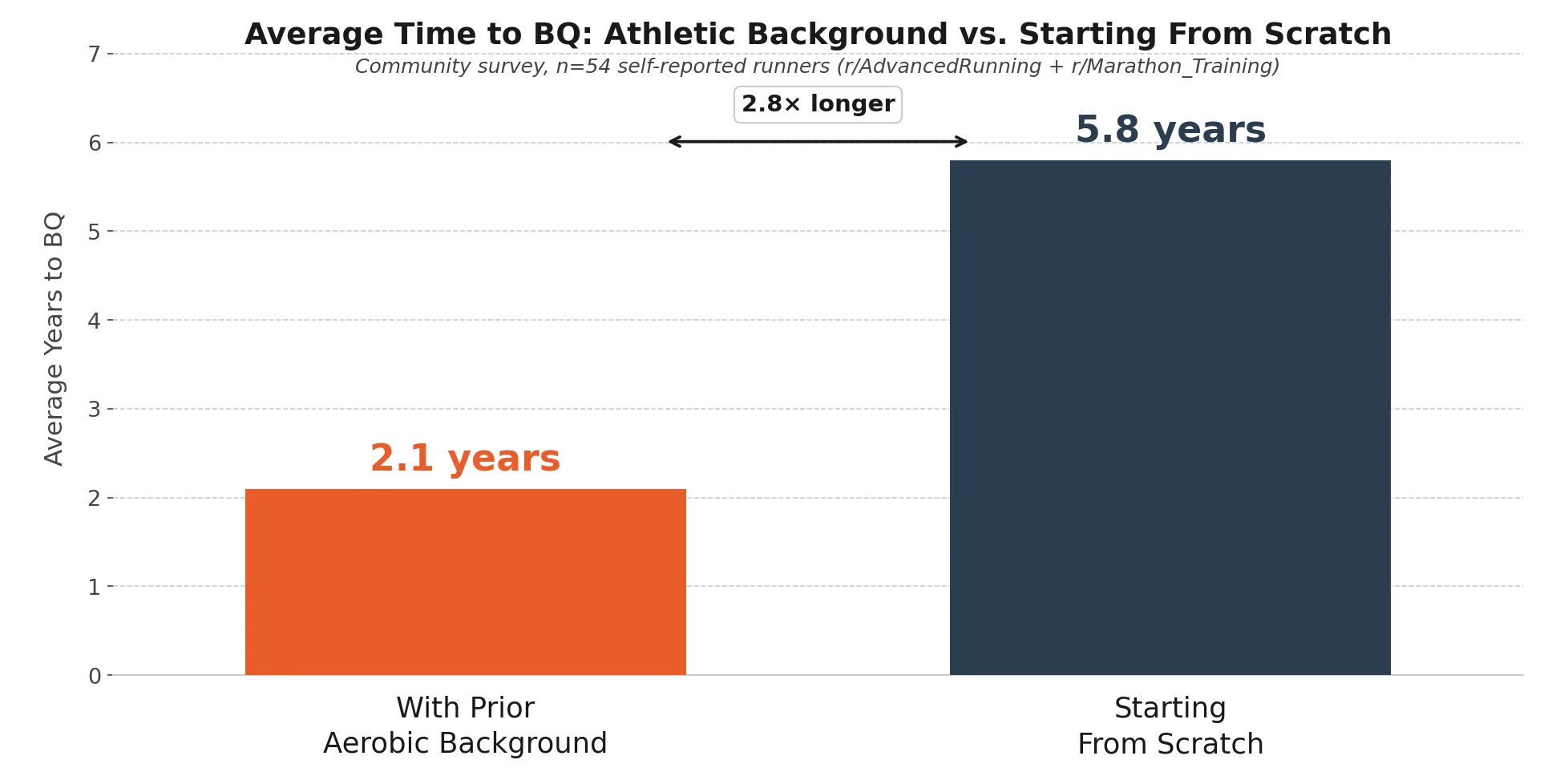
That’s nearly a 3x difference from the same starting line.
Almost every runner who qualified in under a year had meaningful aerobic history, even if they hadn’t run seriously before.
One respondent cycled regularly since 2020 and qualified in his debut marathon.
Another had played a Division I sport and qualified in his second race, despite never having trained specifically for distance running.
A third had run 30–35 miles per week casually for 18 years with no particular goal, then qualified within 2 years of structured training.
The physiology behind this pattern is well established.
Research on master runners found that the two best predictors of long-distance race performance are peak aerobic capacity (VO2peak) and peak weekly training volume sustained over 3 years, together accounting for about 90% of performance variance.

Any aerobic sport builds the underlying engine: cardiac stroke volume, mitochondrial density, and the ability to sustain a high percentage of VO2max for extended periods.
A cyclist, a soccer player, and a swimmer who each transition to running arrive with far more of that engine already built than someone starting from zero.
They don’t have to develop aerobic capacity from scratch.
They just have to redirect it.
If you’ve spent years in any aerobic sport, your BQ clock likely starts with a head start your training log doesn’t reflect.
The definition of “aerobic background” matters here, and the Reddit discussion surfaced some nuance.
Organized team sport in high school, competitive cycling, years of recreational running at consistent volume, or sustained triathlon training all appear to compress the timeline.
Casual activity, including walks, occasional hikes, or light gym work, doesn’t carry the same weight, because it doesn’t develop the same sustained cardiovascular load.
Does Your First Marathon Time Predict How Long Your BQ Journey Will Take?
Most runners assume their debut marathon time is a signal: run a 3:50 first and you’ll get there faster than someone who ran a 4:30.
The data doesn’t cleanly support that assumption.
Among the 12 respondents with enough detail to track from first marathon to BQ, the improvement amounts were large and the timelines were unpredictable:
| First Marathon | BQ Time | Improvement | Years Taken |
|---|---|---|---|
| 5:11 | 3:38 | 93 min | ~7 years |
| ~3:58 | 2:40 | ~78 min | 2 years |
| 4:09 | 3:06 | 63 min | ~4 years |
| 3:53 | 2:59 | 54 min | ~4 years |
| 3:40 | 2:58 | 42 min | ~2 years |
| 3:22 | 2:53 | 29 min | ~3 years |
| 3:24 | 2:56 | 28 min | ~10 years |
| 3:43 | ~3:06 | ~37 min | 9 months |
Two runners started within minutes of each other (3:22 and 3:24) and their timelines were 3 years and 10 years respectively.
One runner improved 78 minutes in 2 years from a 3:58 debut.
Another improved just 29 minutes from a 3:22 debut over 3 years.
Starting slower didn’t always mean a longer journey, and starting faster didn’t guarantee a shorter one.
The reason comes down to what the marathon actually rewards over the long term.
A 2022 study in Current Research in Physiology found that while VO2max predicts marathon performance in runners at mixed fitness levels, in trained runners it’s blood lactate response, your lactate threshold, that becomes the primary performance predictor.
Lactate threshold is highly trainable, and it responds to years of consistent aerobic mileage more than to any single starting point.
A runner who debuted at 4:30 but trains consistently for 4 years can develop a lactate threshold well above a runner who debuted at 3:45 but trained inconsistently.
The debut marathon is essentially a snapshot of where your fitness is on one day.
Your marathon fitness trajectory is determined by what happens in the training blocks after that day.
Where you start matters far less than how consistently you train in the years that follow your first race.
Why This Data Is More Optimistic Than Your Actual Odds
Every single person who responded to the original Reddit threads had either qualified for Boston or was actively close to doing so.
The runners who trained for 8 years, never got there, and quietly stopped trying did not post their story.
Runners who attempted a BQ goal and concluded after years of effort that it wasn’t reachable for them were not represented in the 54-person sample.
This is textbook survivorship bias: when you only hear from people who succeeded (or nearly succeeded), the picture looks more achievable than it actually is.
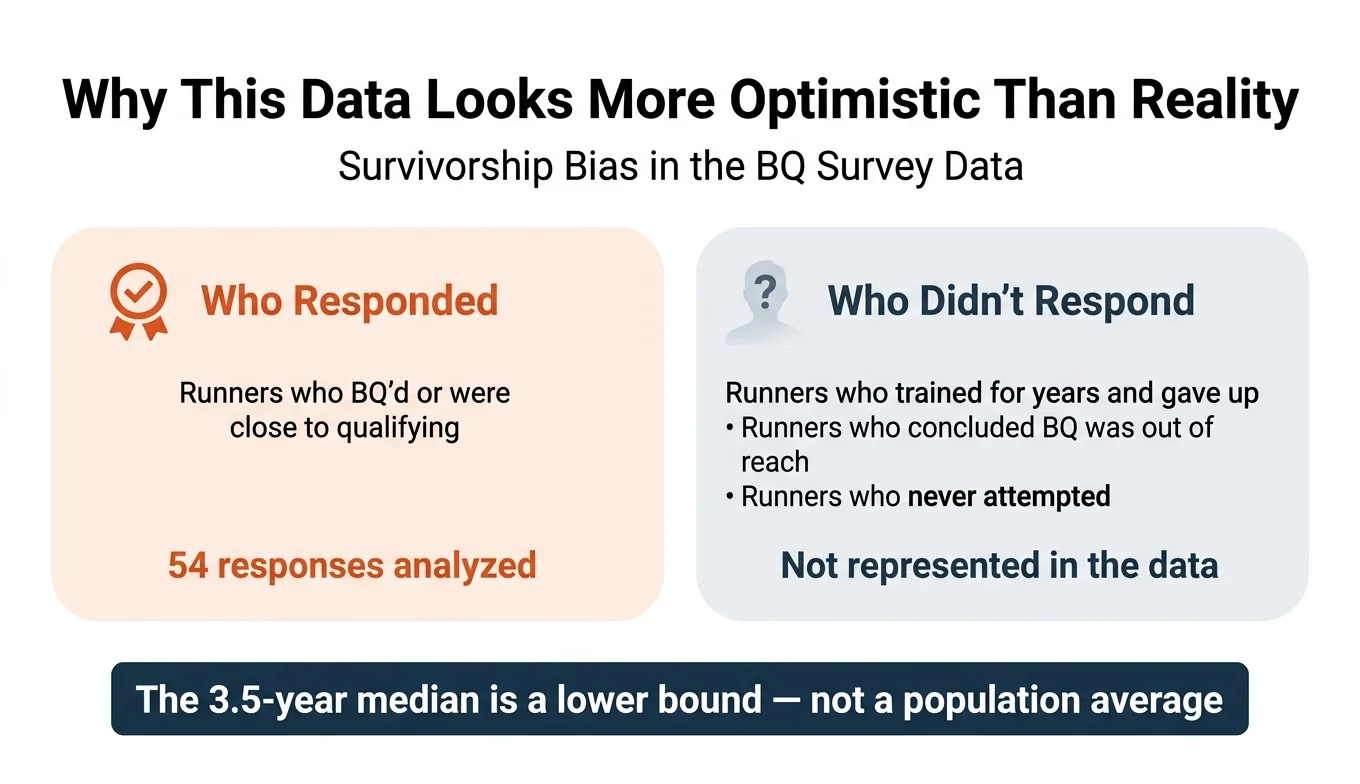
The gap between what this data suggests and what the full population of BQ-aspiring runners would show is almost certainly large.
Fewer than 20% of U.S. marathon finishers run fast enough to meet the published qualifying standard in any given year, and with the registration cutoff adding a further buffer requirement of several minutes, the share who actually qualify and register is smaller still.
Several Reddit commenters flagged this directly.
One noted that the standards have dropped roughly 10 minutes for most age groups since 2017, meaning runners who qualified a decade ago on times that now fall short would extend the failure-to-qualify population further.
Another pointed out that many experienced runners don’t even attempt a BQ because they view it as genuinely out of reach, meaning the data also misses a group who never enter the sample at all.
The 3.5-year median is best understood as a lower bound for the average aspiring BQ runner, not a population average.
None of this makes the goal unworthy of pursuit.
It does mean that if you’re planning a multi-year BQ campaign, your planning horizon should account for a longer arc than the Reddit sample alone suggests.
How to Set a Realistic BQ Timeline Based on Where You’re Starting
The community data and the exercise science point toward the same practical framework.
Your starting point falls into one of two profiles, and each comes with a different realistic planning horizon.
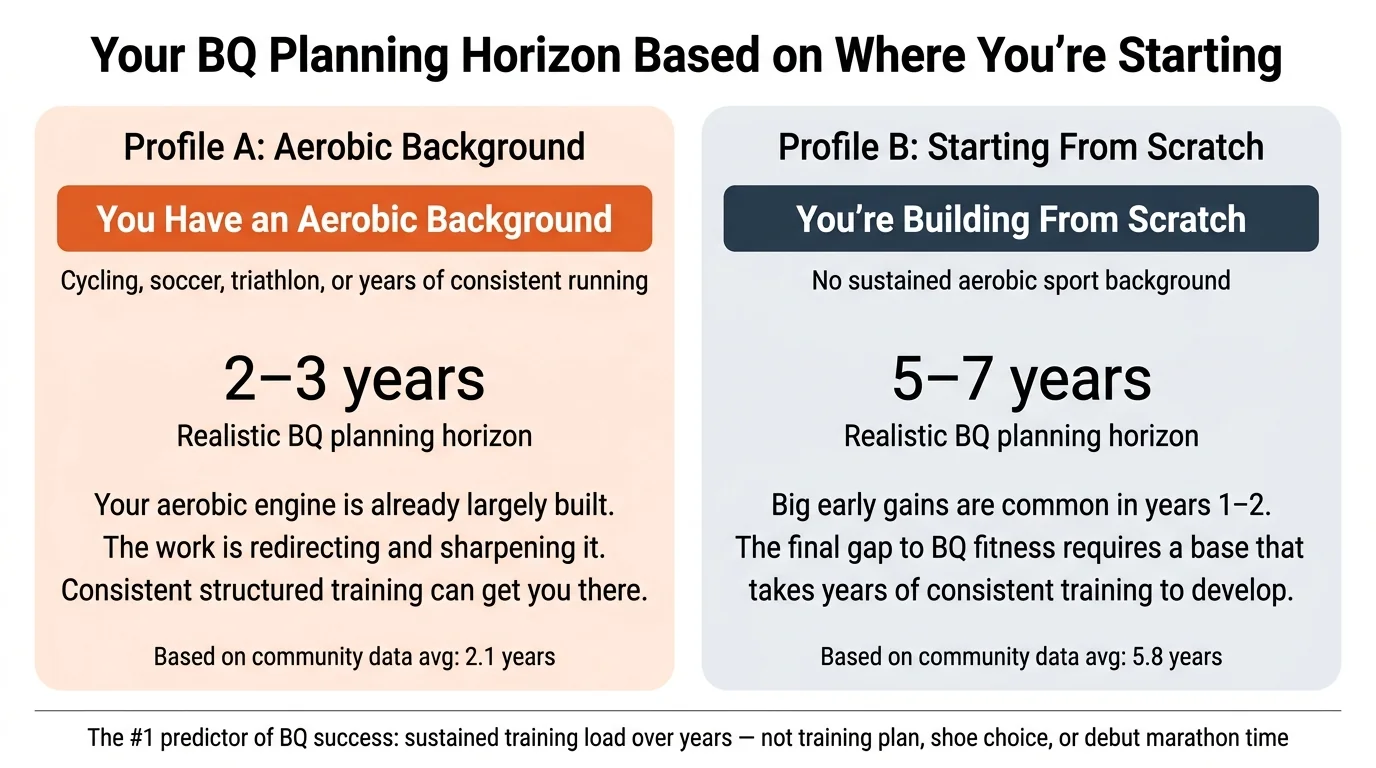
You have a meaningful aerobic background.
You’ve spent years in endurance sport: competitive cycling, soccer, swimming, triathlon, or consistent distance running, even if untargeted.
Based on the community data, a 2–3 year timeline to BQ with structured, progressive training is genuinely achievable.
The physiological infrastructure is largely already built.
The training work is redirecting and sharpening it.
You’re building from scratch.
You’re coming to endurance running as a true beginner, or from a background where sustained aerobic load wasn’t part of your life.
A 5–7 year planning horizon is more honest and more useful than a 2–3 year target.
That doesn’t mean progress will be slow throughout.
Many runners in this group improve dramatically in years 1 and 2, but the final gap to BQ fitness tends to require a training base that takes years to develop.
In both cases, the variable that predicts success most reliably is not training plan design, not shoe choice, and not any single race result.
According to a review in Frontiers in Physiology, the ability to sustain a high training stimulus over time is the single most important factor in limiting performance decline, and in driving long-term improvement.
Sustained load builds the lactate threshold adaptations that determine marathon pace.
It builds the mitochondrial density and cardiovascular efficiency that make faster paces feel manageable.
It accumulates the training history that, as the master runners research showed, explains 90% of performance variance alongside aerobic capacity.
The runners in the Reddit data who took the longest to BQ tended to have low training volume, frequent injuries, or years of inconsistent effort before committing to a structured approach.
The runners who got there fastest had high consistency, a strong aerobic base, and a clear training direction from early on.
When you’re ready to map that direction to a specific goal pace, a Boston Marathon qualifying pace calculator can show you exactly what finishing time you need for your age and gender, and how far your current fitness sits from that target.
Qualifying for Boston is achievable for many committed runners, but it requires building the training base for it and a timeline that honestly accounts for how long that work takes.
RunnersConnect Bonus
Racing Boston marathon this year? Download your FREE Boston Marathon Pace Calculator now.
A community data analysis of 54 self-reported BQ timelines found a median of about 3.5 years from the start of structured training to a Boston qualifying time.
The most common single range was 3–5 years, with about half of all respondents qualifying between years 2 and 5.
Athletic background was the strongest variable in the dataset: runners with a prior aerobic sport history averaged 2.1 years to BQ, while runners without one averaged 5.8 years.
First marathon time was a weaker predictor than most runners expect, with improvement amounts and timelines showing little consistent pattern by starting point.
Survivorship bias is a critical limitation: every person in the dataset had either qualified or was close, making these numbers more optimistic than a full population of BQ-aspiring runners would produce.
The physiological research aligns with the community data: lactate threshold is the primary driver of marathon performance, and it responds most reliably to sustained, consistent training load over years.
Runners with aerobic background should plan 2–3 years for a realistic BQ timeline.
Runners starting from scratch should plan 5–7 years.