
You just finished a 10-mile run, and you’re famished. You empty out the kitchen, eating whatever’s in sight.
Yet during the run itself, you barely noticed hunger.
This is the post-run appetite paradox, and it confuses runners constantly.
You burned 1,000+ calories, your body’s energy tank is depleted, and the hunger feels urgent and justified.
Part of you wonders whether this is real hunger or your body overcompensating for the calories you burned.
And you’re not sure whether eating everything you’re craving will undo the work you just put in.
The answer is more nuanced than “always eat” or “resist at all costs.”
Running triggers a cascade of hormonal, metabolic, and hydration signals that all point toward eating, and understanding which signals are firing (and when) is the key to managing post-run appetite without guesswork.
So, in this article you’re going to learn the research-backed practical advice on:
- The three distinct mechanisms driving post-run hunger
- Why appetite suppression during running doesn’t stop the rebound hunger afterward
- How glycogen depletion creates a separate appetite signal independent of hormones
- The dehydration-hunger connection runners often miss
- A practical protein-and-carb framework to satisfy hunger without overdoing calories
Why Does Running Suppress Your Appetite During Exercise?
High-intensity running shifts your body’s hormonal environment in a way that shuts down hunger signals.
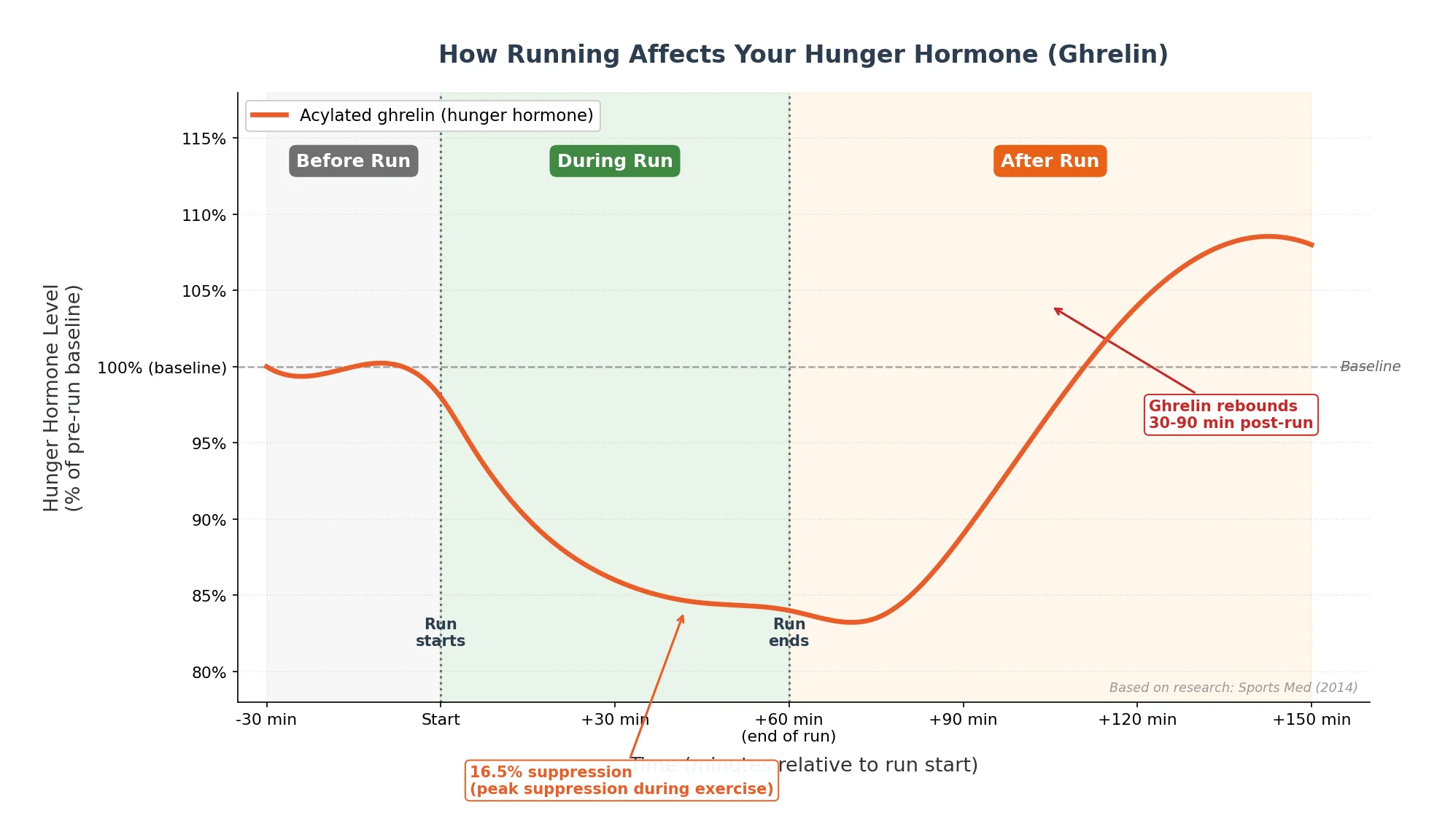
The moment you start running at moderate to hard effort, plasma concentrations of acylated ghrelin, the hormone that tells your brain to eat, begin to drop.
Simultaneously, your body releases peptide YY (PYY) and glucagon-like peptide-1 (GLP-1), both appetite-suppressing hormones that shift your brain’s focus from eating to running.
Research has shown that acute exercise suppresses acylated ghrelin by a median of 16.5 percent while simultaneously increasing PYY and GLP-1.

This hormonal shift is proportional to exercise intensity. The harder you run, the more pronounced the ghrelin suppression and appetite-suppressing hormone elevation.
This is why runners often finish a hard effort and feel no immediate hunger, even though they’ve depleted glycogen stores and burned massive calories.
The hormonal environment actively works against appetite, creating a brief window of hunger suppression that can last anywhere from 30 to 90 minutes post-run, depending on how hard and how long you ran.
Your body’s appetite suppression during and immediately after running is real, but it’s temporary.
Why Does Hunger Hit So Hard After You Stop Running?
The appetite suppression that served you during your run doesn’t last.
As your body temperature normalizes, blood flow shifts back to the gut, and your nervous system transitions from “fight or flight” to “rest and digest,” acylated ghrelin levels rebound, sometimes to higher levels than before the run.
A study tracking 90 minutes of treadmill running found that acylated ghrelin remained suppressed throughout the exercise and the immediate 30-minute recovery window, but by 60 to 90 minutes post-run, ghrelin began rising back toward baseline and sometimes beyond.
This rebound is your body’s attempt to restore energy balance.
You’ve created a large caloric deficit, perhaps 800 to 1,500 calories depending on pace and duration, and your metabolic system detects this gap and initiates hormonal signals to eat.
The rebound hunger is not weakness or lack of willpower.
It’s a predictable physiological response to acute energy depletion, mediated by the exact same hormonal systems that keep energy balance stable in non-exercising life.
Ghrelin rebound typically occurs 30 to 90 minutes post-run, making that post-run window a critical period for strategic fueling.
RunnersConnect Bonus
Download your Calorie Calculator for Runners. This calculator will tell you the exact amount of calories you burn each day so you can better target your nutrition needs.
How Does Glycogen Depletion Drive Hunger Independently?
Hormone-driven hunger explains part of the post-run appetite surge, but it doesn’t explain the full story, especially on long runs.
Your muscles and liver store glucose as glycogen, and during running, you burn through these stores at a predictable rate based on intensity and duration.
Once glycogen is depleted, your body sends out an independent hunger signal that’s separate from ghrelin rebound.
Depleted glycogen stores directly trigger changes in blood glucose dynamics and brain fuel availability, and your brain interprets this metabolic state as “need food now” even if ghrelin levels are stable.
Research has shown that after glycogen-depleting exercise, meal initiation occurred within 76 minutes on average, driven by metabolic fuel sensing rather than hormone levels alone.
This is why a 5-mile moderate-paced run might leave you hungry but manageable, while a 15-mile long run leaves you absolutely ravenous.
The longer the run, the greater the glycogen depletion, and the stronger this metabolic hunger signal becomes.
Glycogen-depletion hunger is also more persistent than ghrelin-rebound hunger because it’s tied to an actual metabolic deficit in fuel availability, not just a hormonal signal.
Glycogen depletion creates a distinct hunger mechanism independent of ghrelin, explaining why long runs trigger more intense hunger than the hormone rebound alone would predict.
Why Does Dehydration Feel Like Hunger?
Runners often finish a run 5 to 10 percent dehydrated, and this fluid loss has a direct effect on appetite signaling.
The brain’s hunger and thirst centers are interconnected, and when your body detects dehydration, the signal to your brain sometimes manifests as hunger rather than thirst.
This happens because acylated ghrelin levels increase with dehydration, and your blood becomes more concentrated, which disrupts the normal glucose regulation your brain relies on.
The result is a convincing hunger signal that food might help, when what your body actually needs is water.
Research has shown that thirst and hunger regulation pathways overlap in the hypothalamus, meaning dehydration can trigger appetite signals even when food intake is not the primary need.
This is why some runners find that drinking water immediately after running reduces the intensity of their hunger, even though water has no calories.
The dehydration signal clarifies once you rehydrate, and the urgency of the appetite drops accordingly.
Dehydration masquerades as hunger because the brain’s thirst and appetite centers share signaling pathways, making water the first intervention post-run.
Does Your Body Always “Eat Back” the Calories You Burn?
Post-run hunger feels justified because you’ve burned significant calories, and your body is signaling that it needs fuel.
Many runners wonder whether their body demands they eat back all or most of the calories they burned.
The research answer is mixed, and it depends on several factors.
Your body does attempt to restore energy balance over time, but the degree to which it succeeds varies widely between individuals.
Research has shown that energy compensation after exercise ranges from 28 to 63 percent depending on exercise volume and individual characteristics, meaning your body may only partially offset the caloric burn through increased appetite.
Some of this incomplete compensation comes from the fact that your body reduces energy expenditure elsewhere: moving around less, fidgeting less, and sitting still more to offset the calories burned during the run.
Lean and athletic runners tend to compensate more through increased appetite, while overweight individuals compensate less.
This means the post-run hunger you feel is real and reflects your body’s attempt to restore balance, but it doesn’t automatically mean you need to eat every calorie back when you understand your true calorie balance for running.
Post-run hunger is a real physiological signal, but it’s not a blank check to eat back every calorie you burned.
How Can You Manage Post-Run Hunger Without Overdoing It?
Managing post-run hunger isn’t about fighting the signal or pretending it doesn’t exist.
It’s about understanding which hunger drivers are active and responding strategically to all three.
The most effective approach addresses dehydration, glycogen depletion, and hormonal rebound simultaneously, which creates a recovery outcome that satisfies hunger while supporting adaptation.
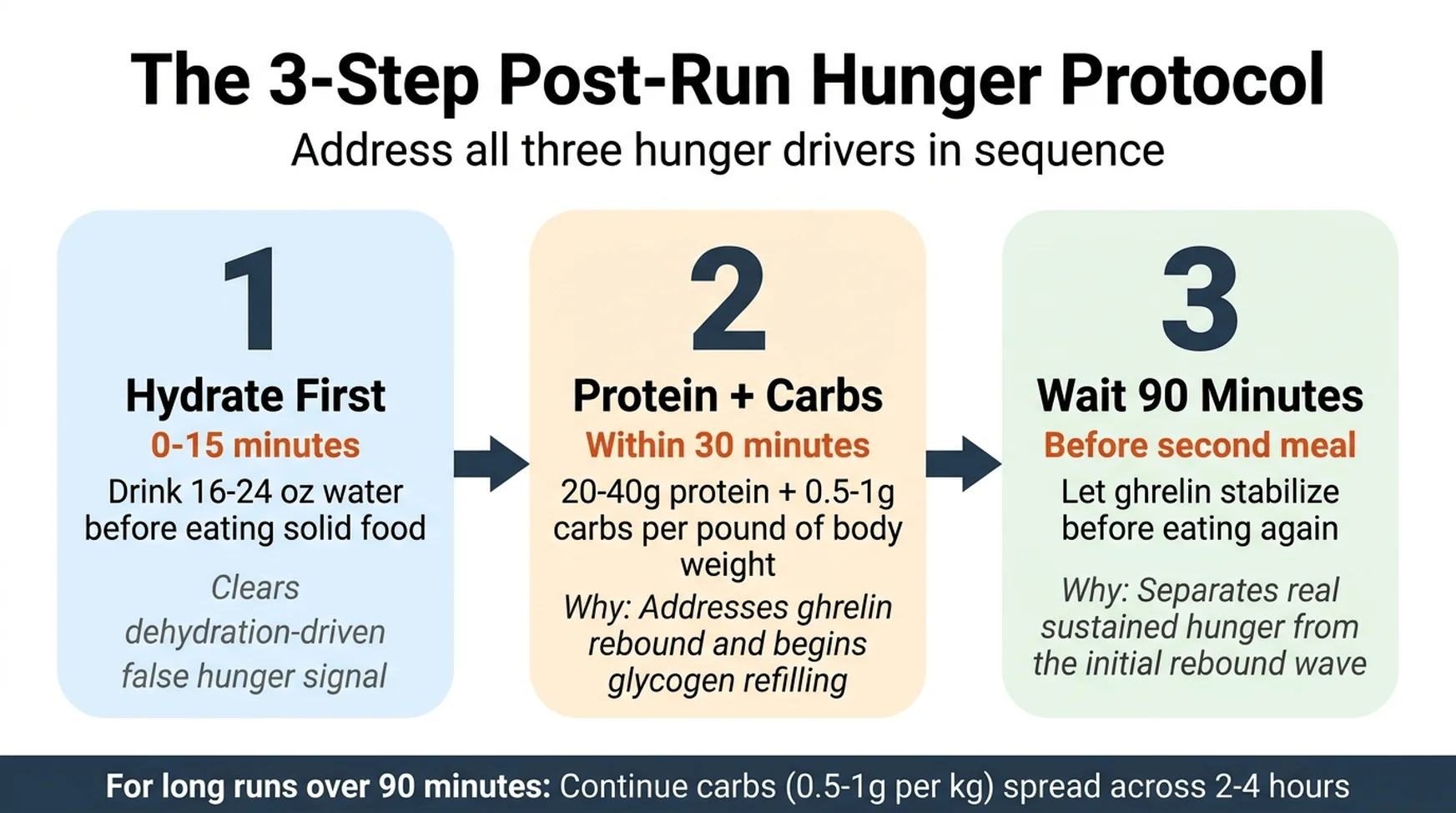
Step 1: Hydrate First, Before Eating
Drink 16 to 24 ounces of fluid (water or electrolyte drink) within the first 30 minutes post-run, before eating solid food.
This clarifies the dehydration-driven appetite signal and allows you to assess whether the remaining hunger is actual fuel need or residual appetite noise.
Most runners find that rehydrating alone reduces the intensity of post-run hunger by 20 to 30 percent, making it easier to fuel strategically rather than emotionally.
Step 2: Eat Protein and Carbs in a 3:1 to 4:1 Ratio Within 30 Minutes
Once you’ve hydrated, consume a snack or small meal combining carbohydrates and protein within the 30-minute post-run window when your muscles are primed to accept and store glucose and amino acids.
Aim for 0.5 to 1 gram of carbohydrate per pound of body weight, combined with 15 to 25 grams of protein.
Research has shown that a 20 to 40 gram protein dose ingested in the post-exercise window stimulates strong muscle protein synthesis and prolongs satiety for 2 to 4 hours.
Protein is especially important because it has a high satiety effect, meaning it suppresses ghrelin more effectively than carbohydrates alone and keeps you satisfied longer.
Examples: chocolate milk (carbs + protein), Greek yogurt with granola and berries, a turkey sandwich, or a recovery shake with fruit and whey protein.
Step 3: Wait 90 Minutes Before a Second Meal
After your 30-minute recovery snack, resist the urge to eat again for at least 90 minutes.
This allows ghrelin levels to stabilize and the glycogen-depletion signal to be partially addressed by the carbohydrate you’ve consumed.
If you’re still hungry after 90 minutes, eat a second meal or substantial snack.
But the gap ensures you’re responding to sustained hunger, not just the ghrelin rebound wave.
Step 4: Continue Carbohydrate Intake Over 2 to 4 Hours
For runs longer than 90 minutes, muscle glycogen recovery is incomplete immediately post-run.
Consume an additional 0.5 to 1 gram of carbohydrate per kilogram of body weight over the next 2 to 4 hours, roughly matching how many calories you burned, spaced in multiple feedings if possible.
This addresses the glycogen-depletion hunger signal systematically rather than trying to satisfy it all at once in a single large meal.
A structured three-step approach satisfies all three hunger drivers without requiring willpower or guesswork: hydrate first, eat protein and carbs within 30 minutes, then wait 90 minutes before eating again.
Summary: Factors Driving Post-Run Hunger
| Hunger Driver | Timeline | Intensity (Relative) | Management Strategy |
|---|---|---|---|
| Acylated ghrelin rebound | 30–90 min post-run | Moderate | Protein-carb snack in 30-min window |
| Glycogen depletion signal | 60+ min post-run (longer on long runs) | High on runs 90+ min | 1.0–1.2 g carbs/kg over 2–4 hours |
| Dehydration-driven appetite | Immediate post-run | Varies by sweat rate | 16–24 oz fluid before eating solid food |
| Energy compensation signal | Ongoing (hours and days) | Low–moderate | Awareness without restriction; don’t fight normal appetite |
RunnersConnect Bonus
Download our FREE recovery foods guide, with the top 10 foods for each of the essential recovery vitamins, minerals and macro nutrients. Plus a sample 1-day meal plan!
The Bottom Line
Post-run hunger is not a flaw in your training or a sign of weakness.
It’s a predictable physiological response to three distinct metabolic and hormonal signals: ghrelin rebound, glycogen depletion, and dehydration masquerading as appetite.
Understanding which signal is driving your hunger at any given moment, and responding to it strategically, transforms post-run eating from an emotional minefield into a clear recovery protocol.
Hydrate first, eat protein and carbs within 30 minutes, then assess hunger from a clear metabolic baseline.
Your post-run appetite is your body’s way of saying it needs fuel and recovery support.
Listen to it, fuel it strategically, and the hunger will resolve naturally as your body’s systems return to balance.