

You’re three miles into your race.
Your legs feel strong. Your breathing is steady.
Then it hits: a wave of nausea that makes you slow down and wonder if you’re going to be sick right there on the course.
Running nausea is far more common than you think, especially during longer efforts or races.
There’s real science behind why it happens, and once you understand the mechanism, you can prevent it.
So, in this article you’re going to learn the research-backed practical advice on:
- What causes nausea during running and how blood flow redistribution triggers it
- The major factors that make nausea worse and how to control each one
- Specific hydration, nutrition, and pacing strategies that prevent nausea on race day
- Why runners throw up during hard efforts and how to prevent it
- What causes nausea after you stop running and how to settle it quickly
Why Does Running Make You Feel Nauseated?
When you run, your body does something dramatic: it redirects blood away from your digestive system to your working muscles.
Research has shown that during intense running, blood flow to the gut can drop dramatically as the body redirects circulation to working muscles, a process called splanchnic hypoperfusion.

This is a built-in feature of your physiology.
When you’re running, your muscles demand oxygen and fuel, so your body smartly prioritizes. The problem is that your gut still needs blood flow to digest food, maintain the integrity of your intestinal wall, and keep nausea at bay.
When blood flow drops dramatically, your intestinal lining becomes more permeable and more sensitive to movement and stress.
Add in the bouncing motion of running, the jostling of your stomach contents, and a core body temperature that’s rising with effort, and you’ve created the perfect storm for nausea.
Your gut isn’t getting the resources it needs to function smoothly. The stress hormones your body releases during hard exercise, especially epinephrine, further disrupt normal digestive motility.
Ready For More?
Then start our FREE Race Day Fueling email course!
You’ll learn how to calculate when you’ll bonk, how to hydrate, what foods to eat during your race, and more! From case studies to scientific research, we’ll help you learn how to best fuel for your next race.
What Triggers Nausea During Running?
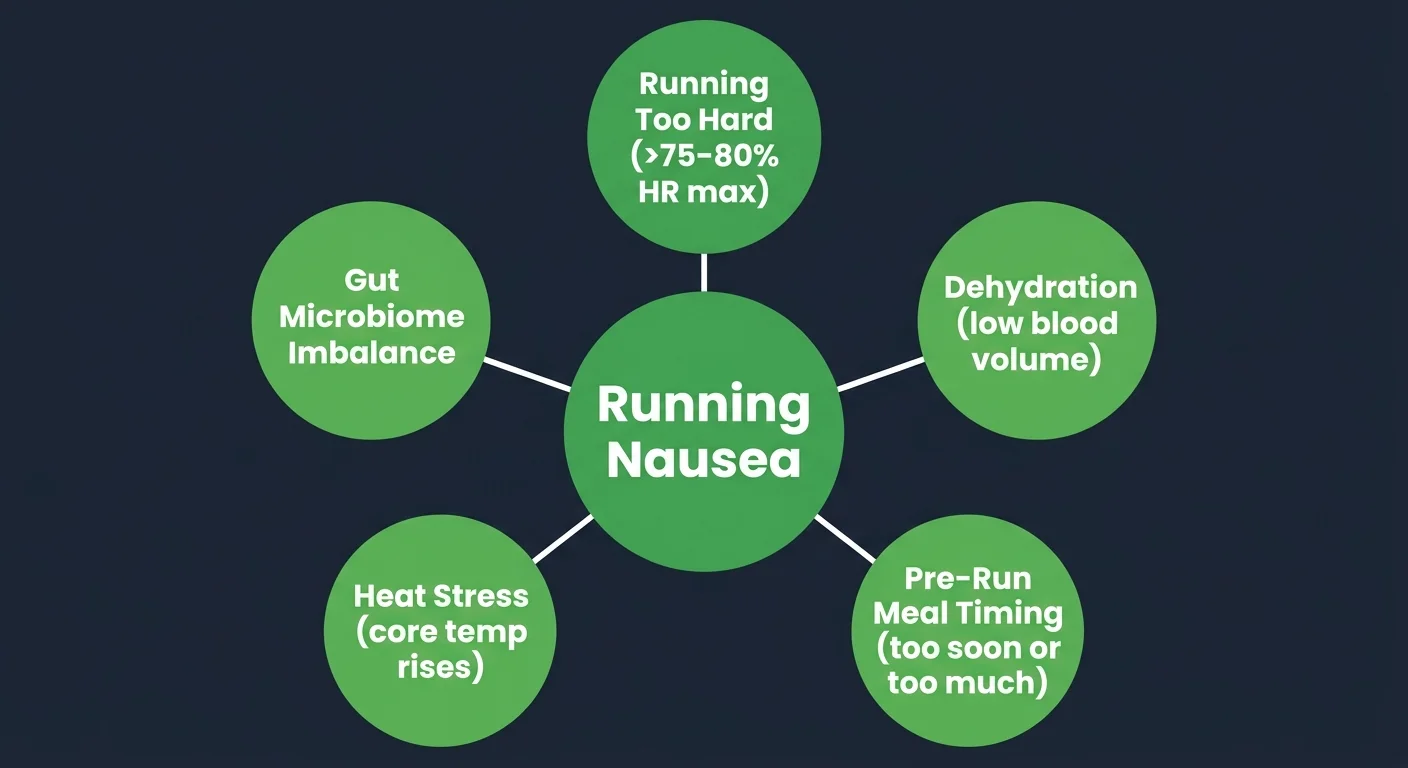
Blood flow redistribution is the underlying mechanism, but several specific factors determine whether you’ll actually feel nauseous on a given run.
Does Running Too Hard Cause Nausea?
The harder you run, the more blood your working muscles demand, and the more your gut suffers.
Nausea typically becomes a risk when you exceed about 75–80% of your maximum heart rate for sustained periods.
Your body has a circulatory budget, and hard efforts exhaust it faster than steady-state running does.
Threshold work, tempo runs, and race-pace efforts all trigger more aggressive blood flow shifts than your long, slow distances.
This is why you might feel fine on an easy 10-mile run but nauseated after a hard 5K effort.
Does Dehydration Make You More Likely to Feel Sick During a Run?
When you’re losing fluid through sweat, blood volume drops and your cardiovascular system has to work harder to maintain oxygen delivery to both muscles and vital organs.
This creates a vicious cycle: less blood available, more aggressive redistribution, worse gut distress.
Dehydration also increases the osmolality of your blood.
Osmolality is the concentration of electrolytes relative to water, and when it rises too high, your brain receives direct nausea signals.
Even mild dehydration (2% body weight loss) noticeably worsens GI symptoms during exercise.
Does What You Eat Before Running Trigger Nausea?
Your stomach can only hold so much and digest so fast, especially during exercise when blood flow to your digestive system is already compromised.
Running with a very full stomach means your stomach is working hard to digest food while also being jostled by the impact of running.
Running with nothing in your stomach, on the other hand, means low blood glucose and low fuel availability, which also triggers nausea and cramping in many runners.
There’s a narrow window of optimal timing: enough fuel to stabilize blood sugar, but nothing so large or difficult to digest that your stomach is overloaded.
Why Does Running in the Heat Make Nausea Worse?
Your core body temperature rises with exercise intensity, and this heat stress is an independent trigger for nausea.
Hot days amplify the problem because your body is also working hard to cool itself through sweating, which diverts more blood to the skin.
This triple demand (muscles need blood, gut needs blood, skin needs blood for cooling) can overwhelm your circulatory capacity.
Studies show that core temperature above 39°C (about 102°F) significantly increases the risk of nausea during endurance exercise.
Can Drinking Too Much Water Cause Nausea While Running?
Drinking too much fluid, especially hypotonic fluids (water or very dilute sports drinks), can actually make nausea worse.
Excess fluid in your stomach creates gastric distension, which is uncomfortable and triggering in itself.
Overhydration can also dilute your blood sodium, a condition called exercise-associated hyponatremia, which directly causes nausea and confusion.
More isn’t always better when it comes to hydration during running.
Does Dehydration Make Running Nausea Worse?
Yes, significantly. But it’s not just about total fluid loss.
The composition of what you’re drinking matters as much as the volume.
A sports drink with the right osmolality (typically 200–300 mOsm/kg) actually helps your stomach absorb fluid faster and reduces nausea compared to plain water or highly concentrated drinks.
The presence of sodium in your drink helps your body retain fluid, maintain blood volume, and preserve the electrolyte balance that keeps nausea signals quiet.
Individual sweat rates vary dramatically, from about 0.5 liters per hour in smaller athletes to 2+ liters per hour in larger athletes or in very hot conditions.
The goal during running is to drink enough to replace about 50–75% of your sweat loss, which for most runners means 400–800 ml (roughly 14–27 oz) per hour, depending on your size, pace, and conditions.
During a race, drink on a schedule (every 15–20 minutes) rather than drinking only when you feel thirsty, because thirst lags behind your actual fluid needs.
Testing your hydration strategy in training is non-negotiable if you’re prone to nausea.
What works for your training buddy might not work for you because of differences in sweat rate, stomach capacity, and sensitivity to fluid movement.
How Does Pre-Run Nutrition Affect Nausea?
What you eat before running directly impacts whether your stomach will cooperate during the effort.
Carbohydrates digest fastest, about 1–2 hours for a small meal, while fat and protein take 2–3 hours or more.
Fiber, despite its health benefits, slows digestion and sits in your stomach longer, which increases nausea risk during running.
The classic pre-run meal recommendation, a small carbohydrate-based meal with minimal fat and fiber, exists for this reason.
For runs starting within 1–2 hours of eating, aim for a small snack of 100–200 calories of easy carbs (banana, toast, rice cake) rather than a full meal.
For runs starting 2–3 hours after eating, a regular breakfast or lunch of carbs + modest protein works well.
High-fat pre-run meals (like eggs, nuts, or fried foods) stay in your stomach longer and are more likely to cause nausea during running because they delay gastric emptying.
Your individual tolerance matters enormously. Testing different pre-run meals in training (not on race day) is essential.
Keep a simple log: what you ate, when you ate it, and whether nausea happened.
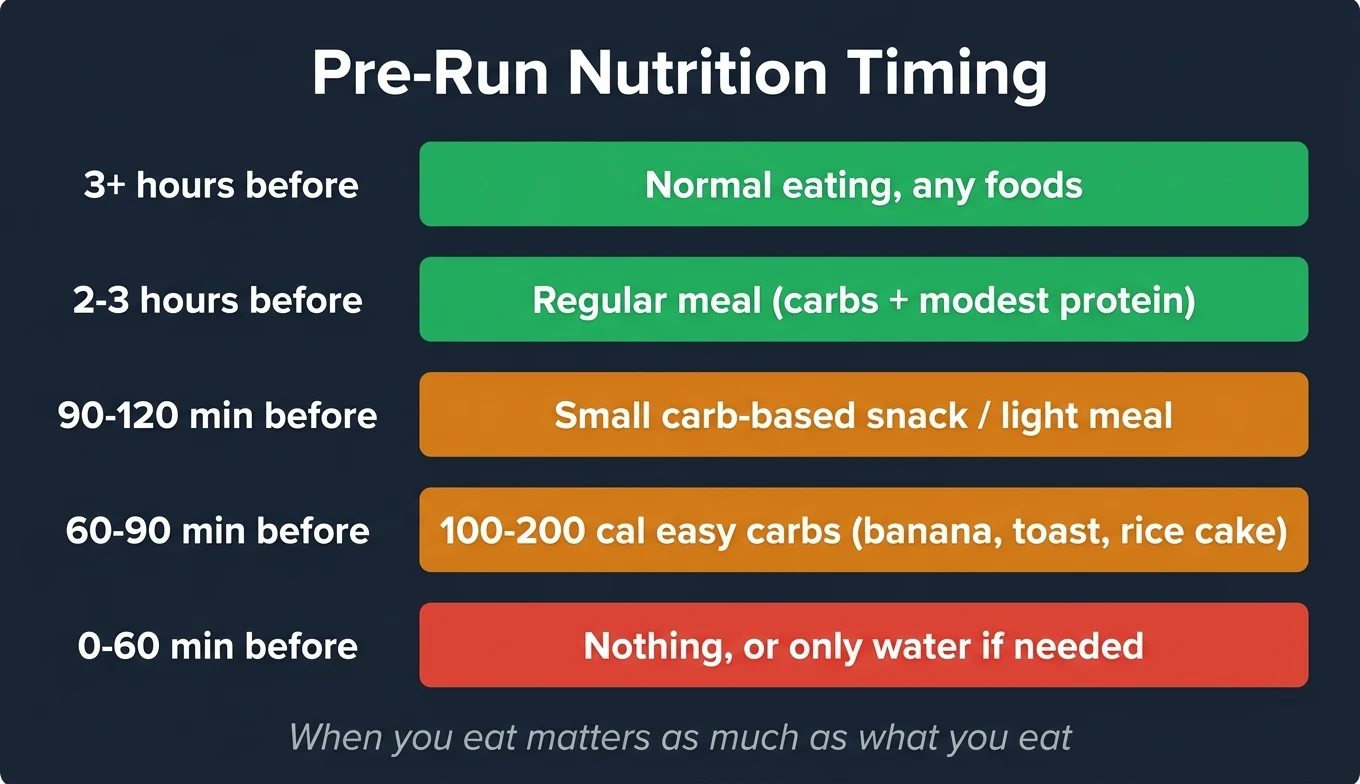
Over several weeks, a pattern will emerge that shows your personal window for eating and running comfortably.
How to Stop Nausea While Running: Solutions That Work
Understanding the causes of nausea is half the battle. The other half is applying specific strategies to prevent it during training and racing.
How Does Slowing Down Reduce Nausea During a Race?
The most powerful nausea prevention tool is pacing.
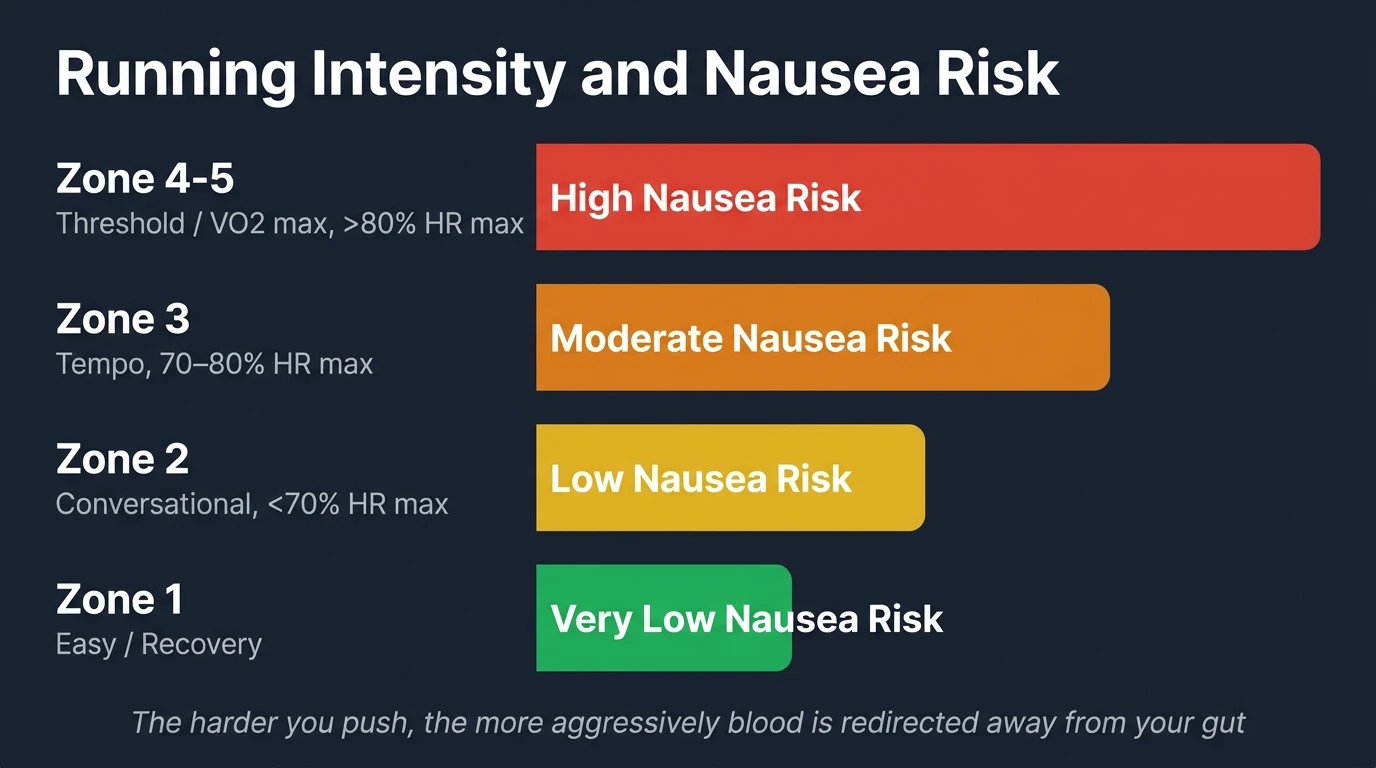
Running hard drives aggressive blood flow redistribution, and most runners simply won’t experience nausea if they stay in zone 2 (easy, conversational effort).
For longer races, holding an intensity where you can still speak in short sentences keeps your circulatory demand manageable and your gut blood flow acceptable.
If nausea starts during a race, the immediate fix is to slow down.
Drop back to an easy jog and give your digestive system 5–10 minutes to recover as blood flow restores and core temperature stabilizes.
What Should You Drink to Prevent Nausea While Running?
Drink a sports drink containing 6–8% carbohydrate and 20–30 mEq/L of sodium during efforts lasting more than 60 minutes.
This combination optimizes gastric emptying and keeps your blood volume and osmolality stable, both critical for nausea prevention.
Practice your race-day hydration plan in training at the same intensity, in similar conditions, and with the same drinks you’ll use on race day.
Many runners discover during training that they perform better with smaller, frequent sips (every 15 minutes) rather than larger drinks every 30 minutes.
What’s the Best Pre-Race Eating Plan to Avoid Nausea?
Finalize your pre-run meal timing in training.
Once you know that eating a banana 60 minutes before running works, stick with that plan.
During longer races (half-marathon or beyond), consume carbohydrates every 30–60 minutes in the form of sports drinks, gels, chews, or easy foods like pretzels or rice cakes.
Solid food during running is harder on the stomach, so most runners tolerate liquid carbs and simple carbs better when in motion.
Do Probiotics Help Prevent Nausea During Running?
Your gut microbiome, the trillions of bacteria living in your intestines, plays a bigger role in exercise-induced GI distress than most runners realize.
Dysbiosis (an imbalance in your gut bacteria) increases inflammation and permeability of your intestinal wall, making nausea and cramping more likely during running.
Specific probiotic strains, particularly Bifidobacterium, have shown promise in reducing GI symptoms during endurance exercise.
A controlled study found that runners who took a Bifidobacterium-containing probiotic for 4 weeks reported significantly lower GI symptom severity during the final miles of a marathon compared to runners who took a placebo.
That’s why I always recommend our partner MAS Flush to runners dealing with nausea and GI issues.
It’s formulated specifically for the runner gut, with clinically dosed Bifidobacterium strains proven to support athletes.
Can You Train Your Gut to Reduce Nausea Over Time?
Your gut can adapt to running stress just like your muscles adapt to training.
Regular running exposure gradually trains your digestive system to tolerate harder efforts with less distress.
This is why many runners report that their early-season races include nausea but their late-season races don’t. Their body has become more resilient to the stress of running hard.
Include one or two weekly efforts at goal race pace or slightly harder to condition your gut to that intensity.
This “GI training” combined with your nutrition and hydration strategy will dramatically reduce nausea on race day.
Does Your Running Pace Cause Nausea?
Pace directly determines how hard your cardiovascular system is working and therefore how aggressively blood is redistributed away from your gut.
A general rule: if you’re running faster than a pace that feels sustainable for 20–30 minutes, you’re likely pushing hard enough to risk nausea.
Most runners can sustain zone 2 effort (easy, conversational) without nausea risk, even over long distances.
Zone 3 effort (tempo, slightly harder than conversational) begins to increase nausea risk for some runners.
Zone 4–5 effort (threshold and VO2 max work) puts most runners at high nausea risk unless they’re well-trained and properly fueled.
The warm-up matters too. A 10–15 minute easy warm-up allows your cardiovascular system and digestive system to gradually shift into higher intensity, which reduces nausea compared to starting a hard effort cold.
RunnersConnect Bonus
Download your FREE Guide where we share the Best Foods to Eat Before Running.
Why Do Runners Throw Up, and How Do You Stop It?
Vomiting comes from the same blood flow shift that causes mild queasiness, driven further by higher intensity.
A systematic review of exercise and gut function found that intestinal injury and permeability rise as intensity and duration rise, and that heat stress makes both worse.
Damage to your gut lining scales with how hard you run. That’s why vomiting appears in 5K races and track sessions far more often than on easy long runs.
When researchers compared gut damage across exercise intensities, hard efforts produced clearly more intestinal damage than easy ones.
Those researchers suggested your anaerobic threshold may predict susceptibility better than a fixed percentage of maximum effort. Raising your threshold could therefore lower your risk at the same pace.
Heat compounds the effect, so a hot race can produce vomiting at a pace you handle comfortably in cool conditions.
Dry heaving and gagging happen when the retching reflex is triggered on an empty stomach.
Your abdominal muscles contract with nothing to bring up, which is why gagging appears at the end of a hard 5K or on a final interval.
In a study of marathon runners, 27% reported moderate gut symptoms during the race, and nausea was the symptom reported most often during the race itself.
Runners who got gut symptoms in training were more likely to get them on race day, which makes your training runs the place to find your limits.
How Do You Prevent Throwing Up During a Hard Effort?
Gut damage accumulates across the whole effort, so the strongest levers are how you pace the race and what sits in your stomach while you run it.
- Negative split your hard races. Starting slower than goal pace and finishing faster keeps peak circulatory demand short.
- Cut fluid volume in the final 20 minutes. A stomach holding fluid while you run at maximum effort is a common trigger for vomiting at the line.
- Sip rather than gulp at late aid stations. Small volumes clear the stomach quickly, while large ones stay put.
- Raise your anaerobic threshold across a training block. A higher threshold puts race pace at a lower fraction of your capacity, which should reduce gut damage at the same speed.
What Causes Nausea After You Stop Running?
Nausea often peaks in the minutes after you stop, and it can linger long after your breathing has settled.
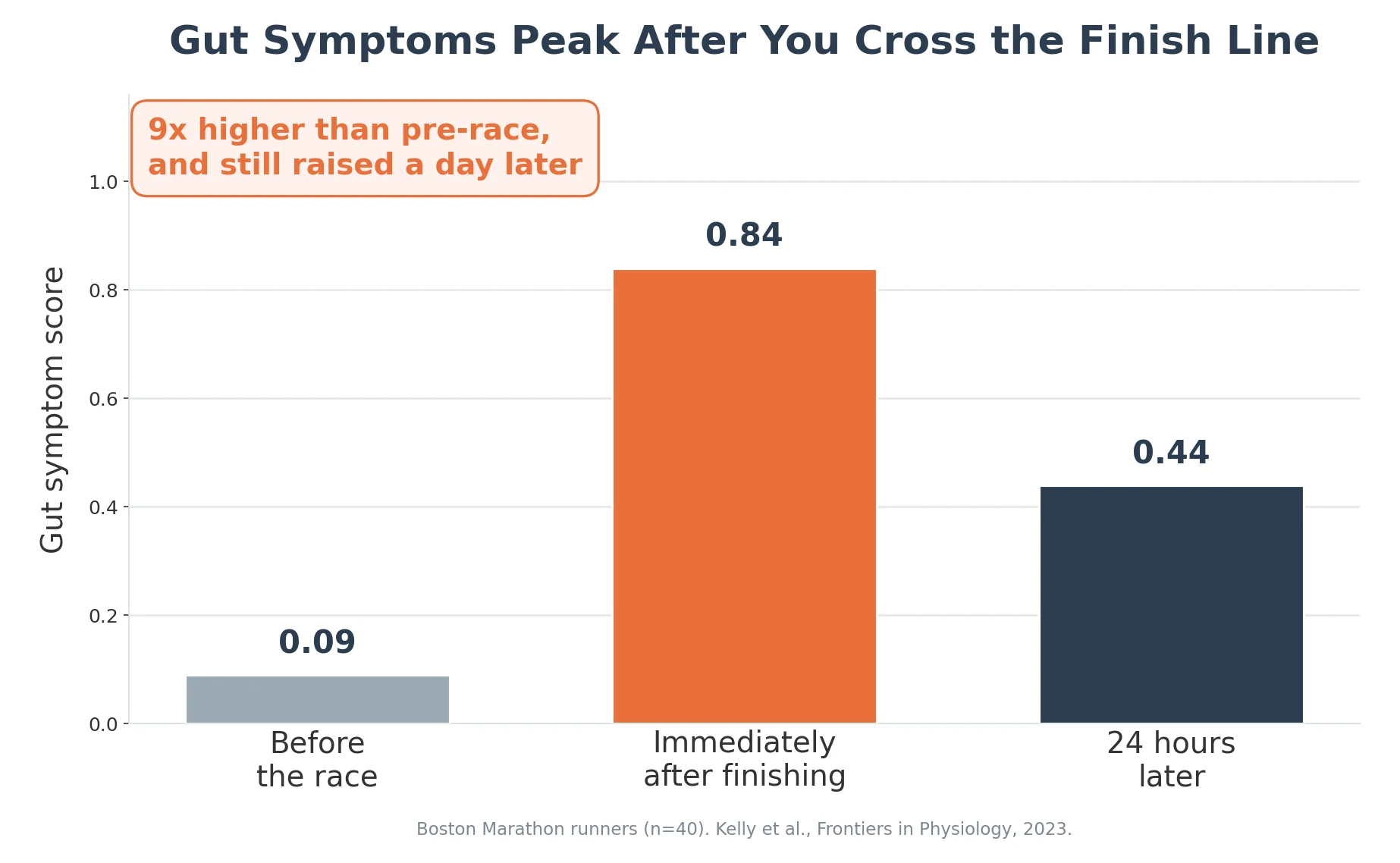
Research on Boston Marathon runners found gut symptom scores were roughly 9 times higher immediately after the finish than before the start, and were still raised a full day later.
Those same runners carried high levels of a marker of intestinal cell damage at the finish, and the marker fell over the following 24 hours.
Runners with more gut cell damage tended to report worse symptoms, though the strength of that link varied a lot between individuals.
Your blood pressure also drops once you stop running.
Your leg muscles stop squeezing blood back toward your heart the moment you stand still, and blood pools in your legs instead.
Blood pressure measured in marathon finishers fell across the board after the race, along with the resistance in their blood vessels.
Low blood pressure after a race drives the same process behind runners collapsing after they cross the line. In its milder form it produces nausea and lightheadedness.
Your stomach itself recovers quickly.
By 30 minutes after hard exercise, the stomach clears a drink at the same rate it does at rest, taking about 22 minutes to empty half its contents.
The nausea that lingers afterwards traces back to your gut lining and your blood pressure, which is what the fixes below target.
Dehydration compounds all of it, and the Boston runners who finished in a more dehydrated state tended to report worse symptoms.
How Do You Stop Feeling Sick After a Run?
The fix targets your blood pressure first, because that’s the part you can change in the first few minutes.
- Keep walking for 5 to 10 minutes. Walking keeps the leg muscle pump working and stops blood from pooling in your legs.
- Lie down and raise your legs if you feel lightheaded. Elevating your legs restores blood flow to your head within a minute or two.
- Take fluid before food. Small sips of a cool drink with sodium settle the stomach faster than solid food does.
- Give it 30 minutes before eating properly. Your stomach is clearing at its normal rate by then, so what you eat afterwards goes back to being a recovery decision.
Nausea that lasts more than a few hours after a run, or arrives with a headache and confusion, needs medical attention.
Summary: Nausea Prevention at a Glance
| Nausea Trigger | Root Mechanism | Prevention Strategy | Race-Day Fix |
| Running too hard | Aggressive blood flow redistribution | Control pace to conversational effort (zone 2–3) | Slow down immediately, recover for 5–10 minutes |
| Dehydration | Low blood volume, high osmolality | Drink 400–800 ml/hour of sports drink (6–8% carb, sodium) | Sip electrolyte drink every 15 minutes, continue pacing adjustment |
| Wrong pre-run meal | Full stomach or low blood sugar | Eat small carb meal 1–2 hours before, test in training | Consume sports drink for carbs, avoid solid food |
| Heat stress | Core temperature elevation competing for blood flow | Run in cooler conditions, slow pace on hot days | Hydrate frequently, continue at reduced pace |
| Gut dysbiosis | Inflammation and intestinal permeability | Start probiotics (Bifidobacterium) 4–8 weeks before race | Probiotics build over weeks, not immediately helpful on race day |
| Overhydration | Gastric distension, possible hyponatremia | Drink to schedule (15-minute intervals), not to thirst | Stop drinking or reduce intake, slow pace |
| Vomiting during hard efforts | Gut lining damage rises with intensity, and retching fires on an empty stomach | Negative split hard races, and cut fluid volume in the final 20 minutes | Back off to an easy jog and let the effort settle |
| Nausea after you stop | Blood pools in the legs and blood pressure falls once the muscle pump stops | Walk for 5–10 minutes after finishing instead of standing still | Keep walking, raise your legs if lightheaded, take fluid before food |
Nausea during running is your body signaling that something in your race-day strategy needs adjustment.
Gastrointestinal problems during running encompass more than nausea alone, but by preventing nausea through smart pacing, proper hydration, careful pre-run nutrition, and probiotic gut support, you’re addressing the root causes that lead to broader GI distress.
The runners who execute flawlessly on race day (the ones who feel strong at mile 20) aren’t ignoring their gut. They’re conditioning it, fueling it, and pacing with it in mind from the start of their training cycle.