

You planned every run for 16 weeks, and then a week of it vanished.
Maybe a fever knocked you flat, maybe work swallowed your evenings, maybe your legs just said no.
Now you are staring at a training log with holes in it, convinced you are the only runner who could not stick to the plan.
You are not that runner, and those missed runs are almost certainly not the disaster your head is telling you they are.
The real danger is what panic makes you do next, like cramming three lost workouts into the next four days.
That is the move that actually costs you on race day.
So, in this article you’re going to learn the research-backed practical advice on:
- What missing a week of marathon training really does to your fitness
- When in your plan a missed run matters, and when it barely registers
- Whether you should make up missed runs or repeat a whole training week
- Which workouts to protect and which ones you can let go
What Happens If You Miss a Week of Marathon Training?
Missing up to about a week of running has almost no lasting effect on your marathon fitness.
Skip seven days or fewer and the physical cost is close to nothing, even though your training log looks alarming.
Your body does not undo months of work in a few quiet days.
Certain markers like VO2 max can dip slightly when you stop running, but those small numbers do not translate into a slower race.
A meta-analysis of detraining studies found that meaningful drops in maximal oxygen uptake generally take two to four weeks of doing nothing to appear.
Strength and endurance adaptations fade even more slowly than that.
The bigger threat in the first week off is the story you tell yourself about being ruined.
That anxiety pushes runners into rushed decisions that cause the very setback they were afraid of.
What if the gap ran longer than a week though.
Here the largest real-world dataset we have offers a straight answer.
An analysis of nearly 300,000 marathon runners found that a 7 to 13 day training gap left runners only about 4% slower than their uninterrupted result.

For a four-hour marathoner, roughly 4% works out to about ten minutes.
Not the time you wanted, but a long way from a wasted training block.
More than half of the runners in that dataset had at least one seven-day gap, and nearly a third lost ten days or more.
The ones who raced well were not the ones who never missed a day.
They were the ones who responded calmly when a gap showed up.
RunnersConnect Bonus
Had to take some time off recently with an injury? Download our one-of-a-kind Performance Decline Calculator to find out what your estimated performance decline would be for any race distance.
Does It Matter When You Miss the Runs?
Timing decides how much a missed run actually costs you.
The same 300,000-runner dataset showed that gaps eight to twelve weeks out from race day had almost no measurable effect.
Miss training that early and you have weeks of runway to rebuild.
Gaps in the sharper window of three to seven weeks before the race carried a clearer penalty.
A missed week during your race-specific block matters more than the same week missed during early base building.
The response is still not to panic and cram, only to protect the sessions that matter most in the time you have left.
Impact also depends on who you are as a runner.
Faster runners chasing tight goal times feel a missed week more than steadier mid-pack runners do.
Younger, higher-mileage runners tend to be more sensitive to disruption than older athletes.
That mostly reflects bigger training loads and slimmer margins, not some flaw in your preparation.
Why Did You Miss the Runs? Answer That First
Before you decide anything about your plan, get honest about why the runs disappeared.
The reason changes the right response completely.
If you were sick with a fever or symptoms below the neck like chest congestion or body aches, resting was the correct call.
Running through that kind of illness slows your recovery and raises your injury risk rather than proving anything.
Keep resting until the symptoms clear, then ease back in.
If something hurt, you did the smart thing by backing off.
Running through sharp or worsening pain is how a niggle becomes a stress fracture that ends the whole build-up.
You protect a race by responding to warning signs, not by pushing past them.
If life stress caused the gap, work deadlines or broken sleep or family chaos, understand that your body does not sort stress into neat categories.
The strain from a work crisis stacks on top of the strain from training.
Sometimes the sharpest thing you can do for your race is skip a workout when your stress load is already maxed out.
Should You Make Up Missed Runs?
For one to three missed runs, the answer is simple: do not make them up.
Resume your schedule exactly as written and let the missed runs go.
Do not squeeze them into the coming days, and do not bolt extra mileage onto next week to catch up.
Trying to compensate is one of the most reliable ways runners injure themselves late in a plan.
A sudden jump in volume asks your body to absorb a load it was never prepared for, right after it already signaled that it needed a break.
That impatience wears the disguise of diligence, and it is how strong training blocks unravel in the final weeks.
A full week off calls for a controlled return rather than a leap back to normal.
Cut your first week back to about 70% of the planned volume.
If you lost two weeks, start near 50% and rebuild from there.
Spend the first few days on easy running and only add quality workouts once you genuinely feel recovered.
Recovered means your legs and your sleep agree, not just your ego.
Should You Repeat a Training Week After Missing One?
Most runners do not need to repeat an entire training week after a single missed week.
The popular advice to redo a week, often tied to beginner plans, is built for safety with brand-new runners rather than for someone deep into a build-up.
If you have months of consistent training behind you, your fitness did not reset, so restarting the week wastes runway you may need later.
Repeating a week makes sense in a few specific cases.
Consider it if you missed two weeks or more, if illness left you clearly weakened, or if the very first easy runs back feel far harder than they should.
Repeat a week when your body is still recovering, not simply because a workout is missing from the calendar.
In practice, slotting back in at reduced volume for a few days usually beats formally rewinding the plan.
The exception is the taper.
If a missed week lands close to race day, do not try to reclaim it during your taper, because arriving rested almost always beats arriving patched together.
Which Missed Workouts Matter Most?
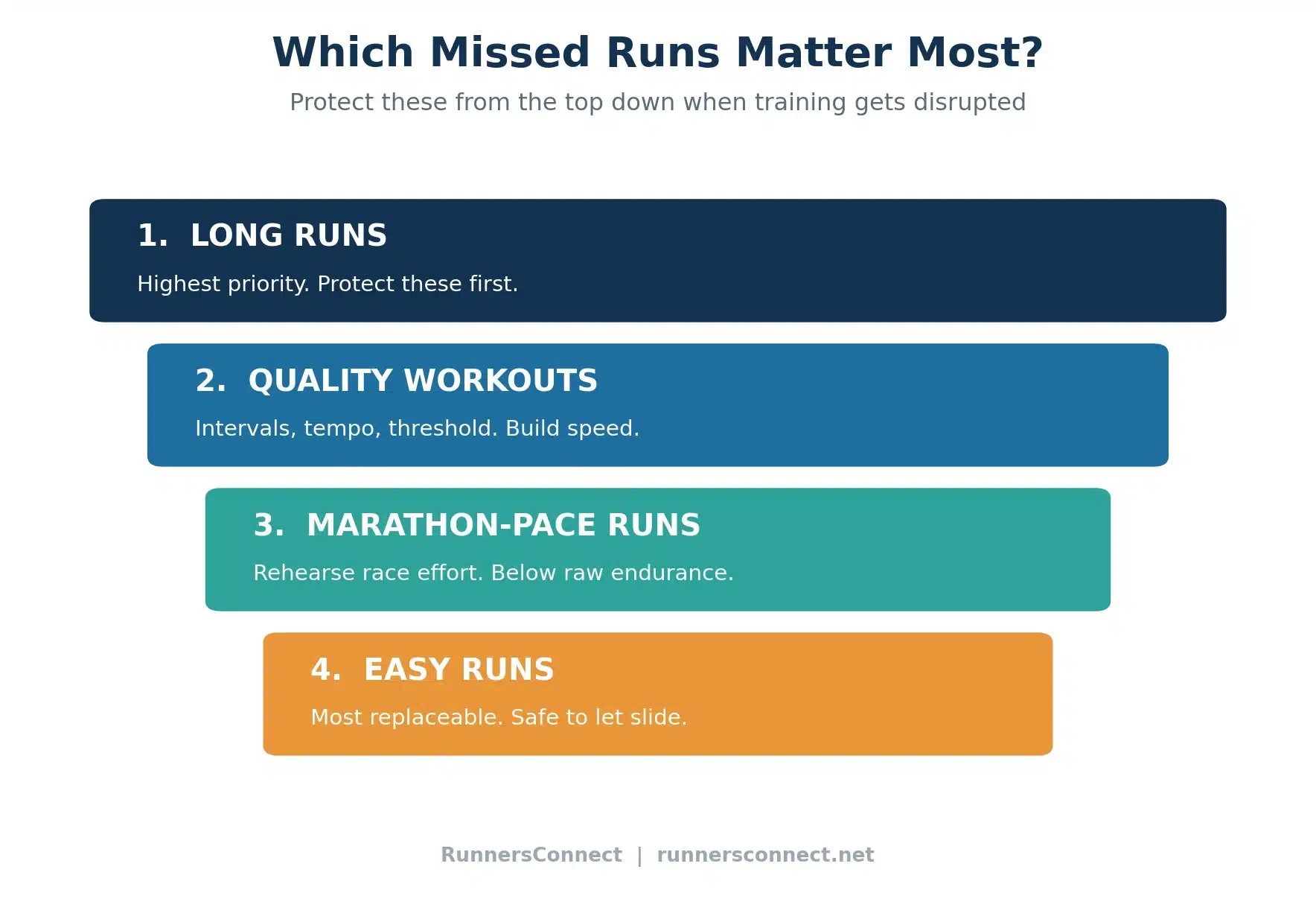
Not every missed session carries the same weight, so a quick hierarchy helps you triage.
Long runs sit at the top, especially in the middle-to-late weeks of a marathon build.
They build the endurance and the mental durability that race day demands, so protect these first.
Quality workouts like intervals, tempo, and threshold runs come next because they sharpen speed and teach your body to clear lactate.
Marathon-pace sessions rank below those, valuable for rehearsing race effort but less foundational than raw endurance.
Easy runs are the most replaceable sessions in the whole plan.
They support your aerobic base and recovery, so missing a handful will not derail anything.
If you can only save one type of session, save the long run.
Your phase matters too when you triage.
Early in base building, overall consistency matters more than any single run.
In the peak weeks, defend long runs and quality work above everything else, and let the easy miles slide if something has to give.
How Much of Your Plan Do You Actually Need to Finish?
You do not need a perfect training log to run a strong marathon.
Completing roughly 80% of your planned training is enough to set up a successful race for most runners.
That figure reflects a real pattern that shows up across countless training cycles, grounded in how bodies actually adapt.
What counts most is where that 80% lands.
Hit most of your long runs and your endurance base is solid.
Hit most of your quality workouts and your speed systems are ready.
Missing 20% of your runs does not hand you a 20% drop in performance, because fitness does not scale like that.
Your body actually banks its gains during recovery, not during the workout itself.
Some of those skipped easy runs may have left you fresher for the sessions that truly mattered.
Backing off at the right moment can even make you faster.
One controlled study of well-trained endurance athletes found that a polarized approach, mostly easy running with a small dose of hard work, produced bigger gains in fitness and performance than grinding at moderate effort more often.
Consistency across the whole block beats a frantic scramble to reclaim a few lost days.
Will Three Missed Runs Ruin Your Race?
Three missed runs will not ruin your race.
Months of progressive long runs, quality sessions, and steady mileage do not evaporate over a few quiet days.
Your cardiovascular gains, your mitochondrial density, and your neuromuscular adaptations are far more durable than your anxiety suggests.
Measurable declines take weeks of complete rest to set in, and you are nowhere near that.
The runners who succeed are rarely the ones with flawless logs.
They are the ones who stay healthy, respond intelligently to setbacks, and reach the start line confident instead of broken.
Resume your schedule, protect the sessions that matter most, and trust the work already in the bank.
You are more prepared than you think.