

Lactate threshold has become an increasingly popular term and metric used throughout endurance sports training, especially in running.
Unless you’ve been training under a rock, there’s no doubt you’ve heard about its importance.
But, what exactly is lactate threshold and, more importantly, how do you calculate yours?
That’s what we’re going to help you understand in this article.
We’ll dive into the research and breakdown…
- What exactly lactate threshold training is
- Why lactate training is critical to your performance
- Give you a few methods to help you calculate yours
- And provide a few workouts you can implement in your training.
Defining Lactate Threshold
To understand lactate threshold, it is important to first define lactate.
A study in the National Library of Medicine (NLM) states that lactate is the product of glucose utilization of muscle cells during exercise.
Simply speaking, as our body breaks down glucose for energy, a by-product of this process is lactate.
During easy running, your body reconverts and recycles this lactate back into energy and efficiently expels the waste products.
Therefore, the production of lactate will remain relatively constant while running at an easy aerobic pace, which doesn’t require a huge demand for energy.
As you continue to run faster and demand more energy, the production of lactate will slowly increase.
At some point, whether it be too fast a pace or holding a steady pace for too long, the production of lactate will soar and your body will no longer be able to convert lactate back into energy and expel the waste products.
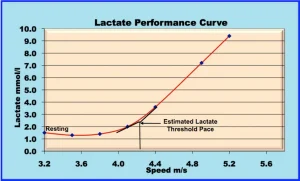
This point is commonly referred to as your lactate threshold.
The lactate then floods into system, muscle power is diminished and you begin to slow down.
Ultimately, lactic acid is one of the largest contributors to why you slow down as the race goes on.
In short, lactate threshold is the point at which your body can no longer remove lactate as fast as it builds up in your blood, and the level of intensity where steady state can no longer be performed.
Why Lactate Threshold is Important
So now that we have a better understanding of exactly what lactate threshold is, why is this training threshold so critical to your performance?
Faster Threshold = Faster Racing
If you can improve or push back the pace at which you begin to accumulate too much lactate to properly clear, you can maintain that pace for longer.
In fact, lactate has been shown in literature to be a pretty accurate prediction of just how fit someone is.
As an example, this study from 2004 found that the more fit a person is, the less lactate accumulates in the blood.
Therefore, there is a direct correlation between lactate threshold and running performance. The higher you get your lactate threshold, the better running performance you will have.
This correlation between lactate and running performance was further bolstered from this 2007 study where faster middle-distance runners were found to have a high lactate threshold than slower runners.
Helps Prescribe Training
Identifying and understanding your lactate threshold can also help you to prescribe your training workouts and track your progress over time.
For instance, once you have identified your lactate threshold, you will have a better understanding of where your main zones of training are.
Intensity below your lactate threshold will be your easy, aerobic pace or Zone 2 level of intensity.
This is the pace where you feel like you can go all day long and where you are primarily using fat as an energy source.
Above your lactate threshold is where you will be gradually switching from your aerobic system to your anaerobic system, where the level of intensity is higher, and you will be using more glycogen (carbohydrates) as an energy source.
This intensity level is your Zone 4 and 5.
Your body has only a certain amount of available glycogen to use for energy, that is why you cannot perform at a high level of intensity forever.
A Metric to Track Progress
Lactate threshold can also be an important metric that you can test and track over time to measure progress.
If your lactate threshold is increasing, then you’re running performance will likely be increasing as well.
Additionally, if your lactate threshold is not improving after you re-test it, then that is an indication that you may need to adjust your training or another aspect such as nutrition or sleep.
Methods to Calculate Lactate Threshold
Every runner’s lactate threshold will be different depending on their age, fitness, and experience. There are three main ways to calculate your lactate threshold.
- 30-Minute Time Trial: Perform a specific 30-minute run and capture heart rate data.
- 15-Minute Run: Estimate lactate threshold heart rate and find running pace.
- Going Off of “Feel”: Speak three to four words aloud.
- Lab Test: Get a lactate test performed in a professional lab using a lactate meter.
30-Minute Time Trial
One way to determine your lactate threshold is by using heart rate as the primary metric and performing a 30-minute run.
This method will require a watch that can track heart rate or a heart rate monitor.
Set a timer for a 30-minute run and treat it as a race to see how far you can run in 30 minutes.
Start slow and progressively increase pace for the first 10 minutes.
You will want to start slow and incrementally increase your pace because you do not want your heart rate to rise too high and fast. This will result in inaccurate data.
At the 10-minute mark, click the lap button on your watch or heart rate monitor, and continue running as hard as you can for the last 20 minutes.
After the 30-minute run, review your heart rate data for the last 20 minutes.
Identify what your average heart rate was during those last 20 minutes. That will be your lactate threshold heart rate.
It is important to understand that this heart rate is a range more than an exact heart rate data point.
For instance, if your average heart rate in the last 20 minutes of the run is 160, then when you want to perform at lactate threshold, your heart rate should be in the range of 155 to 165.
This is because a lot of factors can impact heart rate, such as the weather, so it is important to use a range rather than a specific value.
15-Minute Run
Another option to determine your running pace where you are around your lactate threshold, is to perform a 15-minute run to find your heart rate in which you are around lactate threshold.
To do this, first estimate your maximum heart rate.
To estimate your maximum heart rate, the Centers for Disease Control and Prevention (CDC) recommends that you do 220 – your age. For instance, if you are fifty, then your maximum heart rate will be 170 beats per minute (220 – 50).
This isn’t always super accurate, so we created a heart rate training calculator that can factor in some of the other important data points to give you a better estimate.
Most research has found that your lactate threshold heart rate is typically around 80% to 90% of your maximum heart rate.
Therefore, if your maximum heart rate is 170, then your lactate threshold heart is likely somewhere between 136 to 153 beats per minute.
To begin the 15-minute run test, you will start with 10 minutes of an easy jog to properly warm up.
After 10 minutes you will increase the intensity and run at a pace that you can perform for the whole 15 minutes.
After each minute, record your heart rate and ensure that it is between 80% to 90% of your maximum heart rate.
After the 15 minutes is over, and you stay in your identified lactate threshold heart rate range, record the average pace for the 15 minutes.
That is an estimation of your running pace when you are around lactate threshold.
Going Off of “Feel”
If you do not have the means to monitor your heart rate, you can estimate your lactate threshold pace by feel, or often called Rate of Perceived Exertion (RPE).
To do this, run at a pace where you can comfortably speak three to four words out loud.
You should not be completely out of breath while speaking these words, but you also should not be able to speak full sentences.
If you can get out three to four clean words, then you are running at a pace that is around your lactate threshold.
This method is less accurate, but it is a starting point to begin training your lactate threshold and a data point that can be compared to other tests that you might perform later.
Lab Test
The final way to determine your lactate threshold is to get lactate testing performed in a professional lab by a physiologist. This will likely give you the most accurate data but will include a cost.
Workouts to Improve Lactate Threshold and Running Performance
As mentioned, identifying your lactate threshold can help you understand your current level of running performance, help prescribe training using zone-specific intensities, and track progress over time, which in turn, helps improve your running performance.
So, now let’s talk about some specific workouts you can implement in your training to better target lactate threshold.
Tempo runs and Broken Tempos
The most effective way to increase your lactate threshold is to perform intervals at or around lactate threshold pace.
Tempo runs and broken tempos are the workouts that increase an athlete’s anaerobic threshold most specifically.
Tempo runs are run at a pace that an athlete could maintain for about 60 minutes, and are sustained for approximately 20-40 minutes.
Broken tempos are run at the same pace as tempo efforts, but broken into 10-15 minute sections with a short rest.
What is an example?
One week you may run a 40 minute tempo effort and the following week you may run 4 x 10 minutes at the same tempo effort with a few minutes of rest in between these intervals.
Threshold Intervals
Typically, tempo runs or threshold runs are assigned at somewhere between your 10 mile and half marathon race pace.
However, if you want to work on running faster (mechanics, speed, form, and efficiency), but not deviate from the long-term goal of progressing aerobic fitness, then you can implement faster paced intervals at 8k to 10k paces with a short amount of rest.
Here’s an example workout: 2 mile (3k) warm-up, 3-5 times 1 mile (2k) at 10k pace with 1 minute rest, cool down 2 miles (3k)
These threshold intervals allow you to run much faster than a tempo run (usually 6-7 percent faster), but because of the short rest, you can maintain a threshold effort.
During these threshold intervals, you’ll often barely catch your breath before starting the next interval, but that means the workout will also go by quickly.