

You nailed your long runs.
Your tempo workouts were faster than ever.
Your training log looks like something out of a running magazine.
Then race day arrives and your legs just don’t deliver what training promised.
This disconnect between training fitness and race performance is one of the most frustrating experiences in running, and it has a specific physiological explanation rooted in how your body builds mitochondria.
Understanding how long mitochondrial biogenesis takes, what drives it, and why it creates a fitness lag before race performance catches up gives you a strategic edge most runners never develop.
You’ll Learn:
- What mitochondria do and why they determine your aerobic ceiling
- Exactly how long mitochondrial biogenesis takes : from first signal to peak density
- Which types of training trigger the fastest mitochondrial adaptations
- Why your body can feel fit in training before race performance reflects that fitness
- How to use the mitochondrial timeline to plan smarter training cycles
What do mitochondria actually do for your running?
Mitochondria are the cellular structures inside your muscle fibers that convert oxygen, carbohydrates, and fat into ATP, the energy currency your muscles use to contract.
When you run aerobically, your muscles depend almost entirely on mitochondrial output to sustain pace.
Two variables determine how much mitochondrial capacity you have: density (the size of individual mitochondria) and volume (the total number per muscle fiber).
Research has shown that trained endurance athletes have two to three times more mitochondria per muscle fiber than sedentary individuals, and this difference accounts for a large portion of the gap in aerobic performance.
More mitochondria per fiber means more sites where oxygen can be used to produce energy, which translates directly to a higher sustainable pace at any given perceived effort.
Aerobic training progressively stresses this system, and the mitochondrial response is the central adaptation that makes you faster over months and years of training.
How long does it take to increase your mitochondria?
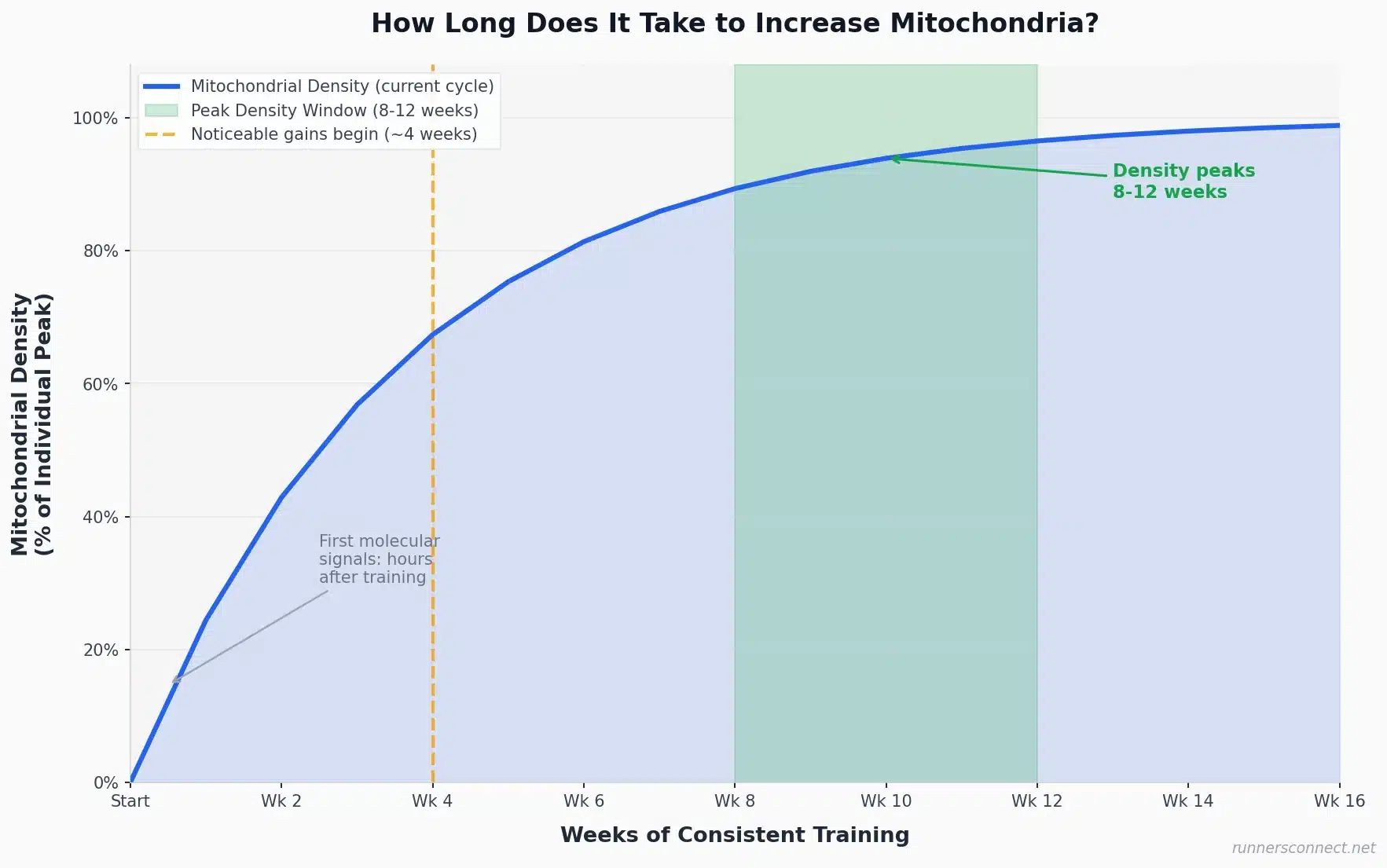
The answer depends on whether you’re asking about the first signal, meaningful functional gains, or peak density. These are three distinct milestones that happen on very different timelines.
The first signal: within hours. Mitochondrial biogenesis begins almost immediately after a training session.
Meaningful functional gains: 4-8 weeks. It takes consistent training for 4 to 8 weeks before you begin noticing real changes in how efficiently your aerobic system performs: less perceived effort at the same pace, better fat oxidation, and more stable energy during long runs.
Mitochondrial density peaks after approximately 8-12 weeks of consistent training at a given stimulus. This is why runners who maintain steady training for 10-12 weeks suddenly feel a step change in fitness.
Volume keeps growing for years. Unlike density, which reaches an individual ceiling at 8-12 weeks, total mitochondrial volume can continue increasing across multiple training cycles over years.
This is the physiological basis for why experienced runners with 5-10 years of consistent training have a fundamentally different aerobic engine than a runner in their first two years, even if their weekly mileage is currently identical.
The half-life principle. Mitochondria also have a half-life of approximately one week, meaning your body both builds and breaks down mitochondria continuously.
When you maintain consistent training stimulus, synthesis outpaces breakdown and density rises.
When you reduce volume or take time off, breakdown catches up and density declines.
That is why detraining effects on aerobic fitness become measurable within two weeks.
RunnersConnect Bonus
Download your FREE Long Run and Aerobic Pacing Calculator now.
Need help converting your race times to your optimal easy and long run pace? Download our FREE calculator and we’ll do the math for you.
What type of training builds mitochondria fastest?
Both easy aerobic running and high-intensity work trigger mitochondrial biogenesis, but through different molecular pathways and with different emphases on density versus volume.
Easy and long runs drive adaptation primarily through cumulative time under aerobic demand. The longer your muscles sustain aerobic metabolism, the stronger the signal for mitochondrial growth.
Easy runs at 65-75% of max heart rate are the single most effective daily stimulus for long-term mitochondrial volume development because they can be repeated frequently without accumulating excessive fatigue.
Tempo runs and threshold work stress the mitochondrial system at a higher intensity, which drives both density and the metabolic efficiency of existing mitochondria. Your cells get better at using the mitochondria they have.
VO2max intervals apply the most powerful acute stimulus for mitochondrial signaling, but the recovery cost limits how often you can apply this training, so weekly volume contribution is lower.
The practical implication is that running most of your miles at easy pace while including weekly threshold and interval sessions creates the broadest mitochondrial stimulus . Polarized training models consistently produce the best aerobic adaptations in endurance athletes.
Neglecting any of these three zones for an extended period creates gaps in the mitochondrial development spectrum.
Why does fitness build up faster than race performance?
This is the question at the center of every runner’s frustration when a strong training block doesn’t convert to the race result they expected.
During a training cycle, mitochondrial density is building steadily toward its peak at 8-12 weeks.
As density rises, your VO2max, lactate threshold, and running economy all improve, and those improvements show up directly in workout paces.
Workouts also happen in controlled conditions: optimal nutrition timing, familiar courses, no race-day stress hormones, no 5am wakeup followed by a two-hour drive, and no competition dynamics pushing you through early miles too fast.
The gap between workout performance and race performance is widest in the middle of a training cycle, when mitochondrial density gains are fastest but race readiness, which includes specific pacing, fueling, and taper, hasn’t been fully developed.
The “backlog of fitness” phenomenon occurs because mitochondrial volume gains from a given training cycle continue accumulating even after that cycle ends.
You may finish a training block with mitochondrial density near its peak but not have had the opportunity to fully express that fitness in a goal race before the next cycle begins.
Each successive training cycle then starts from a higher baseline of total mitochondrial volume, which means the density gains of 8-12 weeks build on a progressively stronger foundation.
This is why runners who stay consistent across two or three years of structured training often make their biggest race performances in year three, even though their training logs from year three don’t look dramatically different from year two.
How to use the mitochondrial timeline to train smarter
Understanding the 8-12 week density arc changes how you should interpret training blocks and plan race timing.
Plan race peaks at 10-12 weeks into a training cycle. Mitochondrial density is near its peak, and if you’ve tapered correctly, your race performance should better reflect your fitness ceiling.
Don’t evaluate fitness after 4 weeks. Biogenesis is still in its early phase at the 4-week mark.
Functional performance gains often lag behind the structural changes by 2-3 weeks.
Build volume before intensity. Total mitochondrial volume takes years to develop, and running high mileage at easy pace is the most efficient way to drive that long-term adaptation without injury risk.
Respect the taper. The 2-3 weeks before a goal race allow your mitochondrial system to consolidate gains, clear accumulated fatigue, and fully express the density improvements your training built.
Carry fitness forward. Each training cycle that ends short of your potential is not wasted.
The mitochondrial volume gains from that cycle transfer to the next, giving you a higher starting point for the following block.
A race result that falls slightly short of your workout-based expectations is not a training failure. It often means you reached the peak of micro-cycle mitochondrial adaptation and the full expression of that fitness will emerge in your next training block.
The runners who understand this are the ones who stay consistent through disappointing race results, trust the process, and eventually experience the performance breakthroughs that confused athletes never stay patient enough to reach.
Mitochondrial development is not a single-cycle event. It is a multi-year accumulation, and every consistent week of training is a deposit into that account.




One Response
I always ѕpent my half аn hour to read
this blog’s articles daily along with a cup of coffee.