

Cupping had its moment at the 2016 Olympics, when swimmers and gymnasts turned up covered in circular purple welts, and it never really left.
Walk into a physio clinic today and cupping sits on the menu next to dry needling and soft tissue work. Runners book it for stubborn shin pain, tight calves, and knees that ache after every long run.
The marks look dramatic. The question is whether anything useful is happening underneath them.
Cupping now has a decent research base behind it, including a trial run specifically on runners, and the results are more interesting than either side of the argument usually admits.
So, in this article you’re going to learn:
- What the suction actually does to the tissue under the cup
- Why cupping beats no treatment and stalls against fake cupping
- What happened when 81 runners had their quads cupped after a hard run
- Whether cupping does anything for runner’s knee or shin splints
- What the side effect data shows
- Where to put your recovery time instead
What Does Cupping Actually Do to Your Body?
Cupping applies negative pressure to the skin, created either by a vacuum pump or by heated air that contracts as it cools.
Three versions show up in clinics. Dry cupping uses suction alone, wet cupping adds small incisions so the suction draws out blood, and fire cupping uses a flame to heat the air inside the cup before it goes on the skin.
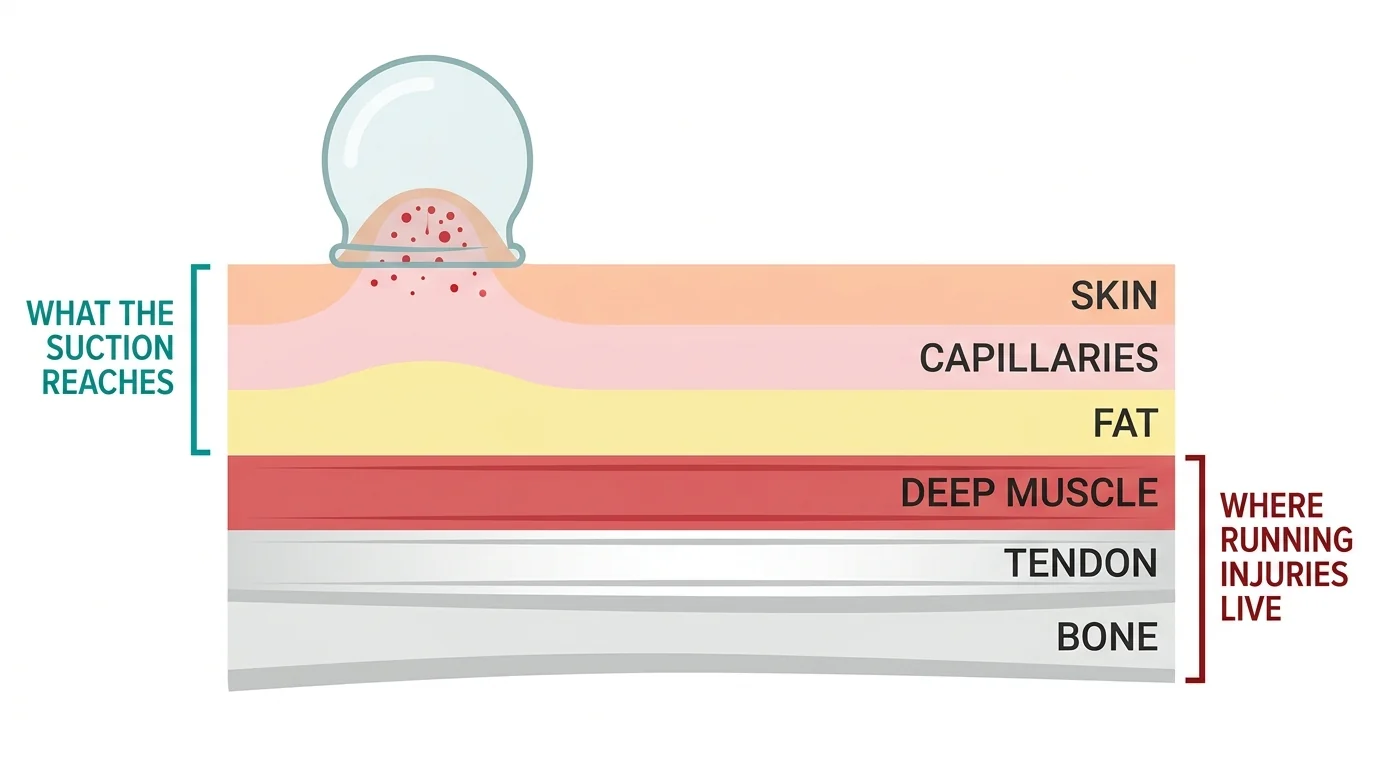
The suction pulls skin and superficial tissue up into the cup and ruptures small capillaries, which is what produces the round bruise. In dry cupping the mark is broken blood vessels, and nothing leaves the body.
Blood flow does change afterwards, and that part is measurable. Researchers using laser Doppler flowmetry recorded a rise in skin blood flow after cupping in 12 healthy adults.
The effect may reach deeper than the skin. Testing 20 healthy volunteers with near-infrared spectroscopy, researchers found dry cupping changed how quickly tissue took up and released oxygen, and they argued the effect could benefit athletic performance.
So cupping is doing something real to the tissue. The honest version of the mechanism argument is that a plausible physiological effect exists.
A treatment can move a number in a lab and still fail to change anything you care about as a runner.
Whether that blood flow signal turns into less pain, faster recovery, or a healed injury is a separate question, and it has been tested directly.
Does Cupping Actually Work, or Is It a Placebo?
Cupping performs well whenever the comparison is doing nothing at all.
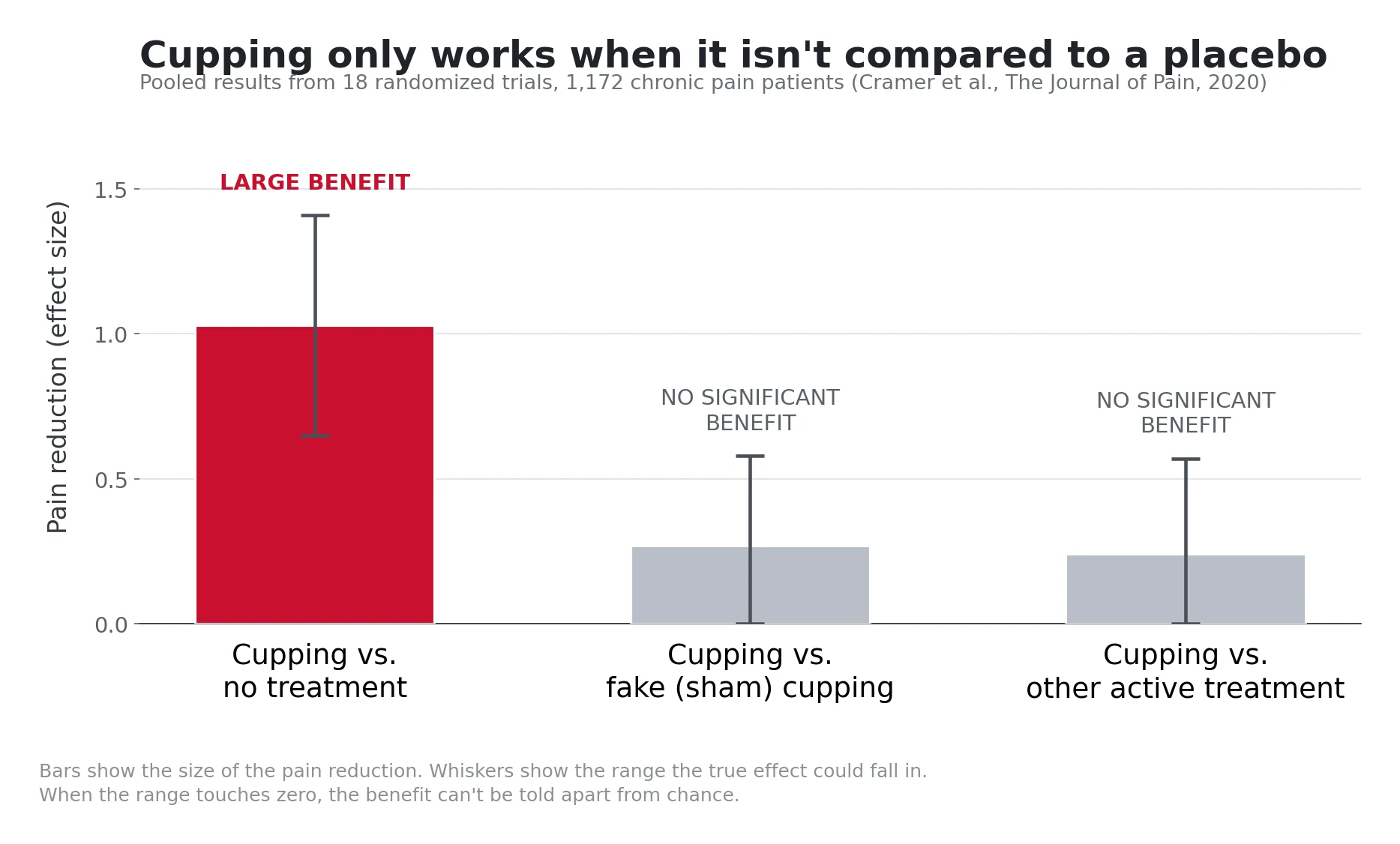
Researchers pooled 18 trials covering 1,172 patients with chronic pain and measured cupping against no treatment. It produced a large short-term reduction in pain.
Then they ran the comparison that matters. Sham cupping applies the cups with the suction quietly released, so the patient still gets the practitioner, the table, and the ritual, without the pressure.
A meta-analysis in The Journal of Pain found cupping produced a large drop in pain compared with no treatment, and no significant advantage over fake cupping.

Removing the expectation removes most of the benefit. That is the standard signature of a placebo response, and it shows up across the individual trials too.
A randomized trial in the Journal of Physiotherapy gave 90 people with chronic low back pain either real dry cupping or sham cupping once a week for 8 weeks, and the difference in pain between the groups came out close to zero at every check-in.
Larger reviews split the same way. A 2025 review in BMJ Open reported that cupping reduced pain intensity in chronic musculoskeletal pain while producing no improvement in functional disability.
Pain intensity is a self-reported score, and it’s the outcome most sensitive to belief. Disability measures what you can physically do, and it isn’t shifting.
The reviews that do report a benefit are candid about how thin the evidence underneath them is. A review of 21 dry cupping trials covering 1,049 participants concluded that dry cupping reduced pain in chronic neck and low back pain, then rated the overall evidence low to moderate quality and declined to draw a definitive conclusion.
RunnersConnect Bonus
Download your FREE Injury Assessment and Prediction Video now.
A good injury prevention program starts with assessing where you’re weak and where you might be tight or inhibited. In the video I’ll demonstrate the six mobility tests you need to perform to assess what you need to begin working on.
Does Cupping Help Runners Recover After a Hard Run?
Recovery is one of the most common reasons runners book cupping, and it’s the use that finally has a trial built around actual runners.
In 2025, researchers recruited 81 recreational runners, had them run hard, then randomly assigned them to 5 minutes of cupping on the quadriceps or to a sham treatment consisting of fake hip and knee joint mobilization. They tracked muscle pain, fatigue, perceived recovery, and vertical jump height for the next 72 hours.
A randomized trial published in 2025 found that cupping the quads after a hard run produced no improvement in muscle pain, fatigue, perceived recovery, or jump height over the following 72 hours.
Every outcome came back flat. The runners who got cupped felt the same, recovered the same, and jumped the same height as the runners who got the dummy treatment.
One recent study does look better for cupping. Testing 55 men with exercise-induced muscle soreness, researchers found stronger suction lowered soreness scores and improved sprint times and jump distance 24 hours later.
Look at what that trial used as its comparison. The control group received no treatment at all, which is the setup that has flattered cupping in study after study.
Does Cupping Work for Runner’s Knee or Knee Pain?
Knee pain is a common reason runners end up under the cups, and the knee is where the placebo-controlled evidence happens to be strongest.
A placebo-controlled trial published in 2026 put 62 women with knee osteoarthritis through 12 sessions of either real dry cupping or sham cupping across 6 weeks, then followed them for another month.
Both groups improved. Neither group improved more than the other on pain at rest, pain during movement, disability, sit-to-stand performance, walking speed, or stair climbing.
12 sessions of knee cupping over 6 weeks delivered nothing that 12 sessions of fake cupping didn’t also deliver.
Runner’s knee has a different cause than knee osteoarthritis, and the mechanism argument gets weaker rather than stronger. Patellofemoral pain is driven by how load is distributed across the kneecap while you run, which is a function of strength, cadence, and training volume.
Suction applied to the skin above the joint changes none of those three things.
Does Cupping Help Shin Splints?
Cupping for shin splints rests on the thinnest evidence of any use case in this article.
One randomized trial has tested it directly. Researchers assigned 46 people with medial tibial stress syndrome to either cupping or the Graston technique for 3 weeks, and reported that both reduced pain, with cupping edging out Graston.
Read that comparison carefully before you book anything. Cupping was measured against another passive treatment with weak evidence behind it, and the trial ran no sham arm and no untreated control group.
A treatment beating another unproven treatment tells you very little about whether either one beats time and a sensible training plan.
Shin splints respond to load management and to calf and hip strength, which is unglamorous and well supported. If your shins are the problem, the full shin splints guide walks through the causes and the fixes that hold up.
Is Cupping Safe?
Cupping is low risk in competent hands, and the risks it does carry are worth knowing.
The chronic pain meta-analysis found adverse events were more common in people who got cupping than in people who got no treatment. Most were minor, including bruising, itching, skin irritation, and lingering soreness at the cup sites.
The serious injuries come from fire cupping. A review of burn cases in the journal Burns traced the injuries to faulty technique in creating the vacuum, with the flame as the point of failure.
Burns and scarring remain the most reported serious complications, and that’s a real cost to weigh against a benefit that keeps failing to separate from placebo.
A treatment with no proven effect beyond placebo still carries a small chance of a burn, and that trade only makes sense if the upside is real.
So Should You Try Cupping for a Running Injury?
Cupping will make you feel better for a few hours, and that feeling costs money and leaves the injury exactly where it was.
Placebo effects are real effects. If a few hours of pain relief helps you get through a session, cupping delivers that about as well as any other hands-on treatment, and it delivers it through the ritual rather than the suction.
The problem is opportunity cost. Every hour on a treatment table is an hour not spent on the strength work, load management, and gait changes that resolve running injuries.
Compare cupping with something like Graston and Active Release Technique, which sit on similarly thin evidence but at least propose a plausible mechanism and carry almost no risk of harm.
| What runners use cupping for | Best available evidence | Verdict |
|---|---|---|
| Recovery after a hard run | 81 runners, cupping vs dummy treatment, 72-hour follow-up | No benefit on pain, fatigue, recovery, or jump height |
| Knee pain | 62 women, 12 sessions, cupping vs sham cupping | No benefit over fake cupping on any outcome |
| Shin splints | 46 people, cupping vs Graston, no sham arm | Uninformative, as neither arm was a control |
| Chronic pain intensity | 18 trials, 1,172 patients | Large benefit vs no treatment, none vs sham cupping |
| Function and disability | 18-trial meta-analysis and a 2025 review | No benefit over sham cupping |
If you have a running injury that isn’t healing, the boring answer is still the right one. Work out what’s overloading the tissue, reduce that load, build the strength that lets the tissue tolerate it again, and give it time.
Cupping is a good way to feel looked after and a poor way to get healthy.
Your physio isn’t a fraud for offering it. The marks on your calves are broken capillaries, and the work that gets you back to running happens on the gym floor and in your training log.
One Response
Glad to hear the benefits are anything but promising. The after effects look insanely painful. And hard to explain to you non-athletic friends.