

You crossed the finish line of a 10k feeling fine, and then the stairs the next morning told a different story.
Your quads ache, your calves feel tight, and walking downhill hurts more than the race did.
That soreness is normal after a hard race, but it raises 2 questions every runner asks: why does a race this short hurt so much, and how soon can you train again?
In this article, you’ll learn:
- Why your legs hurt after a 10k, even when the distance is shorter than your long run
- How long post-race soreness lasts after a 10k or half marathon
- When to run again, and which recovery methods have research behind them
Why Do Your Legs Hurt After Running a 10k?
The soreness you feel a day after a race is called delayed onset muscle soreness, and it comes from small tears in your muscle fibers.
A 2003 review of muscle soreness research found that eccentric muscle actions cause this micro-injury more often and more severely than any other type of muscle work.
An eccentric action happens when a muscle lengthens while it is working to control a load.
When running, your quads do this every time your foot hits the ground and your knee bends to absorb the impact, and your calves do it as your heel lowers toward the ground.
At race pace, you hit the ground harder and more often per minute than on an easy run, so each of those landings puts more force through the same muscles.
That’s why a 6.2 mile (10 km) race can leave your legs more sore than a slow 10 mile (16 km) long run.
A 2020 trial of 30 everyday runners after a 10 km (6.2 mile) street run found that the race alone reduced their hop distance and thigh muscle strength and raised creatine kinase, a marker of muscle damage in the blood.

That means a 10k is long and fast enough to damage muscle, even in runners who train for the distance.
Downhill sections add to the damage, because your quads lengthen under more load on each step down a slope than on flat ground.
How Long Does Soreness Last After a 10k or Half Marathon?
Post-race soreness usually peaks the day after the race and fades within 2 to 3 days.
A 2020 study of non-elite runners who finished a half marathon in about 1 hour 57 minutes found that their muscle soreness and fatigue returned to pre-race levels by 48 hours, but the peak force their legs produced in a jump test was still below normal.
That means your legs can feel fine 2 days after a race while your muscles are still producing less force than they did before it.
So once the soreness is gone, start with easy runs and give your legs a few more days before a hard workout.
How long the race took you matters more than the distance on the bib.
If you run a 10k in under 40 minutes, the race is short enough that you can usually return to normal training within a few days.
If your 10k takes 50 to 60 minutes or more, you spent longer on your feet at a hard effort, and you should give it the same respect you’d give a 10 mile (16 km) or 15k race.
A half marathon needs more recovery again, and a marathon needs far more, which the guide on how to recover from a marathon covers in detail.
RunnersConnect Bonus
Download your FREE Marathon Recovery Schedule for Runners.
It’s a PDF showing how to recover correctly in the 3 weeks post marathon, plus our cross training guide with over 20 sample workouts for the most common cross training types
When Can You Run Again After a 10k?
You can usually run again 1 to 2 days after a 10k, as long as the run is short and easy.
The 2003 soreness review found that light exercise was the most effective way to ease muscle soreness, but the relief only lasted as long as the exercise did.
The same review recommended cutting both the intensity and the duration of training for 1 to 2 days after a session that causes heavy soreness.
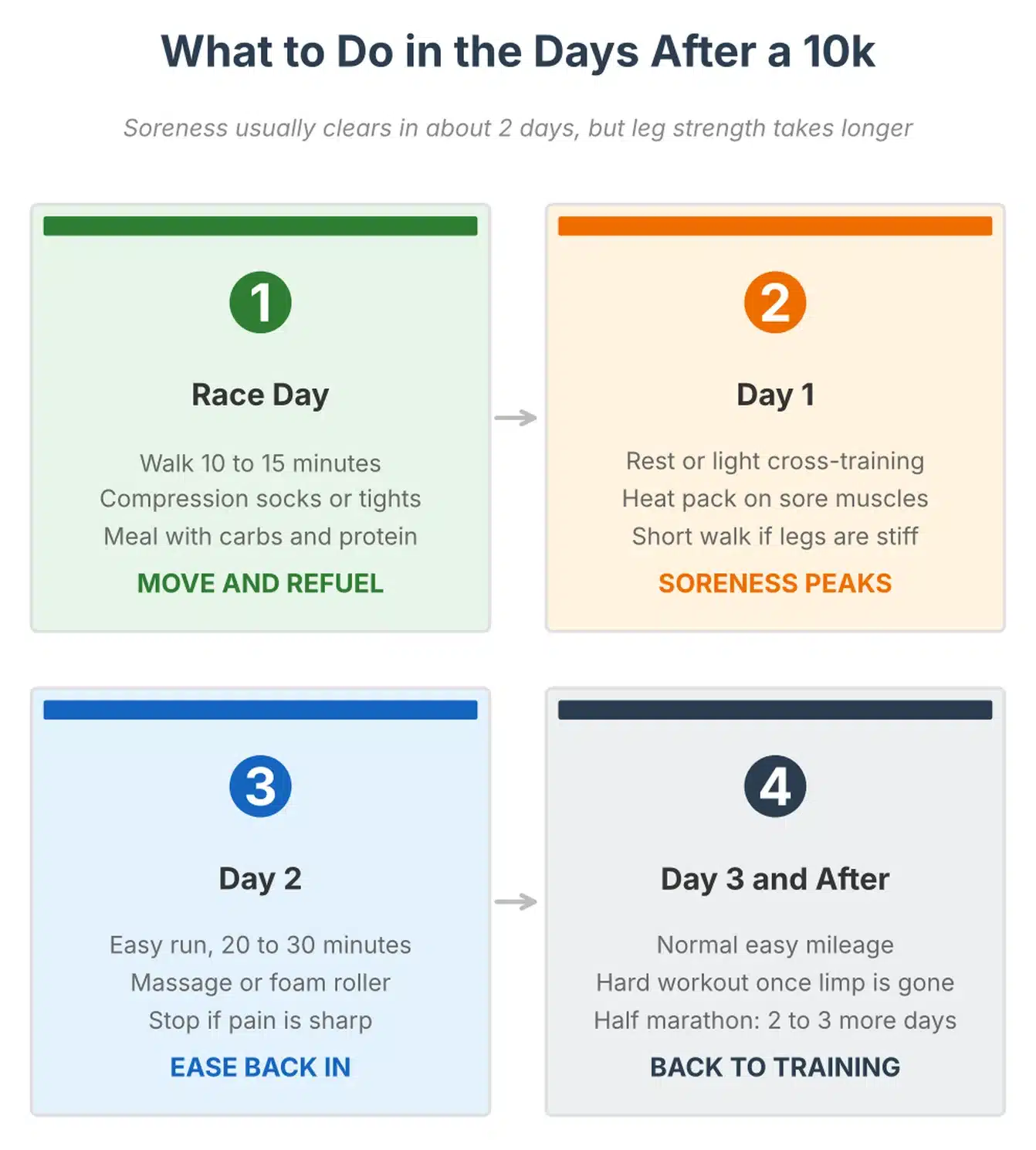
To apply that after a 10k or half marathon, use this schedule:
- Race day: walk for 10 to 15 minutes after you finish and eat a meal with carbohydrate and protein within a few hours.
- Day 1: rest, or walk and do light cross-training if your legs are still sore.
- Day 2: run 20 to 30 minutes at an easy, conversational pace if soreness has eased.
- Day 3 and after: return to your normal easy mileage, and wait until any limping or sharp pain is gone before your next hard workout.
If you raced a half marathon, add 2 to 3 more easy days before the first workout, because your leg strength takes longer to come back than your soreness does.
Pain that is sharp, sits in one spot, or gets worse as you run is a sign of injury rather than normal post-race soreness, so stop and get it checked.
What Actually Helps Sore Legs Recover Faster After a Race?
Several recovery methods reduce post-race soreness, but they differ in how much research supports them.
Does Massage Help Post-Race Soreness?
Massage has the strongest evidence of any recovery method for muscle soreness.
A 2018 meta-analysis of 99 studies on post-exercise recovery found that massage was the most effective method for reducing both muscle soreness and how tired people felt after exercise.
Wait a day or two after the race before a deep tissue massage, and ask for light to moderate pressure while your legs are still sore.
If a massage isn’t practical, a foam roller lets you work on your quads and calves at home.
Do Compression Socks and Tights Help?
Compression garments reduce soreness and help your legs get their strength back sooner.
A 2014 analysis of 12 studies found that wearing compression garments after damaging exercise had a moderate effect on reducing soreness and on restoring muscle strength and power over the following 1 to 3 days.
That means pulling on compression socks or tights after your race and wearing them for the rest of the day is a low-cost way to speed up recovery.
For more on which garments work and how long to wear them, see this breakdown of whether compression socks work.
Should You Take a Warm Bath or an Ice Bath?
For relieving soreness in the first 2 days, heat has better support than ice.
A 2022 analysis of 59 studies covering 1,367 people found that heat packs ranked first of 10 recovery options for relieving muscle soreness at both 24 and 48 hours after exercise.
So a heat pack on your sore quads or calves the evening after your race or the next day is a better choice than ice.
A warm bath is another way to get heat into your legs, though warm-water soaking ranked below heat packs in that analysis.
Ice baths had less to offer after a 10k.
In the same 2020 trial of runners after a 10 km street run, 10 minutes in a 50°F (10°C) ice bath did not restore strength, hop distance or creatine kinase any faster than 10 minutes in room-temperature water or resting.
What Should You Eat After a Race to Reduce Soreness?
Your regular meals cover most of what your muscles need to repair after a 10k or half marathon.
A 2021 randomized trial of 323 everyday runners found that taking extra milk protein for 3 days after a 15 km (9.3 mile) road race did not reduce muscle soreness compared to taking the same calories as carbohydrate.
Most of the runners in that trial already ate about 80 grams of protein a day, so extra protein added nothing to what their diet already provided.
That means you don’t need a special shake after a 10k.
Eat a normal meal with carbohydrate and protein after the race, and keep eating regular meals over the next 2 days.
RunnersConnect Bonus
Download our FREE recovery foods guide, with the top 10 foods for each of the essential recovery vitamins, minerals and macro nutrients. Plus a sample 1-day meal plan!
Does Tart Cherry Juice Reduce Soreness?
Tart cherry juice is one of the few foods with direct research in runners, though it was tested around a marathon.
A 2010 trial of 20 non-elite marathon runners found that the runners who drank tart cherry juice for 5 days before the race and 2 days after it got their leg strength back faster and had lower markers of inflammation than the runners on a placebo.
The juice did not reduce how sore the runners felt, so it makes the most sense in the days around a half marathon or marathon, when getting your strength back is the goal.
Is Stretching Worth It After a Race?
Stretching is the one popular method the research does not support for soreness.
The 2018 meta-analysis that ranked massage first found that stretching did not reduce muscle soreness after exercise.
Gentle stretching won’t hurt if it feels good, but spend your recovery time on massage, compression or a warm bath instead.
Post-Race Recovery Methods at a Glance
This table sums up what the research found for each method.
| Method | What the research found | When to use it |
|---|---|---|
| Easy running or walking | Eases soreness while you do it | Day 1 to 2 after the race |
| Massage | Most effective method for soreness and fatigue across 99 studies | 1 to 3 days after the race |
| Compression garments | Moderate drop in soreness and faster return of strength | Right after the race and that day |
| Heat pack or warm bath | Heat packs ranked first of 10 options for soreness at 24 and 48 hours | Evening after the race and the next day |
| Ice bath | No faster recovery than resting after a 10k | Optional |
| Extra protein | No less soreness than carbohydrate after a 15 km race | Normal meals are enough |
| Tart cherry juice | Faster return of strength after a marathon | 5 days before to 2 days after a long race |
| Stretching | No reduction in soreness | Only if it feels good |


2 Responses
Is there any research on how long it is before you return to normal IL-6 levels with rest and without rest? Also, is there a difference between hard effort and “just a little harder than training runs” effort on IL-6 levels? I ask this because many of our running club members run races every weekend (sometimes 2 in a weekend), but treat most of them as an event and run just hard enough to “get points” in the races series. So, they may take more than 60 minutes for a 10K, but the effort is not close to lactate threshold or barely tempo pace. Thanks!
Hi Joyce, I am not aware of any such research, but I will get our writer to look into it for you! You may just need to clarify what you mean by rest and without rest…..are you saying total time off vs running week after week? We have covered about recovery from hard workouts, which from what you are saying is what a lot of your club are doing….using those races as hard workouts? Hope this helps! https://runnersconnect.net/running-injury-prevention/recovery-from-running-hard-workouts/ Will look into a future post for you!