

Obstacle course races draw more than five million participants each year.
Runners who’ve dominated road races suddenly find themselves staring down walls, crawling through mud, and gripping monkey bars with burning hands.
The honest question most of them ask before signing up: is this actually safe?
The good news is that researchers have been tracking injuries at Tough Mudder and similar events since 2014. The data gives a clear, number-backed answer that cuts through both the event marketing and the online horror stories.
You’ll learn:
- What medical studies show about Tough Mudder injury rates
- Which injury types show up most often
- How the risk compares to running a marathon
- Which specific obstacles carry the highest risk
- How to train and prepare to lower your odds before the start line
What does the research say about Tough Mudder injury rates?
The clearest picture comes from a 2022 review published in the Journal of Special Operations Medicine that pooled data across seven separate obstacle course event studies.
Across seven studies, only 1.4% of obstacle course race participants needed medical attention during the event, with roughly 6% of those cases requiring hospital transport.

That puts the hospital transport rate at under 1 per 1,000 participants on average.
Two earlier studies focused specifically on Tough Mudder events provide a more granular picture.
A 2014 case series from Lehigh Valley Hospital in Pennsylvania tracked 22,000 participants at a Tough Mudder and found 38 people needed ambulance transport to a hospital.
That works out to 1.72 hospital transports per 1,000 participants at that event.
An Australian response study provided a lower number under different conditions.
Their Tough Mudder event was far from any nearby hospital, so the medical team set up an on-site field hospital to treat dislocated shoulders, broken bones, and deep lacerations directly.
With that setup, only 0.59 per 1,000 participants required actual hospital transport, with an additional 10 going by private car.
The range across the published data: somewhere between 0.6 and 1.7 people per 1,000 need hospital-level care at a given Tough Mudder event.
What types of injuries happen most often at obstacle races?
The 2022 review identified two dominant injury categories across all the studies it analyzed.
Sprains and strains lead the list, followed by skin injuries including abrasions, lacerations, and blisters.
The ankle and knee are the most commonly injured joints.
A survey of 153 obstacle course race participants in Poland found that 27.4% reported at least one race-related extremity injury, with the lower limb affected more frequently than the upper limb.
More serious injuries do occur, though at lower rates.
The 2014 Australian field hospital treated 12 dislocated shoulders, 12 fractures, and 26 deep lacerations requiring stitches during a single event.
ACL injuries are a specific concern flagged by a 2024 systematic review.
The review found ACL injury rates are elevated in obstacles involving high-impact landings, and female participants face a higher ACL injury rate than male participants, consistent with patterns seen in other multidirectional sports.
Electrical burns are a Tough Mudder-specific injury from the Electroshock Therapy obstacle, though the current is calibrated to cause discomfort rather than medical harm.
Infection is a lower-profile risk that often goes unmentioned.
Mud contains bacteria, and open cuts or abrasions from obstacles can become infected if not cleaned promptly after the event.
RunnersConnect Bonus
Download your FREE Injury Assessment and Prediction Video now.
A good injury prevention program starts with assessing where you’re weak and where you might be tight or inhibited. In the video I’ll demonstrate the six mobility tests you need to perform to assess what you need to begin working on.
How does Tough Mudder compare to running a marathon?
The comparison that matters most to most runners is a simple one: am I taking on meaningfully more risk than I do in a road race?
The answer is yes, but the gap is smaller than most people expect.
A 12-year study of the Twin Cities Marathon across 81,000 runners found a hospital transport rate of 0.37 per 1,000 participants.
Tough Mudder’s hospital transport rate of 0.6–1.7 per 1,000 is roughly 2 to 4 times the marathon baseline.
That’s a real difference, but it’s still a very low absolute risk on both sides.
A runner’s chance of needing hospital care at a Tough Mudder is less than 0.2% in the best-case scenario and around 0.17% in the worst-case data point from published research.
The comparison also gets complicated by what the events ask of your body.
A marathon pushes cardiovascular and metabolic stress for hours.
A Tough Mudder adds explosive movements, upper body loading, grip work, and terrain variety that most road runners haven’t trained for specifically.
The elevated risk reflects that mismatch as much as any inherent danger in the obstacles themselves.
| Event | Hospital transports per 1,000 | Approximate risk |
|---|---|---|
| Twin Cities Marathon (12-year average) | 0.37 | 0.04% |
| Tough Mudder (Australian, with field hospital) | 0.59 | 0.06% |
| Tough Mudder (Pennsylvania, without field hospital) | 1.72 | 0.17% |
Which obstacles carry the highest injury risk?
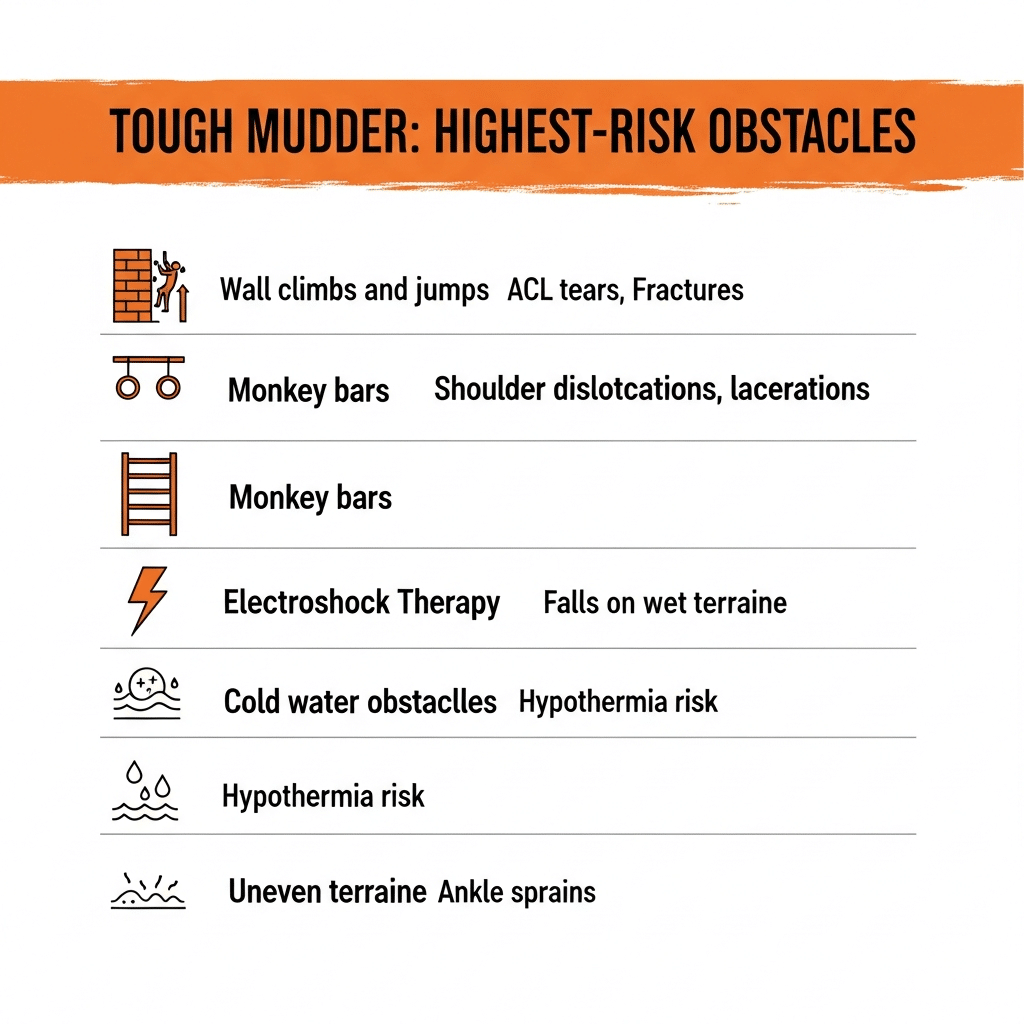
The 2022 review and case series data point to a consistent pattern: injuries cluster around a specific set of obstacle types.
Wall climbs and jumps are responsible for a disproportionate share of ACL tears, shoulder dislocations, and fractures.
Jumping from a height and landing awkwardly on uneven terrain is the single highest-risk movement pattern in obstacle course racing.
Monkey bars and overhead obstacles drive most hand and wrist lacerations, and they stress the shoulder complex in ways that road running doesn’t prepare you for at all.
A grip failure at height adds a fall risk on top of the upper body loading.
Electroshock Therapy is the obstacle most likely to cause a fall.
The shocks are unpredictable, and participants who flinch unexpectedly can lose their footing on wet, uneven ground.
Water obstacles in cold conditions add a hypothermia risk that’s easily underestimated.
Core temperature drops faster than most runners expect, especially later in a race when they’re already depleted and wet.
Uneven terrain between obstacles drives most ankle sprains.
Fatigue accumulates across the course, reaction time drops, and a misstep on rutted ground becomes a sprain.
Tough Mudder allows participants to skip any obstacle without penalty.
Using that option on obstacles you’re not prepared for is the most effective injury prevention tool on the course.
How to reduce your injury risk at a Tough Mudder?
The injury data points to specific physical gaps that increase risk for runners crossing into obstacle racing.
Addressing them directly before the event cuts exposure to the most common injury mechanisms.
Build ankle stability and proprioception.
Trail running, single-leg balance work, and lateral movements are more useful preparation than road mileage alone.
The ankle sprains that account for the largest share of injuries come from terrain runners haven’t trained on, combined with end-of-race fatigue.
Train your grip and shoulders.
Dead hangs, farmer carries, and pull-ups build the grip and shoulder capacity that monkey bars and wall climbs demand.
Upper body loading is where road-focused runners are consistently underprepared.
Practice landing mechanics.
Box jumps with controlled landings, step-downs, and eccentric single-leg squats build the neuromuscular control that reduces ACL risk in high-impact landing scenarios.
Female runners in particular benefit from this work, given the elevated ACL risk the 2024 systematic review flagged.
Run on trails or grass before the event.
Even 4 to 6 weeks of off-road running adapts your ankles and stabilizing muscles to the terrain demands.
Road mileage doesn’t transfer as well as most runners assume.
Know the course format ahead of time.
Review which obstacles are included and mentally decide in advance which ones you’ll skip if your form or confidence isn’t there on race day.
A structured injury prevention routine run consistently in the 8 weeks before the event is more protective than any amount of race-day caution.
| Risk factor | What it drives | Mitigation |
|---|---|---|
| High-impact landings | ACL injuries, fractures | Landing mechanics training, eccentric leg work |
| Overhead obstacles | Shoulder dislocations, lacerations | Dead hangs, pull-ups, grip training |
| Uneven terrain | Ankle sprains | Trail running, single-leg balance work |
| Cold water obstacles | Hypothermia | Acclimatization, knowing signs of cold stress |
| Electroshock obstacles | Falls on wet terrain | Skip the obstacle if fatigue is high |
| Open cuts post-race | Infection | Clean all abrasions thoroughly within hours |
Citations
- Knapik JJ. Obstacle Course Events: Hazards and Prevention Measures. J Spec Oper Med. 2022;22(2):129-138. PMID 35649408.
- Greenberg MR, Kim PH, Duprey RT, et al. Unique Obstacle Race Injuries at an Extreme Sports Event: A Case Series. Ann Emerg Med. 2014;63(3):361-366.
- Luke S, Dutch M. Extreme Sporting Events and Transport-Mitigating Strategies: An Australian Perspective. Ann Emerg Med. 2014;64(2):215-216.
- Lessiohadi NJ, Pai J, Goodman WB, et al. Obstacle Course Races Present a Risk of Musculoskeletal, Knee, and Anterior Cruciate Ligament Injury. Arthrosc Sports Med Rehabil. 2024;6(6):100986. PMID 39776501.
- Łyszczarz M, Kobierecki M, Mostowy M, Szadkowska I. An analysis of self-reported upper and lower limb injuries



2 Responses
I’ve done 2 of them and haven’t been injured yet! Crossing my fingers as I write this! 🙂
Great Kyle! More planned in your future? Keep up the good work!