

You have been doing your hip strengthening exercises every day, and the injury that sidelined you still flares up on your runs.
It is one of the most frustrating parts of coming back from a running injury.
You are putting in the rehab work, but the payoff feels invisible.
Good hip strength has been linked to a lower risk of IT band syndrome and patellofemoral pain, along with a lower risk of injury overall.
So the question most runners really want answered is simple.
How long until the strength work actually starts to pay off?
Here is what you will learn:
- How long it takes to strengthen your hips enough to feel a difference
- Why hip strength shows up in weeks rather than days
- Which hip exercises build strength the fastest
- How often to train your hips to see results
- How to keep running while your hips catch up
How long does it take to strengthen your hips?
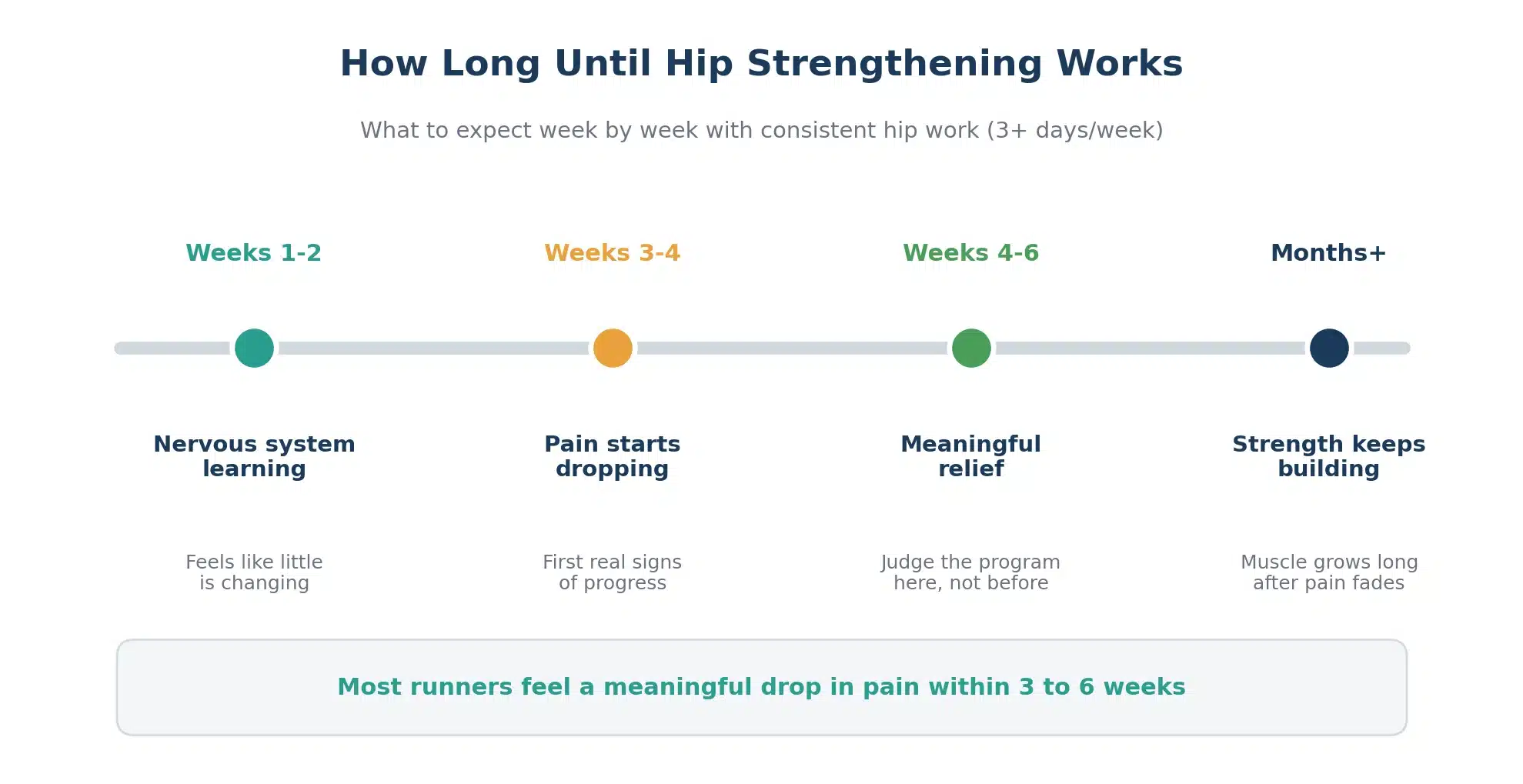
Most runners feel a meaningful drop in pain within three to six weeks of consistent hip strengthening.
Researchers have found that hip strengthening reduced knee pain sooner than working the quadriceps alone.

A four-week mark shows up again and again in the research on hip rehab for runners.
One controlled trial reported that a three-week hip abductor program was enough to increase strength and reduce pain in runners with runner’s knee.
A meta-analysis of the evidence found that combining hip and knee strengthening cut pain more than training the knee alone.
Plan on three to six weeks of consistent work before you judge whether a hip strengthening program is working.
The lesson is patience over panic.
If the first two weeks feel like nothing is changing, that is normal and expected.
Why does hip strength take weeks instead of days?
Your first strength gains come from your nervous system, not bigger muscles.
In the early weeks of any strength program, your brain gets better at recruiting the muscle fibers you already have.
This neuromuscular phase is why you can feel stronger and move better before a muscle looks any different.
Structural changes in the muscle itself take longer to build and keep developing for months.
For a runner rehabbing an injury, that split matters.
The early pain relief you feel around week four comes largely from better control of the hip, not from a dramatically stronger muscle.
Better hip control arrives first, and raw strength keeps building for months after the pain fades.
Which hip exercises build strength the fastest?
The exercises that work fastest target the muscles on the side and back of your hip.
These are the gluteus medius and the hip abductors, the muscles that keep your pelvis level when you land on one leg.
The following moves show up in nearly every study that successfully rehabbed injured runners.
Side-lying hip abduction. Lie on your side and lift your top leg toward the ceiling with your toes pointed slightly down.
Clamshells. Lie on your side with knees bent, then open your top knee while keeping your feet together.
Single-leg bridges. Lie on your back, drive through one heel, and lift your hips while keeping the other leg raised.
Hip hikes. Stand on a step on one leg and let the opposite hip drop, then lift it back level.
Banded lateral walks. Loop a band above your knees and take controlled steps sideways while staying in a slight squat.
You can find full demonstrations in our guide to the best hip strengthening exercises for runners.
Most rehab studies used two to three sets of ten to fifteen repetitions per exercise.
Focus your effort on side-lying abduction, clamshells, and single-leg bridges, since these carry the strongest research support.
RunnersConnect Bonus
Download your FREE Hip Strengthening Exercises Guide.
Download a video version of the 5 most effective hip exercises for runners.
You’ll get full descriptions on how to perform each one and a video to help guide you.
How often should you do hip exercises to see results?
Frequency is the single biggest factor separating programs that worked from programs that did not.
A review of the research supports strengthening the hip abductors and rotators at least three times a week for six weeks or more.
Every successful study in the running injury literature shared one habit.
The runners trained their hips frequently, at least three days a week and sometimes daily.
Daily hip work is realistic because these exercises are low impact and take only ten to fifteen minutes.
Skipping to once or twice a week is where most home rehab quietly fails.
Train your hips at least three times a week, and daily is better while you are actively rehabbing.
How can you keep running while your hips get stronger?
You do not have to sit still for six weeks while your hips catch up.
If you can run without pain, keep running at an easy effort and let the strength work happen alongside it.
If running still hurts, protect the injury and hold your fitness with cross training that does not aggravate the pain.
Pool running, cycling, and the elliptical all keep your aerobic engine sharp while the hip settles down.
The runners who rec




2 Responses
Did they still run while doing the strength program?
Hi Alex, the studies do not actually specify this in their papers, it is likely that the ones who could still run would be running, but the ones whose pain was more severe, were probably only focusing on these exercises. Sorry we could not answer your question precisely!