

You’re pushing through your fourth VO2 max interval when your legs suddenly feel heavy and your breathing becomes ragged.
The next repeat is only 90 seconds away, and your coach says that’s plenty of recovery.
The recovery between repeats is one of the most under-coached variables in VO2 max training.
Most runners guess at their recovery intervals based on feel or what they’ve seen other runners do.
Some copy workout files from apps without understanding why the rest duration is programmed that way.
Others assume that if they recovered in 60 seconds for a threshold workout, they can do the same for VO2 max repeats.
The truth is that rest between VO2 max repeats is not arbitrary.
It’s a mechanical decision that directly determines how long your body can sustain the intensity needed to trigger aerobic adaptations.
So, in this article you’re going to learn the research-backed practical advice on:
- Why rest duration controls your total VO2 max stimulus during a workout
- The exact work-to-rest ratios that research shows optimize aerobic gains
- How much recovery time you need and when you’re resting too long
- Whether active recovery beats passive recovery for these efforts
- Why short, fast intervals with quick turnarounds backfire for VO2 max training
Why Does Rest Duration Matter During VO2 Max Intervals?
Your muscles run on three energy systems: the phosphocreatine system for explosive efforts up to 10 seconds, the anaerobic glycolytic system for efforts up to two minutes, and the aerobic system for sustained efforts where your heart pulls in oxygen.
VO2 max training specifically targets that aerobic system by forcing your body to work at or near its maximum oxygen uptake capacity.
This is where your lungs, heart, and mitochondria are all operating close to their ceiling.
When you finish a hard VO2 max repeat, your aerobic system doesn’t instantly reset to empty.
Your heart rate is still elevated, your breathing is still fast, and your muscles are still fatigued.
The longer and harder your interval, the more time your body needs to work through its workout and recovery process, allowing your body to recover its phosphocreatine stores and clear the lactate that accumulated during the hard work.
Research has shown that aerobic fitness directly enhances recovery from high-intensity intervals through faster lactate removal and more efficient phosphocreatine resynthesis.
Insufficient rest means your phosphocreatine system hasn’t fully recharged by the time the next repeat starts.
Your muscles are working on a partially depleted battery.
That forces your body to recruit more anaerobic (lactate-producing) effort to hit your target pace, which shifts the training stimulus away from pure aerobic development and into lactate tolerance.
Adequate rest allows each repeat to be driven primarily by aerobic power rather than anaerobic compensation, which is what triggers VO2 max adaptations in the first place.
This is why rest duration isn’t something you can just minimize.
The workout’s quality depends on it.
What’s the Ideal Work-to-Rest Ratio for VO2 Max Intervals?
The research on optimal work-to-rest ratios for VO2 max training points toward a clear recommendation.
A comprehensive 2024 meta-analysis examined dozens of interval training studies and identified an inverted U-shaped relationship: peak benefits occur at approximately 140 seconds of work followed by 165 seconds of recovery.
That translates to a work-to-rest ratio of about 0.85 (roughly 1:1.2 in practical runner language).
If you’re doing 4-minute intervals, that’s about 4 minutes of work paired with roughly 5 minutes of recovery.
The ratio matters, but interval duration matters just as much: the meta-analysis found that 3–5 minute intervals produced the largest VO2 max improvements, averaging about 0.85 liters per minute.
Studies using these longer intervals typically paired them with rest periods of 1:1 (equal work and rest) to 2:1 (twice as much rest as work).
A 3-minute interval might have 3 minutes recovery (1:1) or 4–6 minutes recovery if you’re using a 2:1 approach for deeper fatigue management.
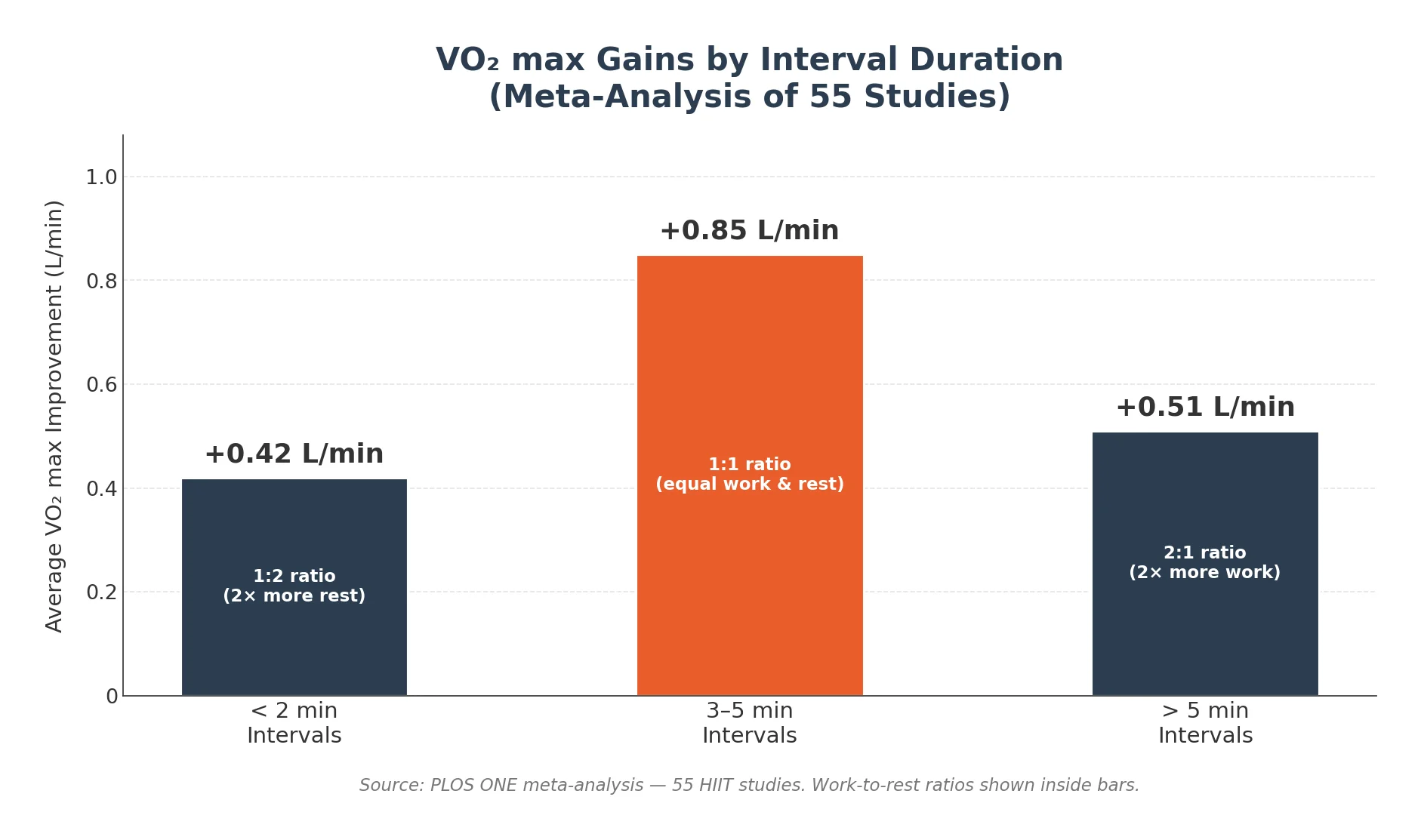
The most common and effective rest prescription for VO2 max intervals is a 1:1 ratio when using 3–5 minute repeats, meaning 3–5 minutes of recovery between efforts.
Nitrates from beetroot have shown particular promise for improving oxygen efficiency during these high-intensity aerobic efforts, and research has found that nitrate supplementation can improve time to exhaustion at VO2 max-level intensities by improving how efficiently muscles use the oxygen they receive.
That’s why we partnered with MAS Endurance: it’s built around beetroot nitrates, beta-alanine for fatigue buffering, and caffeine at endurance-appropriate doses, all designed to work over the 45–90 minutes a VO2 max session actually takes.
This stands in contrast to older sprint interval protocols, where much shorter recovery windows (sometimes under 90 seconds) are prescribed for very short bursts of maximum effort.
VO2 max intervals are different: you’re not trying to stress the sprint system.
You’re trying to sustain aerobic intensity, and that requires more time for phosphocreatine resynthesis and lactate clearance so the next repeat can be truly aerobic rather than compensatory.
How Much Recovery Time Do You Actually Need Between Reps?
If you’re designing your own VO2 max workout, here’s the practical floor and ceiling for recovery durations.
Too little rest, and you’re wasting the workout by making it metabolically anaerobic.
Too much rest, and you’re leaving aerobic benefits on the table.
The same 2024 systematic review identified a minimum threshold for phosphocreatine resynthesis: recovery periods under 20 seconds don’t provide enough time for your phosphocreatine system to resynthesize meaningfully.
Your muscles can’t restock their PCr reserves fast enough, which is why very short recovery windows force greater reliance on lactate production in the next repeat.
If you’re aiming for true VO2 max stimulus, 20 seconds is below the viable threshold.
At the other end, studies on sprint interval training (which uses much shorter work intervals than VO2 max work) found that recovery durations exceeding 97 seconds produced diminishing returns.
Beyond that window, the aerobic training stimulus plateaued.
For VO2 max work with longer intervals, this extrapolates to roughly 2.5–3 minutes as an upper recovery bound before the training signal starts to fade.
For 3–5 minute VO2 max intervals, aim for 2–4 minutes of recovery time, with 3 minutes being the standard middle ground for most runners.
This is where runner intuition often fails.
If your repeat felt incredibly hard, your first instinct is to take longer recovery.
But excessive rest actually undermines the metabolic adaptation you’re chasing.
Your heart rate will drop lower than necessary, your aerobic system will fully reset, and the next repeat won’t drive the same sustained high-intensity signal that triggers VO2 max improvements.
Individual variation matters here.
A runner with a very high VO2 max will recover lactate and phosphocreatine faster than someone with lower aerobic fitness.
An experienced runner doing their hundredth VO2 max workout might need slightly less recovery than someone doing it for the first time.
But the research-backed window of 1:1 to 1:1.5 rest-to-work ratio accounts for most of that variation.
The key is not to obsess over hitting the exact number.
Your body will tell you if you’re overtraining or undertraining through your ability to hit your target pace consistently.
If you’re falling off pace significantly in the fourth or fifth repeat, you didn’t take enough recovery in earlier reps.
If you’re hitting pace easily in all repeats, you might be resting too long and missing out on aerobic stimulus.
Should Your Recovery Be Active or Passive?
This is where most runners have intuition backward.
During VO2 max intervals, many runners assume they should jog slowly during recovery or walk to catch their breath.
The thinking is that moving will help flush out lactate faster.
In reality, the picture is more nuanced.
A classic study examining 15-second high-intensity repeats found that active recovery (running at 50 percent of maximum aerobic speed) allowed runners to spend a higher percentage of total workout time at very high intensities.
Runners achieved around 64 percent at 90+ percent of VO2 max with active recovery.
Passive recovery (complete rest) resulted in only 43 percent of total time at those elite intensity levels, despite allowing longer total duration in the workout.
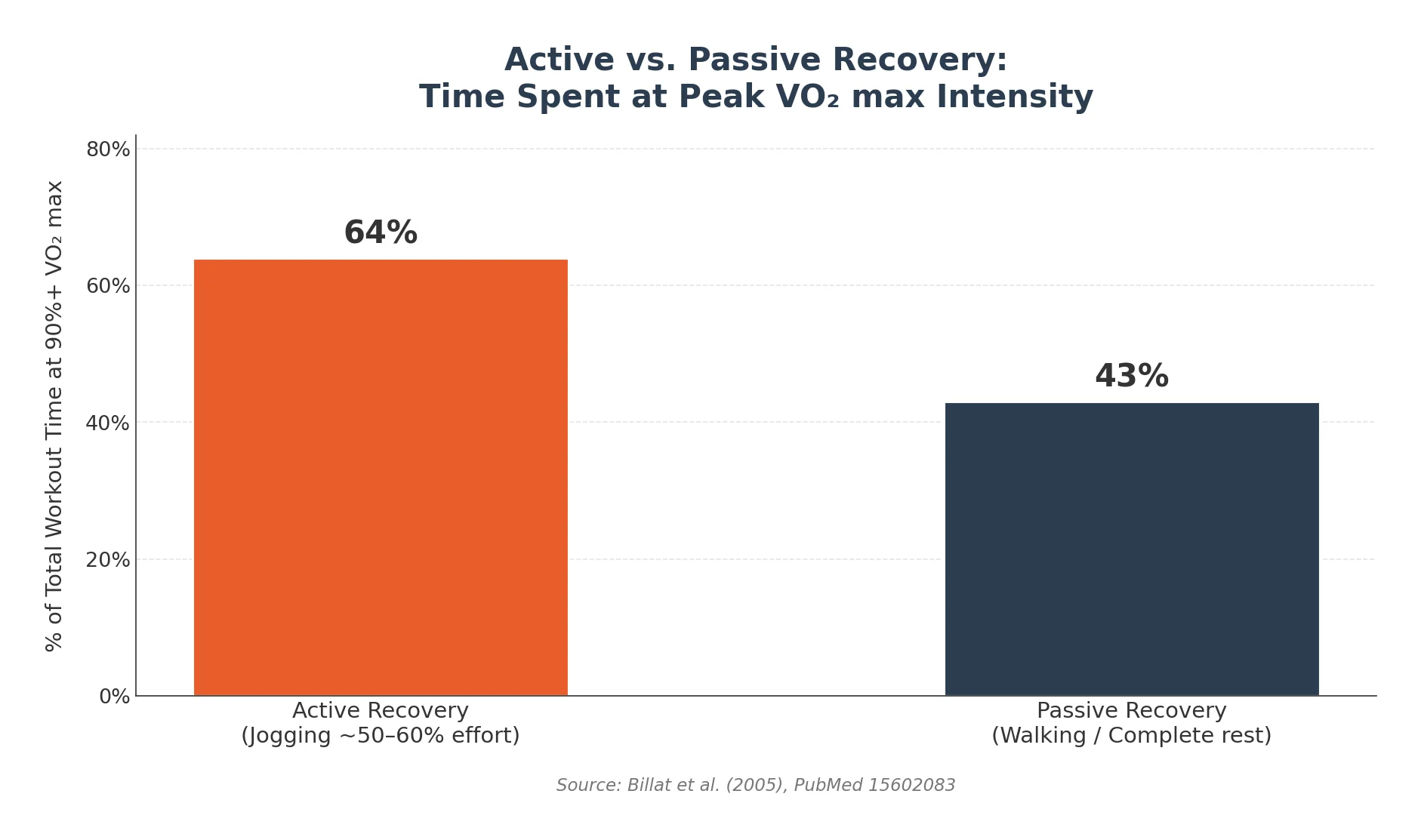
Here’s why this happens: during active recovery, your heart rate stays elevated and your aerobic system remains “primed.”
When the next hard repeat begins, you’re already operating closer to maximum oxygen uptake, so you reach your target intensity faster and sustain it longer.
With passive recovery, your heart rate drops significantly, and your aerobic system fully resets.
The next repeat requires a longer acceleration phase to ramp back up to VO2 max speed.
For maximizing VO2 max stimulus, active recovery at conversational pace (around 50–60 percent effort) keeps your aerobic system engaged and improves total time at high intensities compared to walking or complete rest.
There’s a tradeoff, though.
Active recovery is physically and mentally harder.
Most runners report that completing VO2 max intervals with active recovery feels more exhausting, even though they’re covering less total distance at hard intensity.
For that reason, many coaches alternate between active and passive recovery based on the runner’s fatigue level and the training block.
Early in a VO2 max training block, passive recovery might be the better choice to accumulate more total volume.
In a peak block where maximizing VO2 max stimulus is the priority, active recovery becomes more valuable.
Why Longer Intervals with Adequate Rest Beat Short Intervals with Short Recovery
You’ve probably seen workout files that look like this: 10 repeats of 30 seconds at 100 percent effort with 30 seconds jogging recovery.
The appeal is obvious.
Short repeats feel manageable, and beginners can complete more total reps without completely falling apart.
But the research paints a different picture about what actually develops VO2 max.
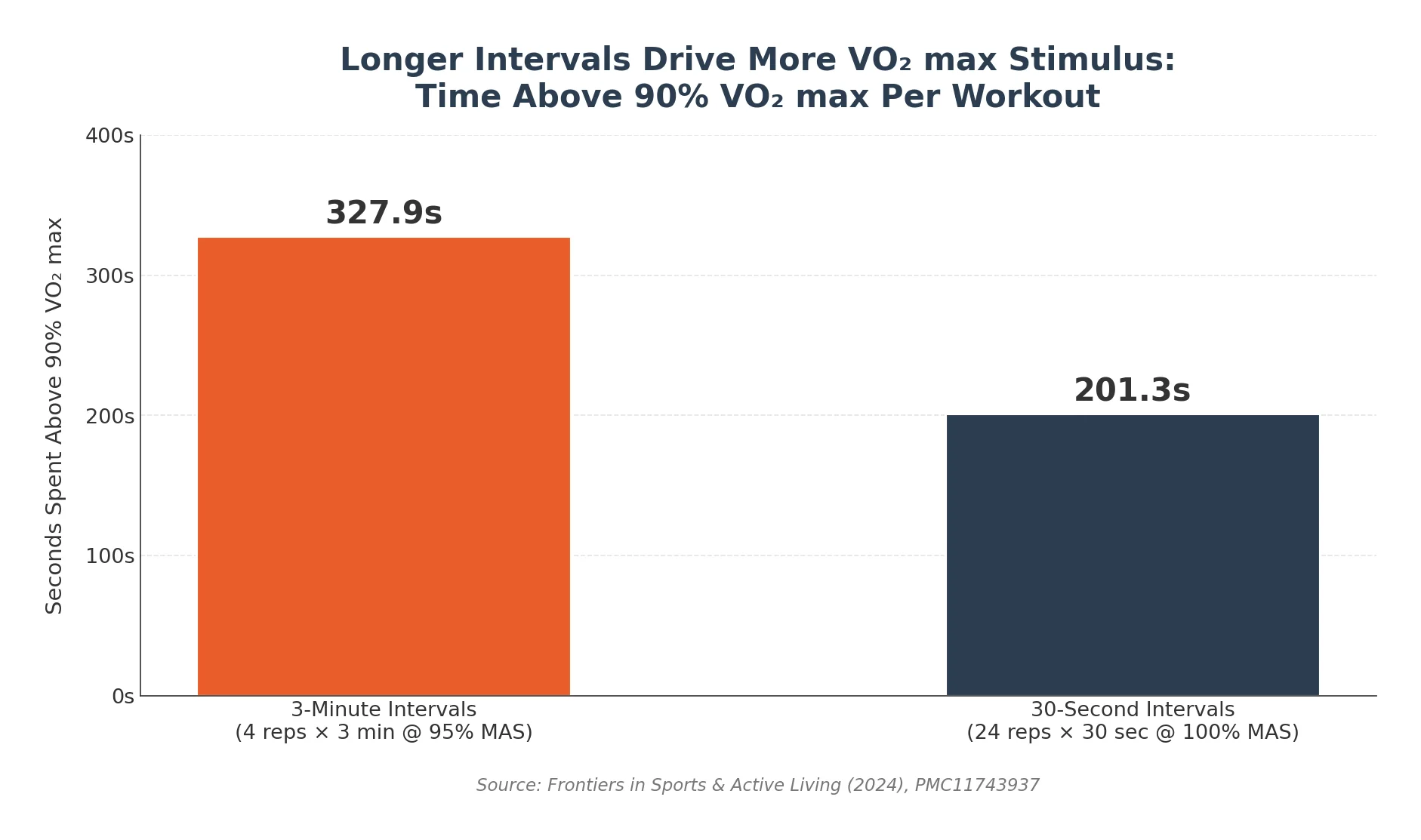
A 2024 study compared traditional longer intervals (4 repeats of 3 minutes at 95 percent maximal aerobic speed) against a newer, fashionable approach of many short, fast intervals (24 repeats of 30 seconds at 100 percent maximal aerobic speed).
Both workouts aimed to develop VO2 max, but only one delivered the goods.
Why does this happen?
When you do 30-second repeats with 30-second recovery, your heart rate doesn’t have time to fully rise during the short burst.
Your aerobic system never fully engages before the effort ends.
The next 30-second recovery doesn’t allow meaningful phosphocreatine resynthesis or lactate clearance, so the repeat becomes increasingly anaerobic with each rep.
You’re hitting faster speeds, but your aerobic system (the actual target of VO2 max training) is barely stressed.
Short intervals with short recovery produce less sustained time at VO2 max and shift metabolic stimulus toward lactate tolerance rather than aerobic development.
Longer intervals (3–5 minutes) with adequate recovery (2–4 minutes) allow your aerobic system to rise to near-maximum levels during the work phase and sustain that elevation for a meaningful window.
Each repeat can be driven aerobically rather than anaerobically.
The training stimulus stays consistent across all reps because your recovery periods give your body genuine opportunities to resynthsize energy stores and clear metabolic byproducts.
This doesn’t mean short intervals have no place in training.
Shorter repeats are valuable for developing speed and teaching your body to handle faster paces.
But if your goal is to increase your VO2 max ceiling, the research is clear: invest in longer intervals with longer recovery.
That’s where the adaptation signal is strongest.
| Variable | What Happens Without It | Research-Backed Recommendation |
|---|---|---|
| Rest duration (3–5 min intervals) | Anaerobic drift; lactate system compensates, undermining aerobic stimulus | 2–4 minutes (1:1 to 1.2:1 rest-to-work ratio) |
| Work-to-rest ratio | Too short: anaerobic; too long: aerobic system fully resets | ~0.85 (approximately 1:1 for most runners) |
| Recovery type | Passive recovery drops heart rate and aerobic prime, extends ramp-up next rep | Active recovery at 50–60% effort (conversational pace) |
| Interval duration | Short bursts never allow aerobic system to reach and sustain peak output | 3–5 minutes per repeat (not 30-second bursts) |