
You’ve probably seen the Instagram posts: runners at altitude camps in Boulder or Flagstaff, talking about EPO gains and blood volume increases.
And you’ve probably thought: “That sounds great, but I can’t take three weeks off work to live at 7,000 feet.”
You might not need to.
Research by Scoon and colleagues found that runners who added 30 minutes of post-exercise sauna bathing to their normal training improved their time to exhaustion by 32%, equivalent to cutting nearly 2% off their 5k time.
That’s the difference between a 20:00 5k and a 19:36.
The mechanism: heat stress triggers the same EPO production and blood volume expansion as altitude training, but you can do it at your local gym for $15 instead of spending $3,000 at an altitude camp.
Strategic heat exposure drives adaptations nearly identical to altitude training: increased red blood cell production, expanded plasma volume, and improved oxygen delivery to working muscles.
For time-constrained adult runners, this protocol can deliver altitude-level gains without altitude-level disruption.
In this article, you’ll learn:
- How heat exposure triggers the same physiological response as altitude
- The exact protocol that produces measurable results in three weeks
- Which workouts to pair with sauna sessions and which to avoid
- What to expect week by week, and when to stop before your race
Why Does Altitude Training Work — and Why Can’t Most Runners Use It?
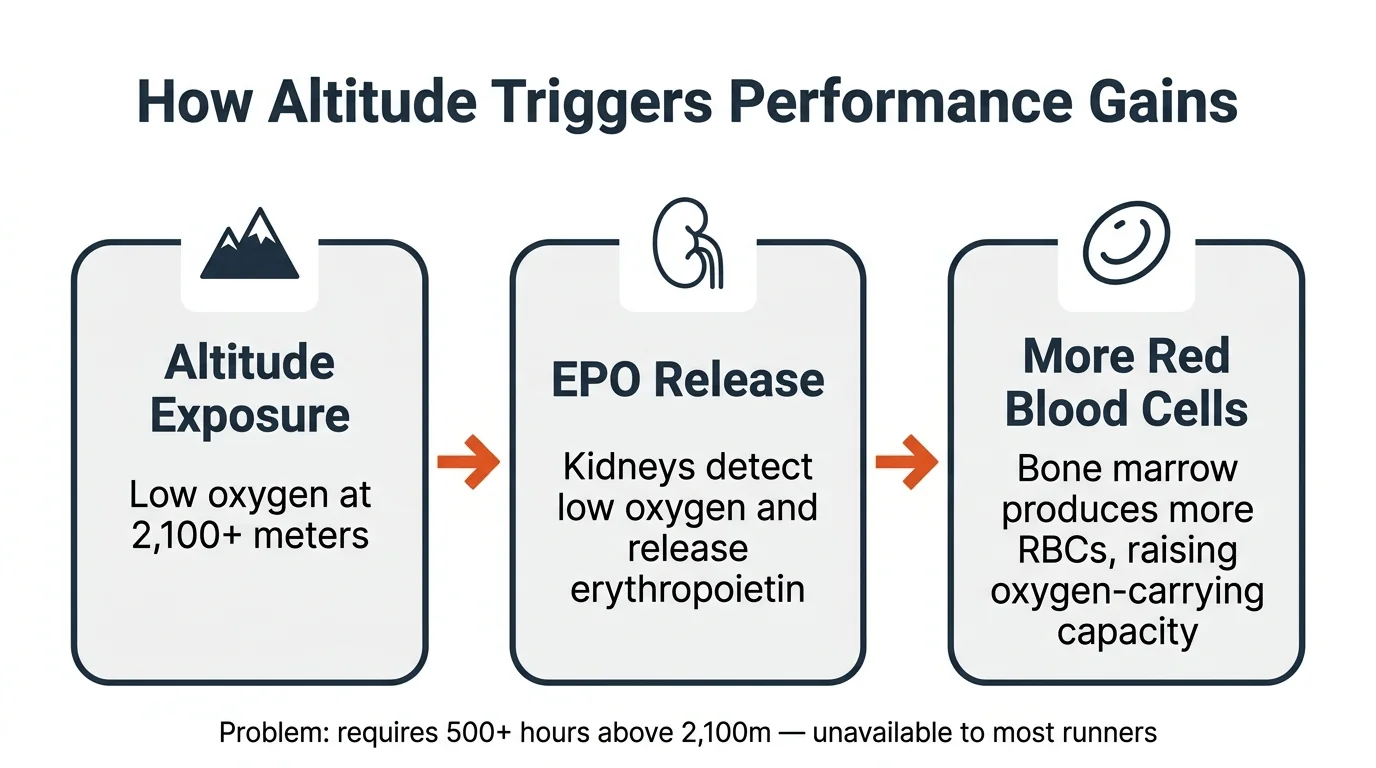
At elevation, reduced oxygen availability triggers your kidneys to release erythropoietin (EPO).
EPO signals your bone marrow to produce more red blood cells, increasing your blood’s oxygen-carrying capacity.
The access requirement is what makes altitude training impractical for most runners.
Getting meaningful hemoglobin increases from altitude training takes 500+ hours of exposure above 2,100 meters.
That’s not a weekend trip to the mountains.
That’s weeks of living at elevation, and most adult runners can’t take that time away from work and family.
Even “live high, train low” protocols require access to altitude houses or hypoxic tents that cost thousands of dollars monthly.
How Does Heat Exposure Trigger the Same Adaptations?
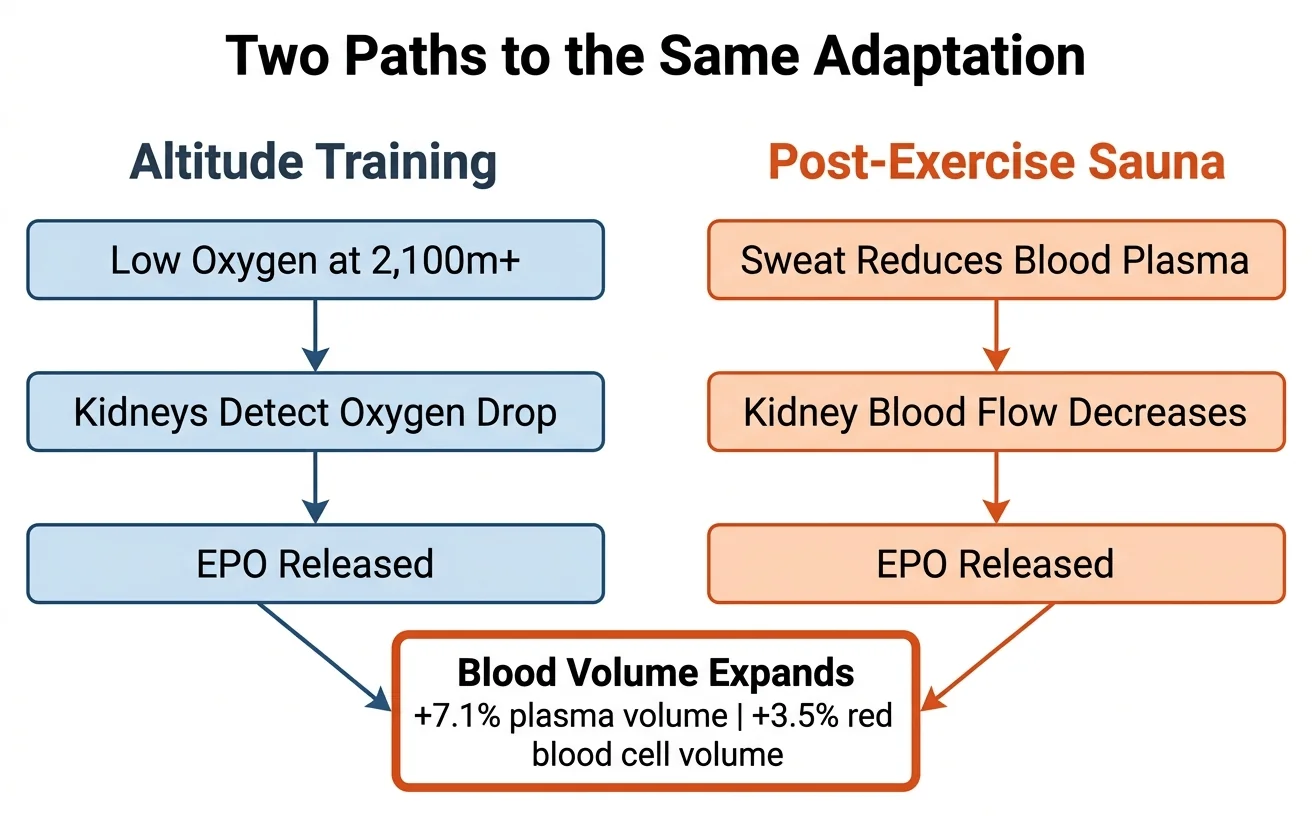
When you sit in a sauna after training, you sweat heavily, and that sweat draws primarily from your blood plasma.
As plasma volume drops and strategic dehydration sets in, blood flow to your kidneys decreases.
That reduction in renal blood flow triggers the same EPO release that altitude exposure produces.
The landmark study from Scoon and colleagues tested competitive male runners over three consecutive weeks of post-exercise sauna bathing.
Research has shown that three weeks of post-exercise sauna sessions increased plasma volume by 7.1% and red blood cell volume by 3.5% in competitive runners.

Plasma is the liquid component of blood, separate from red blood cells.
When both expand, your blood carries more oxygen per heartbeat.
That’s the same outcome altitude training works to produce, at a fraction of the cost and logistics.
RunnersConnect Bonus
Don’t guess on the protocol. Get the exact sauna training parameters from the peer-reviewed research on one printable sheet.
Includes session safety checklist, workout pairing guide, and the 7-10 day pre-race stop schedule.
What Does Blood Volume Expansion Actually Do for Your Running?
Think about your cardiovascular system like a water pump.
When there’s more fluid in the system, each pump stroke moves more volume with less effort.
More blood volume means every heartbeat delivers more oxygen to working muscles without your heart working harder.
That shows up as lower heart rates at the same effort levels.
Research on competitive middle-distance runners found an 8% improvement in VO2max and a 4% improvement in running speed at lactate threshold after three weeks of post-exercise sauna bathing.
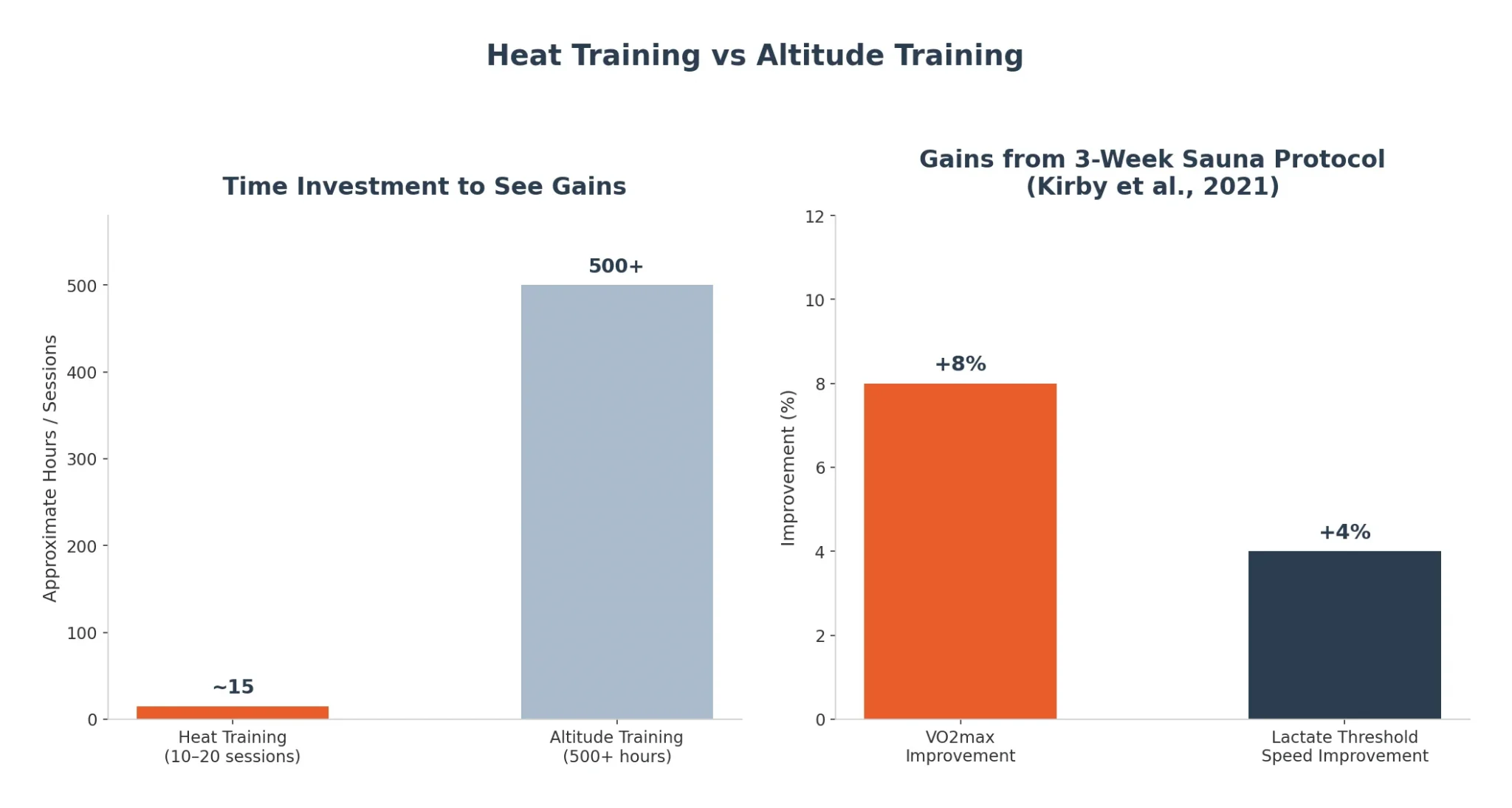
For context, traditional altitude training requires 500+ hours at elevation to produce similar hemoglobin increases, while heat training delivers comparable results in 10-20 sessions over 2-4 weeks.
Those VO2max and lactate threshold gains translate directly into race performance across every distance.
What’s the Sauna Protocol That Produces Results?
The research is consistent on the parameters that drive adaptation.
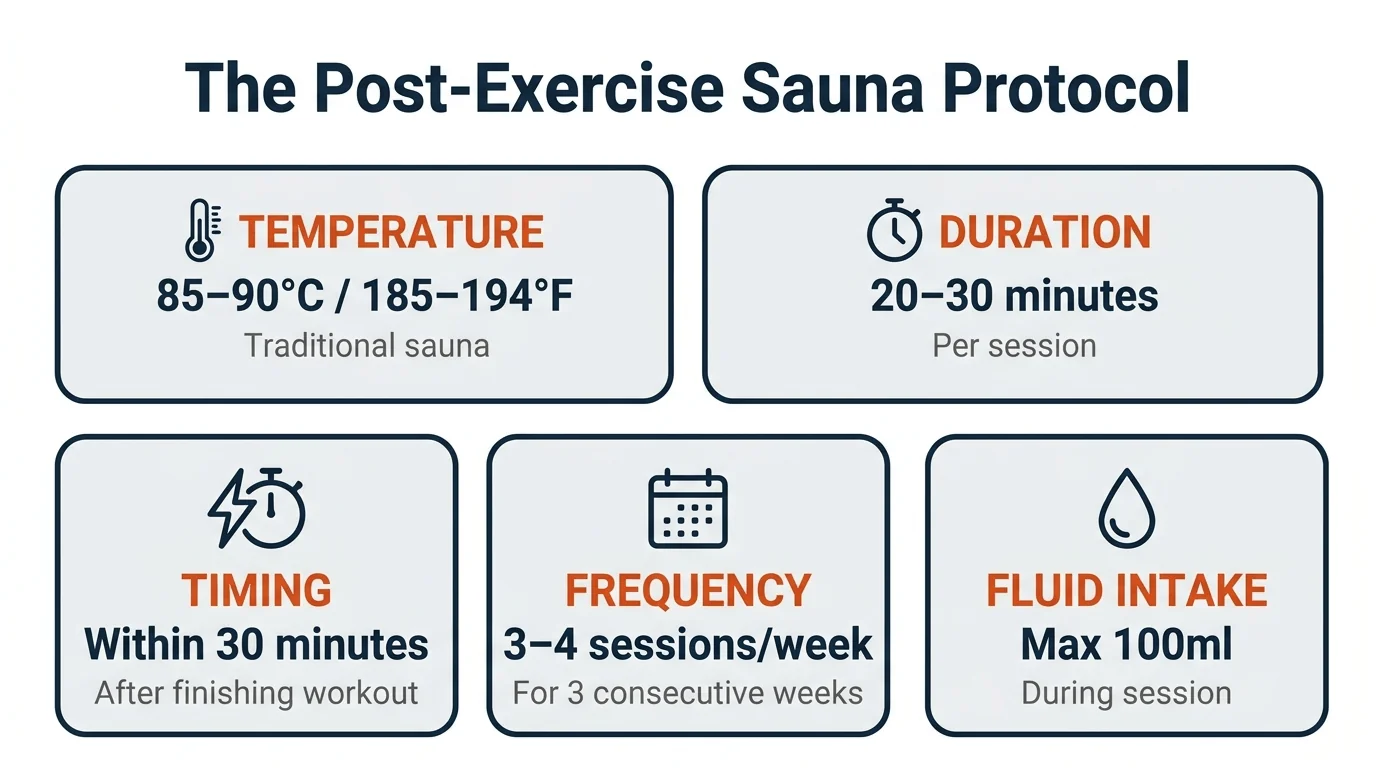
- Temperature: Traditional saunas at 85-90°C (185-194°F) appear optimal. Infrared saunas at lower temperatures can work, though sessions may need to run slightly longer.
- Duration: 20-30 minutes per session.
- Timing: Enter the sauna within 30 minutes of finishing your workout. This capitalizes on your already-elevated core temperature and maximizes the physiological stimulus.
- Frequency: 3-4 sessions per week for three consecutive weeks.
- Fluid intake: Drink minimally during the session, no more than 100ml total.
That last point is the one most runners get wrong.
The Scoon study participants allowed themselves to become strategically dehydrated during heat exposure, and that controlled stress is part of what triggers the EPO response.
The dehydration during your sauna session is the physiological stimulus, so drink minimally and let it develop.
Your heat tolerance builds quickly.
Most runners notice significant improvement within 3-5 sessions.
When Should You Use Sauna Training — and When Does It Hurt Your Recovery?
Timing has two layers: where sauna training fits in your racing calendar, and which workouts you pair it with.
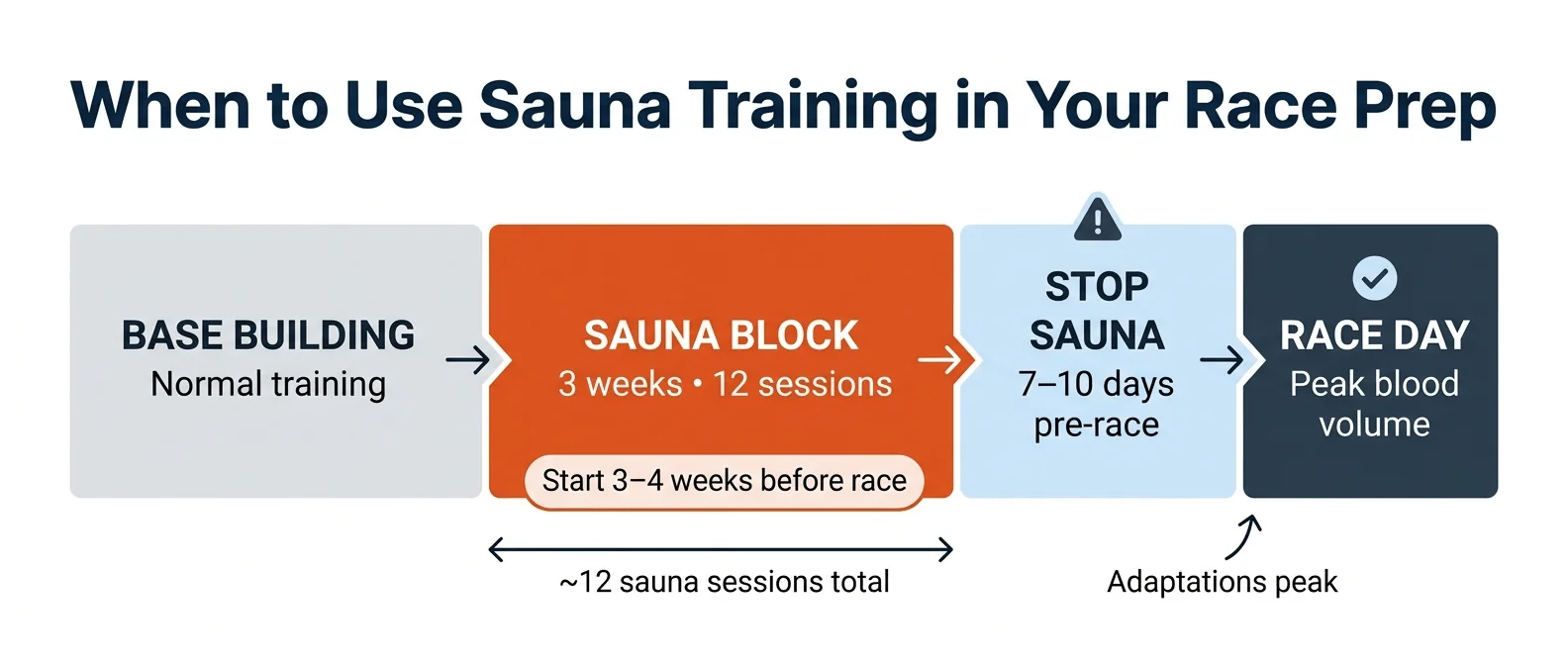
Start your sauna protocol 3-4 weeks before a goal race, which gives you time for approximately 12 sessions across three weeks before stopping.
Discontinue all sauna training 7-10 days before competition to let your blood volume adaptations stabilize and arrive at the start line fresh.
For workout pairing, use sauna after moderate to moderately-hard sessions where you finish feeling strong: tempo runs, threshold work, and steady-state efforts.
Skip it after depletion workouts, long runs exceeding 90 minutes, or sessions already completed in hot conditions.
After very hard training, heat exposure creates competing demands on your circulation.
Your body needs blood flow directed to muscles for repair, but heat drives circulation to the skin for cooling instead.
When you’re already depleted, that trade-off slows recovery rather than accelerating adaptation.
Is Post-Exercise Sauna Training Safe?
Post-exercise heat training isn’t appropriate for everyone.
Avoid it if you have cardiovascular conditions, uncontrolled high blood pressure, or a history of heat illness.
Pregnant women should not use post-exercise heat training, and anyone on medications that affect sweating or thermoregulation should consult their physician first.
For everyone else, hydration before and after is non-negotiable.
Drink 500-750ml of fluid in the hour before your session.
Post-sauna, rehydrate aggressively with electrolyte-rich fluids and carbohydrates.
Research on post-exercise carbohydrate restoration recommends 1.2g per kilogram of bodyweight per hour for the first 4 hours after sessions combining hard training with heat exposure.
Exit immediately if you experience extreme dizziness, nausea, rapid heartbeat, or confusion: these are heat exhaustion signals requiring immediate cooling and rehydration.
How Quickly Will You See Results?
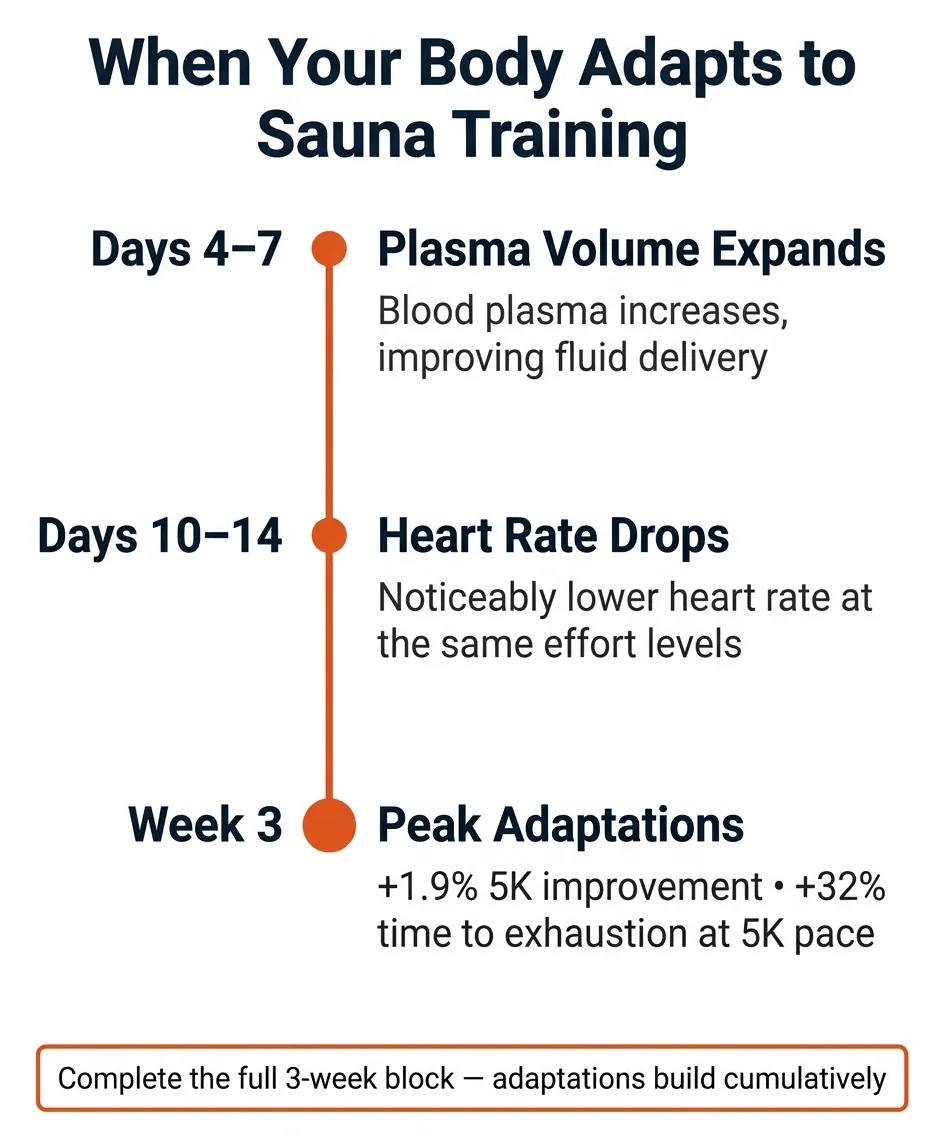
Plasma volume expansion begins within 4-7 days of starting the protocol.
You’ll notice lower heart rates at paces that previously felt harder within 10-14 days.
Peak adaptations arrive around week 3.
After three weeks of post-exercise sauna training, runners in the Scoon study improved their 5k performance by 1.9% and increased time to exhaustion at 5k pace by 32%.
Individual responses vary.
Runners with higher baseline fitness often see smaller percentage gains, since they’ve already developed more aerobic capacity to work with.
How Do You Fit Sauna Training Into a Real Training Schedule?
Post-exercise sauna adds 20-30 minutes to workouts you’re already doing.
Start by securing consistent sauna access: most gyms have one, community centers often do, and home infrared units have become more affordable.
Schedule your first 3-week block during a base-building phase, not during race-specific training when every session targets a specific adaptation.
Run the block so it ends 3-4 weeks before your goal race, giving you time to complete 12 sessions and still take the 7-10 day pre-race break.
Monitor recovery carefully during week 1.
The added heat stress is a real training load, and some runners need to reduce overall volume by 10-15% initially.
Watch your resting morning heart rate: if it stays elevated 2 or more days in a row, reduce session frequency that week.
RunnersConnect Bonus
Don’t guess on the protocol. Get the exact sauna training parameters from the peer-reviewed research on one printable sheet.
Includes session safety checklist, workout pairing guide, and the 7-10 day pre-race stop schedule.